There’s been a German Wikipedia entry about the Chug Chaluzi bothering me for a long time. It claims to document the only German resistance group that acted from Jewish-religious motives. Yeah, uh, no kidding. But that’s not what you think it means, post-genocide Germany.
Religious motivation among Jews was NOT a category of honor. In 1943 it was a category of stigma. The framing of a religious resistance group reads to me like someone wants to say there was only one loaf of white bread served at Passover, if you catch my drift.
German-Jewish self-understanding from emancipation through 1933 ran on Bildungsbürgertum, Reform, and liberal Judaism. Orthodoxy was a minority current, looked down upon as problematic for obvious reasons in a society moving away from passive acceptance of fate.
Observant practice was coded backward and associated with Ostjuden, the Eastern European Jews whose visible religiosity acculturated German Jews had spent two generations distancing themselves from. It was not subtle, it was visceral.
This history is important and it blows up the Wikipedia page.
You don’t just slap a religious label on Jewish resistance to Nazism and move on like it’s somehow a good thing. Like you can’t just slap kosher on a cheeseburger and say it’s the “only one”. Stop right there.
There needs to be documentation of what stands out as an inherent contradiction in Jewish resistance history. This post may help.
Rosenzweig’s 1913 return to Judaism was rather remarkable as a reversal. The Frankfurt Lehrhaus existed because German Jews had to be reintroduced to Jewish content they no longer carried. They shed it for what are obvious reasons to German Jews, probably invisible to German non-Jews. Christians walk around being Christian without having to do anything or justify anything. Celebrate Christmas, don’t celebrate it, doesn’t change a thing about being Christian. It wasn’t so easy for other religions, because to be Jewish invited scrutiny and judgment, challenges to explain and define traditions and behaviors. You aren’t going to synagogue? How dare you claim to be Jewish then? Expectations of religion among Jews was a form of externally applied control that erased diversity and freedom of self-realized identity. Shedding religion was an act of normalcy in German culture to arrive at the apathetic state of practice Christians enjoyed already.
Inside Zionism this hierarchy ran the exact same direction. Labor Zionism, cultural Zionism, Hashomer Hatzair, the kibbutz movement. Secular, often anti-clerical because religion was correctly seen as too antiquated, conservative and accommodating to the rise of Nazism. Religious leadership in some communities, working under Nazi coercion through Judenrat structures, urged compliance with deportation orders that turned out to be transports to death camps. Mizrachi was a minority stream within an already-minority movement, and the Hechaluz cadres skewed socialist. Jizchak Schwersenz teaching religious content through a Hechaluz-affiliated cell stands out precisely because it cut against the grain of German-Jewish liberalism and mainstream pioneer Zionism at once. It doesn’t make sense at all, which is the seed of why it lacked honor.
Antisemitism operates by inherently dumbing down of such distinctions and diversity within Jewish history. Nazi racial law, based on German cultural habits of rapid assessment with minimal depth, flattened the internal hierarchy. Those who didn’t shed the signal or stigma were sucked into a huge pool of observant or assimilated, Mizrachi or Reform, Berliner or Ostjude. Deportation lists were designed to be highly efficient because very low quality, so they made no such distinction. The status structure that had stigmatized religious observance for sixty years, providing an assimilation path through agnosticism, was intentionally and cruelly collapsed inside a decade.
The state that emerged from this argument tells you who won it. Israel was founded in 1948 as a secular state by secular Zionists. Ben-Gurion led Mapai, a labor socialist party. The Declaration of Independence invokes “the Rock of Israel” rather than God, a deliberate compromise drafted to satisfy religious signatories without committing the state to religious authority.
The kibbutz movement, the Histadrut, the Palmach, the founding institutions were all secular. Religious Zionism was allowed accommodation through the status quo agreement on Shabbat, kashrut in state institutions, and rabbinical control of personal status law, but the entire architecture of the state was secular by design.
Mizrachi was never more than a coalition partner, and was certainly not a founding ideology. The Jewish state built by Zionists was a Jewish state in the ethnic and national sense, not the religious one. That’s essential history, which Germans clearly aren’t looking at when they try to reframe stories of resistance to fit their own prejudices.
Schwersenz’s religious pedagogy in 1943 Berlin sat completely outside the mainstream, outside the groups that would actually deliver the Zionist goal five years later.
This is the precondition for reading Schwersenz’s pedagogy as resistance.
Without the racial state the same content reads as weirdly provincial traditionalism. He said what? They believed in what? The honorific framing requires the catastrophe that erased the framework that had produced a meaningful stigma. Religious motivation became a badge, inverse to its actual meaning by systemic erasure of the Jewish social structure that had marked it.
Postwar inversion is therefore best described as Wikipedia being exactly backward. The category “religiously motivated Jewish resistance” is like military intelligence. We all know it’s a contradiction while knowing it’s not meant to be one. The real historical contingency has been dropped out, and that shouldn’t be how Wikipedia operates.
The Wikipedia error traces to Barbara Schieb, historian at the Gedenkstätte Deutscher Widerstand, the official German resistance memorial. She puffed up that Chug Chaluzi was the only resistance group inside Germany that acted from Jewish-religious motives. H-Soz-Kult quoted her in the writeup of the 2000 exhibition Juden im Widerstand. Her flawed framing has institutional authorship at the state-funded memorial that re-contextualizes German resistance. The effect is notable, when it is presented as an official German position on who gets remembered and how.
A religious resistance at the time would seem completely upside down and backward in 1933. That framing however was destroyed by the regime the actual resistance was resisting. The opposite category now is being spread online because of what it opposed wasn’t stopped soon enough, and the modern accounting isn’t contextual.
Take a look at what happened when surviving members gathered in Berlin in 1993. It’s rather enlightening to the question of what really needs to go on a Wikipedia page. Nathan Schwalb-Dror, then 85, the funder who had moved Hechaluz money to the Berlin underground from 1944, came from Geneva. When Gad Beck spoke about the Existenzkampf the Israeli visitors in the audience, in Berlin under the Senate’s visiting program, pressed for clarification on the February 1945 arrest. Beck’s memoir attributed it to two Jewish Greifer working with two SS men, connected to the Stella Goldschlag network of Gestapo-run Jewish informers. The actual Zionists from Israel itself wanted operational details to walk the actual walk. They wanted names. They wanted to know how the inner circle had been penetrated and exactly who was involved.
Schwalb-Dror would not be moved. He stuck to his prepared report on Hechaluz’s wider rescue operations in Slovakia, Croatia, and Hungary, where the organization helped tens of thousands. Berlin had been a small group among many. Christine Zahn, the moderator, ended the event to keep the dispute from rolling into a public scandal, as it should have. Only taz reported the breakdown of the resistance narrative.
Nicht ins KZ, sondern in den Widerstand
The Wikipedia effect obliterates real history. It pumps the low-resolution honorific category against high-resolution accountability that actual Jewish resistance demanded to be counted among the honorable. The blurry Wikipedia treatment works only at distance. Up close, with the surviving participants in the room, the truth wanted to come out. Participants, and hopefully you now too, see the contradiction.
The Jewish memorials should do better, even if German Wikipedia fiction about Jewish memorials never will.
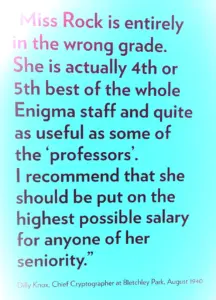 Her name was Margaret Rock, also known as one of Chief Cryptographer Dilly Knox’s “girls” in Cottage 3 at Bletchley Park, working alongside Mavis Lever.
  The top UK salary allowed Margaret,