A new article makes the strange claim that propaganda networks have “shifted” targeting from drugs to political activism.
New war: How the propaganda network shifted from targeting ‘addicts’ to activists.
The problem with such “new” analysis, any historian could probably show, is that activists historically have been called things like drug addicts to make them targeted more easily (avoid scrutiny of anti-democratic actions).
There is no shift, just recognition a system of heavy-handed criminalization uses encoding to escape proper scrutiny.
The Nixon campaign in 1968, and the Nixon White House after that, had two enemies: the antiwar left and black people. You understand what I’m saying? We knew we couldn’t make it illegal to be either against the war or black, but by getting the public to associate the hippies with marijuana and blacks with heroin, and then criminalizing both heavily, we could disrupt those communities. We could arrest their leaders, raid their homes, break up their meetings, and vilify them night after night on the evening news. Did we know we were lying about the drugs? Of course we did.
Today extremist right-wing Americans just overtly say they are going with war with the “left” instead of pretending to care about drugs.
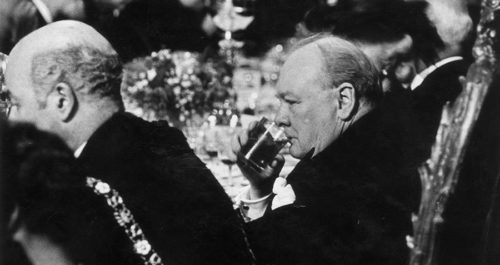
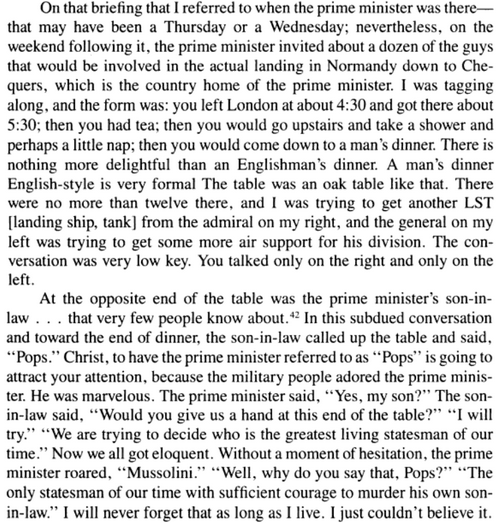
This very typically biting and insightful anecdote about Churchill comes from a military history book describing Allied preparations for D-Day:
Air Superiority in World War II and Korea: An Interview with Gen. James Ferguson, Gen. Robert M. Lee, Gen. William W. Momyer, and Lt. Gen. Elwood R. Quesada. (1983). United States: Office of Air Force History, U.S. Air Force. Page 56
Mosley was to put it more concisely later when he repeated that the British Fascists wanted to turn Parliament ‘from a talk-shop to a work-shop’. When Churchill praised Mussolini’s Italy for its economic realism, it was of course the British Chancellor of the Exchequer envying the Fascist dictator for the room for manoeuvre which the absence of an effective opposition gave him.
The offensive declarations of January 1927 were of a different nature, in that they clearly justified the introduction of Fascism as a bulwark against Bolshevism.
However, a careful reader of history will note that Churchill preferred death to either Fascism or Bolshevism and thus was crudely thinking of himself as above either.
…his Commons speech of 14 April 1937 he suggested that a self-respecting Briton would face death rather than accept ‘to choose between Communism and Nazism’ :
I hope not to be called upon to survive in a world under a government of either of these dispensations.
Self-respecting here is taken to mean a Briton who hasn’t stooped so far as to allow extremism to take hold. Or to put it another way, as I described in a 2014 blog post, fall victim to what Germany experienced:
The stock market crash of 1929 led to extremely heated conflict by radical groups trying to split votes; intellectual communism versus ultra-nationalism. This led to violence, which led to mob rule by fascist militia and 1932 end of the republic.
Britain arguably rested upon a representative government that had increasingly allowed for mass dissent. And while it was far from an ideal system it didn’t end with abrupt violent revolution in the “European” way.
Seems almost natural for Churchill to claim to appreciate the very thing that he also detested so much, through dark sarcasm and sharp wit.
The question of Peter Thiel’s political philosophy has become increasingly relevant as his influence in American technology, finance, and politics continues to grow. Recently, while researching historical connections between technology and warfare, I discovered a telling detail: A Dr. Walter Thiel, described in USAF records as Hitler’s “best propulsion expert,” was killed by an innovative 1943 Allied bombing run on his Nazi slavery and weapons research center.
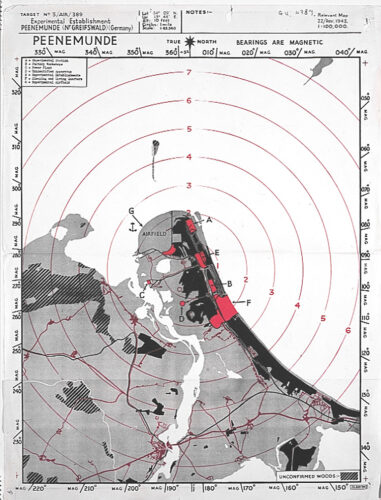
British attack plan of Operation Hydra “Target F: Sleeping and residential quarters”, which killed Nazi Walter Thiel and many of his slaves. This was the first bombing of German V-weapon programs, later called operation “Crossbow”. It pioneered precision night-time identification and marking of targets
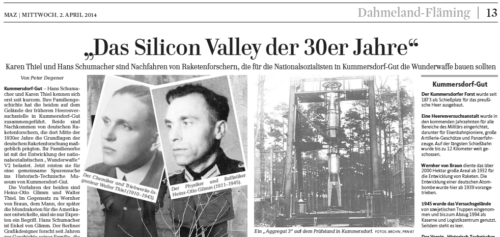
This bombing target has been a fascination of the direct descendants of Walter Thiel, who propagandize it as a loss of their Silicon Valley of the 1930s (“Das Silicon Valley der 30er Jahre”) and loss of their Nazi wonder weapon (“Wunderwaffe”). Märkische Allgemeine Zeitung (MAZ) is a regional newspaper in Brandenburg, Germany an area known for harboring and promoting Nazi sentiment (e.g. AfD).
The Thiel family descendants not only continue to glamorize Nazism, but openly boast how Walter Thiel was inexplicably inducted as a Nazi into an American “Space Hall of Fame”. Plaque celebrating a 1976 induction ceremony for a Nazi. Source: “Space Hall of Fame”, Alamogordo, New Mexico
A tone-deaf promotion in America of this slave-abusing Nazi, given he had been killed by 1943 Allied precision targeting, led me down a path investigating the Thiel family lineage and their movements after World War II (perhaps with a nod to Operation Paperclip). What emerged is a pattern of concerning connections that raises questions about Peter Thiel’s silence on historical atrocities like Nazism and apartheid—regimes that appear intertwined with his family history and a peculiar lack of accountability by moving to America.
The threads connecting these historical dots aren’t merely coincidental. From his father Klaus Friedrich Thiel’s emigration from Germany with one-year-old Peter in 1968, to the family’s strategic relocation to parts of Africa “remaining more German than Germany“, to Peter’s own later writings on monopoly power and democracy, a consistent hate-based worldview emerges that deserves closer examination.
This investigation isn’t simply about genealogy, but about understanding how historical ideologies might shape the philosophy of one of today’s most powerful tech investors and political donors.
…Thiel, convicted in France under Holocaust denial laws…
Denial of history and science? That mindset allegedly fits Peter Thiel.
Thiel said no to investing [in electric cars]. “He doesn’t fully buy into the climate change thing,” said Musk.
But I’m getting ahead of myself.
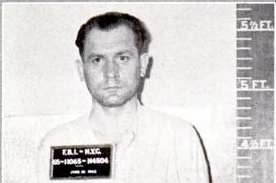
Here’s another obscure example from 1942. Werner Thiel was caught by the FBI with “coal-shaped bombs” and Life Magazine ran a piece called “The Eight Nazi Saboteurs Should be Put to Death”
Source: Life, July 13, 1942. FBI mugshot of Nazi terrorist Werner Thiel.
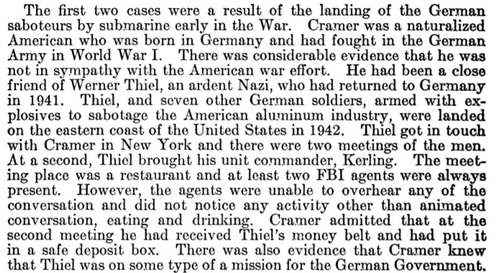
This case was cited in 1954 government records that discuss “…Thiel, an ardent Nazi…” coming by boat to the U.S.
Smith, H. A. (1954). The Far East and South Asia. United States: U.S. Government Printing Office.
It was only a decade after this 1954 U.S. government report that Susanne and Klaus Friedrich Thiel (chemist) in 1968 emigrated to America from Germany with their 1-year old son named Peter.
Thiel is no ordinary American or European. His father, Klaus, was born in Germany in 1938, which means Thiel’s grandparents were German adults during World War II.
Leaving Germany with a 1-year old son meant they avoided having to face their family role in the Holocaust, and denied Peter an American anti-Nazi education that was mandated for all children in Germany:
A visit or even spending a decade of your adult life there isn’t enough time to ever understand it, if you haven’t grown up in Germany yourself; most modern, young Germans have very balanced and matter-of-fact view on Nazi Germany and the Holocaust.
Even more strange, this immigrant family took a very significant detour while attempting to become American in the 1970s.
Just as international condemnation of South Africa for an apartheid government began to ramp up, the Thiel family relocated there to profit directly from chemistry work for barbaric concentration camps of mining operations, sending little Peter to a overtly racist whites-only school.
…many of the forms of social control described by van Onselen in Rhodesian compounds in the first three decades of the century are still being explicitly used in South African mining in 1979.
[Peter] said, with no facial affect, that apartheid was a sound economic system working efficiently, and moral issues were irrelevant.
The weird thing about being the white kid of parents bouncing from one brutally oppressive society to another where they seem to have been on the wrong side of history every time, is that their kid ends up extremely scared, really really scared of the world (e.g. false-paranoia fundamental to Nazism).
…he was bullied to some extent as a child and I think sort of comes into the world feeling a little bit aggrieved and maybe justifiably aggrieved…
Justifiably? Here’s what Peter Thiel himself published in a book regarding his views on victims of a crime:
…there’s a line in the book that describes, you know, rape – date rape as, you know, seductions later regretted…
This framing suggests that Peter doesn’t view victims as having legitimate grievances—an ironic position given his own claims of childhood bullying. By his own logic, shouldn’t his experiences with bullies be dismissed as merely “friendships later regretted”?
He also writes in that essay that, you know, women’s suffrage is kind of an unfortunate thing because women tend to vote… he’s never actually, like, changed his point of view there.
The implication is clear: Thiel opposes women’s right to vote precisely because women exercise that right by voting.
First he refers to raping women as “seductions later regretted”, then suggests women deserve no power or voice at all? No right to self-representation for the targets of violence? “He was bullied…” and then becomes a bully.
But wait, it then gets even worse. Peter Thiel used an encoded phrase (“welfare beneficiaries”) in order to argue non-whites also should lose the right to self-representation in government.
Just to give the full context, the quote is “Since 1920, the vast increase in welfare beneficiaries and the extension of the franchise to women, two constituencies that are notoriously tough on libertarians, have rendered the notion of a capitalist democracy an oxymoron.” So it’s not just women, it’s welfare beneficiaries.
His reference to 1920 as a start point seems important, given “America First”, eugenics, Jim Crow laws as well as my note above (about his formative years in South Africa) let alone this was the time that Nazi Germany emerged.
He’s promoting a racist doctrine of mob/police violence against non-white “beneficiaries” in order to end democracy, so whites can extract and hide ill-gotten wealth — a literal call for the return to “national socialism” (Nazism). He could have titled this essay “his struggle” (Mein Kampf, as Hitler put it) and nobody would have blinked.
Also as an apparent self-loathing victim, he hates immigrants while being one, which probably surprises nobody.
…he was donating money to this group called NumbersUSA, which is a very, very hard-right immigration group. You know, it’s – the idea is reducing the amount of immigration drastically…
It appears from all of his writing that Thiel lacks any empathy and neither sides with victims of obvious crimes, nor believes women or non-whites should be given any voting rights at all. He seems repeatedly to promote a return to the 1930s rise of fascism.
Or should I say the Thiel family pro-slavery fantasy of “Das Silicon Valley der 30er Jahre“?
This all is very curious because if he was so “justifiably aggrieved” by experiencing bullying inside white insecurity militancy as a child, then do you think he could feel pain of others and help liberate targets?
Instead it appears he hates victims and has made himself into an unapologetic proponent of the “cultural populism, white grievance” (fascism) bullying model to harm people even more than he was as a child.
Some apologists attempt to normalize Thiel’s views by falsely labeling them as some odd strain of “libertarian.” However, his actions consistently contradict libertarian principles, as noted in this NPR interview:
DAVIES: And, of course, it’s a little odd that a libertarian would want to shut down a publication.
CHAFKIN: It’s completely inconsistent with libertarianism, I think. And I think there’s lots of stuff about Thiel that, you know – I think describing him as a libertarian, you know, is way off. He also, you know, started this gigantic surveillance company, Palantir, which I think is about 180 degrees from what you and I would think of, probably, as libertarianism.
Looking across his career path—from law to finance to technology—the only consistent thread isn’t ideological consistency but rather an unquenchable thirst for power without accountability.
He was in law, but didn’t really do law, he was in finance, but didn’t really do finance, and ends up in tech, but doesn’t really do tech. Morality seems to have gotten in his way…
…Thiel was not a techie guy. He was not a computer geek. How did this happen? How did he have money to invest in something like a startup like PayPal?
CHAFKIN: No. And this is what’s so amazing because he didn’t have the technical skills, as you say. He’d kind of washed out of corporate law. And he’d only lasted – he didn’t last very long in finance either – comes back and basically scrounges together some money from friends and family. You know, we’re not talking about a huge sum here, but it’s enough to make a small investment, you know, on the order of $100,000 in PayPal, which at the time was – it was basically a one-man operation, this other coder that he found, Max Levchin. And they kind of zig and zag and eventually, you know, found their way to become a tech startup. But as you say, it almost happened by accident. Or maybe it happened because he had the, you know, ambition and skill to put himself in that position.
I want you to think seriously about what transpired at this moment in his life and the unregulated industry where his financial “success” is rooted.
The nexus between Thiel’s family history and PayPal’s founding purpose becomes difficult to ignore when examined closely. Thiel invested family money (with apparent roots in Nazi Germany and apartheid South Africa) into creating what he himself characterized as:
…the equivalent of a Swiss bank account in your pocket… governments can’t stop their citizens from moving money out of the country.
This vision wasn’t merely about financial technology—it was explicitly about circumventing government oversight and sanctions. The parallel to Nazi financial tactics is striking. After World War II, investigators discovered:
A list has been discovered in Argentina that includes names of thousands of former Nazis and their Swiss banking accounts that may have held stolen profits from German appropriations during World War II. The records were found in a Buenos Aires building that was formerly a Nazi headquarters, officials said.
The pattern is consistent:
First, establish a “sound economic system” (as Thiel described apartheid) that collapses government and extracts wealth through oppression.
Second, create financial channels to move that wealth beyond the reach of international law and accountability. PayPal’s founding philosophy—enabling borderless money movement beyond government control—follows this blueprint with disturbing precision.
…this bunch of buccaneers who took a lot of gambling and porn transactions …this guy who had been their leader, who had been – you know, they were brothers in arms, you know, against the world and the banking system, you know – was leaving… from the point of view of some of the people who were there, you know, a bit of a betrayal or a sense of, you know, just him not really caring what other people thought…
This “brothers in arms against the world and the banking system” rhetoric should sound disturbingly familiar. It directly echoes a central propaganda theme of Nazi ideology: presenting themselves as heroic warriors against a supposedly corrupt global banking system (which they consistently linked to Jewish people in their antisemitic worldview).
This same rhetorical strategy has been recycled by contemporary figures promoting hate-based ideologies, including Kanye West, whose recent antisemitic comments followed remarkably similar patterns.
And the conclusion of the journalist above is backwards. In fact it is the exact opposite, which comes out later in the very same article.
…he’s literally destroyed a media company for writing things that he didn’t like. …to kind of control the narrative about himself. And I think that’s been one of the sources of his power. …somebody who’s able to shape his own personal narrative and cultivate this army of followers that’s, you know, in some places, borderline – bordering on, you know, cult-like.
You’d think someone writing these two paragraphs could have put them together better.
Peter Thiel doesn’t care at all about people. He cares a LOT about what people think about him.
He cares about loyalty to him and him alone, which is undeniably a philosophy straight out of 1930s fascist Germany (and Putin’s Russia, for those really paying attention to profits in America based on hate).
This pattern reveals a man driven by profound insecurity rather than conviction. Despite his wealth and influence, Thiel operates from what psychologists might call a scarcity mindset—an existential fear that manifests as an obsessive need to monopolize power in all its forms: financial, informational, and political. This isn’t merely ambition; it’s a defensive posture against imagined threats (monsters under the bed) that do not actually exist.
This psychological profile makes Thiel a dangerous ally. Those who partner with him serve a purpose only as long as they reinforce his fear-addled worldview. Historical accounts of his business relationships show a consistent pattern: when associates raise ethical concerns or challenge his methods, they’re quickly isolated or discarded. Morality itself becomes reframed as a threat to the bottomless insecurity-driven quest for unrestricted power—a hallmark of authoritarian thinking that has repeated throughout history.
Thiel, like other particular Germans or South Africans overly obsessed with false power, never stops “really caring what other people thought”. That’s why he has poured his money into social programs, political campaigns and propaganda:
…he owned a sort of nightclub. He was publishing a NASCAR magazine, and it was staffed by all these conservative journalists. So it was sort of like a sports magazine, but it was attempting to kind of do some of the same culture war stuff that he had been trying to do as an undergraduate.
This “same culture war stuff” might not just be tied to him “as an undergraduate”. Was he in any way the funding source behind a “fake news empire” setup for cognitive warfare?
Pundits and governments just might have given Russia too much credit, he says, when a whole system of manipulating people’s perception and psychology was engineered and operated from within the US. “Russia played such a minor role that they weren’t even a blip on the radar.”
To be fair it would be far easier to patch the hole that Russia comes through versus completely changing the business logic failure of America that enables constant domestic disinformation for profit/power from immigrants like Thiel.
It all begs the question, starting with his family generating their ill-gotten wealth from Nazism and apartheid, whether Thiel’s prolific writing and campaigning on social issues has ever formally denounced Nazism and apartheid. He clearly believes in standing firm against things and being a contrarian, even fighting hard to cancel speech.
So where has Peter Thiel stood against Nazism or when has he cancelled Nazi speech? Again we see the opposite. He allegedly ordered a ban on funds if a group said it opposed Nazism.
The Four Freedoms, ratified by UN and USA, call for freedom of religion and speech, freedom from tyranny and want. Based on my research Thiel objectively appears to regularly oppose freedom of speech, promotes tyranny and dismisses want. It all reads to me like someone 3/4 on the wrong side of history, from a family repeatedly on the wrong side of history, and I haven’t looked at the other 1/4 yet.
In other words, after exhaustive reading I’ve been unable to find formal denunciations of Nazism by anyone in the Thiel family, only denial and continuation. In Peter’s latest book “Zero to One” (a barely hidden allegory for the Nazi binarism of extremist evaluation and value placement) he very openly expresses broken ideas like this:
Only one thing can allow a business to transcend the daily brute struggle for survival: monopoly profits. So, a monopoly is good for everyone on the inside… Monopoly is therefore not a pathology or an exception. Monopoly is the condition of every successful business.
There it is again. Hitler’s Mein Kampf was a book in German that translates to “the daily brute struggle” to do good only for “everyone on the inside” (i.e. Nazis). It’s the very definition of pathology and exception.
This kind of monopoly is not business at all; it’s use of political power to totally collapse the market (eliminate business) with a government that runs things to benefit only those in power.
The far more appropriate words for what Thiel tries to advocate for here — classic fascism or Nazism — appear exactly zero times in the book.
Crooks and Liars even frames Thiel’s philosophy and politics in terms of him participating in Nazi meetups:
Peter Thiel, the German-American billionaire co-founder of PayPal, and one of the first investors in Facebook, loves to hang out with White Nationalist Nazis, apparently…
Thiel probably would say he just loves to hang out with monopolists, the white men who care only about what’s good for insiders (them).
Seems at this point that the complete failure of a German immigrant to denounce Nazism — while describing core objectives of Nazism as some kind of ideal, even spending time “to hang out” with Nazis — is something very important to highlight. What do government agencies doing business or aligning with Peter, let alone political candidates he’s funding, think of this?
Also, back to Thiel family history, it probably is worth mentioning to denounce Nazism is only a start.
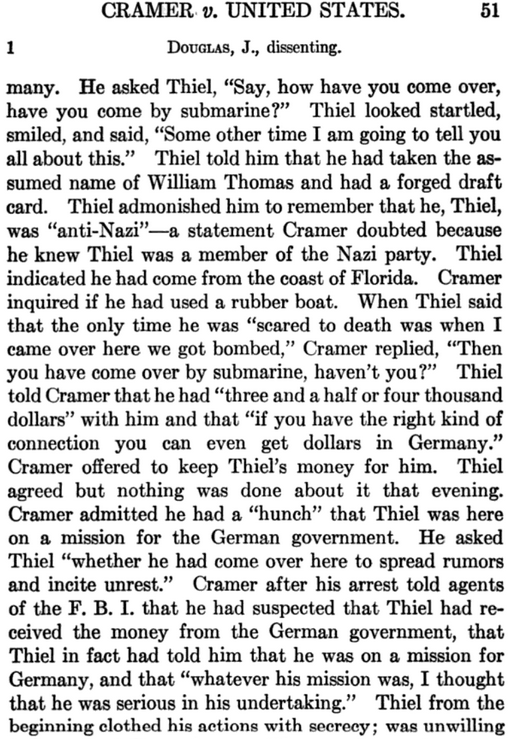
Davis, J. C. B., Wagner, F. D., Putzel, H., Lind, H. C. (1946). United States Reports: Cases Adjudged in the Supreme Court at … and Rules Announced at …. United States: Banks & Bros., Law Publishers.
This 1940s court case reveals a critical historical pattern: Werner Thiel claimed to be “anti-Nazi” while actively working to undermine American democracy. The judge noted the deception was transparent—Thiel’s actions contradicted his words.
This same pattern of claiming one thing while doing another persists today. The contemporary “America First” movement—which Thiel heavily finances—mirrors the very infiltration tactics documented in these Supreme Court records. Simply denying Nazi sympathies isn’t enough; one must actively oppose such ideologies through consistent action.
In this context, Thiel’s funding of political figures who embrace “America First” rhetoric raises alarming historical parallels that can’t be dismissed as coincidental.
I guess you could say I’m just asking rhetorical questions here, sort of like someone else has been known to do:
Thiel, the founder of the PayPal financial service, relied on rhetorical questions. He asked Google who was working on artificial intelligence, whether “senior management considers itself to have been thoroughly infiltrated”…
If there is an [infiltration], it might look a bit like Thielism…
After examining the extensive evidence connecting Peter Thiel’s family history, his educational background, his business practices, and his political statements, a disturbing pattern emerges. Despite having countless opportunities to distance himself from ideologies of oppression and exclusion, Thiel has consistently remained silent on Nazism while actively promoting concepts that mirror its core tenets—monopolistic power, elimination of democratic checks, and restriction of rights for women and minorities.
This silence is particularly striking given Thiel’s willingness to take strong public positions on numerous other controversial issues. His refusal to denounce Nazism stands in stark contrast to his eagerness to attack perceived enemies in media, business, and politics. One must ask: What does this selective silence say about his values and vision for America’s future?
For those doing business with Thiel, investing alongside him, or supporting politicians he funds, this question transcends academic interest. It strikes at the heart of what kind of society we wish to build and whose voices we elevate to positions of power and influence.
The historical threads connecting Nazi Germany, apartheid South Africa, and Peter Thiel’s modern philosophy of power aren’t merely coincidental—they represent a concerning continuity of thought that demands greater scrutiny as his influence in American life continues to grow.
a blog about the poetry of information security, since 1995