Although I spent many months deep in the archives of British history to write my Master’s thesis on the WWII liberation of Ethiopia I continue to find things now that I wish I had known a long time ago.
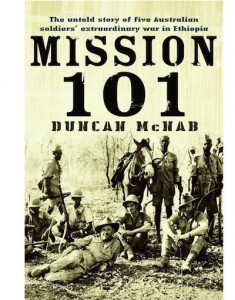
Lately I’ve been reading again about Mission 101, where just a few thousand men in an Allied expeditionary force were sent into Ethiopia to defeat a far greater Italian occupation force at least 10 times their size. It’s mentioned in books like “Fire in the night : Wingate of Burma, Ethiopia, and Zion,” or the more obvious title of…wait for it… “Mission 101”.
In late 1940 a group of five young Australian soldiers set out on a secret mission. Leading a small force of Ethiopian freedom fighters on an epic trek across the harsh African bush from the Sudan, the small incursion force entered Italian-occupied Ethiopia and began waging a guerilla war against the 250,000-strong Italian army. One of these men, Ken Burke, was Duncan McNab’s uncle.
The mission wasn’t actually about five Aussies, and I’ll get to that in a minute. The name seemed strange to me, in modern context, because we use 101 to imply some kind of basic level. Someone saying “Mission 101” today sounds almost exactly opposite to the task of taking a few soldiers into unknown territory against massive odds. That sounds really hard, right?
Top-ranked answer on a search engine is a Slate post called “101 101” that tells us the expression since the 1930s has meant a starter course for beginning students:
Many freshmen will kick off their college careers with courses like Psychology 101, English 101, or History 101. When did introductory classes get their special number? In the late 1920s. The Oxford English Dictionary finds the first use of “101” as an introductory course number in a 1929 University of Buffalo course catalog. Colleges and universities began to switch to a three-digit course-numbering system around this time.
This is a wholly unsatisfying answer. It takes for granted that in transition to a three number system someone would only use 101, and not 100, 010, 001, 000 or any other possible combinations.
Why 101?
I needed more. And the search engines were doing little to help, not least of all because searching for anything + “101” gives you an introduction to that topic and not the expression.
It says Mission 101 had a leader named Lt Col Daniel Sandford who served as artillery during WWI, and then as British Consul to Abyssinia before retiring there at the end of his term in office.
The key to this story, I soon figured out, is that WWI British artillery commonly used a fuse numbered 101 for their large explosive shells. The next question was why Sandford would transpose an old artillery fuse number on a WWI explosive shell to the WWII mission he ran?
This is where the story gets interesting.
After Italy invaded Ethiopia in October 1935 Sandford was forced to escape back to England. Italy then was poised to threaten British control of the Red Sea routes to Asia. The Sudan (occupied by Britain since 1899), bordering west Ethiopia, was thus directed by the British military to begin training Ethiopians as guerrilla forces ready to retake their country.
When Archibald Wavell was appointed General Officer Commanding-in-Chief in 1939 of Middle East Command over the Mediterranean and Middle East, he set about the task of asserting control over Red Sea routes as well as protecting Egypt (occupied by Britain since 1882, “sovereign” under Anglo-Egyptian Treaty of 1936). Wavell thus came up with a covert plan to encourage indigenous rebellion in Gojjam, a western Ethiopia province bordering Sudan where Italians had failed to establish control.
Guess what the name of that plan was.
October 1939 Britain estimated war with Italy was fast approaching and Sanford was dispatched back to Khartoum to gather Sudanese troops and Ethiopian exiles, arrange military supplies, and start heading east with his few thousand men. “Mission 101” was the plan to use a trigger group to detonate a larger popular uprising inside Ethiopia that would push the Italians out.
Mission 101 thus meant a small force of Ethiopians, Sudanese and Eritreans to rout the very large presence of Italian occupiers.
As a footnote, and as I’ve written about here before, Bletchley Park allegedly had cracked Italian Enigma encryption as early as 1936 giving a decisive advantage to the small force deployment in Mission 101.
Batey, who was only 19 at the time, cracked the code in an Italian Naval Enigma machine…
Australians don’t get a lot of mention in any of this, if any at all, despite by some accounts being tasked to help oversee the “Ethiopian patriot” forces.
The Americans in 1942, emulating/collaborating with the British, launched their own secretive Detachment 101:
The unit, officially designated as OSS Detachment 101, consisting initially of 21 members, began an intensive training program in early April 1942. William A. Peers, who later succeeded Eifler as commander of Detachment 101, said in his memoirs that the designation for the group was chosen to give the impression that the unit was well established and had been activated for a considerable length of time.
Clearly either Peers missed the Sandford memo or he intentionally created a fake “well established” backstory instead. It became a foundation that led to “the tenth group” of special forces in 1950s named to make the Soviets think there are at least nine others just like it.
Fascinating to think that 101 could have shifted from British military meaning the earliest and smallest step of a series to the American military meaning the opposite: a later stage and evidence of large impact. Although the OSS Detachment 101 in Burma was thought to be America’s “most effective tactical combat force”, to this day I don’t know of anyone who says 101 to suggest they had 100 priors.
There you have it. Given a history of British artillery fuse numbering, and the leadership role of WWI-veteran Sandford, the use of a small tactical action to trigger or initiate a much larger strategic impact makes sense as the origin of 101.
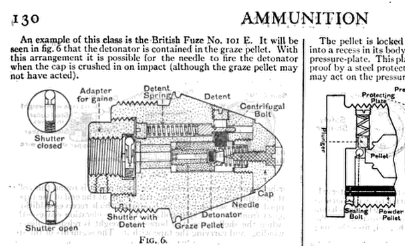
The best evidence of the exact number used on a fuse comes from a war museum file (IWM MUN 2582) which helps confirm that saying 101 went from military use to public in 1920s; set the stage as a common way to “starting” or “initiating”.
The No 101 percussion fuze was introduced in 1916 and represented an attempt to overcome the No 100 fuze’s weak points. The 101 did away with the ‘cocked pellet’, used a fixed needle, and placed the detonator in the graze pellet. The needle was originally pressed in, but loose needles often caused premature explosions and a screwed-in needle was used after the Mark I. The 101 ran to five ‘Marks’ and was declared obsolete in 1921.
It ironically even uses the phrase “this class” to describe something other than what we would think of today when hearing about the 101 class becoming common in the 1930s.
I recently met with members of state and federal government to discuss counter-drone solutions. When I brought up the 1940s drone issues they said “waaaaaht, I never” so here we go…
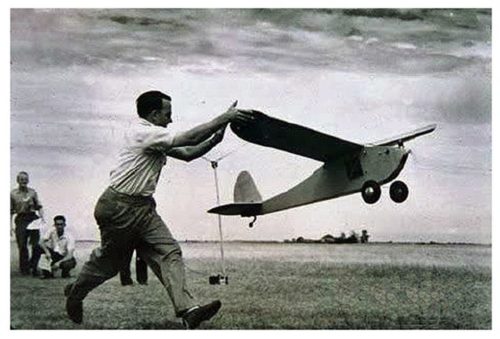
There was a 1935 Radioplane (RP-1) that evolved by 1939 into OQ-2 for use in the subsequent years. Over 15,000 of these types of UAV flew for the US Army Air Forces (USAAF) and others, all the way to 1952.
…training tool for anti-aircraft gunners. Such specialists were required to hit a moving target several miles up with cannon fire and it seemed an adequate thought that having a remote-piloted aircraft in training would make for more accurate gunners on the ground.
I’ll make a special side note here to mention that this concept of training anti-aircraft to hit moving targets was also the birth of artificial intelligence and “cyber”.
Cybernetics (coined from Greek kybernetes for “captain” of a ship or more literally someone who steers) was a book published in 1948 by Norbert Wiener.
It was based on his World War II experiments in anti-aircraft systems meant to anticipate planes by interpretation of radar images. And cybernetics/kybernetes should not be confused with kubernetes, which is Google’s highly popular open source software to steer swarms of drones.
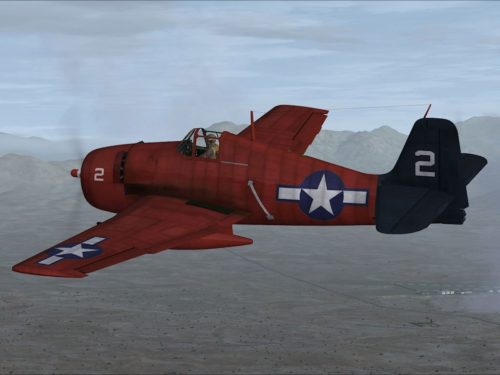
By the end of 1940s there had been an overproduction of prop warplanes, which also led the US to convert its Hellcats into UAVs for target practice.
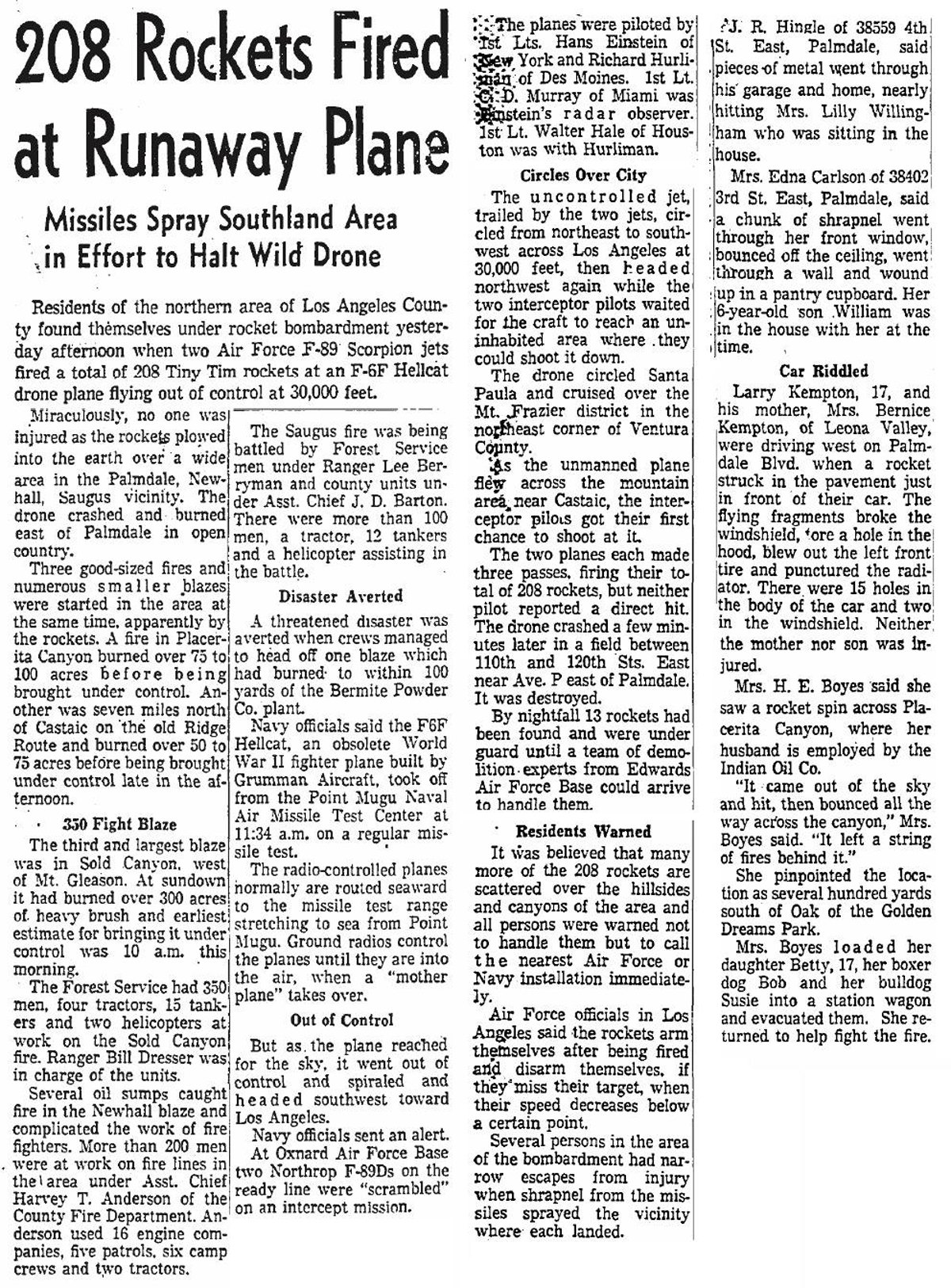
First, the US Navy lost radio connections and had to attempt to “shoot down pilotless F6F-5K Hellcat, minutes after it went out of control”.
And second, the worst part was not being a runaway military drone accidentally flying towards Los Angeles, but rather how “twin Scorpion interceptors fired more than 200 missiles, missing their target each time”.
Instead the missiles — each pod containing 52 Mighty Mouse 2.75-inch rockets — damaged property and set off a string of brush fires across northern Los Angeles County. The Hellcat drone finally crash-landed harmlessly in the Mojave Desert. Angry and frightened residents complained. Los Angeles County Supervisor Roger W. Jessup promised a detailed investigation and introduced a resolution urging the “utmost care” by Navy officials in sending the “robot planes skyward.”
Note how detailed these stories are of American military planes firing rockets into civilian areas.
Edna Carlson was at home there with her 6-year-old son when shrapnel exploded through her front window, bounced off the ceiling, pierced a wall and landed in a cupboard.
More fragments passed through the home and garage of J. R. Hingle, barely missing a visitor sitting on his couch.
Larry Kempton was driving west on Palmdale Boulevard with his mother, Bernice, when a rocket hit the street in front of the car. Fragments splintered the windshield, blew out a tire and put holes in the radiator. Neither person was injured.
Historians point out a detail that the double whammy here is the *ROCKETS themselves were DRONES* “supposed to disarm themselves” and didn’t function intelligently as intended either.
The Air Force reported that the missiles were designed to arm themselves when fired, but if they missed their target, they were supposed to disarm themselves when they flew below a certain speed.
In other words it’s understandable how some might want to forget that drone development in the 1940s ended with scorched earth, wildfires raging, firefighters scrambling and American civilians running for cover.
Headlines about drones in America essentially started as fun and inspiring “Guff wins 1st place at the 1938 Radio Control Nationals”
And then two decades later “208 Rockets Fired at Runaway Plane: Missiles Spray Southland Area in Effort to Halt Wild Drone”, which set the stage for public nervousness through the 1960s about automated missiles (Cuba Crisis) let alone surveillance drones and driverless cars… all a reality at that time.
A curious thing about writing a poem is how it can suggest to the reader a topic while subtly communicating a tangent. Recently I was being peppered by questions of attribution in security that reminded me of Henry Wadsworth Longfellow’s poem:
		My Lost Youth

OFTEN I think of the beautiful town
  That is seated by the sea;
Often in thought go up and down
The pleasant streets of that dear old town,
  And my youth comes back to me.			5
    And a verse of a Lapland song
    Is haunting my memory still:
    'A boy's will is the wind's will,
And the thoughts of youth are long, long thoughts.'

I can see the shadowy lines of its trees,		10
  And catch, in sudden gleams,
The sheen of the far-surrounding seas,
And islands that were the Hesperides
  Of all my boyish dreams.
    And the burden of that old song,			15
    It murmurs and whispers still:
    'A boy's will is the wind's will,
And the thoughts of youth are long, long thoughts.'

I remember the black wharves and the slips,
  And the sea-tides tossing free;			20
And Spanish sailors with bearded lips,
And the beauty and mystery of the ships,
  And the magic of the sea.
    And the voice of that wayward song
    Is singing and saying still:			25
    'A boy's will is the wind's will,
And the thoughts of youth are long, long thoughts.'

I remember the bulwarks by the shore,
  And the fort upon the hill;
The sunrise gun with its hollow roar,			30
The drum-beat repeated o'er and o'er,
  And the bugle wild and shrill.
    And the music of that old song
    Throbs in my memory still:
    'A boy's will is the wind's will,			35
And the thoughts of youth are long, long thoughts.'

I remember the sea-fight far away,
  How it thunder'd o'er the tide!
And the dead sea-captains, as they lay
In their graves o'erlooking the tranquil bay		40
  Where they in battle died.
    And the sound of that mournful song
    Goes through me with a thrill:
    'A boy's will is the wind's will,
And the thoughts of youth are long, long thoughts.'	45

I can see the breezy dome of groves,
  The shadows of Deering's woods;
And the friendships old and the early loves
Come back with a Sabbath sound, as of doves
  In quiet neighbourhoods.				50
    And the verse of that sweet old song,
    It flutters and murmurs still:
    'A boy's will is the wind's will,
And the thoughts of youth are long, long thoughts.'

I remember the gleams and glooms that dart		55
  Across the schoolboy's brain;
The song and the silence in the heart,
That in part are prophecies, and in part
  Are longings wild and vain.
    And the voice of that fitful song			60
    Sings on, and is never still:
    'A boy's will is the wind's will,
And the thoughts of youth are long, long thoughts.'

There are things of which I may not speak;
  There are dreams that cannot die;			65
There are thoughts that make the strong heart weak,
And bring a pallor into the cheek,
  And a mist before the eye.
    And the words of that fatal song
    Come over me like a chill:				70
    'A boy's will is the wind's will,
And the thoughts of youth are long, long thoughts.'

Strange to me now are the forms I meet
  When I visit the dear old town;
But the native air is pure and sweet,			75
And the trees that o'ershadow each well-known street,
  As they balance up and down,
    Are singing the beautiful song,
    Are sighing and whispering still:
    'A boy's will is the wind's will,			80
And the thoughts of youth are long, long thoughts.'

And Deering's woods are fresh and fair,
  And with joy that is almost pain
My heart goes back to wander there,
And among the dreams of the days that were		85
  I find my lost youth again.
    And the strange and beautiful song,
    The groves are repeating it still:
    'A boy's will is the wind's will,
And the thoughts of youth are long, long thoughts.'	90
This could happen anywhere, despite being about a specific place. Supposedly in 1855 he set out to describe an idyllic life in Portland, Maine. And yet what city “beautiful town that is seated by the sea” does not have “pleasant streets” with “shadowy lines of its trees”? Is anyone surprised to hear of an old American shipping town with “black wharves and the slips” below “the fort upon the hill”?
Even more to the point, after a long vague description leaving the reader without any unique Portlandish details, the writer admits “there are things of which I may not speak”. Vague by design?
Ok, then, decoding the poem to suggests a series of fleeting (pun not intended) feelings that defy direct attribution to a particular city. Action words give away bundles of emotion from a young boy excited by a generalized theory of adventure. No real location is meant, which leaves instead the importance of stanza action lines (7th); they seem to unlock a message about generic youthful rotations: haunting, murmurs, singing, throbs, goes, flutters, sings, come, sighing, repeating. “Lost youth” indeed….
Next time you bang on a vending machine for a bottle that refuses to fall into your hands, ask yourself if restaurants soon will have only robots serving you meals.
Maybe it’s true there is no future for humans in service industries. Go ahead, list them all in your head. Maybe problems robots have with simple tasks like dropping a drink into your hands are the rare exceptions and the few successes will become the norm instead.
One can see why it’s tempting to warn humans not to plan on expertise in “simple” tasks like serving meals or tending a bar…take the smallest machine successes and extrapolate into great future theories of massive gains and no execution flaws or economics gone awry.
Just look at cleaning, sewing and cooking for examples of what will be, how entire fields have been completely automated with humans eliminated…oops, scratch that, I am receiving word from my urban neighbors they all seem to still have humans involved and providing some degree of advanced differentiation.
Maybe we should instead look at darling new startup Blue Apron, turning its back on automation, as it lures millions in investments to hire thousands of humans to generate food boxes. This is such a strange concept of progress and modernity to anyone familiar with TV dinners of the 1960s and the reasons they petered out.
Just me or is anyone else suddenly nostalgic for that idyllic future of food automation (everything containerized, nothing blended) as suggested in a 1968 movie called “2001”…we’re 16 years late now and I still get no straw for my fish container?
I don’t even know what that box on the top right is supposed to represent. Maybe 2001 predicted chia seed health drinks.
Speaking of cleaning, sewing and cooking with robots…someone must ask at some point why much of automation has focused on archetypal roles for women in American culture. Could driverless tech be targeting the “soccer-mom” concept along similar lines; could it arguably “liberate” women from a service desired from patriarchal roles?
Hold that thought, because instead right now I hear more discussion about a threat from robots replacing men in the over-romanticized male-dominated group of long-haul truckers. (Protip: women are now fast joining this industry)
Whether measuring accidents, inspections or compliance issues, women drivers are outperforming males, according to Werner Enterprises Inc. Chief Operating Officer Derek Leathers. He expects women to make up about 10 percent of the freight hauler’s 9,000 drivers by year’s end. That’s almost twice the national average.
The question is whether American daily drivers, of which many are professionals in trucks, face machines making them completely redundant just like vending machines eliminating bartenders.
It is very, very tempting to peer inside any industry and make overarching forecasts of how jobs simply could be lost to robots. Driving a truck on the open roads, between straight lines, sounds so robotic already to those who don’t sit in the driver’s seat. Why has this not already been automated, is the question we should be answering rather than how soon will it happen.
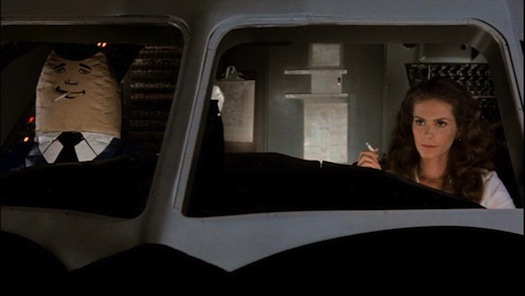
Only at face value does driving present a bar so low (pun not intended) machines easily could take it over today. Otto of the 1980 movie “Airplane” fame comes to mind for everyone I’m sure, sitting ready to be, um, “inflated” and take over any truck anywhere to deliver delicious TV dinners.
Otto smokes a cig
Yet when scratching at barriers, maybe we find trucking is more complicated than this. Maybe there could be more to human processes, something really intelligent, than meets a non-industry specific robotic advocate’s eye?
Systems that have to learn, true robots of the future, need to understand a totality of environment they will operate within. And this begs the question of “knowledge” about all tasks being replaced, not simply the ones we know of from watching Hollywood interpretations of the job. A common mistake is to underestimate knowledge and predict its replacement with an incomplete checklist of tasks believed to point in the general direction of success.
Once the environmental underestimation mistake is made another mistake is to forecast cost improvements by acceleration of checklists towards a goal of immediate decision capabilities. We have seen this with bank ATMs, which actually cost a lot of money to build and maintain and never achieved replacement of teller decision-trees; even more security risks and fraud were introduced that required humans to develop checklists and perform menial tasks to maintain ATMs, which still haven’t achieved full capability. This arguably means new role creation is the outcome we should expect, mixed with modest or even slow decline of jobs (less than 10% over 10 years).
Automation struggles at eliminating humans completely because of the above two problems (need for common sense and foundations, need for immediate decision capabilities based on those foundations) and that’s before we even get to the need for memory and a need for feedback loops and strategic thinking. The latter two are essential for robots replacing human drivers. Translation to automation brings out nuances in knowledge that humans excel in as well as long-term thoughts both forwards and backwards.
Machines are supposed to move beyond limited data sets and be able to increase minimum viable objectives above human performance, yet this presupposes success at understanding context. Complex streets and dangerous traffic situations are a very high bar to achieve, so high they may never be reached without human principled oversight (e.g. ethics). Without deep knowledge of trucking in its most delicate moments the reality of driver replacement becomes augmentation at best. Unless the “driver” definition changes, goal posts are moved and expectations for machines are measured far below full human capability and environmental possibility, we remain a long way from replacement.
Take for example the amount of time it takes to figure out risk of killing someone in an urban street full of construction, school and loading zones. A human is not operating within a window 10 seconds from impact because they typically aim to identify risks far earlier, avoiding catastrophes born from leaving decisions to last-seconds.
I’m not simply talking about control of the vehicle, incidentally (no pun intended), I also mean decisions about insurance policies and whether to stay and wait for law enforcement to show up. Any driver with rich experience behind the wheel could tell you this and yet some automation advocates still haven’t figured that out, as they emphasize sub-second speed of their machines is all they need/want for making decisions, with no intention to obey human imposed laws (hit-and-run incidents increased more than 40% after Uber was introduced to London, causing 11 deaths and 5,000 injuries per year).
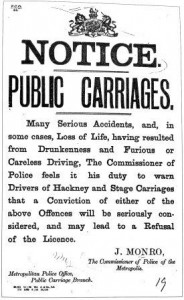
For those interested in history we’re revisiting many of the dilemmas posed the first time robotic idealism (automobiles) brought new threat models to our transit systems. Read a 10 Nov 1832 report on deaths caused by ride share services, for example.
The Inquest Jury found a verdict of man- slaughter against the driver,—a boy under fifteen years of age, and who appeared to have erred more from incapacity than evil design; and gave a deodand of 50/. against the horse and cabriolet, to mark their sense of the gross impropriety of the owner in having in- trusted the vehicle to so young and inexperienced a person.
Young and inexperienced is exactly what even the best “learning” machines are today. Sadly for most of 19th Century London authorities showed remarkably little interest in shared ride driving ability. Tests to protect the public from weak, incapacitated or illogical drivers of “public carriages” started only around 1896.
Finding balance between insider expertise based on experience and outsider novice learner views is the dialogue playing out behind the latest NHTSA automation scales meant to help regulate safety on our roads. People already are asking whether costs to develop systems that can go higher than “level three” (cede control under certain conditions and environments) autonomous vehicle are justified. That third level of automation is what typically is argued by outsiders to be the end of the road for truck drivers (as well as soccer moms).
The easy answer to the third level is no, it still appears to be years before we can SAFELY move above level three and remove humans in common environments (not least of all because hit-and-run murder economics heavily favoring driverless fleets). Cost reductions today through automation make far more sense at the lower ends of the scale where human driver augmentation brings sizable returns and far fewer chances of disaster or backlash. Real cost, human life error, escalates quickly when we push into a full range of even the basic skills necessary to be a safe driver in every environment or any street.
There also is a more complicated answer. By 2013 we saw Canadian trucks linking up in Alberta’s open road and using simple caravan techniques. Repeating methods known for thousands of years, driver fatigue and energy costs were significantly dropped though caravan theory. Like a camel watching the tail of one in front through a sandstorm…. In very limited private environments (e.g. competitions, ranches, mines, amusement parks) the cost of automation is less and the benefits realized early.
I say the answer is complicated because level three autonomous vehicle still must have a human at the controls to take over, and I mean always. The NHTSA has not yet provided any real guidance on what that means in reality. How quickly a human must take-over leaves a giant loophole in defining human presence. Could the driver be sleeping at the controls, watching a movie, or even reposing in the back-seat?
The Interstate system in America has some very long-haul segments with traffic flowing at similar speed with infrequent risk of sudden stop or obstruction. Tesla, in their typically dismissive-of-safety fashion despite (or maybe because of) their cars repeatedly failing and crashing, called major obstructions on highways a “UFO” frequency event.
Cruise control and lane-assist in pre-approved and externally monitored safe-zones in theory could allow drivers to sleep as they operate, significantly reducing travel times. This is a car automation model actually proposed in the 1950s by GM and RCA, predicted to replace drivers by 1974. What would the safe-zone look like? Perhaps one human taking over the responsibility by using technology to link others, like a service or delegation of decision authority, similar to air traffic control (ATC) for planes. Tesla is doing this privately, for those in the know.
Ideally if we care about freedom and privacy, let alone ethics, what we should be talking about for our future is a driver and a co-pilot taking seats in the front truck of a large truck caravan. Instead of six drivers for six trucks, for example, you could find two drivers “at the controls” for six trucks connected by automation technology. This is powerful augmentation for huge cost savings, without losing essential control of nuanced/expert decisions in myriad local environments.
This has three major benefits. First, it helps with the shortage of needed drivers, mentioned above being filled by women. Second it allows robot proponents to gather real-world data with safe open road operations. Third, it opens the possibility of job expansion and transitions for truckers to drone operations.
On the other end of the spectrum from boring unobstructed open roads, in terms of driverless risks, are the suburban and urban hubs (warehouses and loading docks) that manage complicated truck transactions. Real human brain power still is needed for picking up and delivering the final miles unless we re-architect the supply-chain. In a two-driver, six-truck scenario this means after arriving at a hub, trucks return to one driver one truck relationship, like airplanes reaching an airport. Those trucks lacking human drivers at the controls would sit idle in queue or…wait for it…be “remotely” controlled by the locally present human driver. The volume of trucks (read percentage “drones”) would increase significantly as number of drivers needed might actually decline only slightly.
Other situations still requiring human control tend to be bad weather or roads lacking clear lines and markings. Again this would simply mean humans at the controls of a lead vehicle in a caravan. Look at boats or planes again for comparison. Both have had autopilots far longer, at least for decades, and human oversight has yet to be cost-effectively eliminated.
Could autopilot be improved to avoid scenarios that lead to disaster, killing their human passengers? Absolutely. Will someone pay for autopilots to avoid any such scenarios? Hard to predict. For that question it seems planes are where we have the most data to review because we treat their failures (likely due to concentrated loss of life) with such care and concern.
There’s an old saw about Allied bombers of WWII being riddled with bullet holes yet still making it back to base. After much study the Air Force put together a presentation and told a crowded room that armor would be added to all the planes where concentrations of holes were found. A voice in back of the crowd was heard asking “but shouldn’t you put the armor where the holes aren’t? Where are the holes on planes that didn’t come back”.
It is time to focus our investments on collecting and understanding failures to improve driving algorithms of humans, by enhancing the role of drivers. The truck driver already sits on a massively complex array of automation (engines and networks) so adding more doesn’t equate to removing the human completely. Humans still are better at complex situations such as power loss or reversion to manual controls during failures. Automation can make both flat open straight lines into the sunset more enjoyable, as well as the blizzard and frozen surface, but only given no surprises.
Really we need to be talking about enhancing drivers, hauling more over longer distance with fewer interruptions. Beyond reduced fatigue and increased alertness with less strain, until systems move above level three automation the best-case use of automation is still augmentation.
Drivers could use machines for making ethical improvements to their complex logistics of delivery (less emissions, increased fuel efficiency, reduced strain on the environment). If we eliminate drivers in our haste to replace them, we could see fewer benefits and achieve only the lowest-forms of automation, the ones outsiders would be pleased with while those who know better roll their eyes with disappointment.
Or maybe Joe West & the Sinners put it best in their classic trucker tune “$2000 Navajo Rug”
I’ve got my own chakra machine, darlin’,
made out of oil and steel.
And it gives me good karma,
when I’m there behind the wheel
a blog about the poetry of information security, since 1995

 Lately I’ve been reading again about Mission 101, where just a few thousand men in an Allied expeditionary force were sent into Ethiopia to defeat a far greater Italian occupation force at least 10 times their size. It’s mentioned in books like “Fire in the night : Wingate of Burma, Ethiopia, and Zion,” or the more obvious title of…wait for it… “Mission 101”.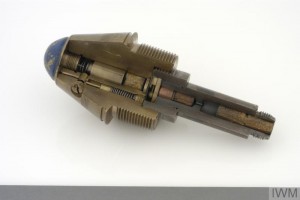
 Next time you bang on a vending machine for a bottle that refuses to fall into your hands, ask yourself if restaurants soon will have only robots serving you meals.
 Young and inexperienced is exactly what even the best “learning” machines are today. Sadly for most of 19th Century London authorities showed remarkably little interest in shared ride driving ability. Tests to protect the public from weak, incapacitated or illogical drivers of “public carriages” started only around 1896.