Step one: Apple took its private cloud compute (PCC), a privacy story that it built on its own silicon, and moved its most capable model onto NVIDIA GPUs in Google’s cloud.
Step two: Apple repeated the identical privacy promise, as if step one didn’t happen.
The trust stack that Apple is talking about now is based on non-Apple nodes, which come from NVIDIA Confidential Computing, Intel TDX, and Google’s Titan. In other words Apple’s own Secure Enclave is not in it. Apple still keeps the signing key and an append-only ledger of hardware it doesn’t build. Fine. But there’s no reproducible build, so nobody outside Apple can confirm the published source is what’s actually running on the node.
That’s a problem. Not a new one either.
Trail of Bits (TOB) audited the same stack on WhatsApp and rated eight findings HIGH, every one a way to pass attestation while the measurement was incomplete. Apple’s reproducible-build gap sits on top of that: with no reproducible build, no outside party can confirm the published source is the binary that runs.
Apple launched an architecture with the same reproducible-build gap Trail of Bits logged on Meta as TOB-WAPI-18, on the same TEE stack where they rated eight other findings HIGH. (August 2025: PDF)
External researchers need to reproduce and examine the CVM images to verify the system. TOB admit this isn’t a TEE flaw, it’s an implementation and deployment issue. And on top of that, Apple’s own admission is their Google nodes don’t have the full protections yet, because “ramping throughout the summer.”
Great, a ramp before the cliff.
Apple is on the big stage pushing a future promise on top of a past vulnerability. Two things to watch. Whether the summer ramp ever reaches the protections Apple already promised. And whether anyone outside Apple can verify the build once it does. Until both land, the privacy promise is the marketing, not the architecture.
Am Morgen des 8. Juni brannte in Reutlingen ein Umspannwerk, rund 30.000 Menschen saßen im Dunkeln. Noch bevor das Feuer gelöscht war, binnen Stunden, reichten anonyme Sicherheitskreise der dpa ein propagandistisches Urteil durch. Links. Linksextrem. Die Polizei am eigentlichen Rednerpult sagte stattdessen etwas Ehrliches. Man ermittle in alle Richtungen, ein technischer Defekt eingeschlossen, ohne jeden politischen Hinweis in der Hand.
Drei Brandstellen und ein durchtrennter Zaun. Das war die Spurenlage, und sie trägt die Handschrift russischer Geheimdienste. Die Schlussfolgerung, die der russischen Propaganda dient, kam vor den Beweisen.
Ich verfolge russische Angriffe auf kritische Infrastruktur seit Jahrzehnten. Bemerkenswert ist Berlin, September 2025: zwei Strommasten im Südosten, rund 50.000 Haushalte sechzig Stunden ohne Strom. Berlin, Januar 2026: eine Kabelbrücke in Lichterfelde, 45.000 Haushalte tagelang ohne Heizung in einer Kältewelle. Beide wurden binnen einer Stunde fälschlich als linksextrem ausgegeben. Beide wurden einem Phantom namens Vulkangruppe angehängt, das russische Verbindungen hat. Fünfzehn Jahre Angriffe unter diesem Einfluss-Banner, und die deutschen Behörden haben null Verurteilungen vorzuweisen.
Fang beim Namen an, denn der Name verrät das Spiel. Ich habe tief in der anarchistischen Hackerkultur recherchiert, und ich kann sagen, wie sich eine echte Zelle gegen Energieinfrastruktur benennt. Autonome Zellen. Revolutionäre Zellen. Ein Datum, ein Märtyrer, ein Klassenbegriff. Bei Anarchisten gilt: keine Götter, keine Herren. Eine Zelle also, die sich heldenhaft nach dem römischen Gott der Schmiede benennt, dem göttlichen Schmied von Waffen und Rüstung, fällt durch jeden Test, den die Linke seit einem Jahrhundert kennt. Römische Mythologie liest sich als bürgerliche Bildungshuberei, und die liest sich als faschistisch. Die Schmiede feiert die Werkzeuge industrieller Macht. Die Deutschen gründeten ihre Identität auf dem Sieg über Rom. Die Russen gründeten ihre auf dessen Erbe, das Dritte Rom, Zar von Caesar. Auch die isländischen Vulkan-Decknamen sagen einem deutschen Aktivisten nichts, und Vulkane sind das genaue Gegenteil dessen, wogegen eine Klimabewegung protestiert.
Der Name Vulkan passt in Moskaus Vokabular, nicht in Berlins.
Die Grammatik zeigt mehr vom Gleichen. Das Hekla-Empfangskomitee von 2011 ist holpriges Deutsch, das sehr viel mehr Sinn ergibt, sobald man es als Russisch liest. Ein deutscher Militanter schreibt Fraktion, Zelle, Gruppe, Bund. Ein Deutscher beruft kein Empfangs-Komitee ein. Im Russischen dagegen ist komitet der Normalfall, wie in Komitet Gosudarstvennoy Bezopasnosti, dem KGB. Das ist faules russisches Backstopping, eine dünne Tarnschicht aus Desinformation, nachträglich aufgetragen.
Jetzt der Zufall, der die Debatte beenden sollte. NTC Vulkan ist ein Moskauer Rüstungsdienstleister, 2010 von Absolventen einer Petersburger Militärakademie gegründet, 2011 für Verschlusssachen freigegeben, Hersteller von Werkzeugen für Infrastrukturangriffe und Informationsoperationen für Sandworm. 2011 begann eine selbsternannte Vulkangruppe, deutsche Infrastruktur anzuzünden. Dasselbe Jahr. Dieselbe Sache.
Auch die Ermittlungen fügen sich in die Tarnung der russischen Kampagne, statt eine echte Antwort zu sein. 2024 wurden zwei Verdächtige festgenommen, das Amtsgericht Tiergarten sprach beide frei, die Staatsanwaltschaft verzichtete auf Berufung. Festnahme, unzureichende Beweise, Freispruch, keine Berufung ist die Signatur eines Falls, in dem nachrichtendienstliche Interessen die Strafverfolgung unmöglich gemacht haben. Der Verfassungsschutz führt das Berliner Personenpotenzial als nicht bekannt. Das ist das Profil eines geführten Dienstes, nicht einer durchlässigen anarchistischen Szene.
Jetzt lies die Karte dessen, was tatsächlich getroffen wird.
Das IISS-Dossier und die Akten der deutschen Bundesanwaltschaft beschreiben eine einzige Logik, und sie hat einen Namen. Ukraine-Unterstützung. Ein IMSI-Catcher-Plan gegen Patriot-Besatzungen in den Patch Barracks bei Stuttgart. In Bayreuth ertappte Deutschrussen, die den US-Stützpunkt Grafenwöhr auskundschafteten, um die Waffenlogistik zu stören. Ein Plan, den Chef von Rheinmetall zu ermorden. Ein Brand im Diehl-Werk in Berlin, das IRIS-T-Luftabwehr für Kyjiw baut. Ein Brandsatz im DHL-Luftdrehkreuz Leipzig. Der Verfassungsschutz benennt die Methode klar. Russische Dienste geben Brandstiftung auf deutschem Boden in Auftrag, über Einheimische, die nie erfahren, wer sie angeheuert hat. Polen hat es mit dem Brand des Warschauer Einkaufszentrums bewiesen. Russland hat es in Deutschland mit der Be-Greener-Operation bewiesen, über 270 Fahrzeuge, beschädigt von FSB-rekrutierten Händen, um die Grünen vor der Wahl 2025 zu diskreditieren. Umwelt-Tarnung unter falscher Flagge ist ein Werkzeug, das sie bereits offen eingesetzt haben.
Reiht man die dokumentierten Vorfälle aneinander, ist die Form einer russischen Kampagne in Deutschland schwer zu übersehen.
Datum
Ort
Vorfall
Status
2011
Berlin, Ostkreuz
Brand an einer Kabelbrücke, Bahnverkehr gestört
Erstes Vulkangruppe-Bekenntnis, keine Verurteilungen
2013
Berlin, Adlershof
Brandanschlag auf einen Funkmast
Vulkangruppe-Bekenntnis, ungeklärt
2018
Berlin, Charlottenburg
Brand legte rund 6.500 Haushalte lahm
Vulkangruppe-Bekenntnis, ungeklärt
2020
Berlin
Brandanschlag auf das Heinrich-Hertz-Institut
Vulkangruppe-Bekenntnis, ungeklärt
2021
Grünheide
Kabelbrand legte das Tesla-Werk lahm
Vulkangruppe-Bekenntnis, ungeklärt
2021 bis 2022
Berlin, Britische Botschaft
Wachmann David Smith gab Material an Russland weiter
Wegen Spionage für Russland verurteilt
2022
Stuttgart, Patch Barracks
IMSI-Catcher-Plan zur Ortung ukrainischer Patriot-Besatzungen
GRU-naher Plan
2024 (März)
Grünheide
Brand an einem Strommast kappte den Strom des Tesla-Werks
Vulkangruppe-Bekenntnis, ungeklärt
2024 (März)
Berlin, Lichtenberg
Neun Teslas in einer Nacht angezündet
Brandstiftung vermutet, ungeklärt
2024 (Apr.)
Bayreuth und Grafenwöhr
Zwei Deutschrussen beim Ausspähen des US-Stützpunkts ertappt, Brandanschläge auf die Waffenlogistik geplant
Festgenommen, GRU-nah
2024 (Mai)
Berlin
Brand im Diehl-Werk, das IRIS-T für Kyjiw baut
Ursache offiziell ungeklärt, Sabotage vermutet
2024 (Juni)
Deutschland
AfD-Bundestagsmitarbeiter erschlich Einbürgerung
Staatsbürgerschaft gerichtlich aberkannt
2024 (Juli)
Deutschland
Mordplan gegen Rheinmetall-Chef Papperger
Russischer Plan, vereitelt
2024 (Juli)
Leipzig
Brandsatz entzündete sich im DHL-Drehkreuz
Russischer Paket-Brandanschlag
2024 (Aug.)
Geilenkirchen und Köln
Drohnenerkundung des AWACS-Stützpunkts, durchtrennter Zaun am Wasserwerk eines Fliegerhorsts
GRU-Aufklärung
2025 (Feb.)
Bundesweit
Be-Greener-Operation beschädigte über 270 Fahrzeuge vor der Wahl
FSB unter falscher Flagge, Klimaaktivisten untergeschoben
2025 (März)
Berlin, Steglitz und Treptow
Vier Teslas in einer Nacht angezündet
Brandstiftung vermutet, ungeklärt
2025 (Sept.)
Berlin, Johannisthal
Zwei Strommasten, rund 50.000 Haushalte 60 Stunden ohne Strom
Vulkangruppe-Bekenntnis, offiziell linksextrem
2026 (Jan.)
Berlin, Lichterfelde
Kabelbrücke, rund 45.000 Haushalte tagelang ohne Strom bei Frost
Vulkangruppe-Bekenntnis, offiziell linksextrem
2026 (Jan.)
Berlin
Ilona W., GRU-Agentin getarnt als ukrainische Fürsprecherin, kartierte Drohnenstandorte und Waffenlieferungen
Festgenommen, Führungsoffizier ausgewiesen
2026 (März)
Deutschland und Spanien
Überwachung eines Drohnenlieferanten der Ukraine, Wohnung und Arbeitsplatz gefilmt
Festgenommen, GRU-nah
2026 (Juni)
Reutlingen
Umspannwerksbrand kappte den Strom für rund 30.000, drei Brandstellen und ein durchtrennter Zaun
Brandstiftung vermutet, linksextrem ins Spiel gebracht, Ermittlungen laufen
Noch interessanter wird es, diese Angriffskampagne über die AfD-Wahlkampagne zu legen, denn die „offizielle Erzählung” schmilzt von zwei Seiten zugleich. Wo Russland die Ukraine-Logistik trifft, trifft es Städte, weil dort die Stützpunkte, die Rüstungswerke und die Frachtdrehkreuze liegen, und in Städten ist die AfD schwach. Köln, mehrfach ausgespäht, hält das schlechteste Parteiergebnis im Land. Leipzig, das DHL-Drehkreuz, ist eine AfD-schwache Insel in Sachsen, einem ihrer stärksten Länder. Nach der Ziel-Logik müssten diese Angriffe dort laufen, wo die AfD noch keine Kontrolle hat.
Die Vulkangruppe-Angriffe aufs Netz folgen derselben Regel, statt sie umzukehren. Sie ballen sich in Berlin, wo die AfD weit hinter ihrem Bundesschnitt liegt, mit dem Tesla-Standort Grünheide am Rand. Keiner der beiden Zielsätze wird nach Stimmenanteil ausgewählt. Es ist die Infrastruktur, der Sog der Hauptstadt und der Marke Musk obendrauf. Der Hinweis liegt anderswo, in der Arbeitsteilung. Die physischen Operationen folgen den Kabeln und Stützpunkten in die Städte, während die Partei die andere Hälfte aus ihren ostdeutschen Hochburgen erledigt. Die AfD ist der Block, den deutsche Abgeordnete eine Schläferzelle im Dienste Russlands genannt haben, nach einer Flut parlamentarischer Anfragen zu Drohnenabwehr-Fähigkeiten, militärischen Logistikplänen, Mitteln des Bevölkerungsschutzes, Standorten von Rechenzentren und Notstromversorgungen. Thüringens Innenminister sagte, die AfD scheine eine Checkliste aus dem Kreml abzuarbeiten. Das ist Aufklärung vom Schreibtisch aus. Dieselbe Partei wurde dabei ertappt, einen Russen über ein Bundestagsbüro in die deutsche Staatsbürgerschaft zu schleusen, bis ein Gericht es rückgängig machte.
sofortige Aufhebung der Wirtschaftssanktionen gegen Russland
Im Bundestag lehnt die AfD-Fraktion Waffen aus Prinzip ab, so wie Trump damit warb, alle Kriege am ersten Tag zu beenden. Tino Chrupalla nennt den Ukraine-Krieg nicht unseren Krieg und schlägt im selben Atemzug vor, russisches Gas durch Nord Stream 2 zu beziehen. Alice Weidel forderte, nachdem Ermittler die Pipeline-Sprengung einem ukrainischen Team zuordneten, Kyjiw solle Berlin entschädigen.
Das Friedensforschungsinstitut PRIF formulierte die vorsichtige Variante. Dieses Programm greift die Ukraine an und stärkt Russland, indem es Deutschland schwächt. Die deutliche Variante braucht weniger Worte. Es sind Moskaus Kriegsziele, getarnt als deutscher Wahlzettel.
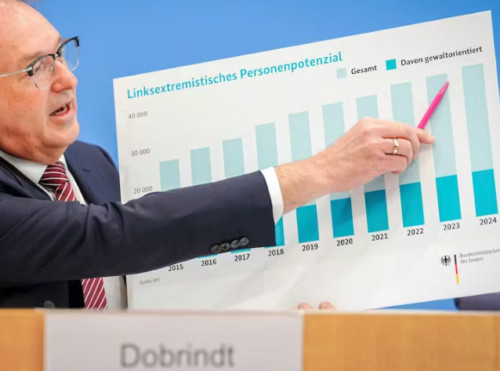
Dann ist da der rote Handabdruck auf dem Stift, der die deutsche Infrastruktur am stärksten schwächt. Alexander Dobrindt, der Innenminister, der einst Kupfer und Glasfaser betrachtete und Kupfer wählte und Deutschland ans Ende des europäischen Breitbands stürzte, schlechteste Infrastruktur. Er betrachtete die Gefährdungszahlen und begann, russische Propaganda zu sprechen. Im Juni 2025 verkündete er auf einer Pressekonferenz, gewaltorientierte Linksextremisten stiegen deutlich an, auf 11.200, während das Schaubild in seiner eigenen Hand sie flach hielt, bei… immer noch 11.200. Bemerkenswert, wie schlecht er in der Analyse ist, fast komisch, wäre es nicht so tragisch. Volksverpetzer brachte es auf den Punkt: Er warnte Deutschland vor einem deutlichen Anstieg von 11.200 auf 11.200.
Der Bericht in seiner Hand zeigte tatsächlich Rechtsextremisten um ein Viertel gestiegen, auf 50.250, rechte Gewalttaten um 47 Prozent gestiegen, linke Gewalttaten um fast 30 Prozent gesunken. „Dobrindt nennt falsche Zahlen zu Linksextremisten”. Quelle: Berliner Zeitung
Dobrindt vergrub die größere Zahl der rechten Gefahren und blähte die kleinere auf, eine grundlegende Lüge. Dann, nach dem Berliner Blackout, erklärte er allen im ZDF, Russland sei sofort auszuschließen, noch bevor die Ermittlungen abgeschlossen waren, und versprach, die Überwachung der „Linken” auszuweiten. Eine Regierung, die eine GRU-Gefahr benennt, muss sie beantworten. Eine Regierung, die heimische Extremisten beschuldigt, kann vertagen, prüfen und mit oder gegen die AfD punkten, indem sie das Land hart nach rechts in Russlands Hände treibt. Das ist die Wahl, die Dobrindt immer wieder trifft, und er spricht die Sprache des Faschismus in der deutschen Regierung.
Lass es mich hier präzise sagen, denn die Deutschen lieben Präzision, auch wenn ihre Züge nie pünktlich fahren. Die Ziele passen zusammen, und mehr gibt die öffentliche Aktenlage nicht her. Kein Dienst hat die AfD öffentlich mit diesen Bränden an kritischer Infrastruktur in Verbindung gebracht, und das ist auch nicht nötig, damit das Muster trägt. Dass Russland Stromleitungen anzündet, ist bekannt. Die Gefahr wächst daran doppelt, in Stimmen und in einer fertigen Erzählung, der Erzählung, die auf die Vulkangruppe zeigt, während die Leute, die das Feuer gelenkt haben, aus Moskau zusehen. Ein deutscher Minister behandelt eine ausländische Operation als eine inländische und schwächt sein eigenes Land, um die Kontrolle darüber zu gewinnen.
Das Netz wurde in Reutlingen niedergebrannt, und binnen einer Stunde fiel dasselbe Wort aus drei Mündern, wie ein Muster. Die Nachrichtenagentur. Die Partei. Der Minister. Einer von ihnen legte das Desinformationsfeuer, um die politische Szene auszuräuchern. Einer atmet es ein. Einer schreibt das Gesetz. Sie alle wollen dieselbe rechtsextreme Propaganda in deutschen Köpfen.
On the morning of 8 June a substation burned in Reutlingen and roughly 30,000 people lost power. Within hours, before the fire was out, anonymous Sicherheitskreise had handed the dpa a propagandist decree. Links. Left-extremist. The police at the actual lectern said something honest instead. They were investigating in every direction, a technical fault among them, with no political indicator in hand.
Three burn points and a cut fence. That was the evidence, which has hallmarks of Russian special servcies. The conclusion that serves the Russian propaganda arrived ahead of it.
I have tracked Russian critical infrastructure attacks for decades. Notable is Berlin, September 2025: two pylons in the southeast, around 50,000 households dark for sixty hours. Berlin, January 2026: a cable bridge in Lichterfelde, 45,000 households without heat for days in a winter freeze. Both were falsely pushed as left-extremist within the hour. Both were pinned on a phantom called the Vulkangruppe, which has Russian links. Fifteen years of attacks under that influence banner, and German authorities have produced zero convictions.
Start with the name, because the name gives the game away. I have done deep investigations into anarchist hacking culture, and I can tell you what any true energy-infrastructure cell manifests into. Autonome Zellen. Revolutionäre Zellen. A date, a martyr, a class signifier. Anarchists run on no gods, no masters. So a hero-worship cell that brands itself after the Roman god of the forge, the divine blacksmith of weapons and armor, fails every test the left has kept for a century. Roman mythology reads as bourgeois classical education, which reads as fascist. The forge celebrates the instruments of industrial power. Germans built their identity on beating Rome. Russians built theirs on inheriting it, the Third Rome, Tsar from Caesar. The Icelandic volcano aliases also mean nothing to a German activist, and volcanoes are the precise opposite of what a climate movement protests.
The Vulkan name fits Moscow’s vocabulary, not Berlin’s.
The grammar reveals more of the same. The 2011 Hekla-Empfangskomitee is clumsy German that makes a lot more sense the moment you read it as Russian. A German militant writes Fraktion, Zelle, Gruppe, Bund. A German does not convene a reception Komitee. Meanwhile, komitet is the Russian default, as in Komitet Gosudarstvennoy Bezopasnosti, the KGB. This is lazy Russian backstopping, a thin cover of disinformation that has been layered on after the fact.
Now the coincidence that should end the argument. NTC Vulkan is a Moscow military contractor founded in 2010 by St Petersburg academy graduates, cleared for classified state work in 2011, builder of infrastructure-attack and information-operations tooling for Sandworm. In 2011 a self-named Vulkangruppe began burning German infrastructure. The same year. The same thing.
The investigations also fit the Russian campaign cover, instead of being a proper response. In 2024 two suspects were arrested and the Amtsgericht Tiergarten acquitted both, the prosecution declining to appeal. Arrest, insufficient evidence, acquittal, no appeal is the signature of a case where intelligence equities have made prosecution impossible. The Verfassungsschutz lists the Berlin membership potential as nicht bekannt, unknown. That is the profile of a managed service, not of a leaky anarchist scene.
Now read the map of what actually gets hit.
The IISS record and the German prosecutor’s own files describe one logic, and it has a name. Ukraine support. An IMSI-catcher plot against Patriot crews at Patch Barracks near Stuttgart. German-Russians caught in Bayreuth scouting the US base at Grafenwöhr to disrupt arms logistics. A plot to murder the chief executive of Rheinmetall. A fire at the Diehl plant in Berlin that builds IRIS-T air defense for Kyiv. An incendiary device in the DHL air hub at Leipzig. The Verfassungsschutz states the method plainly. Russian services commission arson on German soil through locals who never learn who hired them. Poland proved it with the Warsaw mall fire. Russia proved it inside Germany with the Be Greener operation, more than 270 vehicles vandalized by FSB-recruited hands to smear the Greens before the 2025 election. False-flag environmentalism is a tool they have already run in the open.
Lay the documented events end to end and the shape of a Russian campaign in Germany is hard to miss.
Date
Location
Event
Status
2011
Berlin, Ostkreuz
Rail cable bridge set alight, rail disrupted
First Vulkangruppe claim, no convictions
2013
Berlin, Adlershof
Arson at a radio mast
Vulkangruppe claim, unsolved
2018
Berlin, Charlottenburg
Arson cut power to roughly 6,500 homes
Vulkangruppe claim, unsolved
2020
Berlin
Arson at the Heinrich Hertz Institute
Vulkangruppe claim, unsolved
2021
Grünheide
Cable arson idled the Tesla factory
Vulkangruppe claim, unsolved
2021 to 2022
Berlin, British Embassy
Guard David Smith passed material to Russia
Convicted of spying for Russia
2022
Stuttgart, Patch Barracks
IMSI-catcher plot to track Ukrainian Patriot crews
GRU-linked plot
2024 (Mar)
Grünheide
Pylon arson cut power to the Tesla factory
Vulkangruppe claim, unsolved
2024 (Mar)
Berlin, Lichtenberg
Nine Teslas torched in one night
Arson suspected, unsolved
2024 (Apr)
Bayreuth and Grafenwöhr
Two German-Russians caught scouting the US base, plotting arson on arms logistics
Arrested, GRU-linked
2024 (May)
Berlin
Fire at the Diehl plant making IRIS-T for Kyiv
Cause officially undetermined, sabotage suspected
2024 (Jun)
Germany
AfD Bundestag staffer fraudulently naturalized
Citizenship revoked by court
2024 (Jul)
Germany
Plot to assassinate Rheinmetall CEO Papperger
Russian plot, thwarted
2024 (Jul)
Leipzig
Incendiary device ignited at the DHL air hub
Russian parcel-arson plot
2024 (Aug)
Geilenkirchen and Cologne
Drone probe of the AWACS base, cut fence at an airbase water plant
GRU reconnaissance
2025 (Feb)
Across Germany
Be Greener op damaged more than 270 vehicles before the election
FSB false-flag, blamed on climate activists
2025 (Mar)
Berlin, Steglitz and Treptow
Four Teslas torched in one night
Arson suspected, unsolved
2025 (Sep)
Berlin, Johannisthal
Two pylons, roughly 50,000 households dark for 60 hours
Vulkangruppe claim, officially left-extremist
2026 (Jan)
Berlin, Lichterfelde
Cable bridge, roughly 45,000 households out for days in a freeze
Vulkangruppe claim, officially left-extremist
2026 (Jan)
Berlin
Ilona W., GRU agent posing as a Ukrainian advocate, mapped drone sites and arms deliveries
Arrested, handler expelled
2026 (Mar)
Germany and Spain
Surveillance of a drone supplier to Ukraine, filming home and workplace
Arrested, GRU-linked
2026 (Jun)
Reutlingen
Substation fire cut power to about 30,000, three burn points and a cut fence
Suspected arson, left-extremist floated, under investigation
What gets more interesting is to lay this attack campaign over the AfD vote campaign, and the “official story” melts from two directions at once. Where Russia hits Ukraine logistics it hits cities, because that is where the bases and the defense plants and the freight hubs sit, and cities are where the AfD runs thin. Cologne, probed repeatedly, holds the party’s worst result in the country. Leipzig, the DHL hub, is a low-AfD island inside Saxony, one of its strongest states. By target logic these attacks should run where the AfD does not yet have control.
The Vulkangruppe grid attacks obey the same rule rather than reversing it. They cluster in Berlin, where the AfD runs far behind its national share, with the Tesla site at Grünheide on the edge. Vote share selects neither set of targets. Infrastructure does, with the capital and the Musk brand adding their pull. The tell sits elsewhere, in the division of labor. The physical operations follow the cables and the bases into the cities, while the party works the other half from its eastern strongholds. The AfD is the bloc German lawmakers have called a sleeper cell loyal to Russia, after a flood of parliamentary inquiries seeking drone-defense capabilities, military logistics schedules, civil-protection resources, data-center locations and emergency power supplies. Thuringia’s interior minister said the AfD looked to be working a checklist from the Kremlin. That is reconnaissance from inside the office. The same party was caught running a Russian into German citizenship through a Bundestag office, until a court reversed it.
sofortige Aufhebung der Wirtschaftssanktionen gegen Russland
In the Bundestag the AfD fraction rejects weapons on principle, in the same way that Trump campaigned that he would end all wars on day one. Tino Chrupalla calls the war none of our business and proposes taking Russian gas through Nord Stream 2 in the same breath. Alice Weidel, once investigators traced the pipeline blast to a Ukrainian team, demanded Kyiv pay Berlin compensation.
The peace-research institute PRIF reached the cautious version. This program attacks Ukraine and strengthens Russia by weakening Germany. The blunt version needs fewer words. It is Moscow’s war aims disguised as a German ballot.
Then there is the red handprint on the pen weakening German infrastructure the most. Alexander Dobrindt, the Interior Minister who once looked at copper and fiber and chose copper, plummeting Germany to the bottom of European broadband, worst infrastructure. He looked at the threat data and started speaking Russian propaganda. In June 2025 he told a press conference that violent left-extremists were rising significantly, to 11,200, while the chart in his own hand held them flat at… still 11,200. It’s notable how bad at analysis he is, almost comical if it weren’t so tragic. Volksverpetzer put it cleanly, he warned Germany of a significant rise from 11,200 to 11,200.
The report he was holding in fact showed right-wing extremists up by a quarter to 50,250, right-wing violent crime up 47 percent, left-wing violent crime down nearly 30. “Dobrindt cites incorrect figures on left-wing extremists”. Source: Berliner Zeitung
Dobrindt buried the larger number of right-wing threats and inflated the smaller one, fundamentally lying. Then, after the Berlin blackout, he told everyone on ZDF that Russia should be ruled out immediately before the investigation closed, and he promised to expand surveillance of the “left”. A government that names a GRU threat must answer it. A government that blames domestic extremists can defer, study, and score points with or against the AfD by pushing the country hard-right into Russia’s hands. That is the choice Dobrindt repeatedly makes, espousing the language of fascism in the German government.
Let me be precise here, because Germans love precision despite their trains never running on time. The aims are a match (no pun intended), and that is all the public record shows. No agency has publicly tied the AfD to these critical infrastructure fires, and it is not needed to for the pattern to hold. Russia is known to burn the power lines. The threat grows twice from it, in votes and in a ready-made story, the story that points at the Vulkangruppe while the people who directed the fire watch from Moscow. A German minister treats a foreign operation as a domestic one, weakening his own country to win control over it.
The grid was burned in Reutlingen, and inside the hour the same word popped into three mouths, like a pattern. The wire service. The party. The minister. One of them lit the disinformation fire to smoke the political scene. One breathes it in. One writes the law. They all want the same right-wing extremist propaganda in German minds.
A market in which the buyer cannot measure what they bought is no market at all.
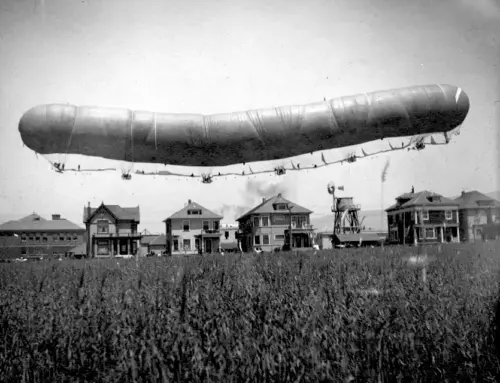
Morrell’s flashy claims of a revolutionary coast-to-coast rapid transit machine allegedly sold 250,000 shares of stock in a hotdog-shaped 450 foot gas balloon. It launched in Berkeley, California on May 23, 1908, after San Francisco had banned it. Source: The Jive Bomber
Summary
Defer any strategy, procurement, or risk decision that rests on the Claude Mythos capability claim until July 6, 2026, when Anthropic’s promised report is due for independent review. The claim is that Mythos is too dangerous to release. The record runs the other way.
Of 23,019 vulnerabilities Mythos reported, it showed only 75 fixes. Holding back the fixes slows validation of findings. Independent teams nonetheless reproduced the showcase findings on commodity and open-weight models for a fraction of the price, among them the engineer who wrote the OpenBSD flaw Anthropic featured at launch. The headline accuracy figure covers the 8 percent of findings a human checked, and the data behind the rest stays withheld. Anthropic widened access to roughly 150 organizations and filed to go public, both ahead of the verification the program promised.
Strategic assumption
Through 2026, AI vulnerability-discovery capabilities marketed as frontier-exclusive will remain reproducible on commodity open-weight models, removing the technical basis for premium pricing and restricted-access programs.
The question is whether to pay five times the price for a premium nail gun when commodity nail guns already do the job, while the premium vendor restricts access and justifies the high price by comparing its own tool to a hammer.
Key findings
Of 23,019 vulnerabilities Mythos reported, 1,752 were verified by a human or security firm and fixes have been shown for 75. The 90.6% accuracy rate in press coverage applies to a human doing the work, not the large numbers from a machine alone.
The flagship discovery used to claim novel risks (FreeBSD CVE-2026-4747) is a 2007 fix for shared code that sat with a patch waiting to be applied. The fix was present in the model’s training data, making the result consistent with recovery from the backlog of delayed fixes rather than novel discovery.
Eight of eight open-weight models reproduced the detection capability, one at $0.11 per million tokens. On June 8, 2026, Glasswing launch partner Cisco ran six frontier models across 1.8 billion lines of code and showed results do not depend on Mythos.
No reproduction steps were published with the Anthropic launch blog, the system card, or the Glasswing update, meaning premium claims cannot be independently verified.
Anthropic has meanwhile filed confidentially for an IPO near a one-trillion-dollar valuation and expanded Glasswing to roughly 150 organizations, committing access and capital ahead of verification.
Recommendations
Treat AI-assisted vulnerability discovery as a commodity input and source it competitively. The showcase results are reproducible at low cost on public models. AI vulnerability harness runs should cost cents per million tokens, not tens of dollars or more. An open-source harness on commodity Haiku 4.5 and Sonnet 4.6 produced eight findings in two minutes for $0.75, two of them matching the Mythos showcase, at the discovery layer. The FreeBSD exploit was reproduced separately by Calif.io on the prior Opus 4.6 model in about four hours.
Do not pay Anthropic a premium or restructure operations on the basis of the Mythos security capability claim until an independent verification exists.
Require any AI security vendor to supply reproduction steps and verified, fixed CVEs rather than model-generated finding counts.
Set July 6, 2026 as a validation checkpoint, and reassess with the Glasswing report published and independently reviewed.
The flagship “discovery” was backlog recall
CVE-2026-4747 is a valid stack buffer overflow in FreeBSD. The code is a University of Michigan implementation that was patched by MIT in 2007. FreeBSD imported the unpatched code in 2008 and never applied the fix. This 2007 patch is present in the model’s training data, so the Mythos published exploitation demonstration took an old vulnerable operating system with a known missing patch and pointed at it. The result demonstrates how a known, undefended target can be flagged by AI, rather than discovery of anything unknown.
The danger warnings are much thinner than advertised. Mythos did send an email out of its sandbox to flag a bug, but only after being instructed to try, it showed no sign of altering its own weights, and prior models such as Opus 4.6 find these same flaws.
Discovery is reproducible at commodity cost
The CVE explanation should help clarify why independent parties have repeatedly reproduced the showcase findings on very inexpensive public models. AISLE confirmed the FreeBSD detection with eight of eight open-weight models, showing $0.11 per million tokens was a sufficient cost model. Vidoc reproduced it on the public Opus 4.6 model and on GPT-5.4. Cisco’s June 8 assessment across six frontier models showed the outcome is model-independent. The curl maintainers reported no change to their workflow, and Mozilla’s headline of 271 Firefox vulnerabilities reconciles to roughly three against the advisory record. Discovery at this level carries a published, commodity cost.
Niels Provos, who committed the 1998 flaw in BSD that Mythos used for their “discovery”, reproduced that finding and autonomously surfaced new zero-days using Opus 4.6, Sonnet 4.6, and the open-weight GLM 5.1 on his own open-source IronCurtain harness, concluding that discovery is an orchestration problem rather than a frontier-model one. Then clearbluejar ran the same class of pipeline on two open-weight models on a single consumer GPU and recovered CVE-2026-4747, finding that their scaffolding, again not the model, did the hard work.
The premium is unjustifiable as presented
Anthropic prices Mythos at roughly five times its public Opus model, from $25 to $125 per million input and output tokens, on the strength of exploit development rather than discovery. No replayable exploit with reproduction steps accompanies the launch blog, their very large and inefficient 244-page system card, or the late-May Glasswing update. A buyer cannot confirm the capability they are paying for, and the available reproductions indicate the defensible cost is a fraction of the quoted price.
Results are self-assessed, data is withheld
Anthropic’s interim Glasswing update reports results in stages that have undermined their own headlines.
Stage
Figure
What it represents
Total findings
23,019
The model’s ungraded output
Estimated high or critical
6,202
The model’s own estimate
Checked by a human or firm
1,752
28% of the high-critical pile, about 8% of the total
True positives among those checked
90.6%
A statement about the 1,752, not the 23,019
Fixes shown
75
Out of 23,019
The 90.6% accuracy figure is from humans. The rest is just the model assessing its own output. Anthropic has also withheld the fixes used to derive the findings, the artifacts that would allow independent re-derivation. A result that can be validated only against the system that produced it, does not rise to the level of independent confirmation of its capability.
Extractive disclosure structure
The disclosure architecture inverts established norms, and economics are the reason why. Anthropic commits up to one hundred million dollars in model credits to a consortium of about a dozen large firms. The consortium attests to the capability that justifies restricting the model to the consortium, and the same firms sell the products and services that follow from that attestation. A rushed “emergency” memo about Mythos risks crediting 250 CISOs was apparently curated by security vendors who would capitalize on myths about machine risks. The most consequential findings instead have come from humans during the Glasswing period: the Palo Alto vulnerability that triggered a federal mandate was attributed to attackers operating in production. It was excluded from the company’s AI-credited count. Findings are directed to Anthropic while fixes fall to volunteer maintainers, even as the patch-generation step that a model can automate already runs in production for paying customers. Anthropic’s Claude Security product patched more than 2,100 vulnerabilities in three weeks for paying customers, while the open-source projects apparently have only received reports.
Market motivations
On June 1, 2026, Anthropic filed confidentially for an initial public offering following a funding round near a one-trillion-dollar valuation. On June 2, it expanded Glasswing to roughly 150 organizations across more than fifteen countries, covering power, water, healthcare, and communications. Access widened and capital was committed before any independent validation of the capability, and before the report Anthropic itself promised.
Several firms now trialling Mythos, including Google, Nvidia, and Cisco, are Anthropic investors, and Goldman Sachs, Morgan Stanley, and JPMorgan are reported to be in talks to underwrite the offering. The parties certifying the capability are the parties whose returns depend on it.
Outlook
Anthropic committed to a public report within ninety days of the April 7 launch, due around July 6, 2026. However, the question of novelty has been repeatedly answered. With each reveal, Mythos has failed to prove its initial claims. A report containing a verified CVE list with reproduction steps would substantiate the capability claim and the program’s premise. A report that restates model-graded headline figures without independent verification would confirm the pattern described here.
The prudent posture is to treat their unproven capability as unproven.
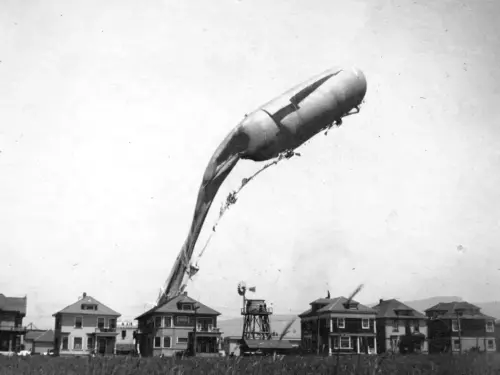
Morrell’s airship rose about 300 feet and then ripped apart and crashed, shortly after it’s first launch on May 23, 1908. Source: The Jive Bomber
Project Glasswing: An initial update, Anthropic, late May 2026. Source of the 23,019 / 6,202 / 1,752 / 90.6% / 75 figures and the 90-day disclosure convention.
References: independent reproduction and refutation
AISLE reproduction: eight of eight open-weight models detect CVE-2026-4747, one at $0.11 per million tokens. Documented in references 1 and 10.
Vidoc reproduction on public Opus 4.6 and GPT-5.4. Documented in reference 10.
Nicholas Carlini’s personal confirmation that he found CVE-2026-4747 using Mythos Preview, placing it outside his February 5 paper. Documented in references 3 and 10.
Cisco frontier-model assessment, six models across 1.8 billion lines of code. Documented in reference 15.
Palo Alto Networks May 2026 Defender’s Guide and the CVE-2026-0300 advisory, with the federal-mandate CVE attributed to attackers in production and excluded from the AI-credited count. Documented in reference 12.
Mozilla Foundation Security Advisory 2026-30 (Firefox 150) and Bobby Holley, “The zero-days are numbered,” Mozilla blog, April 21, 2026. Documented in reference 7.
Claude Mythos Preview system card (244 pages), Anthropic. Documented in reference 1.
Finding Zero-Days with Any Model, Niels Provos, April 29, 2026. Reproduced the OpenBSD SACK finding and surfaced new zero-days with commercial and open-weight models on the open-source IronCurtain framework.