
Category Archives: Security

Proposal: Billionaire Realization Obligation on Tax-Avoiding Xtraction

Proposal for the BROTAX Act

Purpose

To treat borrowing against appreciated assets by the wealthiest taxpayers as a realization of gain, to end the stepped-up basis at death for those taxpayers, and to require lenders to report securities-backed credit.

Findings

  1. The Internal Revenue Code taxes capital gain only when an asset is sold.
  2. Taxpayers holding concentrated positions in appreciated stock obtain cash by pledging that stock as collateral for loans. Loan proceeds are excluded from income.
  3. These loans are commonly carried until death, when section 1014 resets the basis of the collateral to fair market value and the gain that secured the loan is never taxed.
  4. The 25 wealthiest Americans paid federal income tax equal to 3.4 percent of their wealth growth between 2014 and 2018, according to IRS records obtained by ProPublica. One of them paid no federal income tax in 2018 while pledging tens of billions of dollars in shares as loan collateral.
  5. Section 1259 already treats a hedge that locks in gain on an appreciated position as a sale. Borrowing against the same position converts gain into spendable cash and merits the same treatment.
  6. The combined effect of these provisions makes capital gains tax elective for the wealthiest taxpayers.
  7. Closing the borrowing loophole for households above $100 million in net assets would raise more than $100 billion over ten years, according to Fox and Liscow, 182 Tax Notes Federal 647 (2024).

Section 1. Covered Taxpayers

This Act applies to any individual whose net worth exceeds $100 million on the last day of the taxable year. Net worth includes assets held through grantor trusts, non-grantor trusts the individual funded, partnerships and corporations in which the individual holds a controlling interest, private foundations under the individual’s control, and the assets of a spouse.

Section 2. Covered Loans

A covered loan is any transaction in which a covered taxpayer receives cash or cash-equivalent value and retains economic exposure to an appreciated asset that secures or is economically linked to the transaction. Covered loans include securities-backed lines of credit, margin loans, prepaid variable forward contracts, equity swaps, repurchase agreements, and loans from related parties or foreign lenders. The Secretary shall apply this definition according to the economic substance of the transaction.

Section 3. Realization on Borrowing

(a) Proceeds of covered loans drawn during a taxable year, in excess of $1 million, are treated as an amount realized from the sale of the pledged assets on the date drawn.

(b) The gain recognized equals the lesser of the proceeds drawn and the built-in gain in the pledged assets. Gain is taxed under section 1(h).

(c) The basis of the pledged assets increases by the amount of gain recognized. Where multiple assets secure the loan, basis is allocated in proportion to built-in gain.

(d) Repayment of a covered loan produces no deduction and no reduction of basis.

(e) Interest on covered loans is excluded from the deduction under section 163(d).

Section 4. Carryover Basis at Death

Section 1014 shall not apply to property acquired from a decedent who was a covered taxpayer. Such property takes the basis it held in the hands of the decedent. Chapter 11 estate tax continues to apply.

Section 5. Reporting

(a) Any lender extending a facility secured by securities with a balance or commitment above $1 million to a covered taxpayer shall file an annual return with the Secretary showing draws, repayments, outstanding balance, and collateral.

(b) A covered taxpayer who borrows from a lender that files no return loses the exemption under section 3(a) for that loan.

(c) Trusts, partnerships, and corporations attributed to a covered taxpayer under section 1 report their covered loans to the individual.

Section 6. Transition

Covered loans outstanding on the effective date are treated as drawn in five equal annual installments beginning in the first taxable year after enactment. Any renewal, extension, increase, or refinancing of an outstanding facility is treated as a draw of the full balance on that date.

Section 7. Constitutional Basis

The tax under this Act attaches to a transaction in which the taxpayer received money. The taxpayer elected to convert appreciation into cash. Congress has the power under the 16th Amendment to tax income from whatever source derived. In Moore v. United States (2024) the Supreme Court upheld a tax on income realized by an entity and attributed to the taxpayer who held the economic interest. Section 1259 has operated on the same principle since 1997.

Section 8. Effect

A founder who wishes to retain control of a company retains it. A founder who wishes to spend the appreciation pays the tax a seller pays. In 2020 the chief executive of Tesla pledged $57.7 billion in shares as collateral for personal loans. Under this Act, each dollar drawn against those shares is taxed in the year of the draw.

Section 9. Revenue

The Joint Committee on Taxation shall score this Act before floor consideration.
Trump’s Hack Back Overdue: Dutch Firm Shows How to Active Defense Right

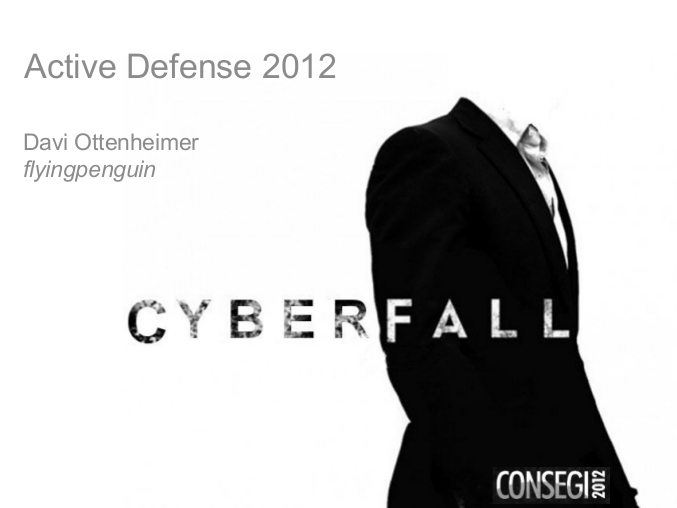
A Dutch security firm pushed code with full system privileges onto roughly three million computers belonging to strangers, then published every domain, file hash and host count it touched. This sentence could not have been written a decade ago, because for some it was a nightmare scenario. Today, however, Eye Security calls it their Operation IXIM. It ran from November 2025 to March 2026 with advice from the company’s lawyers. It is the clearest case I have seen so far of public discussion of active defense done to a standard. That standard, if I may say so myself, is the one David Willson and I put on stage repeatedly in 2012. For example, I posted the CONSEGI deck from Belém, Brazil in December 2012.

The United States this year generated a lot of bluster with a memorandum. On 12 August the White House issued Expanding Capabilities to Combat Transnational Cyber-Enabled Crime, directing a National Coordination Center to license vetted companies for “Cyber Surveillance Operations and Cyber Effects Operations” against foreign criminal groups, “exclusively conducted on behalf of and under the supervision of the Federal Government.” It’s almost too comical to read, but the core message was that the operating procedures were due within sixty days. The workflow and the targeting framework were set to be in a classified annex. Participants post a bond of at least one million dollars.

Well, here we are in November. The sixty days ran out on 11 October. The bombastic Trump program officially consists of the memorandum. Oh, and a fact sheet.

Going back in time, I had noticed right away that Orin Kerr five days after it appeared held the memorandum up against the Computer Fraud and Abuse Act. The statute exempts “lawfully authorized investigative, protective, or intelligence activity of a law enforcement agency.” Kerr weighed in to say that a voluntary program, in which a company proposes an operation and the government signs, would be the company’s activity rather than the agency’s. He concludes executive permission is useless against the elements of the statute, like if a police chief tells you it is fine to break into a house. Only a judicial warrant authorizes entry, from where he sits. The memorandum ends up looking like two signatures from co-directors and a classified annex that don’t add up to a hill of beans.

In the meantime, the reality of a Dutch operation landed.

Eye found a process named Updater.exe on a client laptop. It was calling an unregistered domain name. The program belonged to Time4Popcorn, a closed-source fork of the Popcorn Time streaming client, abandoned years ago. Eye registered the domain and received about fifty requests a second. The updater fetched an executable over plain HTTP, checked no signature, and ran it as SYSTEM on Windows and root on macOS. Whoever held the domain held every machine still running the updater, and Eye counted 3.8 million hardware IDs over six months. This was later revised to 2.5 to 3 million Windows hosts and 250,000 to 350,000 Macs after it found cloned disk images and changing hostnames inflating the count. Its IP sample included government, military and corporate networks.

Eye then served an update from the domain they controlled. The update stopped the updater service on Windows and unloaded the launch daemon on macOS. It collected no telemetry and deleted no files. Eye throttled delivery to one update per hardware ID. By December more than a million systems had been updated. By March request volume had fallen 98 percent. Eye then transferred its fifteen domains to the Shadowserver Foundation for sinkholing, published the flaw as CVE-2026-30612 in June, and presented the whole operation at hack.lu on 22 October with the domain list and file hashes attached.

Set that against our 2012 presentations on active defense theory and practice.

The CONSEGI slides framed active defense as four questions asked in order:

  1. necessary: higher likelihood, higher severity, and existing blocks shown insufficient
  2. effective: borrowed from John Snow’s cholera map and from Microsoft’s Project MARS: trace the attack, sinkhole the communications, tag the infections, shut down command and control
  3. safe: proportionality, bystanders, escalation, reputation and lawsuit, each weighed as consequence against probability
  4. legal: (slide 37) who has the job of defense, who defines what is reasonable, and when a higher authority declines the job, whether you are responsible to defend yourself and under which laws

Or to put it another way:

2012 gate Operation IXIM
Necessary: current blocks insufficient Abandoned updater, root privileges, plain HTTP, vendor gone
Effective: trace, sinkhole, shut down Registered the domains, served the disabling update, handed the domains to Shadowserver
Safe: proportionality, bystanders One action per host, no telemetry, no deletion, counts revised downward and published
Legal: who defines reasonable Company counsel, with Ladybird cited as precedent

The last row is where IXIM diverges. Eye cites Operation Ladybird, in which Dutch police used seized Emotet servers in January 2021 to push an update that uninstalled the malware on 25 April. Ladybird ran on police authority inside a judicial operation. IXIM ran on a company’s legal advice.

Two private firms faced the same decision before Eye and went to a prosecutor. Avast found a flaw in the Retadup command protocol in 2019 and handed its disinfection method to the French Gendarmerie, which waited for prosecutor approval before 850,000 bots were made to self-destruct. Sekoia bought the abandoned PlugX command server for seven dollars in 2023, counted some 2.5 million infected hosts, had a working self-delete command, and published a request for courts and CERTs to ask for it. The Paris prosecutor supervised the cleanup and the FBI took nine warrants for the American machines. Eye had that option and chose its own counsel.

Eleven antivirus vendors flagged Eye’s payload as malware. Eye rewrote the code until one vendor still detected it, and wrote that it was “a little offended by the word malware.” It wasn’t the usual definition of malicious, after all. A SYSTEM-level payload tuned to pass antivirus, delivered to three million machines, with in-house counsel as its only authority. The Safe and Legal parts are self-attested. Eye published a world map of the hosts and no country split, so some share of the three million sits in the United States, where the statute Kerr describes still applies to a Dutch firm.

Our 2012 presentations would end with two requirements for the job: technical capabilities, and a legal framework with guidelines.

Eye brought the first and improvised the second. The memorandum in America would only get you the second, but we’re past its own deadline and have nothing visible to show for it. Kerr’s version of it is that it doesn’t matter anyway. He kind of reminds me of letters of marque being a major critique of active defense, because of attribution, proxies and liability. The White House published the worst bits of a marque structure, bonded contractors proposing their own targets from threat data they buy, and expects a classified annex to move the discussion?

Google’s XCPE action in late October is also worth a mention, but for the opposite reasons. Google used legal action against the domains and servers controlling 1.3 million backdoored Android TV boxes. The malware shipped on devices that passed Google’s certification tests, because Videostrong loaded it after first boot to evade them, and it stays on every box. Google’s head of disruption operations told The Record the severed domains were “effectively rendering the malware benign.” That is the warrant route Kerr likes, but look at the inversion of safety. The certification gap was Google’s own, and Google’s remedy stopped at the point where it would help the device owners. Eye’s clearly stepped in to defeat the harm.

Here is the past decade of publicly discussed attempts to remove or disable a threat on other people’s machines, with what authority.

Case Authority
Wifatch, 2014 to 2015, tens of thousands of routers and cameras Anonymous author. None.
Hajime, 2016 to 2017, IoT devices, left its own backdoor Anonymous author. None.
BrickerBot, 2017, bricked IoT devices outright Anonymous author. None.
Retadup, 2019, 850,000 Windows machines French prosecutor and Gendarmerie C3N. Avast built the tool.
Ladybird (Emotet), 2021 Dutch and German police, Europol.
Hafnium web shells, 2021 US court order, FBI.
Cyclops Blink, 2022, WatchGuard devices US court order, FBI.
Qakbot, 2023, 700,000 machines US court order, FBI with European police.
Mozi kill switch, 2023 Unknown. Signed with the operators’ own key.
KV-botnet and Raptor Train, 2024, SOHO routers US court orders, FBI.
PlugX, 2024 to 2025, ten countries plus 4,258 US machines Paris prosecutor and C3N, then nine FBI warrants. Sekoia built the tool.
XCPE, 2026, 1.3 million Android boxes Civil legal action by Google. Stopped at the servers.
IXIM, 2025 to 2026, about three million hosts Eye Security’s own lawyers.
Trump memorandum program, 2026 DOJ and DHS co-directors, classified annex. No operation on record.

Ladybird had police behind it and XCPE used a court. But it was IXIM’s corporate lawyers who met the 2012 standard from necessity through disclosure. The program written by team Trump to put a federal signature on that kind of work has been completely outclassed by European innovators, which is no surprise to this old hand.

SatNav Degradation to NATO’s East: When the Poof is the Proof

There’s a map of aircraft reports for Nov. 3 going around on social media right now because it shows satellite navigation degraded along nearly the whole of NATO’s eastern border.

From Kaliningrad through Lithuania, eastern Poland, Romania and Bulgaria to the western Black Sea, signals were affected. ItaMilRadar built it from AirNav Radar data and Defence Blog published it as if an imminent threat indicator. The map does, in fact, record where aircraft lost their accuracy. The jammer locations and direction, however, are not present. Nonetheless, this map generated claims that it was from Russia after they stood up a 1,500 km electronic wall on the border. The Midgard OSINT Review checked that claim against the data and reported a surge on a strike night. In other words, stray drones are the actual risk, while device details remain unknown.

The attribution fog of war is the actual story here, perhaps ironically for a jamming night.

Russian electronic warfare at Kaliningrad, St. Petersburg, Smolensk and Rostov jams to push swarms of Ukrainian drones off course. Flank states also run counter-drone jamming to bring down strays. An aircraft receiver in that region reports the same degraded signal either way, with no bearing to the source, so one map is everything at once. An aircraft sees a single problem, which means it shouldn’t attempt to point in either direction without additional work.

Defense right now adds to the fog as a side effect, which means the case stays open against an adversary who considers an open case to be a win.

When the poof is the proof, attribution costs suffer from inflation.

Death by Petard Award: “The Claude app by anthropics is requesting updated permissions”

In the Roman Republic, as Polybius wrote, a sentry’s “watchword” was written on a wooden tablet, and then passed hand to hand up each street of the camp with witnesses at every handoff. Clever, no? Every tablet had to be back with the tribune before dark. A missing tablet was easily traced to the specific relay team, under a specific unit leader. A sentry who was found asleep was tried by the tribunes and punished severely. Polybius says the watches held because the penalty was certain, and the fault was accurately assigned. The severity is the part that usually sticks with people, because it shocks the senses. But accuracy and certainty is what actually made it work. And on that note, the certainty is the part that is easiest to replicate today.

When you look at GitHub today, you have to wonder if nobody in the whole organization studied any history. The user interface hands each installation admin a tablet that represents everything, and therefore nothing: the whole camp may as well be charged with whatever happens, meaning nobody reliably will be held to account.

Take for example how an “application permission” email will be sent from GitHub.

What? Who? Where?

Let’s have a look at one example: “[GitHub] Claude is requesting updated permissions” seems to be going around right now.

A GitHub App, Claude, installed on your account is requesting updated permissions.

Visit https://github.com/settings/installations/ to review and accept or ignore these permissions.

You may choose to ignore this request. If you do, Claude will retain its current permissions.

You can view pending requests by viewing your Apps settings page.
https://github.com/settings/installations

If you run into problems, please contact support by visiting: https://support.github.com/contact?tags=dotcom-integrations

Thanks,
Your friends at GitHub

With friends like these, who needs Romans?

Eight permissions are in the GitHub interface, with a vendor badge and reference and one sentence of explanation for the lot. This particular vendor, should you be bothered to look, has published research on approval fatigue, the exact failure this design produces. The request for updated permissions is nearly impossible to untangle. Five scopes are new. Three are upgrades from read to write. And the “developer note” at the bottom says: “Allow the Claude Apps to automatically create repositories when desired.” That sentence explains one scope. The other seven get… nothing.

GitHub sends this kind of email automatically whenever an app’s permission manifest is changed. GitHub’s documentation says the installer may approve or decline. A declined app keeps its old permissions and keeps doing what it did; whatever needs the new scopes fails, and the installer is told only that it “may not function as expected.” The choice is all or none, with uncertainty pressed firmly onto the none side.

The eight, as they appeared:

  • Administration, read
  • Merge queues, read
  • Repository creation, read and write
  • Webhooks, read and write
  • Commit statuses, read
  • Actions, upgraded from read to read and write
  • Checks, upgraded from read to read and write
  • Organization members, read

Anthropic publishes material on just two of them. The enterprise-server setup guide says webhook write creates a hook on a plugin marketplace repository when automatic sync is turned on, and organization member read checks a connecting user’s role when an installation is linked. The plugin support article confirms the webhook purpose.

The remaining six? Pound sand.

This is the second such email from Anthropic alone this year. In March the app asked for Checks write, with Administration and Merge queues read alongside, and a user filed an issue saying the first thing they assumed was a credential leak. Anyone who declined in March sees those same scopes again in November, stacked on top of the new ones, because GitHub shows the gap between what an installation approved and what the manifest now asks for.

Reasonable assumption, which opens Pandora’s box of operator confusion and fatigue from poor authentication prompt hygiene.

The explanation in that thread was based on text that was said to be from Claude itself. In May a GitHub organisation admin opened a community discussion after the same app sent the same kind of request, asking for per-scope approval, and documented that revoking a single scope after approval requires uninstalling the app, and reinstalling presents the same bundle again.

Just for some perspective, Cursor sent the same email to its users ahead of a review feature. AWS did too in 2024.

This is not a good look for the industry, especially as we know how to do this better.

As I already mentioned, Anthropic has itself published notes on what’s wrong with what Anthropic is doing to its users. In its engineering post on Claude Code auto mode, Anthropic reports that users approve 93% of permission prompts, and that over time this produces approval fatigue, where people stop reading what they approve.

I said as much about this topic in the book I co-wrote in 2012 about cloud security threats. I mean, nothing here is a surprise or new to anyone who has even a few years of real security experience.

Anthropic built classifiers to intercept threats inside the terminal. Meanwhile, it sent the GitHub version of a bad prompt design to every installation admin. The GitHub prompt is through email, completely outside any classifier or sandbox. And then the approval is account-wide and sticky.

If you are already thinking about phishing surface, well done. GMO Flatt Security reported to Anthropic in January that anyone can register a GitHub App, install it on a repository they control, and use its token to open issues on any public repository. Registering an app named Claude with a similar icon and sending this template is kids play. Every email Anthropic sends with a one-line note is pushing the kind of fatigue on its installers that greases them to click through a fake one.

Ok Anthropic, let’s get real. You know the risks. You know the harms. You know better.

You published all this yourself. Does the left hand know what the right is doing?

A vendor that measures approval fatigue in one of their products as a bad thing and manufactures it in another of their products… has a governance failure. Anthropic publishing the harm research and then setting it off under its own installers is evidence the company needs some serious security leadership reconfiguration.

Customers’ repositories deserve better than a sapper blown up by his own charge.

The fix is clear and cheap, which is what makes this a governance (and history education!) failure rather than an engineering one. A changelog entry per scope, published before the manifest changes, stating which feature uses it and what stops working when it is declined. The email links to it.

Done.

Beyond that, one app per capability. Code review, cloud sessions, security scanning and plugin sync carry different scopes. An installer who turned on one should approve the scopes for one. If the tablet has everything and everyone on it, it effectively has nothing and nobody to hold accountable.