Category Archives: Security

Blonde Greek Gods for Kids: Playmobil’s Nazi Aesthetic Explained

A Bavarian toy company called Playmobil is selling blonde haired Greek gods to children through a charity, and nobody seems to find the Nazism origin story strange?

Headquartered in Zirndorf the company launched its “History” line of Greek mythology figures in 2016. The series now includes all twelve Olympian gods, Alexander the Great, Achilles, the Argonauts, and Heracles.

Hermes – 9524: blonde.

Artemis – 9525: blonde.

Alexander – 70950: blonde.

Apollo – 70218: blonde.

Hera – 70214: blonde

Demeter – 9526: blonde

Aphrodite – 70213: blonde

The entire Greek pantheon are presented as Nordic blondes. Originally, the figures were produced exclusively for the Greek market, sold at the Acropolis Museum gift shop in Athens and Greek toy stores, allegedly with proceeds going to the Orama Elpidas (Vision of Hope) bone marrow donor association.

In case you don’t recognize that twist, there’s a known tradition of groups who weaponize charity. Their atrocities become harder to criticize. It’s the foot in the door to normalize harms.

That’s how this disinformation campaign pivoted from its start in Greece back to Germany, even though Germans should know better. The Pergamon Museum, for example, as a monument to German archaeological extraction from Turkey, Iraq, and the ancient Near East sells the blonde Greek gods alongside displays of the looted friezes and gates.

It’s an appropriation loop closed tight.

The architecture doesn’t change

The Nazis were addicts of such appropriation. They did not invent a “fair Apollo” trope, but they forever weaponized the existing ones. Classical studies of “whitened” antiquity became central and integrated into ideological education set forth by Hitler.

Alfred Rosenberg, the Nazi regime’s chief ideological theorist, laid out the “blonde blueprint” in The Myth of the 20th Century (1930).

Playmobil perhaps knows: the Greek gods were appropriated and reframed to “represent the Aryan white ideal of their race.” Apollo symbolized Nordic virtues of “pure thought and rationality”. The fabricated “true Greeks” were the Achaeans and Dorians, who Rosenberg claimed were “of Nordic-Germanic descent” and “the ones who created the magnificent Greek culture.” He went so far as to say darker-skinned Mediterranean populations were, in his racist hierarchy, contaminated by “Pelasgian and Semitic origins.”

Rosenberg rewrote Heracles and Jason as “representations of the ideal Aryan Nordic masculine type” no longer Greek. The Nazi tribalist Gunther classified Plato himself as “a pure-blooded aspect of the northern blood of primitive Hellenism.” Friedrich Hildebrandt declared Plato “a teacher for our time” whose ideal state prefigured the racial hierarchy of National Socialism, completely ignoring Plato’s actual work.

This was an extremist racist fringe becoming state doctrine, taught in German schools, promoted by the regime’s most toxic intellectuals, and backed by the full apparatus of the Third Reich’s cultural production machine for genocide.

Did this German effect on classical studies experience denazification after Hitler’s suicide? No. While racial theory collapsed, the discipline infrastructure remained intact. Those who had served dutifully to enact genocide remained in position, continued teaching and curating the “blonde blueprint”.

Denazification screened for party membership cards, not for intellectual content. Steven Remy’s The Heidelberg Myth (Harvard, 2002) documents how it actually worked: Karl Heinrich Bauer, an outspoken supporter of Nazi sterilization law, became Heidelberg’s first postwar rector — then used the position to reinstate compromised colleagues. The university remained dominated by former Nazis throughout the 1950s. Professors constructed what Remy calls “elaborate narratives of defense and justification” to absolve themselves, while continuing the same research programs, the same curricula, the same visual conventions.

At Göttingen, many professors simply lied on their questionnaires. A 2025 review in the Bryn Mawr Classical Review concluded that the history of humanities at German universities under Nazism “was not a deviation from its true mission, but a continuation of traditions that had existed before.”

The traditions continued after, too.

Albert Norden’s 1965 Braunbuch documented 1,800 former Nazis still holding high-ranking positions across West German state, economy, administration, army, justice, and science.

Bettina Arnold’s research on Nazi archaeology documents that instructional posters produced under the Third Reich, depicting ancient peoples as tall, muscled, with blond hair and light eyes, continued to be used in Germany after 1945. The blonde Greeks weren’t flagged because they weren’t swastikas. They were just how the discipline depicted antiquity.

The Fragebogen asked who you were in the party. It never asked if you were teaching heavily corrupted classics.
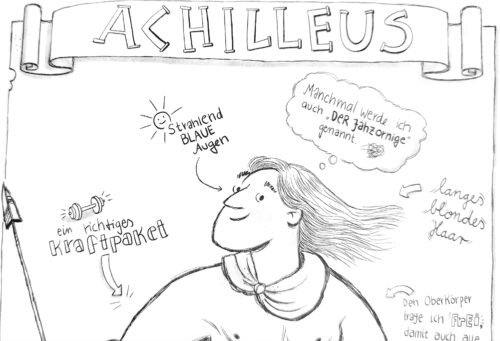
German children’s book in black and white emphasizing “Achilles…blue eyes and long blond hair”. Source: “Ich, Zeus, und die Bande vom Olymp – Götter und Helden erzählen griechische Sagen” by Frank Schweiger.

What evidence actually shows

The proof of Nazis being wrong isn’t necessary, given their self-described supremacy over facts, but we do it anyway.

A 2017 study on the genetic origins of Minoans and Mycenaeans found both populations shared roughly 75% of their ancestry with early Neolithic farmers from Anatolia, with additional ties to the Caucasus and Iran. The Mycenaeans had a small northern European genetic contribution of around 10-15%, so their genetic makeup remained predominantly Mediterranean and Near Eastern.

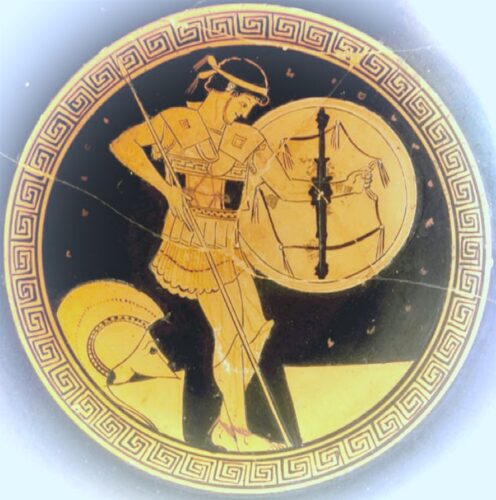
Ancient Greek art consistently shows this. Mycenaean frescoes, Greek pottery, mosaics, and sculptures overwhelmingly depict figures with dark hair and dark eyes. Minoan men at Knossos appear with long dark hair and reddish-brown skin. In addition, modern research has shown Greek statues were vividly painted and not white.
Achilles. Source: Brussels Royal Museum of Art and History

Homer, just one of many storytellers, used “ξανθὸς Ἀχιλλεύς (“xanthos Achilles”). He was marking the man as exceptional and shocking. In other words, he’s saying Achilles is radiant as in light, heroically visible and physically striking. Calling something light therefore blond, is like calling a candle flame or the sun yellow. It’s not actually how anything works. Light isn’t yellow, it’s luminous across a rainbow. Homer was describing something in the way it draws attention because it catches light, something radiant. Imagine writing “he was brilliant” and having a toy designer make him blond because… brilliant means blonde. Nope.

Several Greek gods were explicitly described as dark-haired in ancient sources. Poseidon, Hades, and Dionysus were called kyanokhaitis — “dark-haired,” with the “kyan” referring to a blue-black color. Poseidon’s dark hair correlated with the sea. These weren’t peripheral figures.

Even the Antiquipop academic review of Playmobil’s Greek sets noted diplomatically that “the skin colour of the characters remain quite uniform and white for Mediterranean people.”

They could have said Hitler directly influenced their interpretation. Nazism radicalized embedded Greek antiquity and Germany has retained this radicalism as an aesthetic convention.

Mass-market products continue flattening Greek history through Northern European mysticism.

The transaction

Period / Source Aesthetic Signal Ideology / Notes
18th Century: Johann Joachim Winckelmann White marble, “noble simplicity” Emerging template of heroic “light features” in classical antiquity
19th Century: Neoclassical painters & sculptors Golden/blonde hair on Greek/Roman figures Visual grammar spreads across European art and pedagogy
1930s-1945: Alfred Rosenberg / Nazi theorists Blonde, blue-eyed Greek heroes Explicit racialization: “True Greeks = Aryans”; ideological education & propaganda
Post-1945: German textbooks & museum displays Blonde classical heroes Nazi ideology purged, aesthetic remains embedded in pedagogy and museums
2016–2026: Playmobil Greek mythology figures Blonde Olympians & heroes Commercialized Nazi aesthetic; packaged as charity-friendly; displaces reality

Rosenberg’s racial theory for Hitler stripped of its explicit ideology, laundered through ninety years of “that’s just what heroes look like” visual grammar — sits on a shelf next to the cash register at the Pergamon Museum.

Nobody at Playmobil’s Zirndorf headquarters needed to read The Myth of the 20th Century. The Nazi aesthetic was so thoroughly untouched in German cultural production that blonde-equals-heroic just feels natural. Unremarkable. Default. That’s how successful cultural appropriation works: it makes itself invisible.

The charity shield

The “Play & Give” branding is worth examining as a structure, not just a partnership. Playmobil Hellas has donated over €80,000 to the Orama Elpidas association through this program. The cause is real. Children with cancer need bone marrow donors.

But wrapping racially coded cultural products in charity branding creates a shield that deflects criticism. Who wants to be the person attacking a toy that helps kids with cancer? The structure is elegant: you can’t critique the product without appearing to critique the cause.

This is a pattern that repeats across institutional capture. Wrap the extraction in something nobody can oppose. Philanthropy as packaging. The charity is genuine; the deflection is structural.

What sits on the shelf

It’s 2026. A German toy company is selling blonde Greek gods at a building full of artifacts Germany removed from the lands where those gods were worshipped, and the packaging says it’s for charity.

The Playmobil figures aren’t just bizarrely blonde “for fun”; they exist inside a long, persistent visual grammar that Nazis weaponized, and which survived decades of postwar German cultural production.

The racial theory that made Mediterranean gods look Northern European is ninety-six years old, its author was hanged at Nuremberg, and his aesthetic choices are still moving product.

The product has changed. The architecture hasn’t.

Apple Under FTC Attack From “The Warm-Hearted Protector of the American Press”

FTC Chairman Ferguson’s “warning letter” to Apple CEO Tim Cook on February 12, 2026, threatening enforcement action over Apple News allegedly boosting “left-wing sources,” is state coercion of editorial decisions.

It follows a documented historical pattern with precision.

Ferguson sent an almost identical letter to Alphabet CEO Sundar Pichai in August 2025, accusing Gmail of “partisan filtering” in its spam detection.

Same three-pronged legal threat, same “consumers’ reasonable expectations” language, same implicit enforcement action. He’s clearly pumping a template. Each letter builds momentum for the next target.

The three-pronged fraud Ferguson engages in has been designed to be impossible to satisfy:

  • Prong one says curation “inconsistent with terms of service” violates the FTC Act. But every platform’s ToS grants broad editorial discretion — so this prong only activates when Ferguson decides the discretion was exercised in the wrong ideological direction.
  • Prong two says curation violating “consumers’ reasonable expectations” is a material omission. But “reasonable expectations” of ideological balance in a news aggregator is completely undefined. Ferguson defines what balance looks like. By assertion.
  • Prong three says curation causing “substantial injury” violates the Act. But the alleged “injury” is that consumers received news from sources Ferguson considers left-wing. That’s editorial disagreement reframed as regulatory violation.

This is the state telling a private news aggregator which sources to elevate and which to suppress, under nothing other than his personal threat of federal investigation.

It’s Un-Constitutional

The Supreme Court ruled unanimously in NRA v. Vullo (2024) that “government officials cannot attempt to coerce private parties in order to punish or suppress views that the government disfavors.” The test: whether conduct “viewed in context, could be reasonably understood to convey a threat of adverse government action in order to punish or suppress speech.” Ferguson’s letter meets every element. He holds enforcement authority over Apple. The letter explicitly references potential enforcement action. And it targets editorial curation decisions based on their perceived ideological orientation.

The irony, oh the irony.

The entire Murthy v. Missouri case was brought by Republicans arguing that the Biden administration’s communications with social media companies about misinformation constituted unconstitutional government coercion of private speech. Justice Alito warned in dissent that such pressure campaigns could “stand as an attractive model for future officials who want to control what the people say, hear, and think.” Ferguson is now executing exactly what Alito described — using regulatory authority to pressure platforms into changing editorial decisions based on ideological grievance — except he’s doing it with signed letters on FTC letterhead, which is considerably more explicit than anything alleged in Murthy.

What a Historian Knows

Ferguson’s approach maps precisely onto the early phases of Nazi press consolidation.

The mechanism is not analogy.

This is the structural repetition of Nazism.

Mechanism Nazi Germany (1933-1935) FTC Under Ferguson (2025-2026)
Framing Goebbels introduced the Schriftleitergesetz calling himself the “warm-hearted protector of the German press” Ferguson frames letters as “consumer protection” — reminding companies of “obligations to customers”
Impossible standard Editors required to omit anything that “tends to weaken the strength of the German Reich” or is “misleading to the public by mixing selfish interests with community interests” — undefined, subjectively enforced Platforms must not violate “consumers’ reasonable expectations” of ideological balance or cause “substantial injury” — undefined, subjectively enforced
Regulatory chokepoint Journalists required to register with the Reich Press Chamber to work; the Propaganda Ministry could remove any editor “for pressing reasons of public welfare” Platforms operate under FTC jurisdiction; Ferguson can initiate investigation and enforcement action against any company whose curation he deems ideologically imbalanced
Economic coercion Amann Ordinances (1935) imposed ownership requirements publishers couldn’t meet, forcing sales to the Nazi publishing combine at distressed prices Threat of FTC investigation imposes compliance costs (discovery, legal fees, stock impact) that make algorithmic adjustment cheaper than resistance
Editorial control mechanism Twice-daily Tagesparole from the Propaganda Ministry specified content “down to the headlines and the required epithets” Warning letters specify which editorial outcomes are acceptable; compliance is verified by whether curation outcomes match the regime’s ideological preferences
Personnel capture Editors became de facto civil servants “directly subordinate to the Ministry of Propaganda” rather than their publishers FTC Director of Public Affairs is Joe Simonson, hired directly from the Washington Free Beacon; Bureau of Competition director chosen to target companies that “censor conservative voices”
Escalation sequence 1933: Editor’s Law (content control) → 1935: Amann Ordinances (ownership control) → ongoing acquisitions of non-compliant publishers Aug 2025: Gmail spam filtering letter → Feb 2026: Apple News curation letter → next: search ranking? social media feeds?
Projection Regime accused opposition press of being “Jewish-controlled” and acting against the national interest while systematically capturing the press for party purposes Administration accuses platforms of “censoring conservative voices” while using regulatory authority to coerce platforms into suppressing non-conservative editorial judgment
Compliance effect Hitler complained: “It is no great pleasure to read 15 newspapers all having nearly the same textual content” If platforms adjust algorithms to satisfy Ferguson’s undefined “balance” standard, the result is identical: editorial homogeneity dictated by state preference
The quiet part Amann testified at Nuremberg: “the basic purpose of the Nazi press program was to eliminate all press in opposition to the party” Ferguson’s own pre-appointment materials cite the “removal and demonetization of users who challenge the Silicon Valley political consensus” as a core grievance to be addressed through FTC power

The critical structural parallel is not the end state. We know ICE has been bidding to convert huge warehouses into concentration camps for housing political prisoners, which presumably includes journalists. Already Don Lemon was very publicly attacked and arrested for doing what journalists do.

The parallel is the mechanism: a government official with enforcement authority using vaguely defined legal standards to pressure private editorial operations into compliance with ideological preferences, where the cost of resistance (investigation, enforcement action and potential jail) exceeds the cost of compliance (adjust the algorithm).

Even before the Schriftleitergesetz was formally enacted, German journalists had already become dependent on the regime’s goodwill. The formal law came after the informal pressure had already done its work.

Ferguson’s letters operate the same. He doesn’t need to follow through on enforcement. Apple’s lawyers are meant to calculate the cost of an FTC investigation driven by Trump loyalty and adjust the algorithm. The letter is the initial enforcement.

Trump Asset Architecture

Ferguson clerked for Clarence Thomas. He served as chief counsel to Mitch McConnell, functioning as “judicial confirmation strategist.” He was Republican counsel on the Senate Judiciary Committee. His entire professional life has been spent in the infrastructure of conservative legal movement-building.

His stated purpose, documented in his own pre-appointment materials, is using regulatory power to control perceived ideological imbalances in private media.

His communications director came from the Washington Free Beacon. His Bureau of Competition director was selected specifically to target companies accused of suppressing conservative speech. The FTC’s enforcement apparatus has been staffed for a political mission.

This is what competent complicity looks like at institutional scale: skilled legal professionals who understand exactly what they’re doing, executing a program of editorial coercion through regulatory authority, using consumer protection language as cover for viewpoint-based government pressure on private publishers.

The Weimar Republic had a free press. The architecture of its elimination was not secret. It was documented, prosecuted at Nuremberg, and taught in every competent history program for eighty years.

The Nazi warning signs were the warning letters. So too with Trump.

The technology changes. The architecture doesn’t.

IOC Flies Russian Flag and Bans Ukrainian Athlete Memorial

The pattern is hard to miss. An Italian can compete wearing the Russian flag on his helmet — a flag that’s explicitly prohibited at these Games — with zero consequences.

An Israeli skeleton racer can put the names of terrorism victims on his head.

An American can hold up photos of dead parents in the competition area.

And yet, three Ukrainian athletes were sanctioned. Why? For doing what anyone else seems able to do. It is clear that Ukrainians referencing the 660 fellow athletes and coaches who have been killed are being held to a very different standard.

Vladyslav Heraskevych at the 2026 Winter Olympics, Italy. Source: Alessandra Tarantino/AP

The IOC’s stated objection is that Heraskevych’s act was “premeditated” while others were “spontaneous”, which doesn’t survive contact with reality.

Firestone had his religious memorial cloth custom-made long before the Games. Linton’s helmet was pre-painted. Fischnaller has been wearing a Russian flag for what, a decade already? Every one of these was planned long in advance.

Only Ukrainian athletes are being censored.

Athlete Games Expression Consequence
Smith & Carlos (USA) 1968 Raised fists on podium Expelled
Matthias Steiner (Germany) 2008 Photo of late wife on gold medal podium None
Raven Saunders (USA) 2020 X gesture on podium for “all people who are oppressed” Investigated, no sanction
Gwen Berry (USA) 2020 Raised fist protesting racial injustice None
German hockey captain 2020 Rainbow armband during matches None
Multiple football teams 2020 Took a knee before matches None
Heraskevych (Ukraine) 2022 “No War in Ukraine” sign after final run None
Manizha Talash (Refugee) 2024 Cape reading “free Afghan women” Disqualified
Jared Firestone (Israel) 2026 Kippah with names of 11 killed at 1972 Munich Games. Worn on his head None
Maxim Naumov (USA) 2026 Photo of parents killed in 2025 plane crash, held in kiss-and-cry area None
Jessica Linton (Canada) 2026 Helmet reading “I ski for Brayden” honoring deceased skier None
Roland Fischnaller (Italy) 2026 Helmet displaying Russian flag, which is explicitly banned None
Kateryna Kotsar (Ukraine) 2026 Helmet reading “Be brave like Ukrainians” Banned
Oleh Handei (Ukraine) 2026 Helmet quoting poet Lina Kostenko Banned
Heraskevych (Ukraine) 2026 Helmet with photos of athletes killed by Russia Disqualified

Here’s how Firestone himself explains his Olympic campaign, wearing a memorial to the dead on his head.

“If I weren’t representing Israel, I wouldn’t do it,” he said. “But this is something I’m willing to sacrifice to have Israel there, to have the Magen David on my helmet be seen at the competitions.” Firestone, who became an Israeli citizen in 2019…

He’s not subtle. That’s political expression by the IOC’s own definition, stated on the record, and they didn’t touch him.

Accommodating Russian flags and Israeli political activists, while banning only the Ukrainians who memorialize their dead athletes and coaches, is the story. The IOC allowed 13 Russian athletes into the Games by labeling their appearance “neutral individuals”, while banning Ukrainians from bringing their dead into the games as neutral.

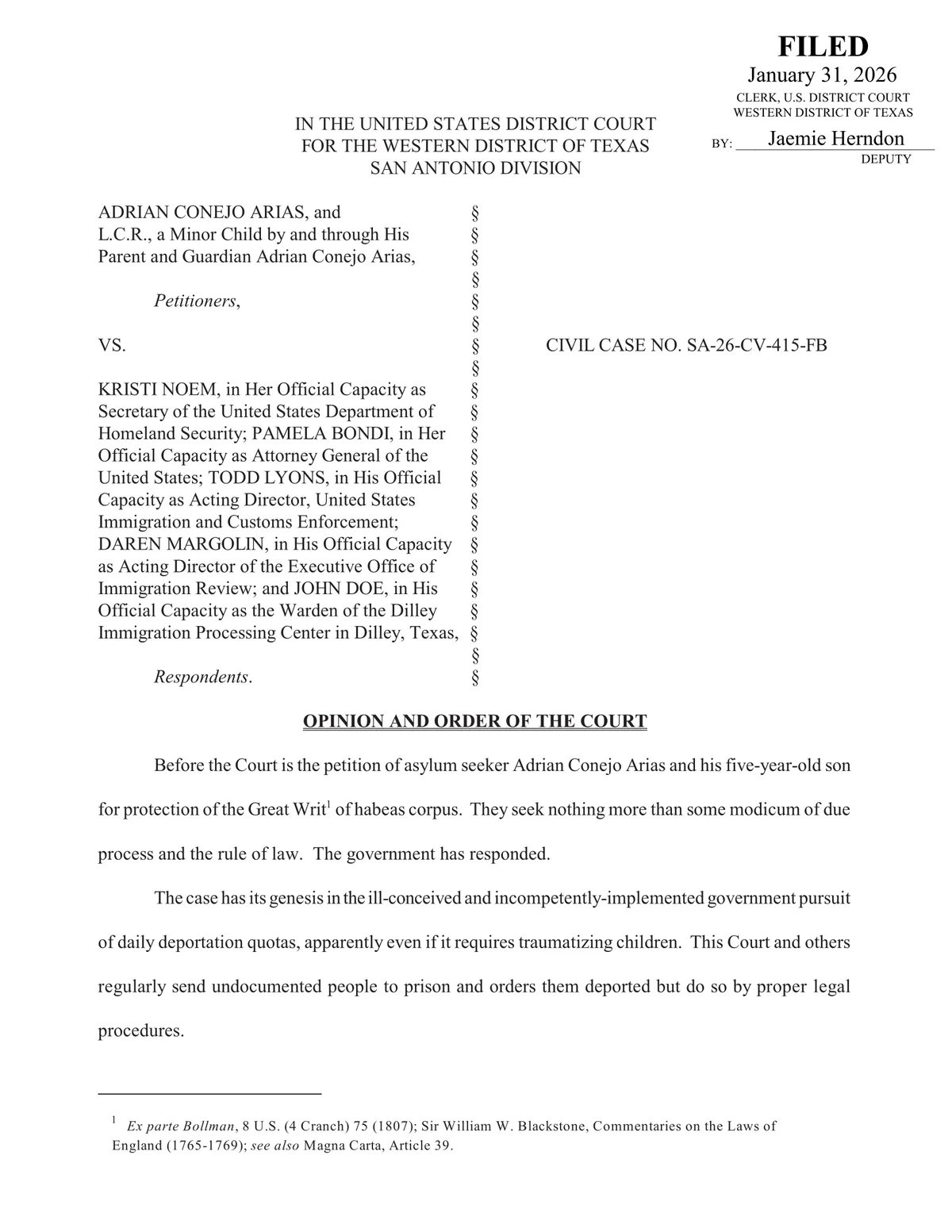
The poem that freed a child from ICE

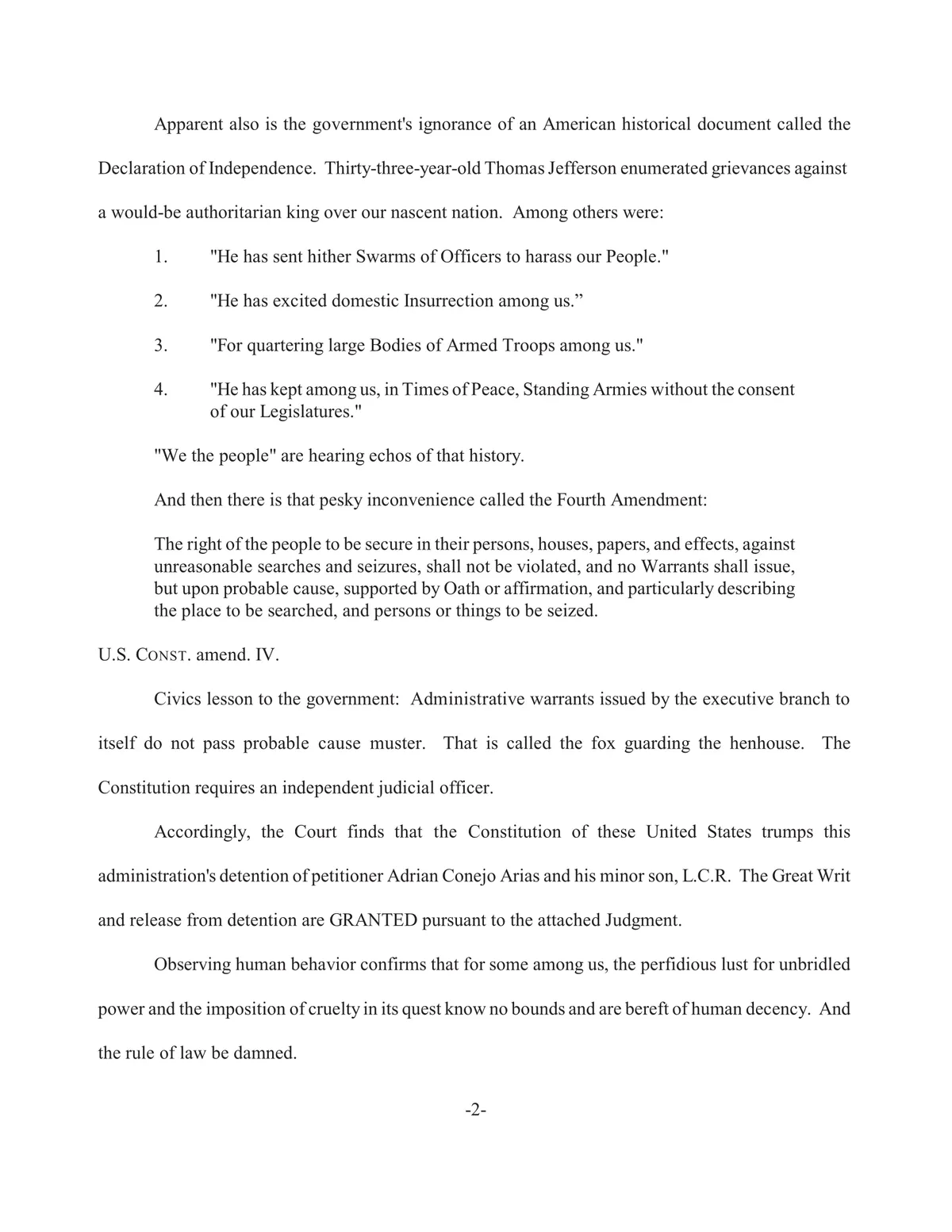
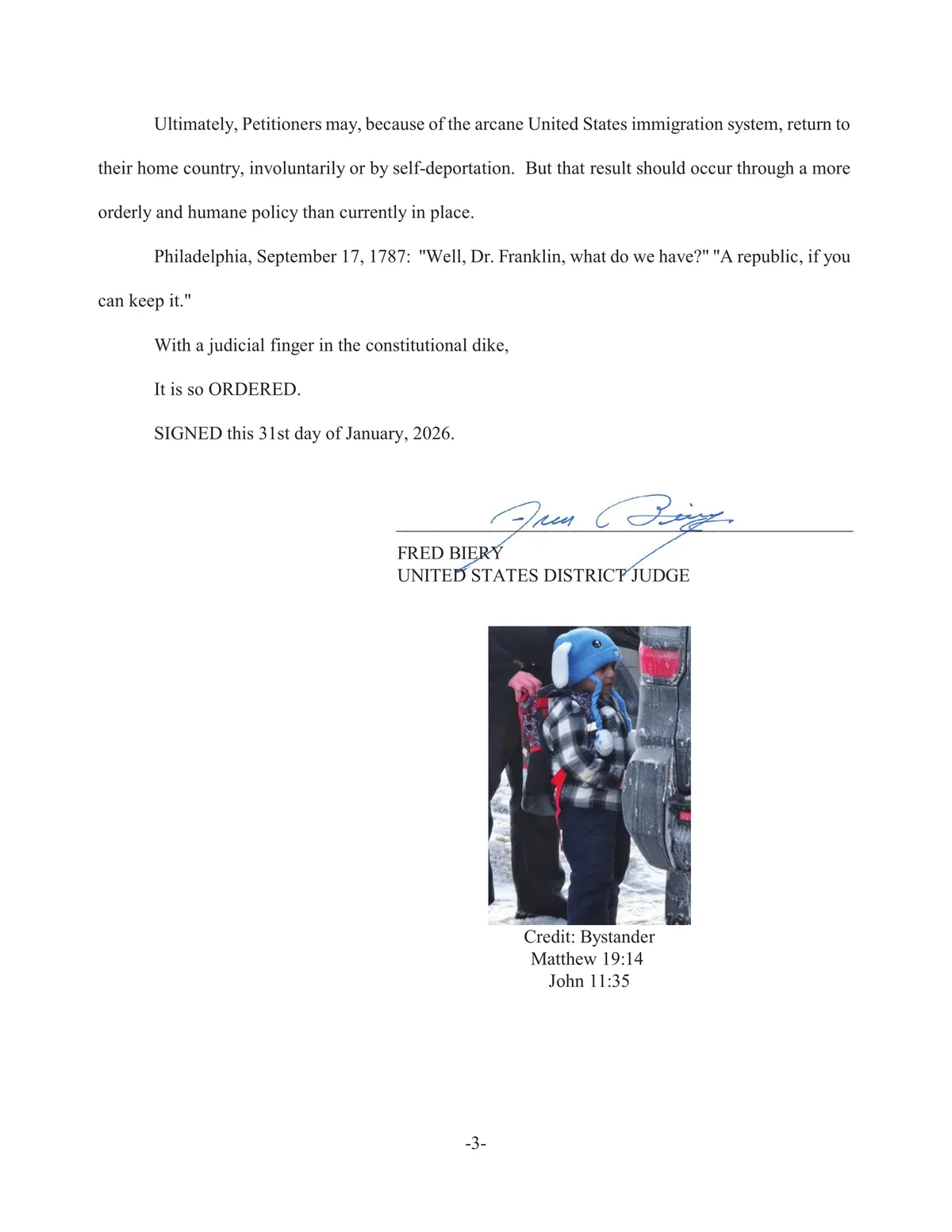
Legal orders free people all the time. Poems move people all the time. Judge Fred Biery’s habeas corpus ruling freeing 5-year-old Liam Conejo Ramos and his father fused the two.

His poem is the operative legal instrument. The literary choices aren’t ornamental; they’re structural to the argument. His use of lowercase “trumps,” the Declaration quotes, the Franklin exchange, the biblical citations all do legal work and poetic work simultaneously.

Most judicial writing that gets called “literary” is literary in addition to being legally operative. Biery’s opinion is literary as the method of being legally operative. The craft is the argument. Strip the allusions and wordplay and you don’t just lose style, because you lose the constitutional reasoning.

His point is that the entire weight of Anglo-American legal and moral tradition stands against what the administration did.

The ending, attaching the photo of Liam in his bunny hat, then the two scripture citations without quoting them, forces you to look them up or already know them. That’s a poet’s move. It trusts silence more than language. I get in trouble for it all the time on this blog and I feel a million times better seeing it in practice like this.

After 500 words of controlled fury, he lets “Jesus wept” do what no further argument could.

In a system increasingly governed by brute executive force, it took a 500-word poem by an 80-year-old judge to do what the entire institutional apparatus of American democracy couldn’t.