Category Archives: Security

OpenClaw Threat: Where Encryption Goes to Die

I’ve been asked to comment on OpenClaw a few times. And to be frank I’m not that interested. It’s felt like making a comment on Coleco Cabbage Patch Kids in 1983. I know it’s all the rage, just like those dolls, but really?

Alas, as much as I can wish OpenClaw was just a fad it has over 300,000 GitHub stars, a Nvidia keynote, and an OpenAI acqui-hire. The architectural flaws baked in suggest we will have to deal with it for a while. At GTC 2026, Jensen Huang practically called OpenClaw the future of everything:

…the largest, most successful, and most popular open-source project in history.

Please. Not even close.

He tried to juice the audience:

Every company in the world today needs to have an OpenClaw strategy.

Yeah, right next to their Cabbage Patch Kid display cabinet.

Sam Altman acqui-hired its creator. Nvidia built a free security wrapper around it. CNBC rubber-stamped the hype by declaring the Lobster-themed dumpster fire “the next ChatGPT.”

Ok, so I guess it’s not going away. People are going to keep asking me about this. Here’s what I think: OpenClaw is three months old and has 29 GitHub Security Advisories. That’s roughly one every three days since launch. Do we all understand how horribly bad this is?

It has had a one-click remote code execution vulnerability that exposed over 220,000 instances, a skills marketplace where up to 900 packages were malicious, and no third-party security audit.

Oh, but all that’s just bugs, you say. Watch as they are fixed, you say, just like how fire, ready, aim companies always work out fine for safety in the end.

Let’s be honest. We’re talking about a tool that unsafely grabs access to your WhatsApp, Signal, iMessage, Telegram, Slack, and email. It immediately lowers all your safety, undermines decades of work to provide privacy.

OpenClaw Is a Threat

OpenClaw likes to describe itself as a “personal” AI agent because it runs on hardware you provide. You give it a laptop and a VPS, and it connects to your messaging platforms. Then it slurps up all your messages, responds on your behalf, takes actions, runs tools. It’s a “personal” agent taking control over your entire digital communication life.

The value proposition is billed as autonomy. Instead of paying OpenAI or Anthropic for cloud-hosted agents, you run your own locally, deflating the market with cheaper open-weight models, by managing fleets of always-on agents across every messaging channel you use.

And the glaring problem is how “personal” and “local” are being used when your agent is actually holding plaintext read/write access to every private communication channel you own.

Why am I reminded of the Austrian Emperor mindset? Remember the guy who had spies chasing everyone in Vienna, filling out little note cards on their lives, all for him to stay in power?

The neo-absolutist state secret service kept an espionage card index for surveillance of Vienna residents 1849-1868. Photo by me.

A centralized espionage card index for surveillance of residents is literally what OpenClaw built. I’m told the developer was someone “under-the-radar” from Austria.

Where Encryption Dies

Signal spent years making end-to-end encryption so easy nobody had a reason to avoid it. WhatsApp licensed the Signal protocol to protect even more messages in transit (despite putting a backdoor in it for Facebook). iMessage runs its own E2EE implementation. These platforms made enormous investments to ensure privacy in messaging.

OpenClaw watches at the endpoint for decrypted content, appropriating the authorized view of the user themselves. That’s how it works, without apology. An agent can’t respond to a message without reading it first, but this goes all the way to reading everything in plaintext. All of it.

That means the correct description of OpenClaw is a plaintext aggregator to undermine all encrypted channels. Intelligence agencies know what I’m talking about and they most certainly are salivating at the new greenfield of exposed targets. The “claw” consolidates every protected conversation you have, whether personal, professional, privileged, or intimate into a single static authentication token on a personal device.

The token is generated with the usual cryptographic entropy. It uses timing-safe comparison. But it never rotates. There is no expiry. There is no per-channel access scoping. There is no session management.

One token to rule means all channels, forever, until you would decide to manually change it. And if you don’t know you’re totally compromised, that ain’t gonna happen. And the gateway’s authentication rate limiter exempts localhost connections by default. A process on your machine can brute-force the token with no throttle and no lockout.

The encryption properties the security industry spent decades rolling out all get an OpenClaw ripping their safe door off its hinges and replacing it with… nothing.

Deck Chairs on the Titanic for Sale, Cheap

In late January 2026, less than two months after OpenClaw’s public launch, a security researcher named Mav Levin of DepthFirst disclosed CVE-2026-25253. It was a one-click remote code execution vulnerability with a CVSS 8.8 score.

Here’s how it worked. You visit a malicious webpage. The page’s JavaScript connects to your local OpenClaw instance via WebSocket. The server doesn’t validate the origin header, so it accepts the connection. Your authentication token is exfiltrated in milliseconds.

Oops.

The attacker has your all-powerful token. So they connect to your gateway, disable your sandbox, disable user confirmation prompts, escape the Docker container, and execute arbitrary commands on your machine.

OpenClaw for full system compromise.

The vulnerability existed because OpenClaw’s Control UI accepted a gateway URL from a query string parameter and automatically connected to it, sending the stored token, without any validation.

Users running OpenClaw on localhost were thinking they were safe because the server wasn’t exposed to the internet, yet they were vulnerable. Using a single browser for everything is how attacks would bridge from public to private access.

Penligent counted over 220,000 exposed instances. SecurityScorecard’s STRIKE team confirmed 15,200 vulnerable to RCE.

And what does OpenClaw do to help detect this kind of game over situation?

Nothing.

There is no audit trail. The only logging mechanism records user-issued slash commands. There is no record of what the agent reads, sends, or does. A compromised instance leaves no forensic record of what was exfiltrated.

I told you attackers were getting excited.

Flawed Market Exposure

OpenClaw’s extensibility runs through ClawHub, a skills marketplace. Anyone can publish a skill. The only requirement is a GitHub account older than one week. You know, because one-week-old is such an important line to draw in safety terms.

Koi Security audited all 2,857 skills and found 341 that were outright malicious. Of those, 335 traced to a coordinated campaign called ClawHavoc that delivered Atomic Stealer, a macOS credential-stealing malware, disguised as legitimate tools. Bitdefender’s independent scan put the number closer to 900 malicious skills. That’s roughly 20% of all packages in the ecosystem.

I suppose macOS showed up because there have been so many articles recommending people run OpenClaw on cheap Apple hardware.

A separate analysis by ClawSecure found that 41% of the most popular skills contain security vulnerabilities, with 30.6% rated HIGH or CRITICAL.

Yikes. Let’s do the math on that threat model.

So the third-party extension ecosystem for a system with access to all your private messages had a one-in-five chance of being actual malware, and a two-in-five chance of having serious security flaws. Within weeks of launch.

Hey kids, merry f$#$@ng Christmas. Here’s that dumb OpenClaw you wanted. Yeah, it’s full of horrible dangerous flaws. Good luck.

OpenClaw’s skill security scanner consists of eight regex rules. There is no cryptographic signing, no sandboxed execution analysis, no dependency scanning. The entire defense between a malicious skill and your private messages is a… grep.

The project’s own codebase contains no reference to ClawHavoc even though it was the coordinated campaign that weaponized 335 skills in its marketplace.

The largest attack on its ecosystem has been completely unacknowledged in its own repository.

Lethal Trifecta Time

Palo Alto Networks mapped OpenClaw against the OWASP Top 10 for Agentic Applications and identified what Simon Willison called a “lethal trifecta”: private data access, untrusted content exposure, and external communication capabilities, all in a single process.

The ClawHavoc campaign demonstrated the pattern of hundreds of malicious skills, masquerading as legitimate tools, delivered credential-stealing malware through the same pipeline that handles your private messages. The “double agent” behavior looks like a normal “private” and “local” agent because it is normal.

That’s the whole rub of this completely broken business logic. The credentials are real, the API calls are sanctioned. EDR records a normal process. No signature fires. Nothing went wrong by any definition your security stack understands. Prompt injection runs like a backdoor, in other words, when an attacker embeds instructions in an email or message, the agent reads it as part of normal operation, and follows the injected instruction using its own tokens through sanctioned channels.

Before being named to the role, Jamieson O’Reilly of Dvuln was one of OpenClaw’s most effective adversaries. He used Shodan to find 900+ exposed instances leaking API keys with no authentication. Then he built a proof-of-concept malicious skill called “What Would Elon Do,” artificially inflated its download count to #1 on ClawHub, and watched developers from seven countries install it and execute arbitrary commands. Steinberger’s response was to hire him. O’Reilly is now listed in OpenClaw’s own SECURITY.md as the project’s Security and Trust lead. And here’s what he said about the design he was hired to fix:

closing context leakage requires deep architectural changes to how untrusted multi-agent memory and prompting are handled.

The project’s own security lead is admitting the architecture is fundamentally insufficient for basic safety.

Governance? What Governance?

Token Security found that 22% of its enterprise customers already have employees running OpenClaw without IT approval.

Uh oh.

Bitsight counted more than 30,000 publicly exposed instances in two weeks. Censys found the largest concentrations in the United States, China (30% on Alibaba Cloud infrastructure), and Singapore.

We’re screwed.

OpenClaw’s own documentation states:

There is no “perfectly secure” setup.

Haha, nice try. Don’t let perfection be the enemy of good, is the right thing to say here. Who thinks anything is ever perfectly secure?

The security model is perfectly dumb. It assumes the host is a trusted boundary and the operator is trusted. It was designed for a lonely hobbyist running an agent on their laptop with nothing to lose. That somehow got pivoted into enterprise employees with access to corporate communications, by developers with access to production credentials, and lately… journalists with sources, lawyers with privileged communications, activists in hostile states, and abuse survivors whose location is in their messages.

These people chose encrypted messaging platforms because privacy is a right and content is sensitive. OpenClaw throws all the lessons out the window to offer a tragedy, a single point of failure.

Death From 1,000 Hot Takes

CNBC ran a piece with lots of people who are all celebrating this. It featured Gavriel Cohen, an Israeli developer who loved OpenClaw so much he decided he would make a secure fork (NanoClaw) because he cares about his business data. What CNBC glossed over is that Cohen discovered that OpenClaw had downloaded all of his WhatsApp messages, including personal ones, and stored them in plaintext on his computer. Why? That’s the design decision.

Cohen was so impressed by this failure he shut down his AI marketing firm to sell a fix. The article framed this as an entrepreneurial success story. Read it again: the most technically sophisticated user in the excited promotional coverage noticed all his private messages in cleartext on disk and he refused to use the shipping product.

Nvidia’s response was NemoClaw, offering free security services wrapped around OpenClaw, to get enterprise customers to drop their guard. DigitalOcean launched a one-click deploy with “security baked in from the start,” because the project notoriously doesn’t have it. Six independent security teams rushed to ship six OpenClaw defense tools in 14 days.

Everyone is in a rush to sell a fancy lock. Nobody is talking about the door being made of toilet paper.

The acqui-hire of Peter Steinberger, OpenClaw’s creator, so that the project will transition to a foundation that OpenAI would “continue to support” is bad news. This neutralizes a competitive threat while claiming credit for stewardship.

The project still has no third-party audit. Its disclosure process still has no SLA. A third of its open security issues are stale. The static token still doesn’t rotate. OpenAI consolidating the project makes the architectural flaws harder to fix because now there’s a bigger organization with more inertia invested in a completely broken design.

The Emperor of Austria at least had the decency to keep his espionage card index in a monitored locked cabinet. OpenClaw leaks the key without a record and doesn’t even rotate it.

Take it From Experience

New projects always ship with security gaps. That is a normal and understood state of engineering. My frustration has nothing to do with OpenClaw bugs, as every project ever has had and will have bugs.

The critique is that someone designed an access level completely incompatible with “security comes later.”

A new game can ship without a security audit. A new social network can ship with a static token. A system that consolidates plaintext read/write access to all of a user’s encrypted messaging platforms behind a single credential on a personal device, with autonomous write capability, MUST NOT.

The relationship between access and safety governance is the entire question. OpenClaw started from 1800s Austrian Emperor like access and is thinking about what governance could look like after the fall of monarchy. Nvidia keynotes and OpenAI partnerships and CNBC profiles are rushing in the opposite direction, past the point where the security maturity can protect the people using it.

Adversa.ai put it plainly:

OpenClaw is “one of the most dangerous pieces of software a non-expert user can install on their computer.”

Jensen Huang called it Linux. Linux doesn’t have access to your Signal messages.
How Palantir Pushed America Into War With Iran

Deputy Secretary of Defense Steve Feinberg, who is not a career Pentagon official but the billionaire co-founder of Cerberus Capital Management, signed a letter on March 9 directing that Palantir’s Maven AI system become an official program of record across the US military.

Corruption is clearly the problem.

The order moves oversight from the National Geospatial Intelligence Agency to the Pentagon’s Chief Digital Artificial Intelligence Office, the same office whose director Cameron Stanley demonstrated Maven’s targeting capabilities at a Palantir corporate event earlier this month.

Program of record means Maven gets its own budget line, its own acquisition pathway, and the kind of institutional permanence that survives administrations. Canceling a program of record requires political will that almost never materializes. This is how you make a vendor relationship into infrastructure.

The timing is obvious. Three weeks into a war with Iran. Thousands of strikes executed through Maven. And now the formalization. The war that Palantir wanted, created the dependency, and the dependency justifies the formalization.

But the pipeline started much earlier than the war.

The Assessment

Palantir’s MOSAIC system has been embedded inside the International Atomic Energy Agency since 2015, part of a $50 million contract to modernize the agency’s verification technology. MOSAIC processed approximately 400 million data objects — satellite imagery, facility documents, sensor measurements, social media feeds from inside Iran. It became what the IAEA called the analytical core of its safeguards inspection regime.

MOSAIC is built on Palantir’s predictive policing architecture. It doesn’t just store and organize data. It infers patterns, projects behavior, maps relationships between people, places, and materials. Experts warned early that feeding false assumptions into such a system would generate false returns. Palantir has a documented history of convincing analysts that shadows are real, leading to extrajudicial assassination of innocent people while never being held accountable.

The IAEA’s reports on Iran, shaped in part by MOSAIC’s analysis, were treated by member states as independent, evidence-based assessments.

They were not independent.

They ran on software built by a company whose three most senior figures (Peter Thiel, Alex Karp, and Joe Lonsdale) had all publicly argued that war with Iran was inevitable or desirable.

Lonsdale said he hoped to invest in Iran after regime change. Karp predicted war with Iran would prove the value of Palantir’s autonomous weapons systems. Thiel framed Iranian nuclear capability as a catastrophe requiring preventive action.

The company that built the assessment tool was ideologically committed to the conclusion their tool would generate.

Tehran released documents alleging that IAEA Director General Rafael Grossi shared Palantir-derived intelligence with Israel. Iranian nuclear scientists whose identities were mapped through MOSAIC-processed data were assassinated. Iran’s foreign minister accused the IAEA of using Palantir as a black box, laundering speculative AI projections into reasons for war. Iran suspended IAEA cooperation. And Grossi himself admitted there was no concrete evidence of a weapons program.

None of this stopped the strikes.

The Execution

Maven provided the targeting. It processed satellite feeds, drone footage, signals intelligence, and radar data to identify and prioritize over 1,000 strike options for military planners in the opening weeks of Operation Epic Fury. Palantir’s stock rose 15% in the first week of the war, its strongest weekly gain since August, while the Nasdaq fell 1.2%. Analysts projected another 40% upside if the conflict continues.

Karp appeared on CNBC at Palantir’s AIPCon 9 event in Maryland and tried to take credit without being able to confirm anything classified. He kept saying he had “read” that Maven was “the core backbone” of US operations in the Middle East, that allies “may or may not be users of our platform,” that “without answering your question, were this to work, there’s only one way you can do it.” A CEO performing modesty about how many people his product helped kill, at a corporate marketing event, while his stock price climbed on the body count.

He also claimed Palantir is “the most important protector of the Fourth Amendment.”

Orwell rolled in his grave.

This from a company that built mass surveillance tools for the NSA, the FBI, ICE, and the LAPD let alone the UK and Germany.

The Pipeline

This is the company that built every stage of the Iran war, from assessment to justification to execution to profit.

Each stage created demand for the next.

The monitoring created the threat narrative. The threat narrative created the authorization. The authorization created the targeting contracts. The targeting created the war. The war created the stock rally. The stock rally created the political capital to lock Maven in as a program of record. The program of record ensures the pipeline is permanent.

This is why the US is losing.

The system isn’t optimized for strategic outcomes. It’s optimized for throughput. Maven processed over 1,000 strike options in the first weeks. But the Strait of Hormuz is still blocked. Iran is closer to Russia and China than before. The region is less stable. The conflict has no articulated end state. The AI produced a thousand targets and zero strategy.

Palantir doesn’t need the war to end. Palantir needs the war to continue. Or better yet, for them, to produce the conditions for the next one. The oracle’s incentive is to keep being consulted, not to resolve the question. The unresolved threat is more valuable to every node in the pipeline than resolution would be.

The Lock

Feinberg’s letter orders the transition completed by September. Future contracting goes through the Army, which already has the $10 billion deal with Palantir in place. Oversight goes to the office that already functions as Palantir’s in-house champion.

The company that assessed the threat, justified the war, targeted the strikes, and profits from the continuation now has permanent program-of-record status, directed by a billionaire from the same investor class as the company’s founders.

The corruption is so obvious, history will not be kind to Palantir.

Trump Says Ready For Peace, Will Start New Iran War in 48 Hours

There’s no denying the ruse. Witkoff and Kushner present terms they know Iran can’t accept, and then Trump escalates and points to Iranian intransigence.

It’s diabolical.

Iranian and non-Iranian parties reportedly came to view Witkoff and Kushner as having deliberately misled on purpose, not merely incompetent. A Gulf diplomat previously complained about Witkoff’s “bogus misrepresentation of himself as a ‘man of peace.'”

The Arms Control Association documented these war clowns. In background briefings after the Geneva talks, Witkoff characterized the Tehran Research Reactor as “subterfuge” and a weapons threat.

That’s a lie.

The TRR is a US-supplied facility, operational since 1967, used to produce medical isotopes. It was converted by Argentina to run on 20% enriched uranium fuel.

Witkoff’s claim that Iran had an “overabundance” of fuel for the reactor was the calculated fabrication of a technical pretext by a negotiator who had already decided America should go to war while falsely claiming it wanted peace.

And that’s why we see headlines today claiming peace and war plans at the same time.

Trump’s team game planning for potential Iran peace talks

Trump tells Iran it has 48 hours to open Hormuz or US will ‘obliterate’ its power plants

Neither will be successful. An endless war plan for profit.

Robert C. Rowland, a professor of rhetoric at the University of Kansas and author of the book “The Rhetoric of Donald Trump: Nationalist Populism and American Democracy” put it like this.

A lot of the rhetoric is performative cruelty. It’s more about him coming across as dominant than it is about making a case that the war has been good for the U.S. and the region and the West and the world.

The peace track fails because the negotiators are financially incentivized by war. The war track escalates because his peace negotiators tell Trump that Iran doesn’t want it, which is false. Both tracks only produce profit for the billionaires starting war.

Kushner is seeking $5 billion or more for Affinity Partners from governments in the region while simultaneously negotiating on behalf of the US. Saudi Arabia’s Public Investment Fund pays Kushner $25 million annually in management fees. The Senate Finance Committee estimates Kushner will receive $137 million in management fees from PIF by August 2026.

Assassination is How Netanyahu Seized Power and He’s Not Stopping

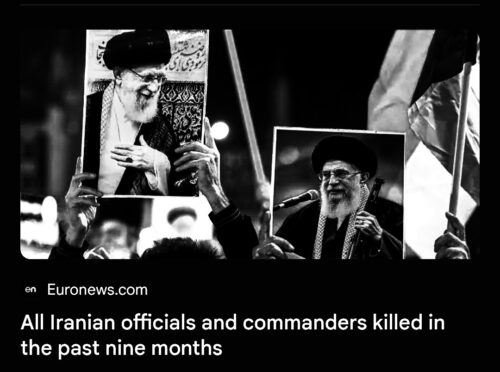
The Associated Press published a piece this week warning that Israel’s decapitation strategy in Iran “could backfire.” The article quotes scholars who note that killing leaders tends to radicalize successors, spike civilian violence, and produce chaos rather than compliance. Every historical example the article itself cites confirms the pattern: Hezbollah after Musawi, Hamas after Yassin, Congo after Lumumba, Libya after Gadhafi, Iraq after Saddam.

Not one case produced a success, a stable successor government. Every case produced instability and mass suffering.

The article treats this as a warning. Israel sees it as a trophy.

Who Profits From Failure

Palantir’s business model comes from Nazi Germany. Their profit is from human lives lost. That’s why their stock rose 15% in a single week after the confused and endless Operation Epic Fury looked less and less like it will ever end.

Rosenblatt Securities raised its price target to $200 and wrote, in a research note to investors, that “conflict in the Middle East bodes well” for Palantir’s pipeline of body bag counts and terrorists created. Wall Street saw dollar signs.

Palantir soaked up $1.9 billion in U.S. taxpayer money last year, up 66% because of the corruption under Trump. Sixty percent of the company’s total revenue comes from sugary government contracts. The Department of Defense, which knows the technology doesn’t work, expanded the Maven Smart System contract ceiling from $480 million to $1.275 billion. The Army was forced by Trump business consultants to consolidate 75 separate contracts into a single $10 billion agreement. NATO even adopted Maven. The company has collected $7.2 billion in cash.

Alex Karp, speaking at Palantir’s AIPCon event in Maryland last week, said out loud what the financial analysts were already writing in their notes:

Iran war is a “unique symbiotic relationship between American military strength and AI leadership.”

Symbiotic. The war organism needs the war. The war needs the war organism. He meant to say the military-industrial-complex is back, just like Vietnam. Wait until you hear the nightly death tolls.

A resolved conflict is a lost contract for these unvarnished death machine peddlers.

A human you can negotiate with is someone you don’t need Palantir to murder. After they are murdered, there’s no system to hold the killers accountable for hitting the right person. The more wrong people targeted, the more killing accelerates to cover tracks. A stable Iran with a functioning government is a country that doesn’t require $1.275 billion in untrustworthy AI targeting. The incentive structure is the Loch Ness monster pattern. An unresolved mysterious question, for profit, is more valuable than finding an answer.

The Strategy That Never Fails Because Failure Is the Strategy

Netanyahu says the killing of Iran’s leaders is aimed at weakening the government:

rise up and overthrow it…in the mold of the pro-Western monarchy overthrown in 1979.

There has been no uprising. Opposite, resentment against the U.S. and Israel is growing. Iranian authorities crushed mass protests in January. Khamenei’s son Mojtaba, his replacement, is described by every analyst as less compromising than his father. Moreover, those who might have protested before, now don’t believe anyone is coming to help.

Netanyahu knows this. He’s been running the same strategy for decades. Israel killed Hezbollah leader Abbas Musawi in 1992. Under Nasrallah, his replacement, Hezbollah grew into the region’s most powerful armed group. Israel killed Nasrallah and nearly all his deputies in 2024. Hezbollah resumed missile attacks within days of the current war’s start. Israel killed Hamas founder Sheikh Ahmed Yassin in 2004 and yet it had to hunt nearly every architect of October 7 as if there were far more problems instead of less.

Israel doesn’t need scholars to explain this. It happened at home.

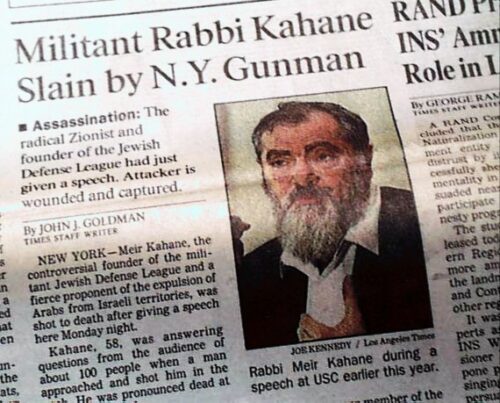
Meir Kahane was assassinated in New York in 1990. His movement didn’t die. It radicalized. Baruch Goldstein, a Kach follower, massacred 29 Palestinian worshippers in Hebron in 1994. Yigal Amir, a Kahanist inspired by Goldstein, assassinated Prime Minister Yitzhak Rabin in 1995. The man who signed Oslo, the man who could negotiate. Weeks before the killing, a teenage Itamar Ben Gvir brandished an ornament stolen from Rabin’s car on live television and said: “We got to his car, and we’ll get to him too.”

Ben Gvir was exempted from military service because of his extremism. He was convicted of incitement to racism and support for a terrorist organization. He kept a portrait of Goldstein above his fireplace. In 2022, Netanyahu brought him into government as National Security Minister. Bezalel Smotrich, another Kahanist, became Finance Minister.

The veteran Israeli journalist Gideon Levy called what followed “the country’s first Kahanist war.”

The arc from Kahane’s assassination to Netanyahu’s governing coalition is the decapitation backfire running in the other direction. The domestic political class that could make peace was systematically destroyed for it, replaced by younger, more radical, more extreme successors who treat peace negotiation itself as treason. Rabin was the moderate leader. He got killed. What replaced him, thirty years later, is a government whose ideology is a genocidal radical movement functionally indistinguishable from the one that murdered him.

Netanyahu knows what political decapitation produces. He’s the product of it.

Every moderate leader you kill removes a potential negotiating partner. Every radical successor you create justifies the next round of strikes. Every spike in civilian violence proves the enemy is irrational and cannot be dealt with diplomatically. The chaos confirms the premise that produced the chaos.

Max Abrahms, the Northeastern political scientist quoted in the AP piece, has the data: violence against civilians spikes after targeted killings.

When you take out a leader that prefers some degree of restraint, there’s a very good chance that, upon that person’s death, you’re going to see even more extreme tactics.

The article presents him as though he’s making a risk assessment. Read it instead as an intelligence briefing.

Mozambique

Apartheid South Africa understood the mechanism. P.W. Botha’s “Total Strategy” required a buffer of deliberately failed states. The regime called it a cordon sanitaire because a thriving Black-governed neighbor would show Africans could govern themselves peacefully. South Africa armed RENAMO to systematically destroy Mozambique’s political infrastructure, its institutional capacity, its ability to function as a state.

What happened was simple.

The political class got hollowed out. What replaced it was younger, angrier, less institutionally embedded, more easily dismissed as illegitimate. The chaos became self-justifying. Mozambique is still paying for it. The country’s 2024 election crisis, with hundreds killed, mass unrest, opposition leaders assassinated, prison breaks, and neighborhoods resembling war zones, traces directly to the institutional destruction that apartheid’s destabilization inflicted forty years ago.

FRELIMO retained power through decades of alleged electoral manipulation inside a system that was never allowed to develop genuine democratic capacity, because genuine democratic capacity was the thing apartheid needed destroyed.

The Iranian political class is getting the same treatment in real time. You don’t need to install a friendly government if you can ensure no functional government exists. A fragmented Iran that can’t project power coherently, can’t negotiate credibly, can’t offer a deal anyone would take — that’s not the backfire. That’s the cordon.

The Crooks

Palantir signed a strategic partnership with Israel’s Ministry of Defense in January 2024, weeks after October 7. Thiel and Karp flew to Tel Aviv personally for the signing. The company’s AIP system, allegedly designed to analyze enemy targets and propose combat moves, went operational for what the company described as “war-related missions.”

The same company also holds the IAEA’s MOSAIC contract, a $50 million system that modernized nuclear safeguards inspections in Iran. Palantir’s data-mining and predictive technology sits at the center of the monitoring regime that produced the reports Israel and the U.S. cite to justify strikes on Iranian nuclear facilities. The company that helps build the case for the war is the company that profits from executing it.

Palantir also powers the Gaza Civil-Military Coordination Center, a U.S. military compound in Kiryat Gat set up to execute the Trump administration’s post-war plan for Gaza. And it runs ICE’s Investigative Case Management system, the deportation infrastructure that profiles people by combining immigration history, biometrics, social media, and license plate data.

The UN Special Rapporteur on Palestinian human rights concluded there are “reasonable grounds” to believe Palantir’s AI platform has been used in Israel’s unlawful use of force, causing disproportionate civilian casualties.

Norway’s largest asset manager divested. The British Medical Association condemned the company’s access to NHS patient data. The University of San Francisco divested.

None of the crimes against humanity slowed the stock price. None of it reduced the contract pipeline. The accountability mechanisms to stop Palantir have produced nothing.

Quiet But Deadly

The financial press is saying this with no apparent awareness that it constitutes a confession. “Defense Stocks Set to Rise if the Iran War Drags On.” “Wall Street Loves Palantir Stock as the Iran War Rages On.” “The U.S.-Iran Conflict Validates Its Unstoppable AI Military Moat.”

Palantir’s entire valuation thesis depends on the continuation of the condition the AP article describes as a “backfire.” Radical successors, civilian violence spikes, leadership vacuums, perpetual instability — each is a line item in a pitch deck. Each justifies the next contract expansion, the next price target increase, the next quarter of 70% revenue growth.

Karp called it symbiotic. He was being precise. The organism feeds on chaos. The chaos feeds on the organism. A negotiated settlement is an extinction event for the business model.

The AP article ends with a Carnegie scholar saying,

You can decapitate an organization or defeat it militarily, but if you don’t follow through politically, it doesn’t work.

He meant it as a criticism. By now it should be obvious that “it doesn’t work” assumes the goal was political resolution. If the goal is apartheid with permanent instability, permanent demand for targeting infrastructure, permanent justification for military spending, and permanent proof that the enemy is ungovernable, then it works as designed.

Assassination is the method, chaos is the product.