Alphabet just filed an SEC disclosure awarding CEO Sundar Pichai a compensation package worth up to $692 million over three years. His base salary stays at $2 million. The rest is equity pay, which means performance stock units tied to Alphabet’s total shareholder return relative to the S&P 100, plus new incentive units tied to the board’s own valuation estimates of Waymo and Wing.
No operational milestones are specified.
No headcount targets.
No product quality benchmarks.
The company declined to comment on what Pichai actually has to do, but as someone with decades of being inside, I can explain.
Here’s the decoder ring.
How CEO equity is setup
Total shareholder return goes up either from increased revenue, or from decreased spend. Remember “spend more to make more” as a cry for market growth? Well, that’s long gone as the new Big Tech cry is “people are our largest cost, so get rid of them”. Mass layoffs now mechanically improve a metric that triggers a big payout to the five or six men playing this game.
Nobody says “fire people” in the game rules for an incentive structure, because a “decrease spend” dog whistle is so loud and clear.
The Waymo and Wing units disclosed are arguably signs of something even worse. Their value is determined by the compensation committee’s self-estimate of per-unit worth.
Not revenue.
Not ridership.
Not delivery volume.
Nothing connected to quality of life or value relevant to anyone affected by the product.
A Waymo that displaces humans and reduces jobs faster is worth more, is a good way to understand the “worth” being written. A Wing that removes human jobs from last-mile delivery is worth more than one that allows humans to “cost” by existing.
The global management class has a specific training pipeline designed to separate the person making the decision from the people affected by it. That’s the colonial inheritance running through Cambridge and Wharton and McKinsey. The entire incentive structure points toward massive displacement and removal of humans.

The decoder
| What the filing says | What it means |
|---|---|
| “Performance-based equity” | Stock price goes up when layoff numbers go up |
| “Total shareholder return” | Earnings per share, which layoffs improve |
| “Per-unit value of Waymo” | Board’s own estimate, no external audit |
| “Scaling Other Bets” | Replacing human labor with autonomous systems |
| “Best interests of stakeholders” | Not employees — shareholders |
| “Base salary unchanged at $2M” | The part that sounds modest; the other $690M is equity |
For context: Microsoft’s Satya Nadella earned $96.5 million in fiscal 2025. Apple’s Tim Cook took home $74.3 million. Pichai’s package is seven times Cook’s.
Meanwhile, the same tech sector reports record-high unemployment among software engineers, with companies citing “efficiency” and “AI-driven productivity” as the reasons they don’t need to rehire.
The scoreboard
Between 2022 and 2025, Big Tech announced over 100,000 layoffs across Alphabet, Microsoft, Meta, and Amazon alone. Here’s what happened to CEO compensation over the same period.
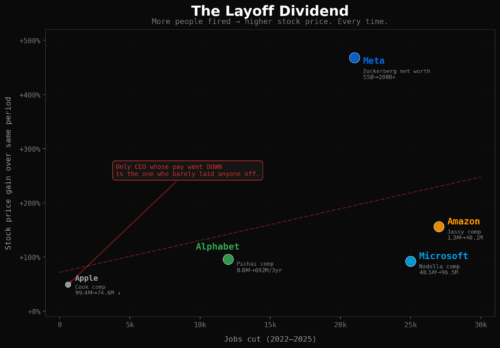
| Company | Jobs cut (2022–2025) | CEO pay trend |
|---|---|---|
| Alphabet (Pichai) | 12,000+ | $226M (2022) → $692M/3yr (2026). Triennial equity grant tripled. |
| Microsoft (Nadella) | 25,000+ | $54.9M (2022) → $96.5M (2025). Record high. +76%. |
| Meta (Zuckerberg) | 21,000 | $1 salary. Net worth: $55B (2022) → $200B+ (2025). Operating margin doubled to 41% after cuts. |
| Amazon (Jassy) | 27,000+ | $1.3M (2022) → $40.1M realized (2024). Ten-year equity grant vesting accelerated by stock surge post-layoffs. |
| Apple (Cook) | ~600 | $99.4M (2022) → $74.6M (2024). The one CEO who took a voluntary cut — also the one who barely laid anyone off. |
The Apple line tells you everything. The only CEO whose compensation went down is the one who didn’t convert headcount into margin improvement. The market doesn’t reward restraint. It rewards extraction.
Is one CEO worth 1,500 engineers?
Pichai’s package: $692 million over three years. Cook’s rate over the same period: $224 million. The gap between the two is $468 million.
Alphabet’s own proxy filing reports median employee total compensation at $331,894. Levels.fyi puts the median Google software engineer at $322,000, a senior L5 at $417,000, and an entry-level L3 at $201,000.
If Pichai were paid at Cook’s rate, the $468 million difference would hire:
| Role | Google comp | Hires | Market comp | Hires |
|---|---|---|---|---|
| Entry-level (L3) | $201K | 2,329 | $150K | 3,120 |
| Median SWE | $322K | 1,454 | $200K | 2,340 |
| Senior engineer (L5) | $417K | 1,123 | $250K | 1,872 |
The left column uses Google’s own inflated compensation rates. The right column uses normal market rates — and the numbers get dramatically worse for the board’s argument.
Google’s comp inflation is part of the same cycle. For years Big Tech bid up engineering salaries to hoard talent and starve competitors. A $417,000 L5 at Google could have been two senior engineers at a normal company. Then Google dumped 12,000 of those overpriced engineers onto a market it had already distorted, cratering the value of the skills it spent a decade inflating.
The hoarding and the layoff are the same strategy in two phases: acquire to block competitors, discard.
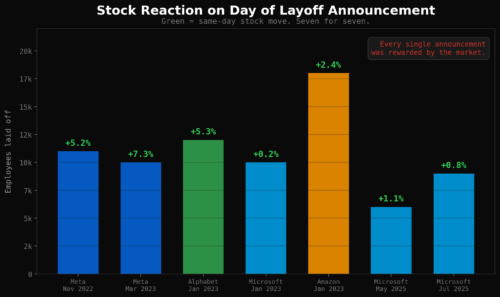
At market rates, the full $692 million as one single person’s compensation package would employ 4,613 entry-level engineers or 2,768 senior engineers for three years. That’s not a few, that’s nearly half of the 12,000 people Pichai fired in January 2023.
Alphabet’s board looked at thousands of engineers and one CEO and signaled the opposite of production. They chose to pay one person the amount it would cost to employ people to produce things. That’s a rent-seeking decision, filed with the SEC, that says the company believes its staff value is an inverted pyramid; value is capture using a position of control, not from making anything.
Meanwhile the engineers who built Search, Chrome, Android, Maps, YouTube, Gmail, Cloud, and TensorFlow are sending applications into a market that Alphabet itself helped flood with 12,000 newly unemployed engineers. Pichai gets $692 million for presiding over the company those engineers made. The engineers get a job market that tells them their skills are worth less every quarter because the CEOs firing them are worth more.
Enclosure
The $692 million package and the tech unemployment headlines have a troubling connection. They’re the same balance sheet. Workers built the platforms over twenty years. The platforms replace the workers. The CEO gets paid for presiding over the conversion.
Thompson’s The Making of the English Working Class documents exactly this sequence: workers build value in a shared system, the system gets captured, the workers get expelled, and the capturers profit from both the thing that was built and the newly desperate labor supply. Google engineers built the commons — Search, Android, and TensorFlow, much of it literally open source. The commons got enclosed. The engineers got expelled. Acemoglu and Robinson call the result an extractive institution: one designed to concentrate wealth rather than distribute it. A compensation committee that awards $692 million to one person while eliminating 12,000 positions is that institution. The SEC filing is its constitution.
The colonial version of this cycle is the closest parallel. Big Tech extracts labor from engineers, converts it into platform value, then sells AI services back to the same companies that can no longer afford to hire the engineers Big Tech overvalued before discarding. The “AI-driven productivity” pitch to enterprises is selling automated labor back to a market these companies emptied of human labor. Extract the resource, process it, sell the product back to the territory you stripped. That’s not a metaphor. That’s the business model, filed quarterly with the SEC, described in the language of shareholder value.
That’s what these CEOs of Big Tech represent now. An incredibly cynical compensation design that treats human lives as throwaway; colonial material for rapid extraction and disposal.