The accuracy in this one seems very low, but the StrategyPage article emphasizes a mindset where some knowledge is better than none.
…an algorithm developed by an army reserve officer, 2nd lieutenant Christian Lance Relleve, whose academic studies covered architecture as well as HSGI (Human Security and Global Intelligence) and International Relations. Relleve presented an algorithm that could predict the internal layout of a building with 70 percent accuracy based on what country the building was in, what the apparent purpose was and obvious external features. Relleve noted that there were many external indicators of how the internal layout was and he examined layouts in many countries for various types of structures.
I’m kind of curious if the accuracy is even lower in reality because many of the “correct” assessments are just warehouses, toilets or similar single-use simple construction.
Use of night vision goggles has escalated dramatically. In the mid-2000s I remember working with a retail giant that was being asked to help track and investigate spread of such technology in organized crime (e.g. where did a supply chain go wrong).
Israel at the same time took another approach and set out to develop a material that would zero a heat signature, making even a group of wearers look like inert rocks. I’m not saying that’s some kind of Biblical reference to stone but you can be sure it was tested in the desert. After 15 years of research and development, they’ve just disclosed the availability of their product.
The Kit 300 is made of thermal visual concealment (TVC) material that combines microfibres, metals, and polymers to make soldiers harder to see with a range of thermal cameras, Hariri said.
The sheet weighs around 500 g and folds up into a small roll. Soldiers can wrap it around themselves when on the move and join their sheets together to build a barrier that resembles rock when they set up a position. “Someone staring at them with binoculars from afar will not see soldiers,” said Harari.
It can also be used as a stretcher: a far lighter solution than the current set-up where a squad member has to carry a dedicated stretcher weighing several kilograms.
That kind of ends on a contradictory note, yet a realistic one. It would be far less believable (a stretch, if you will) had they announced stretchers were no longer needed given sufficient camouflage.
Stickers with the number of a hotline for reporting suspected spies have been posted above some urinals. Packs of tissues handed out to troops carry a notice promising a reward of T$5 million ($180,000) for successfully exposing a spy.
Imagine a urinal sticker with a secret message revealed when it detects something specific… I swear I am talking about a real product already and not inventing some crazy urinalysis feature.
The sticker could say “if you’re a leaker, this sticker will reveal a number for you to call and turn yourself in”.
Ok, ok, so my other question is whether that sticker said something like “leaks can kill, call us if you see one”.
Eighty years ago, wartime necessitated the introduction of the Royal Enfield WD/RE ‘Flying Flea’ and the Welbike, which were parachuted into occupied Europe, providing a means for airborne and assault troops to transmit messages. […] “Motorcycles have been in military use ever since they were invented. So, what we’re doing is nothing new – what’s new is the electrification side of it and the opportunities that presents…they can be used in a way where a petrol engine would just give your position away.”
Electric bikes have many obvious advantages, already getting a lot of attention from special forces in America: given low sound and heat profiles they are much safer, faster, lighter and easier to maneuver than liquid fuel bikes, not to mention an easier and safer supply chain.
Without a Motorcycle in Kandahar, ‘You Are Like a Prisoner’. A foreshadowing of how the Afghan war would be won and lost by distributed / localization networks, hit & run tactics, and terrain advantages.
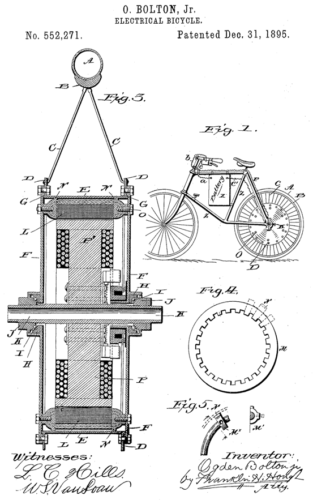
In terms of the US Army, consider how they rode mountain-bike field tests way back in 1896, as I’ve written here before, so the Ogden Bolton electric bike from 1895 might be a better “nothing new” reference than a smelly, greasy 1939 Royal Enfield.
Source: ElectricBike
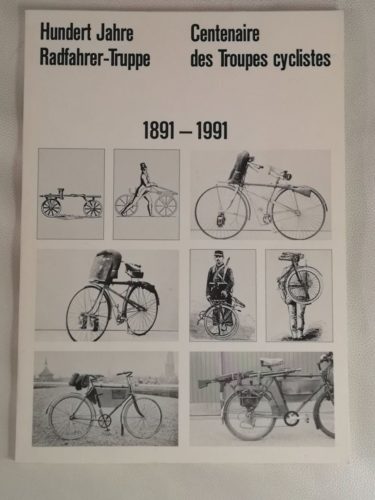
Speaking of references, in 1991 there was even a book published that detailed a century of bikes used in war. It’s kind of amazing to think how many better references there may be versus that WWII Enfield.
Swiss book that gets far less attention than it should
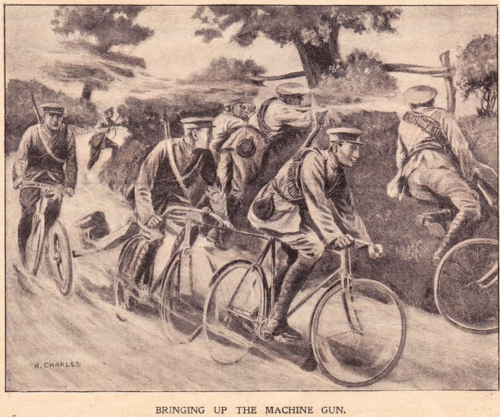
In WWI soldiers allegedly even were pulling heavy gear into battle using bicycles as if some kind of direct replacement for horse power. You’d think electricity would be on their mind.
Source: Leeds Bikes
Journalists in 1914 indeed mention that a bike has a major advantage because it can be dropped flat to the ground and completely hidden from enemy fire, which seems an odd point to make today yet it was an innovation in military thinking at the time.
Being completely hidden, of course, is again why the electric motor signature has been so compelling for 100 years versus oil burners.
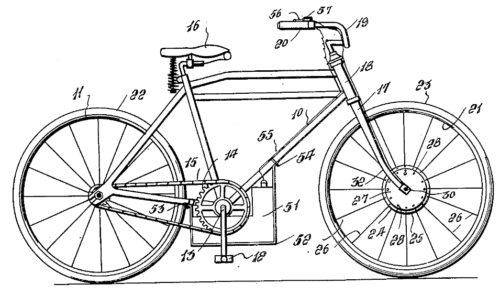
And from there, the 1938 McDonald seems even more relevant, especially because by this time Japan was using bicycles in major offensive campaigns (1937 invasion of China).
Source: ElectricBike
Given the superiority of electric, it’s a wonder anyone bothered with gasoline bikes at all.
It seems all too easy to find evidence of electric bikes in military projects throughout history that are far more relevant to today’s British paratrooper than an Enfield of WWII. Here’s a good one:
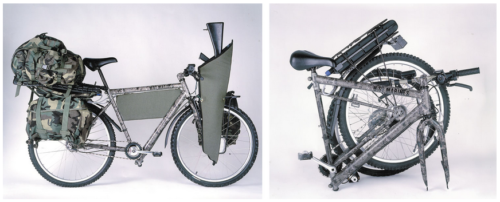
In 1997, [US Government was] seeking a way to move military troops and equipment without the heat or noise signatures of a combustion engine and due to Montague’s experience in the field, they won the grant to develop the Tactical Electric No Signature (TENS) Mountain Bike. Montague worked closely with Currie Technologies on their earliest electric systems to equip these military models with the best electric motor technology of the time. Currie is still making electric drive systems used on many e-bikes today.
US military Tactical Electric No Signature (TENS) Mountain Bike. Source: Montague bikes
Someone in the US military surely thought TENS would be an hilarious acronym for an 18-speed electric bicycle.
So what really is new? The oil industry seems to be losing its death grip. In retrospect, bikes never should have been anything but electric this whole time.
I mean I know it’s fashionable to say electric bikes have short range, have trouble keeping a charge in extreme weather… but let’s be honest about such nonsense.
You can’t pull gasoline out of thin air or water like you can electricity. Even diesel has potential to be created from local sources that gasoline clearly does not. I’ve always found electricity available in even the most remote locations, places oil was nowhere to be found.
In fact, WWII motorcyclists reminisce about their leaky and wasteful fuel cans, which could never serve modern operations.
“We had flimsy cans of petrol, so you cut them in half, pierced it with a lot of holes, three-quarter fill it with earth, pour petrol and put a match on it and it would burn for a long while. That’s how we used to brew up [tea] while we’re on the road!”
With an electric bike he would have just heated water using a simple pad or pole plugged into the battery, having none of the signature/footprint issues of a setting that petrol can on fire.
a blog about the poetry of information security, since 1995