The WWW project merges the techniques of information retrieval and hypertext to
make an easy but powerful global information system.
The project started with the philosophy that much academic information should
be freely available to anyone. It aims to allow information sharing within
internationally dispersed teams, and the dissemination of information by
support groups.
Reader view
The WWW world consists of documents, and links. Indexes are special documents
which, rather than being read, may be searched. The result of such a search is
another (“virtual”) document containing links to the documents found. A simple
protocol (“HTTP”) is used to allow a browser program to request a keyword
search by a remote information server.
The web contains documents in many formats. Those documents which are
hypertext, (real or virtual) contain links to other documents, or places
within documents. All documents, whether real, virtual or indexes, look similar
to the reader and are contained within the same addressing scheme.
To follow a link, a reader clicks with a mouse (or types in a number if he or
she has no mouse). To search and index, a reader gives keywords (or other
search criteria). These are the only operations necessary to access the entire
world of data.
Information provider view
The WWW browsers can access many existing data systems via existing protocols
(FTP, NNTP) or via HTTP and a gateway. In this way, the critical mass of data
is quickly exceeded, and the increasing use of the system by readers and
information suppliers encourage each other.
Making a web is as simple as writing a few SGML files which point to your
existing data. Making it public involves running the FTP or HTTP daemon, and
making at least one link into your web from another. In fact, any file
available by anonymous FTP can be immediately linked into a web. The very small
start-up effort is designed to allow small contributions. At the other end of
the scale, large information providers may provide an HTTP server with full
text or keyword indexing.
The WWW model gets over the frustrating incompatibilities of data format
between suppliers and reader by allowing negotiation of format between a smart
browser and a smart server. This should provide a basis for extension into
multimedia, and allow those who share application standards to make full use of
them across the web.
This summary does not describe the many exciting possibilities opened up by the
WWW project, such as efficient document caching. the reduction of redundant
out-of-date copies, and the use of knowledge daemons. There is more
information in the online project documentation, including some background on
hypertext and many technical notes.
Try it
A prototype (very alpha test) simple line mode browser is currently available
in source form from node info.cern.ch [currently 128.141.201.74] as
/pub/WWW/WWWLineMode_0.9.tar.Z.
Also available is a hypertext editor for the NeXT using the NeXTStep graphical
user interface, and a skeleton server daemon.
Documentation is readable using www (Plain text of the instalation instructions
is included in the tar file!). Document
http://info.cern.ch/hypertext/WWW/TheProject.html
is as good a place to start as any. Note these coordinates may change with
later releases.
And thus began the WWW with a line mode browser in a Z compressed tar (tape archive).
The reason for everybody to get the vaccine is to make sure that the virus doesn’t mutate to a point where it’s resistant to the vaccines — now even the people with vaccines are in danger. As soon as I read that, I said to myself, “Oh my God, it all makes sense.”
Here’s the real kicker, though:
Whenever I hear stuff in the media in terms of vaccines, it’s always “It’s safe and effective, go get it.” There’s never a whole lot of data explaining why it’s safe and effective. That took a lot of digging for me. It’s not so readily available. And then once I got the data, I thought, “Why didn’t I know this stuff?”
The answer to his own question actually comes right at the start of the article, but the connection back to it was never made:
[Pop culture] made me feel like I had some special insider knowledge. From there, I got into fasting, detoxification, sunlight, walking barefoot, and so on. Through that, I developed a general mistrust of the medical community.
Bingo. The answers aren’t easy because, to put it simply, they aren’t easy. Working hard does work, such that the act of digging is really what led to “it all makes sense” more than any simple formula.
Maybe a better way of saying this is just because you’re passionate doesn’t mean success or knowledge is dropped in your lap. Question why you feel entitled to arrival instead of accepting a humble path to get there.
The article is a good example of how education of children needs to focus far more on cognition and systems thinking, instead of narrowly defined skills in specific trades that promise “special insider knowledge” while mostly allowing for ignorance.
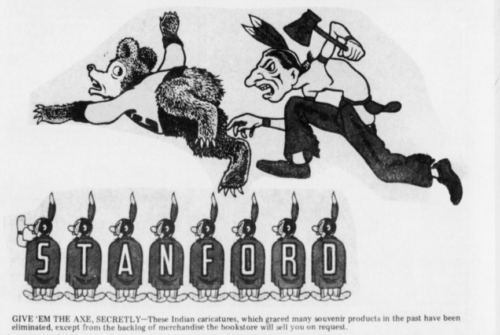
The patently offensive mascot of Stanford secretly sold to its alumni in the “know”, as documented in “Stanford = Genocide“. Source: The Stanford Daily Archives
On July 29th the Stanford Internet Observatory, arguably a Potemkin village by design, released the following PR statement:
Announcing the Journal of Online Trust and Safety… The journal was conceived from a recognition that much of the cutting-edge research on online harm lacks an appropriate journal for publication.
An “appropriate journal”? What was wrong with what people were publishing already? Hold that thought.
Notably, here’s the lineup written in the PR piece, claiming “a wide range” of researchers.
Led by co-editors Stanford, Stanford and Stanford. Stanford will be the journal’s initial managing editor. Founding members of the editorial board include:
Stanford
Stanford
Stanford
Stanford
Stanford
Stanford
Stanford
Stanford
Harvard
Harvard
NYU
NYU
NYU
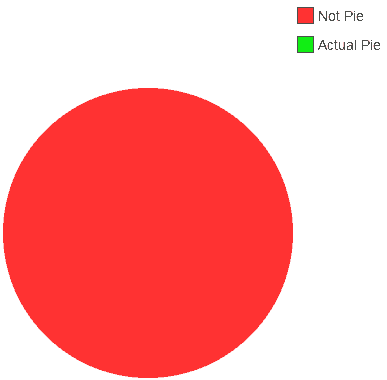
Why so much Stanford? Do I need to create a pie chart here?
If you force enough Stanford “appropriateness” theory into a journal, does it even matter what else is present?
Perhaps “appropriate” was a sloppy way of saying… content tightly curated by friends of the Facebook CEO working as censors in a Stanford-based front funded by the company to undermine critics?
And who genuinely thinks any “Online Trust and Safety” journal should have a disgraced name like Stanford on it at all given their history?
Let me propose another way of looking at this.
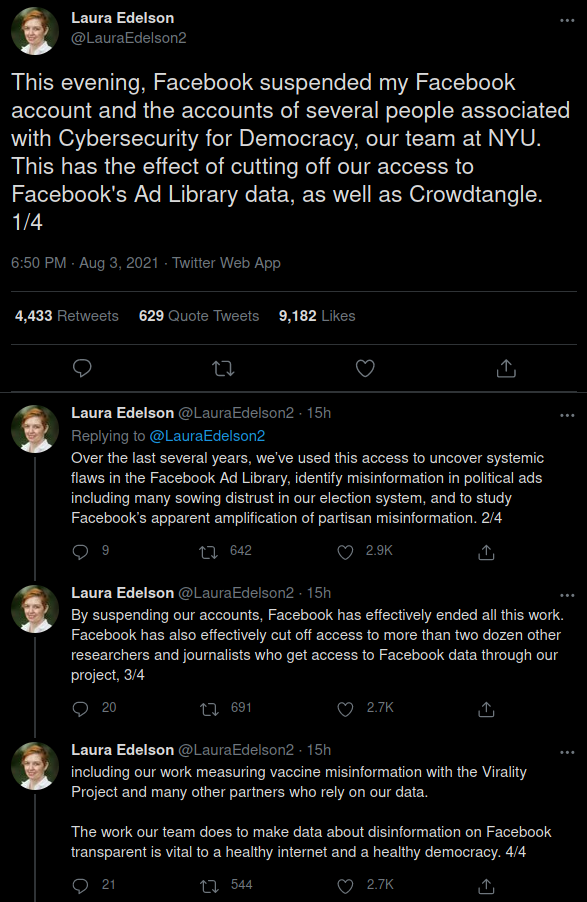
Reports have been coming in that Facebook ironically (and fraudulently) banned independent researchers working on transparency. They’re literally shutting down cutting-edge research on online harm and censoring independent publications, as their arm at Stanford complains an “appropriate” place to publish is needed.
Facebook banned researchers who pried into its ads and misinformation. Sure, go ahead and research us. But, um, you can only look at the data we’ve cherry-picked for you. Hope that’s okay.
And here is Mozilla today in a cut and dried blog post, basically openly calling Facebook liars.
Facebook claims the accounts were shut down due to privacy problems with the Ad Observer. In our view, those claims simply do not hold water. We know this, because before encouraging users to contribute data to the Ad Observer, which we’ve done repeatedly, we reviewed the code ourselves.
Facebook lawyers aggressively shutting down researchers while their Stanford arm announces a publication house for researchers… begs motive. So let’s talk about that too now.
Is the motive to coerce independent researchers into giving up their independence, to stick them (pun not intended) under a heavily weighted editorial group funded by Facebook?
At least one NYU researcher complained publicly via Twitter as well.
And so perhaps the most important point of all is when I reveal the names behind the unbalanced weighting of the editorial board, guess who is from NYU?
That same researcher. Laura Edelson is being listed as someone under the heavily weighted Stanford board.
There’s appears a very good chance that by gluing her into a Facebook-staff run Stanford controlled forum, she rides for a while in an illusion of being included in a process… while it is tightly controlled by people entirely opposed to her independent thoughts.
And what is everyone researching?
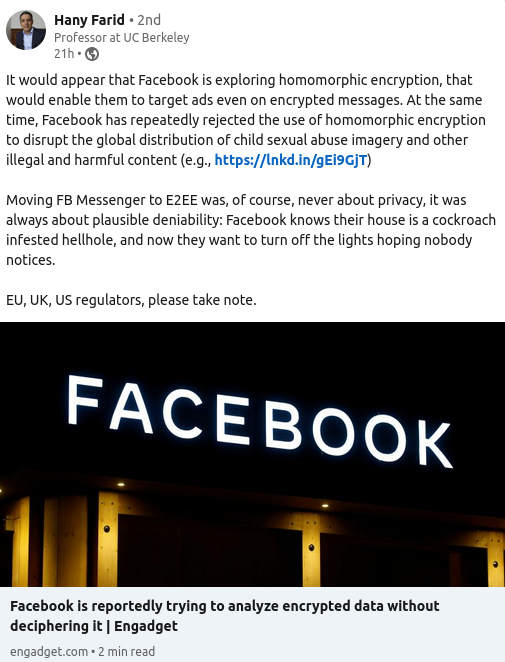
The “cockroach infested hellhole” was left behind by… the same Facebook executive who now is running the Stanford-controlled journal that he is claiming to be the only “appropriate” place to reveal the depths of his “hellhole”.
Guess where Henry Farid will soon be working? He also is being listed as someone under the heavily weighted Stanford board.
Remember that highly offensive Stanford logo at the top of this post? That’s their official “mascot” trying to chase and kill… the mascot of Farid’s academic affiliation.
Foreshadowing.
The PR piece from Stanford has all the hallmarks of deep corruption, a reminder of how Arthur Anderson auditors ended up in a “very special” contract to “help” Enron.
Remember why Arthur Anderson wasn’t issuing independent statements on integrity and executive accountability?
…she told me blowing the whistle had been like telling the Titanic captain “we’ve hit an iceberg, sound the alarm, come up with a plan” but the response was “icebergs don’t matter, we’re unsinkable”. I went on to report on the fraud trials and convictions in 2006 of Enron’s chairman Ken Lay and CEO Jeffrey Skilling.
Now imagine instead that Farid and Edelson found some actual “acceptable” publishing venue outside the direct influence and control of Stanford let alone the men they’re directly criticizing.
I mean imagine the CSO of Facebook was being held accountable as the Enron executives were, instead of running a speaking tour from an academic office to profit even more from the alleged crimes he facilitated.
America just might have a longstanding and widespread problem with these kinds of platform-based censorship tactics, just maybe.
The school can’t both hold up a “policy prohibiting teachers from advocating for social or political causes” while calling itself a Confederate South academic platform.
Sorry, but no.
Using the artifice of being an academic space in order to silence critics should be called out for what it is — censorship.
According to a 2008 paper called the Two Faces of Death, vaccination and antibiotics completely changed mortality statistics for US military:
Throughout America’s first 145 years of war, far more of the country’s military personnel perished from infectious diseases than from enemy action. This enduring feature of war was finally reversed in World War II, chiefly as a result of major medical advances in prevention (vaccines) and treatment (antibiotics). Safeguarding the health of a command is indispensable for the success of any campaign. Wars are lost by disease, which causes an enormous drain on the military’s resources and affects both strategy and tactics.
Wars are lost by disease, as none other than General George Washington himself argued in his day.
Among the Continental regulars in the American Revolution, 90 percent of deaths were caused by disease, and Variola the small pox virus was the most vicious of them all. […] Weighing the risks, on February 5th of 1777, Washington finally committed to the unpopular policy of mass inoculation by writing to inform Congress of his plan. Throughout February, Washington, with no precedent for the operation he was about to undertake, covertly communicated to his commanding officers orders to oversee mass inoculations of their troops in the model of Morristown and Philadelphia (Dr. Shippen’s Hospital). At least eleven hospitals had been constructed by the year’s end. Variola raged throughout the war, devastating the Native American population and slaves who had chosen to fight for the British in exchange for freedom. Yet the isolated infections that sprung up among Continental regulars during the southern campaign failed to incapacitate a single regiment.
Yes you read that right. Washington was killing Native Americans and free blacks in his quest to create a kind of independence that allowed white men like him to preserve and greatly expand slavery for personal enrichment.
Another way of explaining this can be found in the book “Thirteen Clocks”
Parkinson reveals how the system’s participants constructed a compelling drama featuring virtuous men who suddenly found themselves threatened by ruthless Indians and defiant slaves acting on behalf of the king. Parkinson argues that patriot leaders used racial prejudices to persuade Americans to declare independence. Between the Revolutionary War’s start at Lexington and the Declaration, they broadcast any news they could find about Native Americans, enslaved Blacks, and Hessian mercenaries working with their British enemies. American independence thus owed less to the love of liberty than to the exploitation of colonial fears about race.
One might think forced vaccination in this context would become inherently part of the American dream of prosperity and freedom (to continue slavery). Just look at how John Adams wrote to his wife in the month before Declaration of Independence in 1776:
The smallpox is ten times more terrible than the British, Canadians and Indians together. This was the cause of our precipitate retreat from Quebec.
Notably, John Adams refused to abolish slavery such that when the British Army went around America giving slaves their freedom (at least a third of slaves in Georgia were set free — fresh in their mind was how America had been violating the 1735 abolishment of slavery under British rule). Adams even set about trying to win some “restitution” for the American slaveholders forced by the British government to give black people their freedom!
Imagine being the guy demanding an end to tyranny under Britain, yet then turning around and demanding Britain pay Americans compensation as the British freed people from tyranny.
I mean the American military leaders only very reluctantly allowed black men to fight alongside them. By comparison the British encouraged both black men and women to join them, enticing them with freedom from American slaveholders like Washington and Adams.
The most accurate reading of the time is Washington personally refused the constant pressure to end slavery as he could not conceive of how to get rich (offset loss of productivity/wealth he was illegally gaining) without being immoral. Adams refused constant pressure to end slavery as he likewise saw slavery as a “unifying” cause among the wealthy white men holding power.
Adams was often wrong and this was no exception. While Vermont, New Hampshire, and Massachusetts abolished slavery during the war, and while Virginia, Maryland and Delaware legislatures removed barriers for slave owners to free their enslaved workers… Washington and his peers gave lip service, balked and backpedaled.
You would think that Washington or Adams simply would look at the record of black freemen fighting alongside whites in a war for independence, and quickly set blacks free (as the British had said they would). Consider this 1782 document of Freeman service from the State of Connecticut, for example:
Source: US Library of Congress, Revolutionary War documents for Juba Freeman
Instead Washington died on December 14, 1799 from illness allegedly caused by forcing his slaves to work in harsh weather (no one speaks of what happened to his slaves forced to suffer that same weather).
Washington clearly invested his entire life in preserving slavery and nobody can deny the documents that show how hard he worked with his lawyers to secretly find ways to delay and avoid abolition — refuse his slaves freedom even by 1780 when he was legally required to do so. He literally broke the law to keep enslaving people.
This is essential to help understand why President John Adams wrote (incorrectly) in 1801 “the practice of slavery is fast diminishing” or the actual fact that by 1810 nearly 75% of slaves in “northern” states of America had been emancipated. Yet black Americans faced brutally violent racism and the systemic inability of their government to accept blacks into society let alone power, or grant them equal rights.
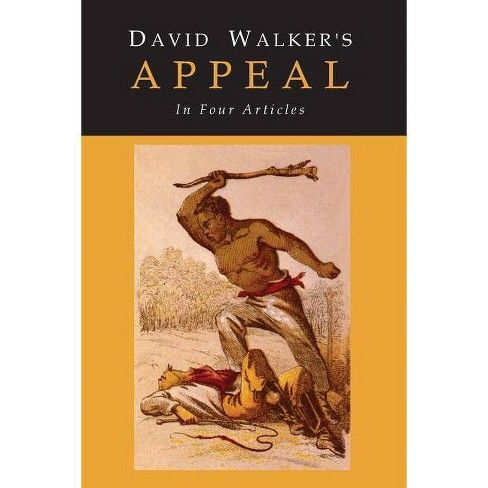
…tell me if their declaration is true — viz. if the United States of America is a Republican Government? — Is this not the most tyrannical, unmerciful, and cruel government under Heaven — not excepting the Algerines, Turks and Arabs? — I believe if any candid person would take the trouble to go through the southern and Western sections of this country, and could have the heart to see the cruelties inflicted by these Christians on us, he would say, that the Algerines, Turks and Arabs treat their dogs a thousand times better than we are treated by the Christians.
American ships circulated this book, as Walker very intentionally engaged with sailors at the port close to his shop in Boston. In response, authorities in the South applied harsh censorship to stop circulation; sailors were thrown in jail for having a copy and spied upon.
David Walker died soon after publishing his clear-eyed assessment of freedom in America… allegedly from disease.
While these important contextual details of America’s first forced variolation (early form of vaccination) rarely are discussed, I find it most interesting how Washington was an adamant advocate and pushed so hard to give people a cure from physical disease one hand while refusing to stop the “cognitive disease” of racism.
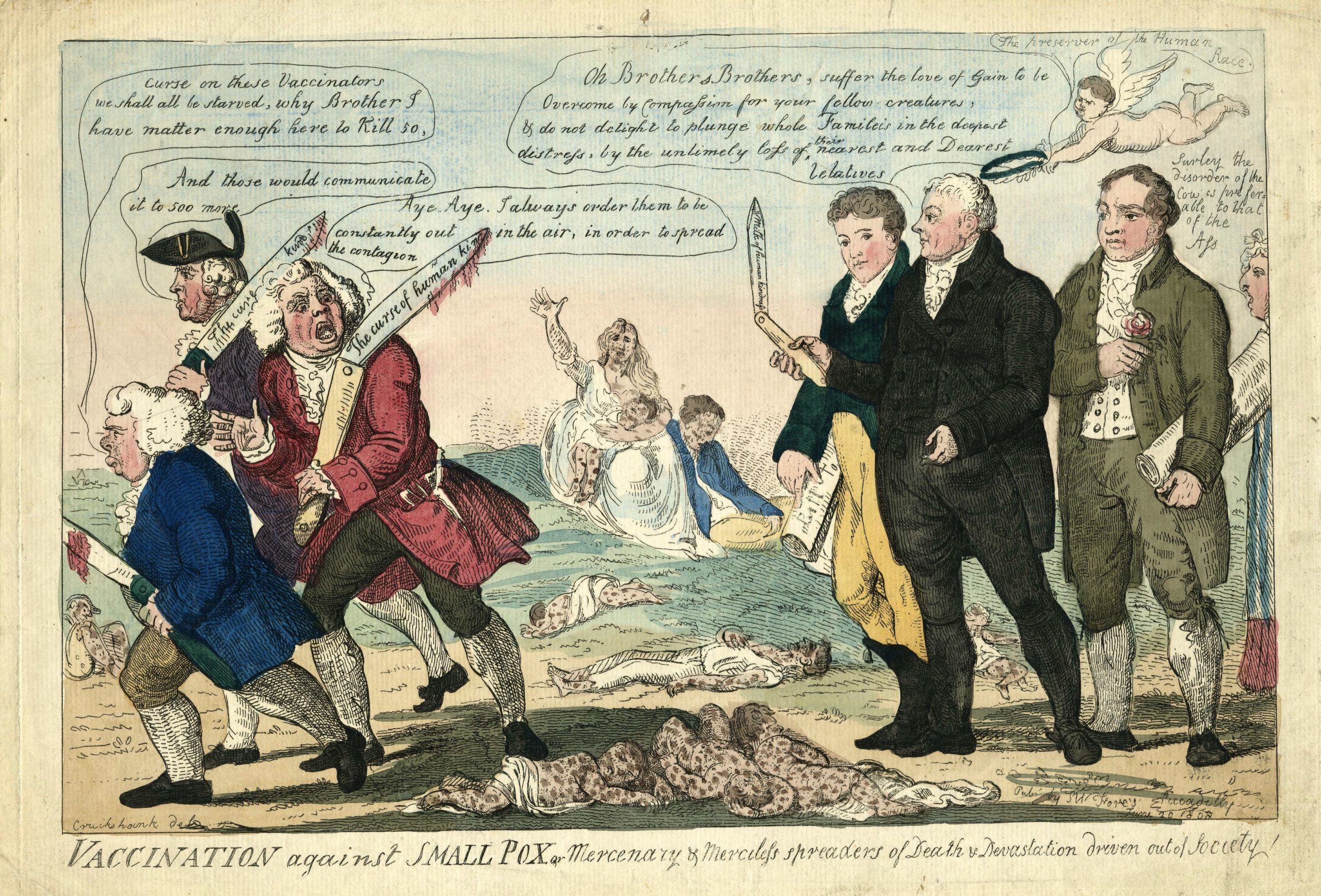
An 1808 illustration by renowned cartoonist Cruikshank with pioneering “speech bubbles” depicting pioneering vaccination proponents chasing away the dangerous old variolators. (Click to enlarge and read)
Washington essentially used variolation as a tactic to help cement a vision of white male prosperity through tyranny in America (dangerously postponing global movement towards abolition, greatly expanding enslavement), which arguably set a direct course towards Civil War.
In that sense, President Grant should be seen as rising above Washington in every regard. Not only emancipating his own slave but directly facing the conflict and ending slavery nationally and establishing civil rights for black Americans. Grant was the best President in American history, a better man than Washington by far… with a curious exception of military vaccination.
During the Civil War almost 40% of Union soldiers with smallpox died from it, such that it has been estimated many more died from disease than during battle.
“Roughly two out of three men who died in the war died from disease,” Hacker says. “The war took men from all over the country and brought them all together into camps that became very filthy very quickly.” Deaths resulted from diarrhea, dysentery, measles, typhoid and malaria, among other illnesses.
Perhaps Grant in his day lacked the data available now, which is is why he didn’t see vaccines as the obvious and undeniably effective way to prevent unnecessary deaths. It raises an interesting question as to whether he would have mandated vaccinations, as he was able to correctly see the future in so many other ways.
a blog about the poetry of information security, since 1995