News about Amazon seems to read like something straight out of a classic American novel and now makes me wonder if the company name is related, as I wrote here in 2015 about that book.
…when you talk to the platform engineers behind closed doors you will often find a modern version of Sinclair’s 1906 novel “The Jungle”; history has some very important lessons to be remembered…
Founder Jeff Bezos was reported to say competing with Bernie Madoff in hedge money made him feel like a loser.
Bezos reportedly confided to former AOL president Ted Leonsis that he quit his job at the hedge fund D. E. Shaw because Bernie Madoff “was kicking my ass.” The Amazon idea came to Bezos as he was researching online business opportunities for the hedge fund.
Madoff was later sentenced to 150 years in jail for crimes, what Bezos credited as “kicking”.
Bezos meanwhile gave up because too jealous of Madoff’s ill-gotten wealth; allegedly he thought a better get-rich strategy for a wealthy hedge gambler was to plunge his millions into gaming a vulnerable market into a forced monopoly (initially books). This was basically creating a tech platform for rent seeking (coerced trade that benefits only one side), which today we call Amazon.
In 2011 at BSidesLV I gave a presentation about the danger of big cloud companies operating like the movie 2001 by Stanley Kubrick — ship automation systems with too much authority detaining and terminating their own crew.
Google AI ethics team discusses next steps in a “private” chat while Google’s AI reads their lips
That presentation was the genesis of the book I have been writing since that time (and in 2012 I spoke about humans enacting a political coup using social media, a step beyond HAL). It has generated enough material so far to probably be a multi-volume set, although I tell myself to edit it down…
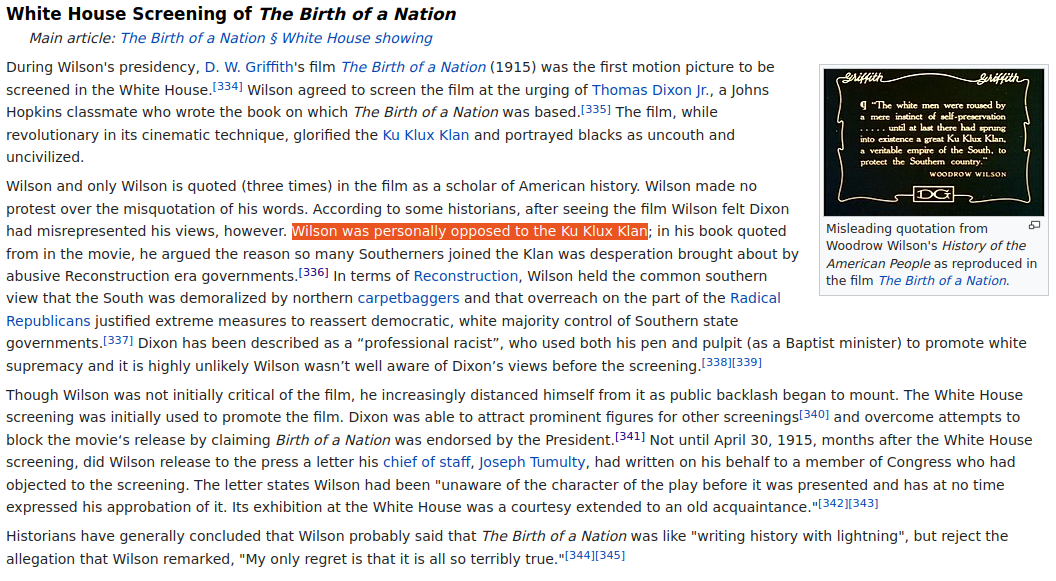
I recently had to explain that someone edited the Wikipedia entry on Woodrow Wilson to falsely claim that the very man who called for a return of the KKK, restarted the KKK as President, and led its rise to humanitarian disasters across America… was somehow “personally opposed to the KKK”.
Click image to enlarge:
Source: Wikipedia
That’s crazy talk.
It would be like saying General Grant was personally opposed to destroying the KKK. Wrong. Grant destroyed it. Wilson restarted it. Those are facts.
A totally false sentence about Woodrow Wilson entered into a Wikipedia post makes literally no sense, is obviously counter-factual, yet there it is… without any citation or reference at all.
It’s like someone from the KKK dropped in and thought it would be really funny for people to read “water in the ocean isn’t wet [citation needed]”.
The cost to disrupt and confuse with these attacks on weakly-anti-racist (also known as racist) systems is very low, the cost to defend (without proper anti-racist measures for prevention of racism) is high.
I’m finding this class of attack all over Wikipedia. Here’s another example from the very racist history of voucher schools, fraudulently trying to minimize their impact and use by white insecurity hate groups in America.
Click image to enlarge and see the crazy counter-factual statement that “all modern voucher programs prohibit racial discrimination” with [citation needed] right next to it:
That is just so factually wrong it’s amazing. Anyone apparently can get garbage to stick immediately on Wikipedia with a very tedious and long process to get it removed or corrected.
Actual analysis of failure to prohibit discrimination in modern voucher programs would be more like the following:
2016: “Dollars to Discriminate: The (Un)intended Consequences of School Vouchers… legislators appear to have neglected to construct policies that safeguard student access and ensure that public funds do not support discriminatory practices…”
2017: The Racist Origins of Private School Vouchers
2017: “Studies on charter schools in Indianapolis, North Carolina, Pennsylvania, and Texas, among other places, show that charter schools can lead to greater racial stratification.”
2017: “…as private school voucher programs grow to scale – statewide and even nationally in other countries – they can actually increase segregation…”
2020: “Century Foundation also proved that voucher programs across the country benefit the most advantaged students … continue the long-residual effects of racism.”
2020: School Vouchers – An Enduring Racist Practice
Wikipedia clearly has widespread integrity issues, weak editing/deployment pipeline process and quality is very low.
Voucher systems not only perpetuate a history of racism, they were intentionally racist and continue to be a tool of racists. When desegregation was ordered, some racists thought the clever trick to continue racism would be to shut all the public schools down and hand out vouchers instead.
In 1958, courts mandated that white-only schools in nine Virginia areas — including the town of Charlottesville — admit black students. Rather than comply and allow the black students, the public schools in Charlottesville and elsewhere in Virginia closed. Some of these public schools in Virginia remained closed for five years, and when they reopened, they were nearly all black students. The white students had relocated to private schools with “segregation grants” to pay tuition.
It’s that simple. Anyone bringing up vouchers who doesn’t start from the position of explaining how racism will be prevented in a well-documented system of racism… is just being racist and perpetuating racism.
And it’s very much the same line of reasoning behind tipping culture — racism used for perpetuation of slavery.
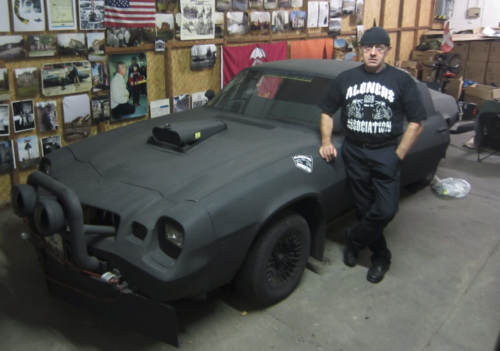
A Danish Jaeger Corps (Special Ops Force) officer named Helge Meyer thought he could help with supply-chain issues of the early-1990s by creating a… Bitchin’ Camaro (ala Dead Milkmen). Ooops, I mean Ghost Camaro (although Meyer oddly referred to the whole thing as being God’s Rambo, which sounds like a 16 year-old white kid from Minnesota spending dad’s money).
Meyer pitched US military leaders in charge of humanitarian efforts in Bosnia on a small and “fast” car for him to drive about, given the typical slow-moving military supply-chain.
He asked the US to sponsor him, and showed up with a 1979 Chevrolet car for the Americans to upgrade.
What else was from 1979…I mean besides gasoline for $0.75/gallon?
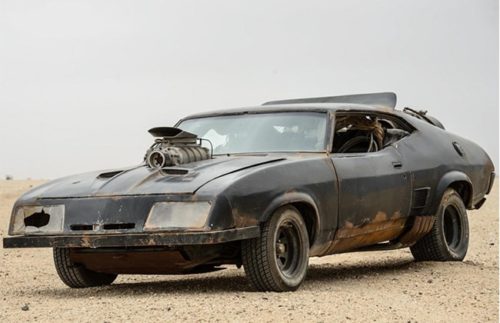
The first “Mad Max” movie was in 1979, starring a Ford with an engine that a character describes as “…last of the V-8s. She sucks nitro”.
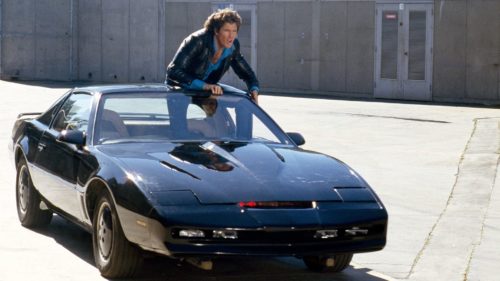
And Mad Max was only a few years before “Knight Rider” became an American TV show centered on high-tech communications stuffed into a sports car.
One can guess Meyer was a fan of both.
For his project he had US military engineers juice his 1979 Camaro stock 5.7-liter V8 engine from 175 horsepower to 220 (more like a Camaro V8 of the early 1970s). Then they added nitrous for a double jump to 440.
Very Mad Max.
Then the US engineers added radar-defeating paint “leftover” from F-117 allocation, giant infrared driving lights, run-flat foam-filled tires, a ground-to-air radio system for aircraft communication, kevlar doors and trunk, steel panels under and around the driver, body-heat sensors, fire extinguishers, night vision systems and a mine-clearing blade. Plus a personal armor system (PASGT) vest and helmet.
Very Knight Rider.
Indeed, DriveTribe called it “combining [Knight Rider] with Mad Max in order to save lives”.
One thing I’ve never seen discussed is why the engine wasn’t quieter, or even silent. In some cases story-tellers say they believe people felt joy when they could hear the loud V-8 coming, yet that seems completely counter to everything “ghost” about it.
Missed opportunity in the 1990s for US military engineers to produce a high-performance electric car to save lives like the 1980 Lektrikar II, if you ask me. After all, while electricity could still be found in Bosnia how was a gas-guzzling thing like this Camaro supposed to recharge its nitrous or avoid stopping for gas? Apparently it couldn’t go very far.
In 2006 I wrote about fast quiet special operations engines, when I briefly profiled the 1999 US Military RST-V Hybrid Electric Diesel: the “Shadow“. It had an electric-only mode with three huge “ghost” benefits: super fast, yet the heat and sound emissions were reduced to almost nothing.
Source: jalopnik
I guess anytime someone brings up the “ghost Camaro” car story, it could be a good conversation starter to ask why high profile emission signatures were favored over silent and clean options available.
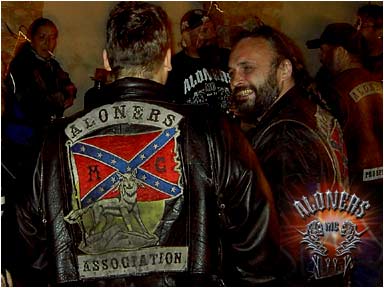
This photo indeed explains the childish “God’s Rambo” mindset I alluded to above.
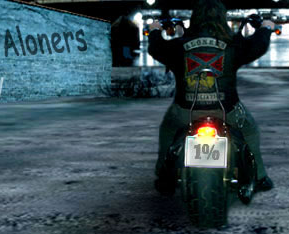
The “Aloners MC” is a German organization that flies the loser US Confederate battle flag as their logo. This is well known in Germany as symbolizing support for extreme right-wing terror groups (Nazism), given a Swastika flag is banned.
The Aloners also fly a 1% symbol next to their loser US Confederate battle flag, to symbolize they see themselves as above the law and irresponsible — thus “God’s Rambo” is reference to extreme right-wing politics, refusing to follow any laws.
Bottom line is the car wasn’t a ghost, it emitted a huge signature on purpose to let people know its presence from far away, and the man driving it can no sooner call himself a humanitarian wearing an Aloners MC shirt (promoting human slavery), than if he wore a Nazi swastika.
Here’s a sobering thought. At the same time as this guy’s operation, I knew personally some anti-fascist Germans who repeatedly drove a small diesel Volkswagen unmodified into Bosnia and survived. You’ll never hear about them or see them. They seem more like the real “ghost” deal than a show-boating Nazi club member infatuated with power unregulated, trying to emulate movies and television.
In terms of scale, UN humanitarian efforts in Bosnia were recorded as the largest operation in their history.
UNHCR managed to deliver some 950,000 metric tonnes of humanitarian assistance to some 2.7 million beneficiaries in Bosnia between 1992 and 1995. It became UNHCR’s largest humanitarian operation ever. […] By the end of 1995 there were over 250 international humanitarian organisations operating under the UNHCR ‘umbrella’. The only major humanitarian organisation to operate outside the UNHCR framework was ICRC. […] By the end of 1995 there were more than 3,000 people from over 250 humanitarian organisations carrying valid UNHCR ID cards [and] over 2,000 vehicles from more than a 150 humanitarian organisations driving around Bosnia with UNHCR registration plates.
During the three-and-a-half year operation, the 21 nations supporting [UN] Provide Promise flew 12,895 supply missions (4,197 by USAF) and delivered 160,536 metric tons (62,801.5 by USAF) of humanitarian goods to Sarajevo. In addition, the USAF airlifters flew more than 2,200 airdrop sorties across Bosnia.
Here’s another sobering thought. Some journalists at the same time as the Camaro story started running aid on their own initiative and ended up building a hugely successful humanitarian organization.
People in Need organization was established in 1992 by a group of Czech war correspondents who were no longer satisfied with merely relaying information about ongoing conflicts and began sending out aid. It gradually became established as a professional humanitarian organization striving to provide aid in troubled regions and support adherence to human rights around the world. Throughout the 25 years of its existence, People in Need has become one of the biggest non-profit organizations in Central Europe.
Now that’s an impressive legacy; Šimon Pánek and Jaromír Štětina setup a system lasting to this day. Compare that with a gas-guzzling orange parade float paid for by American taxpayers that has been in some random guy’s garage after a very brief (albeit useful) stint down range.
So I hereby propose future stories about Helge Meyer use a little more context to point out the wild inconsistencies to his story:
Felt he needed US government to engineer an extremely expensive vehicle just for him and protect him with communications to networks, yet calls himself “alone”.
Made a car obnoxiously loud to alert people of his movements, yet promoted it as a “ghost”.
Said he did it as a warrior for god, yet poses for publicity in a white-supremacist t-shirt that violates most basic (modern) religious principles.
If the measure of the story is someone who did something selfless with technology in order to help others, there are surely far better examples than this hollow-sounding one.
a blog about the poetry of information security, since 1995