The WarZone has a back-and-forth analysis of a second raid on Pearl Harbor, by long-range “flying boat” bombers from Japan, that leaves the reader (or maybe it’s just me) scratching their head.
They had been able to intercept and read U.S. weather reports that would have helped find a window with clear weather over Pearl Harbor. A change in the American codes cut them off from that information and meant the H8Ks were now going to be flying through clouds and rain. Regardless of the U.S. intel misstep, at a distance of around 200 miles from Hawaii, the flying boats were picked up by two U.S. radar stations in Hawaii, and P-40 fighters were scrambled from the island to intercept them. Though they had no airborne radar of their own to warn them of this response, the Japanese intruders were cloaked by darkness and thick clouds and managed to slip through the defenses, arriving over Oahu at around 15,000 feet early in the morning of March 4. Although the night and poor weather offered the IJN aircraft protection, the downside was that their crews now had to find their targets visually.
Open questions:
- What rain? Weather records for the month of May 1942 say “total of 0.01 inches of rain”.
- If darkness and clouds were credited with mission success on long-range approach, was that a necessary sacrifice of accuracy in the attack? I mean did the Japanese want cloud cover more than not?
- Even in clear weather Oahu was in total darkness/lockdown after December 1941. What visuals would they have relied upon?
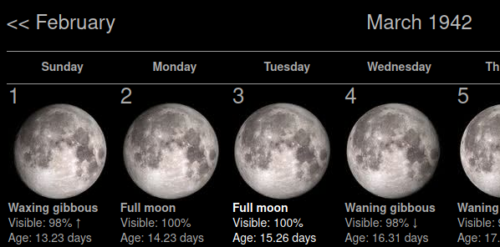
- Why couldn’t the Japanese predict weather on their own, given their battery of weather stations? They were self-timing with March 4, 1942 because full moon, no?
Lots to delve into, but primarily it is interesting that the alleged impact of that American code change was that the Japanese no longer could tell the weather. That doesn’t ring quite right.
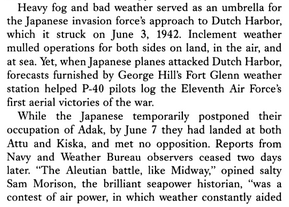
I’m not saying weather wasn’t a decisive factor. Obviously it was, both in providing cover for an approach and clarity in an attack, as described here a month later:
Perhaps even more to the point, the whole reason codes changed after December 1941 was because America’s Office of Censorship along with the US Weather Bureau strongly believed any radio broadcast of weather was a serious national security issue; for example, August 1942:
…a dense fog covered Chicago. Visibility was so low that the play-to-play commentator on the radio was almost completely unaware of the action taking place on the pitch. He struggled to transmit the match, mistaking names of the players and barely keeping the score, but he never once mentioned the reason for his handicap. The word “fog” was never uttered in the transmission and the announcer’s struggle during the live broadcast must have caused an avalanche of laughter among the listeners.
Clearly (pun not intended) weather was important data for mission success, which was an important lesson learned in the prior world war.
Because during [WWI], weather forecasting turned from a practice based on looking for repeated patterns in the past, to a mathematical model that looked towards an open future. Needless to say, a lot relied on accurate weather forecasting in wartime: aeronautics, ballistics, the drift of poison gas. But forecasts at this time were in no way reliable. …Richardson’s mathematical approach to weather forecasting was largely vindicated in the 1940s with the invention of the first digital computers, or “probability machines”. These are still the basis for much weather forecasting today.
Fun history fact, “weather front” became a phrase because modern weather forecasting was born in military predictions of weather at the front (of battle).
Thus, my complaint here is that I’m unconvinced by a simple notion that Japanese in mid-1942 couldn’t find any window for attack once they lost intercepts of American radio weather reports.
In the Pacific, the Japanese had a meteorological advantage over the Allies, thanks to Japanese weather stations ranging from Manchuria to Indochina, which allowed them to accurately predict conditions at sea.
The Japanese allegedly had sophisticated weather forecasting for the Pacific Ocean at the start of the war. And I suspect we don’t know much about it because it requires fluency in Japanese to expose better.
Another telling of the same story suggests it was a string of mechanical failures that forced three bombers out of the plan leaving only two to continue, and then those succumbed to equipment-related to navigation issues.
The H8Ks were supposed to attack in tandem, but the men in the second aircraft couldn’t hear the orders coming from the lead plane. The planes split up, and their bombs were dropped without proper targeting.
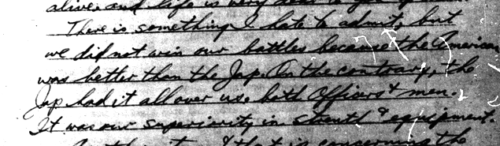
An American soldier even wrote at the time how Japanese appeared to be superior at war except in strength and equipment (such as the H8K lacking reliability and accuracy).
Thus we can’t just discount a string of weather stations that gave the Japanese advanced ability to predict clouds and rain as irrelevant to this story. In fact their model for Pacific Ocean operations was replicated by the Allies.
[Sino-American Cooperative Organization] established 70 meteorology stations throughout China, working out of caves, abandoned buildings, and military camps. Isolated teams of two or three men transmitted data three times a day to Happy Valley, where information was analyzed and relayed to the commander in chief of the Pacific. […] Located 400 miles north of Tokyo, [Inner Mongolia] Camp 4 could track weather patterns crossing central Asia to the Pacific sooner and more accurately than the Japanese.
Although, to be fair, even these advanced Allied weather stations seemed to run into hardship with the weather on long missions.
Motor Machinist’s Mate Matthew Komorowski-Kaye was stationed at Camp 3, a weather station and training facility in an abandoned Buddhist monastery…. One day he received orders to escort a convoy 1,000 miles to the east to Nationalist Chinese Column Five, which had not received supplies in more than a year. They set out in five old Chevy trucks, but as pelting rain turned the roads to rivers of mud, they had to abandon the trucks and resort to footpaths. …when they finally reached the column after 30 days, Komorowski-Kaye had dropped 30 pounds.
So much for superior equipment. At least he delivered his payload on target.
Perhaps it’s best to say that radio broadcasts out of Hawaii (observations) were an easy way to confirm conditions predicted by state-of-the-art weather stations in 1942. When a change in codes cut off the Japanese from hearing these broadcasts, their chances for mission success declined since they launched an audacious extremely long-range un-escorted “boat plane” operation that flew faster than usual weather predictions. Their equipment was prone to failures and they couldn’t pick and choose conditions for all the phases of an extremely fast plan (unlike with slow ships or short sorties from nearby bases).