If you want to talk about disinformation in America, “Jaws” is one of the best examples of how a simple story based on a false fear can do exceptional long lasting harm.
It is very difficult to get sharks back to what they are, correctly seen as loving and affectionate.
An example of shark reality is from 1959 to 2010 the TOTAL number of fatalities was 26 in America (0.5/year average). Only 1 in a 3.7 million chance.
For an obvious comparison in risk homeostasis, lightning data shows a 37.9/year average. That average means 1 in 180,746 Americans will be killed by lightning. And that actually is less likely even than being killed by a dog, which is 1 in 118,776!
Ok, to be fair American citizens killed by anything means we take the population total and divide by recorded deaths. The resulting number really shouldn’t be substituted for a probability because factors creep in.
Do you swim every day with sharks? Things like that make better factoring for probability.
Speaking of swimming with sharks then, here is another example of shark reality, as written by Sune Nightingale:
On a dive one day Cristina Zenato noticed a hook inside a shark’s mouth. In the end she just stuck her hand in and pulled it out. From that moment on the shark changed her behaviour and would show up on the dive and allow Cristina to stroke her, and would give Cristina a little nudge on the hip as if to say “hey I’m here”
Then other sharks started showing up wanting hooks removed…..Cristina now has a box of over 300 removed hooks.
“This is a wild animal and she’s giving me full trust…….It is something to be absolutely in awe of no matter how many times it happens …..what I developed is an appreciation for their vulnerability.”
Really changes your perception of sharks doesn’t it to see one being so cuddly and kind?
Again the odds of an American being killed by shark are about 1 in 3.7 million for everyone in the general population. It’s super remote on a generic predictive scale prone to error.
Yet here we see the odds of being killed by a shark actually even MORE remote, reaching towards zero for someone swimming with them constantly. They seem to love her and trust her.
The author of Jaws expressed his deep regrets for writing such a dangerous fiction, but obviously it did little to change the disinformation effect of his book and the movie.
“Spielberg certainly made the most superb movie; Peter was very pleased,” Wendy Benchley told Associated Press. “But Peter kept telling people the book was fiction, it was a novel, and that he took no more responsibility for the fear of sharks than Mario Puzo took responsibility for the Mafia,” she said, referring to Puzo’s screenplay and novel “The Godfather.”
“Jaws” was “entirely fiction,” Peter Benchley repeated in a London Daily Express article that appeared last week.
“Knowing what I know now, I could never write that book today,” said Benchley, who also co-wrote the screenplay for “Jaws.” “Sharks don’t target human beings, and they certainly don’t hold grudges.”
Americans target sharks and hold grudges against them. Not the other way around.
Nazi POW during WWII in rural America are said to have been given a great life such as somewhat free access to roam, and in some cases even were taken in by families as helpful labor.
They also worked jobs on nearby farms. ‘If it hadn’t been for the POWs, a lot of the crops would have rotted in the fields,’ May said. William Barnes remembers as a young boy, working alongside POWs near Ottawa. ‘And you never worried about your own safety?’ KMBC’s Kris Ketz asked Barnes. ‘Oh, no. No, and it never occurred to me or my parents either. They were just very nice people. They were very happy,’ Barnes said. […] ‘I think there was just, they could see that they were of European origins and had much more seemingly in common with people out here,’ said Virgil Dean, a Kansas historian. It was a complicated time but at least here, a world at war finally ended with enemies no longer. …your best allies,’ May said.
Nazis as “best allies” of America, and this was during WWII?
Rural Americans hated the Japanese. There is no way this would have been the same story given the racism of America. Yet somehow Nazis were described as “best” and “seemingly in common” because they all shared their “European origins”.
Notice the problem?
Let me make an even finer point. American farmers of Japanese heritage, dedicated hard-working loyal Americans, were put into concentration camps by California (in a campaign led by racist Agriculture industry that intended to unfairly advantage white farmers) at the same time Nazi German soldiers were sent to farms in America to save “a lot of the crops”. Completely backwards and illogical.
Now you might say soldiers in the Nazi military were just regular guys who didn’t believe in Nazism, to which I’ll point you back to why this wouldn’t work for Japanese POW. There is more to this story than just whether or not a POW is a nice guy.
When people ask why resistance cells didn’t seem to rise up and continue to attack American soldiers after WWII, consider for a minute whether the defeated Nazis were instead seen as being on the same side and taken in as allies instead of enemies.
In other words, look at how America’s sudden rise of pro-Nazism after 1948 (e.g. Dixiecrats, rejection of civil rights) manifested in Confederate flags suddenly waving again after being completely obscure/ignored before WWII.
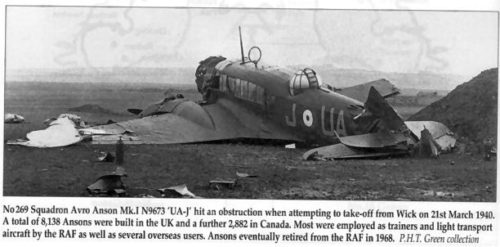
August 18, 1940 a RAF pilot was training in an unarmed plane when he was attacked during the battle of Britain. He countered by ramming the Germans, killing all as he sacrificed himself.
[Nazis] caught sight of the [RAF Avro] Anson flown by Sgt Hancock and gave chase. Reports from ground observers at the time say that the German plane turned towards the Anson and its front gunner opened fire on it. They also say that Hancock turned off his landing lights and slowed his plane, allowing the German aircraft to overfly him. Then, once the Heinkel’s pilot was committed to the manoeuvre, Hancock climbed, ramming the German plane out of the sky.
Add to the list of Ulysses Grant’s already amazing legacy (easily being the best American General and one of the best if not the best President in history) his environmentalism mixed with civil rights: deployment of Black mounted federal soldiers to protect nature (and invent mountain biking).
The first U.S. rangers included Black Americans, known at the time as Buffalo Soldiers. The U.S. Army had assigned them protective duty over newly created “national parks” before a National Park Service existed.
Approximately 500 Buffalo Soldiers were stationed throughout Yosemite, Sequoia, and General Grant parks to conserve wildlife from poachers, as well as to build access routes.
The mid-1890s — a period noted for the “Wheelmen” advocacy in creating roads — is when bicycles also were being explored as rugged all-terrain transportation even for the U.S. Army.
Thus, as it was just pointed out to me by Bilal A. Salaam, in the earliest days of modern cycling a team of eight Black soldiers can be credited with inventing how to reliably ride American mountains (and hills and everything dirt including gravel and mud).
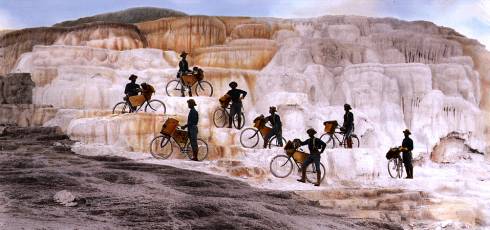
Source: Montana Historical Society. Minerva Terrace, Mammoth Hot Springs, Yellowstone National Park 1896.
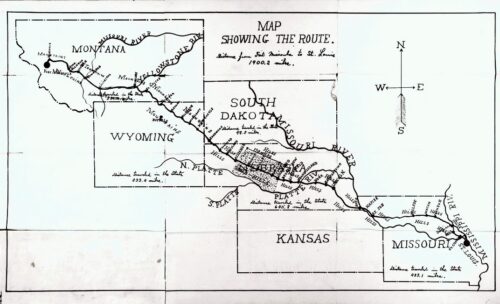
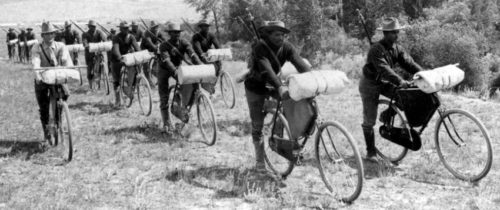
Fort Missoula’s Buffalo Soldier Bicycle Corps in fact trained and tested eight men in a wild Yellowstone, then set out with twelve more men on a jaw-dropping 1,900-miles from Fort Missoula, Montana, to Saint Louis, Missouri.
1,900 miles on bikes in just 40 days with few or no roads. Source: U.S. National Archives
Major General Nelson A. Miles, as Army Commander-in-Chief, expressed his interest by recommending that one full regiment be equipped with bicycles in 1892, and that existing troops at different posts around the country use bicycles to obtain a thorough knowledge of their own country, especially the topographical features, conditions of the roads, sources of supplies, and all information of military importance.
On May 12, 1896, Fort Missoula’s 2nd Lieutenant James A. Moss received permission to organize the 25th Infantry Bicycle Corps, the first of its kind in the country. Moss, a native of Louisiana and a West Point graduate, was an avid cyclist who set out to thoroughly test the practicality of the bicycle for military purposes.
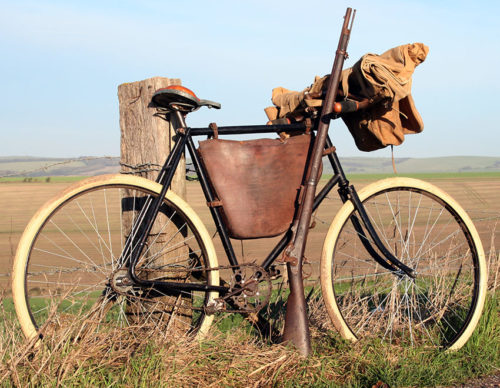
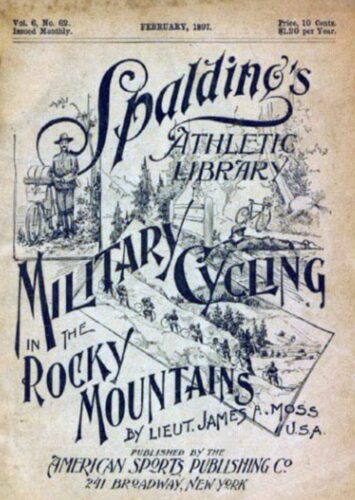
The Spalding design he sought for his men to ride was simple yet very practical. It was a fat-tire single speed with flat bars — iconic first mountain bike — that even would hold its own today.
Moss contacted the A. G. Spalding Company, who provided military bicycles at no cost. The Corps, consisting of eight black enlisted men, soon was riding in formation, drilling, scaling fences up to nine-feet high, fording streams, and pedaling 40 miles a day. Each bicycle carried a knapsack, blanket roll, and a shelter strapped to the handlebar. A hard leather frame case fit into the diamond of each bicycle and a drinking cup was kept in a cloth sack under the seat. Each rider carried a rifle (first slung over the back, later strapped to the horizontal bar) and 50 rounds of ammunition.
Source: Online Bicycle Museum. The Spalding definitively was ridden in 1896 as the first mountain bike in America, heavily marketed and produced by 1897.
That 1897 cover story looks like something straight out of 1987. It might as well say Cannondale, Schwinn or Specialized.
Not only did these Americans handle self-sufficiency with intentionally stretched supply routes (100 mile distance set between resupply stations, and carrying only 2-days food), on challenging terrain, they also navigated egregiously hostile racism and discrimination.
In the face of incredible challenges, in the awesome legacy of Grant’s best ideas, American men who rode the first organized American mountain bikes in history earned their reputation for courage and skill.
Another ride was planned for 1898 all the way to San Francisco to promote even more awareness of Black soldiers, yet it was cancelled instead for unclear reasons. Was there fear that Blacks might object to Polk’s “immoral war” of 1845 that landed California in American hands, or was there worry about Black soldiers interfering with Stanford’s ongoing genocide of non-whites?
Some believed demonstrations like Blacks on a grueling ride to San Francisco, or even serving in combat roles as soldiers in America’s “expansionist” pursuits, would gain respect and social entry or status for non-whites in America:
…many African Americans felt a good military showing by Black troops in the [1899 Spanish-American War in the] Philippines would reflect favorably and enhance their cause in the United States.
The Black soldiers, like their impressive mountain biking, indeed ended up playing an outsized heroic role in the Spanish-American war:
“If it hadn’t been for the black cavalry, the Rough Riders would have been exterminated.” Five black soldiers of the 10th Cavalry received the Medal of Honor and 25 other black soldiers were awarded the Certificate of Merit.
Yet this did not improve barriers to civil rights. Quite the opposite.
These American heroes ran directly into American racism. Instead of celebration and expansion, the backlash of resentment from white insecurity grew against these Blacks who ventured to demonstrate their value and capabilities — success in America meant risk of being punished and relegated to lesser roles.
Shortly after the end of the Spanish-American War a decline began in the status of Black serviceman. White sentiment ran against Black soldiers; too much apparently had been made of their success, causing them to forget their subservient “place.” Even Theodore Roosevelt, who had been a supporter of Black soldiers, reversing his earlier praise, stated that Black soldiers were peculiarly dependent upon their white officers and Black noncommissioned officers generally lacked the ability to command and handle the men like the best classes of whites. Roosevelt apparently was bowing to the pressures of public opinion.
At the close of the century, however, Black servicemen had become impatient with the long-standing policy of limited opportunities, discrimination, and paternalistic white officers. Chaplain Steward’s comments revealed the deepening dissatisfaction of Black servicemen: “The colored American soldier, by his own prowess, has won an acknowledged place by the side of the best trained fighters with arms,” he said. “In the fullness of his manhood he has no rejoicing in patronizing paean, the colored troops fought nobly, nor does he glow at all when told of his “faithfulness” and devotion to his white officers, qualities accentuated to the point where they might well fit an affectionate dog.”
The military refused to meet the growing expectations of its Black soldiers.
Some in America basically refused to end their anti-democratic rebellion — extending Civil War — especially as Blacks proved to be equal in every way to whites who clearly felt a sense of loss from any gains made by their fellow citizens.
A decade later in 1912, Woodrow Wilson narrowly became President with just 42% of the vote and immediately set about denigrating much of Grant’s legacy — using the White House to revive the KKK and terrorize Blacks as well as remove Blacks from service in government and the military so they would be unable to defend America from racist men like Woodrow Wilson.
No one was more at risk of experiencing targeted violence than Black veterans who had proven their valor and courage as soldiers during the Civil War, World War I, and World War II. Military service sparked dreams of racial equality for generations of African Americans, but rather than welcomed home and honored for their service, many Black veterans were targeted for mistreatment, violence, and murder during the lynching era due to their race and military experience.
Such a precedent by the Buffalo Soldiers in resilience, resourcefulness, park management and environmental stewardship continues to this day, although these first mountain bikers in American history have mostly been ignored or forgotten because of… racism.
Mountain biking culture in America never, ever speaks of this true origin story about Black cyclists.
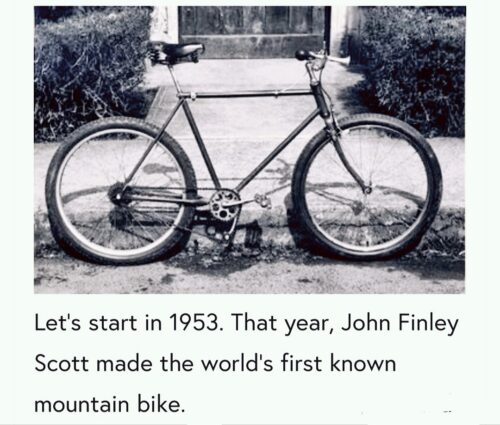
Source: Marin Museum of Bicycling.
Come on. A fat-tire single speed with flat bars for dirt in 1953…? That’s like over 50 years late. What really changed from the famous 1897 Spalding? Marin County is 94% people living in urban areas and 2% American Blacks. They seem the least likely of all to be the original mountain bikers, and yet they sure act like nobody else ever existed.
The Yellowstone expedition’s eight men were named:
Sgt. Dalbert P. Green
Cpl. John G. Williams
Pvt. John Findley
Pvt. Frank L. Johnson
Pvt. William Proctor
Pvt. William Haynes
Pvt. Elwood Forman
William W. Brown
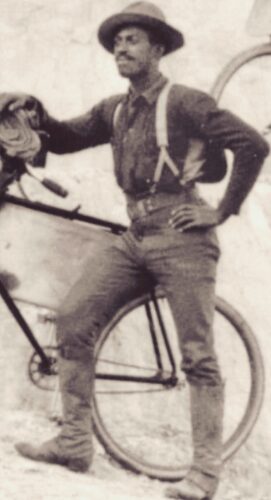
Source: Montana Historical Society. William Haynes, original American mountain biker showing his 1896 gear in Yellowstone.
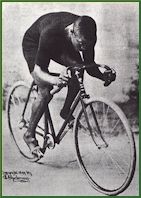
Likewise, the world’s first Black sports celebrity was a cyclist named Marshall Taylor, the forefather of today’s superstar athletes.
You would think such a man would be an American icon, yet how many times have you heard someone even say his name?
This program tells the story of the 25th Infantry’s bicycle trip from Missoula, Montana, to St. Louis, Missouri in 1897. The African American infantry took the trip to test a theory that the bicycle would replace the horse in transporting men for the army. The program also examines the life of the African American soldier at the turn of the century, in particular First Sergeant Mingo Sanders.
The only reference to the bicycle corps that I found in the National Archives files of the soldiers was a 1910 pension application from Frank Johnson, who had “the piles & rheumatism… received by riding a bicycle from Fort Missoula Montana to Saint Louis Missouri.” Frank Johnson, “Declaration for Original Invalid Pension,” 18 May 1910, State of New York, County of New York, National Archives Building, Washington, DC.
a blog about the poetry of information security, since 1995