Equifax soaks up a lot of news as the example of bad leadership, and there has been a lot said about the CSO role and person. But is it really the example we should focus on the most?
By the numbers, Equifax appears to sit among a wide group of breaches that each lost around 100-150 million accounts:
- Under Armor
- eBay
- Target
- Heartland
- Rambler
- TJX
- AOL
- MyHeritage
This group is defined purely by a quantitative measure of the 100-150 million accounts breached. It is unclear how adding qualitative measures (e.g. type of data breached) would change these groups much.
Applying qualitative measures doesn’t explain, for example, why breaches of the most sensitive data will still see a responsible CSO treated incredibly lightly. In fact, the larger breaches arguably align with the more sensitive data when you dig into it. Why are these bigger and more severe breaches ignored, compared to the far smaller breach of Equifax? It doesn’t add up.
Instead, when you look for a correlation of CSO to massive breaches (both in terms of quantity and quality of data lost), all three of the following track through a single person’s tenure. This person never did the CSO job before (or even did a similar job at a public or large organization), and is alleged to have facilitated atrocity crimes, and I think it fair to say he never should be allowed to attempt it again:
- Yahoo 2013 breach of 3 billion accounts, which predated his arrival but ran undetected and undisclosed through his entire 2014-2015 tenure, was disclosed in December 2016 as 1 billion accounts and revised to all 3 billion in October 2017
- Yahoo 2014 breach of 500 million accounts, which occurred during his tenure, known internally as state-sponsored activity in 2014 yet undisclosed until September 2016
- Facebook failures spanning his 2015-2018 tenure, including up to 600 million passwords stored in plaintext (a practice disclosed March 2019) and the token vulnerability introduced in July 2017 that compromised roughly 30 million accounts weeks after his August 2018 departure
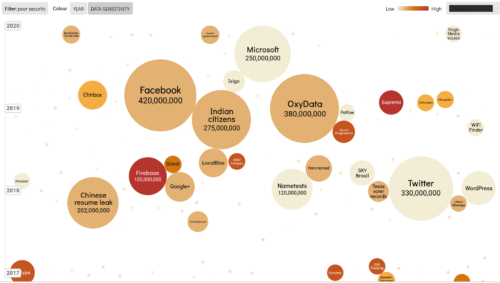
Equifax doesn’t even appear in the “Information is Beautiful” visualization tool that illustrates the world’s biggest “poor security” failures. Facebook is unmistakably largest:
And yet nothing like the following news cycles seems to exist for such an inexperienced, disgraced CSO that was responsible at Yahoo AND Facebook…
- Equifax’s security chief had some big problems…
- Equifax hired a music major as chief security officer…
- Equifax Deep Dive and CSO Qualifications
We need to seriously consider whether an Equifax CSO was treated by social media pundits as an outlier and pilloried because she is a woman held to higher ethical standard than men:
[In a study of sexism at work] …average recommended sentence was around 80 days for Jack and around 130 days for Jane. So that was a difference of nearly two months of jail sentence. …females had a 106 percent higher likelihood of being disbarred than males… punished more severely for the same offenses as men.
Why wasn’t the Yahoo/Facebook CSO scrutinized in a similar fashion given his documented/obvious lack of qualifications in organizational leadership, let alone all the other CSO within the “100-150 million tier” of breached companies?
This question remains open. And why did the Equifax CSO “retire” yet the Yahoo/Facebook CSO get shifted upward to a research position for the very thing he spectacularly failed at?
On top of the massive confidentiality breaches under the Facebook CSO, his legacy also is some of the biggest data integrity failures in history (given 50 million accounts breached, failed to block unfiltered harmful content and is alleged to have facilitated political destabilization and atrocity crimes).
The bottom line is one person attempted to be CSO twice, with no prior experience, and seems to have a track record now of nearly 4 billion accounts compromised with highly questionable disclosure practices. Yet this man seems to have escaped all the scrutiny applied to a woman.
Update Feb 3, 2020:
Vice reports “penalties for data breaches and lax security are often too pathetic to drive meaningful change”.
Update Feb 10, 2020:
While Facebook pivoted its CSO role to an external academic appointment at Stanford, and thus continues to be embroiled in breaches, Equifax went the other direction and has stayed above board.
Statement from the new Equifax CSO, announcing criminal charges, shows a clear resolution, far above the lingering dumpster fire legacy of CSO at Facebook and Yahoo:
This morning, the DOJ identified the perpetrators who attacked Equifax in 2017. With breaches, identification of the attackers (or “attribution”) can be incredibly difficult—even impossible. Being able to share this information is the result of an enormous amount of work by authorities. We cannot thank the U.S. Department of Justice, Federal Bureau of Investigation (FBI), and so many others enough for their tireless efforts to achieve this result.
In parallel, Equifax has been transforming our security program—embedding security into our DNA by driving cultural change, implementing advanced controls tailored to the specific threats we face, achieving relevant certifications, and—just as importantly—sharing what we’ve learned with our customers, partners, and authorities.
Equifax partnered with authorities right from the beginning, and two-way information sharing remains a key part of our security program. The importance of partnering with authorities cannot be overstated. If your security team doesn’t know who to contact at the FBI and the Secret Service, change that today.
At Equifax, we are doing our best to make sure that this never happens again and to support others who want to learn from our experience.
Again, nothing even close to that for Facebook has appeared, only more breaches. Yet the person who said he would lead security has not been held to account for doing the opposite.
Update April 28, 2020:
Insiders at Facebook over the past few years have revealed to me that staff asked to be reassigned away from reporting directly to the CSO, as he lacked basic leadership skill and experience. By the time he was forced to resign he had nobody left under his remit.
This has now been exposed publicly as his legacy not only is the largest breaches in history, but also discredited methods and a group “dissolved and dispersed“.
“Facebook has dissolved and dispersed its security group over the last two years, the people said. The latest cuts are part of a change in philosophy on security efforts, spurred by infighting and long-running issues within the department, they said.”
It boggles the mind how Equifax CSO was getting so much attention instead of this one, a global catastrophe of far greater impact both quantitatively and qualitatively.