September 25, 2025 seems like forever ago. The U.S. Navy held a ceremony at Naval Support Activity Bahrain to decommission USS Devastator, the last of four Avenger-class minesweepers that had operated in the Persian Gulf for 35 years. Vice Admiral George Wikoff, then commander of U.S. Naval Forces Central Command spoke fondly of the defense technological achievement:
They are “true trailblazers” who had defended freedom of navigation and deterred efforts “by adversaries to harm the innocent.”
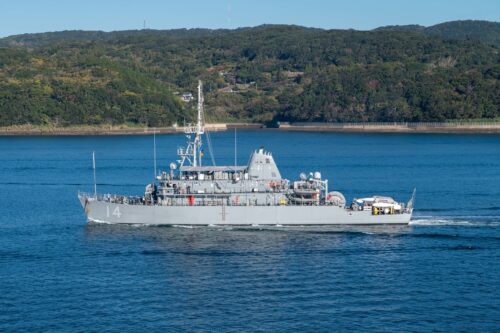
On January 9, 2026, the four decommissioned hulls — Devastator, Dextrous, Gladiator, and Sentry — were physically loaded onto a contracted heavy-lift vessel, the M/V Seaway Hawk, and removed from Bahrain. They are slated for dismantlement.
A little over a month later, defenses gone, on February 28 the United States and Israel launched Operation Epic Fury against Iran. And it goes without saying that Iran’s primary asymmetric response is mining the Strait of Hormuz.
Mind the Gap
That sequence of self-inflicted weakness is documented. For some reason the connection is not yet headline news.
Stars and Stripes covered the September ceremony. USNI News covered it the same day. The War Zone covered the January physical departure and noted, only in passing:
…the continued critical importance of naval mine-clearing capacity in the Middle East is underscored now by a new surge in geopolitical friction between the United States and Iran.
Naval News ran the best report so far: the replacement Independence-class littoral combat ships:
…have struggled to meet the requirements of operational mine countermeasures missions.
Struggled.
CNBC mentioned the decommissioning in two sentences buried inside a March 11 piece on the mine strikes.
No major outlet has run the timeline as a single story about the administration removing the directly applicable dedicated mine-clearing force, while it started the war where mines are the threat.
Avengers in Brief
The Avengers were purpose-built for this exact mission. Wooden hulls were sheathed in fiberglass, using oak, Douglas fir, and Alaskan cedar chosen specifically to minimize magnetic signature and reduce vulnerability to the magnetic-influence mines Iran stockpiles.
At 68 meters and 1,312 tons, they were small enough to operate close to mined areas. They carried sonar, video systems, cable cutters, and remotely detonated mine-disposal devices.
The Navy built 14 of them between 1987 and 1994. The four at Bahrain had been forward-deployed since 2012. At the decommissioning ceremony, Lt. Commander Alex Turner told his sailors to take home their piece of Douglas fir plank and remember what they carried with it.
Now the best American minesweeper ships in history are well on their way to Philadelphia for disposal, if not already gone.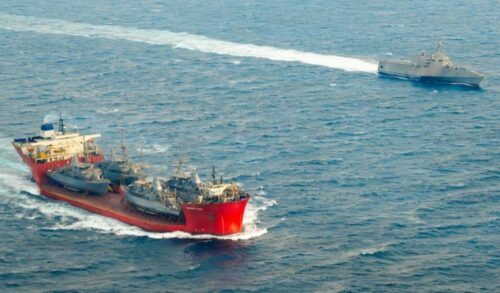
What Has Come Since
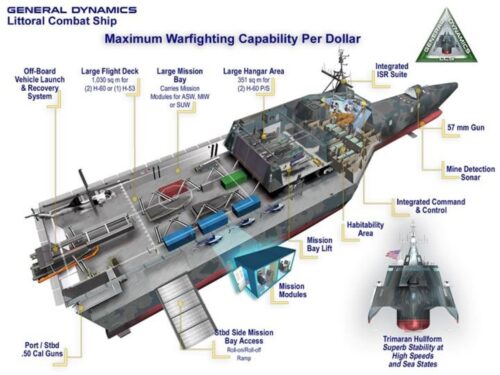
The Independence-class LCS is an aluminum trimaran built by Austal USA, which I blogged here 16 years ago… time sure flies! It is significantly larger than the Avengers. The War Zone noted at the time of departure a size problem:
…could impose limits on how close they can get to mined or potentially mined areas.

Aluminum ships are obviously metal-hulled, which is the exact opposite design choice from the superior design of wooden Avengers. As someone who has sailed across an ocean on aluminum let me be the first to say it’s the worst, the worst, hull material for many reasons not least of all corrosion.
It rapidly develops electrochemical reactions in saltwater, requires far more maintenance, and has lousy magnetic signature management. Plus it is loud and cold, a condensing drum that diminishes comfort. It’s the worst, most annoying, vessel material for open water.
And the late-addition mine countermeasures mission (MCM) package for these ships was not even installed until 2025, which means untested. The USS Canberra received it in April 2024 and arrived in Bahrain in May 2025. USS Santa Barbara and USS Tulsa followed. The whole program had been delayed by more than a decade of failed systems, equipment failures, and integration problems.
Naval News documented the specifics at the time of the Avenger retirement: during one test of the MCM package on USS Tulsa, a tow bracket broke, leaving an unmanned surface vehicle unrecoverable. Another ship had to retrieve it. The sensors in the current suite are ineffective in turbid or deep water. Hormuz is turbid. Pre-mission preparation takes approximately six hours. Any single equipment failure renders the entire system inoperable. The platform lift. The tow hook. The crane frame. Any one of them. Whole system down.
The Navy and Pentagon labeled this transition unenthusiastically, as if it was boredom with what works driving the mistakes:
…a much needed step towards modernizing the fleet.
Needed. Much needed.
The Current Situation
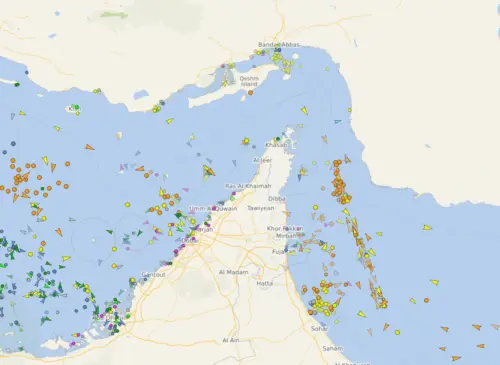
CNN reported March 10 that Iran has begun laying mines in the strait, already a few dozen. According to U.S. intelligence, Iran still retains 80 to 90 percent of its small boats and mine-layers, and could feasibly deploy hundreds more. CBS News reported that while Iran’s total mine stockpile is not publicly known, estimates over the years have ranged from 2,000 to 6,000 naval mines of Iranian, Chinese, and Russian manufacture.
Reuters reported the same day that the U.S. Navy has refused near-daily requests from the shipping industry for military escorts through the strait since the start of the war, telling industry briefings the risk of attacks is too high.
Three shipping industry sources confirmed the Navy’s position has not changed regardless of Trump propaganda: escorts will only be possible once the risk of attack is reduced. A maritime security source told Reuters that securing the strait could require taking control of Iran’s vast coastline.
There are not enough naval vessels to do that and the risks remain high even with an escort. One or two vessels can be overwhelmed by a swarm.
Trump meanwhile keeps saying that the United States is prepared to escort tankers through the strait whenever needed. How?
On March 10, Energy Secretary Chris Wright posted on X that the Navy had successfully escorted an oil tanker through Hormuz. He deleted the post within 30 minutes. White House Press Secretary Karoline Leavitt told reporters shortly after:
I can confirm that the US Navy has not escorted a tanker or a vessel at this time.
On the same day, Trump posted on Truth Social that if Iran had put mines in the strait — “and we have no reports of them doing so” — he wanted them removed immediately or Iran would face military consequences “at a level never before seen.” U.S. Central Command then announced it had destroyed 16 Iranian mine-laying vessels… laying mines.
Avengers Deactivated
Seasoned, capable minesweepers were ripped out by Trump January 2026, and then he unilaterally started a mine war in February.
The Avengers were the tool for this specific problem. They existed for exactly this threat environment in the Persian Gulf for Iranian mines, and close-in clearance work. They had 35 years of operational history in the region. The decision to remove them is as if naval decommission and commission calendars were never in the same room.
The LCS replacement has abruptly been pressed into service as justification for retiring Avengers? The “go fast” aluminum boondoggle has spent two decades trying to justify its existence. The MCM package’s first two operational installs happened only in 2025, and still offers no demonstrated operational mine countermeasures capability.
Mindless.
Trump is now threatening Iran with real-estate baron language of “never before seen” consequences, as he always does to everyone for everything. But the real calculus is that Iran very, very predictably is mining the strait that Trump just removed his own capacity to clear.
Trump spent his entire first term and his entire 2024 campaign promising to reverse everything Biden did. EVERyTHInG.
He reversed DEI programs, climate regulations, NATO commitments, foreign aid, vaccine policy, and the arrangement of furniture in the Oval Office.
Bruh. He did not reverse the decommissioning of the four minesweepers most directly relevant to a war with Iran that his own administration was planning.
So we are supposed to believe a thing Biden initiated is not Trump’s fault? The question is why the administration that undid everything else looked at four of the world’s best mine hunters in Bahrain, with Iran threatening to mine the Strait of Hormuz, and decided THAT was the one Biden decision Trump had to proceed with. One thing is for sure, there wouldn’t be mines in Hormuz right now if Trump wasn’t elected.
Trump, Pentagon Pete, war planning, short and long range strategic thinking. Most of these words will never appear in the same sentence. I have seen more organized planning at a pre-school free play hour.
General Cain tried to sound the alarm before this war began. But no, a real estate developer who has more bankruptcies than brain cells knows better. Just like last year’s bombing of Iran’s nuke sites. Hit them with a big bunch of ordinance, say their program is obliterated and move on. War won!
This war is and will be different. Trump will not get to walk away, saying he won by a TKO.
Thank you for this! It is not getting the kind of media attention it deserves! As a former journalist, I like to hunt down these underreported stories. I’m surprised some of the major news organizations haven’t run with this. It just goes to show that some of the best reporting happens at a grass roots level where journalists are less encumbered by corporations and editors. All this to say! Deeply admire what you’ve done here!
Iranian mines are largely contact and influence types that the Avengers were specifically designed and proven against. The LCS MCM package was built around detecting more sophisticated threats in cleaner water. Wrong tool, wrong environment, unproven.
A former Navy captain went on the record this week with CNN calling LCS a publicity stunt more than anything.
Given the Navy had been trying to retire the Avengers for 20 years and kept failing, because it couldn’t float a suitable replacement, is no defense of the January timing. The LCS finally found its calling with two operational MCM installs in 2025 and suddenly the Avengers are gone in January? Twenty years of delay followed by a six-week gap is a massive failure of current leadership. There was no actual reason to decommission Avengers, given that they could have been working WITH the LCS right now. There was certainly no expense spared on munitions, so what’s the deal with rushing to cut a working minesweeper a month before it’s essential to operational success?
I’m pleased as punch to find this blog. The LCS has a known Hormuz water problem with its MCM, which depends on deployed Textron CUSV and Seahawk MH-60S doing the actual work. The Avenger sailed into the minefield, operating directly. But the AN/AQS-20C and AN/ASQ-235 that an LCS will deploy lack high resolution and can’t see the Iranian moored/bottom mines in turbidity of sediment. And that’s after half a day wasted just to prepare and calibrate them pre-mission.
Avengers were not only suited for this exact work, their Mark 105 magnetic minesweeping sled and acoustic sweep gear was set to imitate a ship signature to remotely trigger influence mines. Since the LCS flips this to an Influence Sweep System on a USV, we’re talking an almost useless 38.5-foot unmanned unreliable bucket with fragile tow brackets and line-of-sight issues (don’t get me started on Starlink vulnerability, the absurdity of mine clearance comms routing through jammed consumer-grade networks).
As you said, USS Tulsa lost its USV tow bracket, which meant the entire sweep capability was gone. It’s no Avenger.
Why has none of the MSM covered this most important story of the War?
Sixteen minesweepers needed, according to WashInst:
“For decades, the United States has systematically underresourced countermine warfare, preferring to leave this unglamorous mission to European partners in a division of labor left over from the Cold War. Accordingly, the U.S. military has long accepted its deficiency in dealing with the main naval threat in the Gulf: Iran’s ability to surreptitiously lay mines in the Strait of Hormuz and around key Gulf Cooperation Council (GCC) anchorages. Whereas Britain’s Royal Navy traditionally maintained four small but effective MCM vessels in the northern Gulf, U.S. Navy forces in Bahrain kept only two new minesweepers in service and two older vessels on standby. Experts agree that up to sixteen MCM vessels might be needed to keep Hormuz clear of mines.” https://www.washingtoninstitute.org/policy-analysis/political-military-challenges-demining-strait-hormuz