
The DSM-5 criteria for Narcissistic Personality Disorder are behavioral. They describe observable patterns of action, speech, and relational behavior. And the clinical personality disorder can be diagnosed remotely.
They don’t require an fMRI or a therapeutic relationship to identify. All you need is someone to publicly, repeatedly, across decades and thousands of documented instances, demonstrate grandiosity, entitlement, exploitative behavior, lack of empathy, and demand for admiration. Narcissistic Personality Disorder in the DSM-5 requires only five of nine.
That’s not ambiguous.
A new bridge story hits nearly all the criteria in a single news cycle.
Guess who
Canada spent $4.7 billion building a bridge to America. Trump’s non-sequitur response has been only: I did nothing but I deserve half of what you built, you must compensate me even when I spent nothing, and you cannot open it until you give me something, I’m stopping this until it’s mine.
Trade policy? No. Negotiation? No. That’s just pathological entitlement response to someone else’s accomplishment.
Trump endorsed this exact bridge in 2017. He issued a joint statement with Trudeau calling it a “vital economic link between our two countries.” The same bridge he’s now threatening to block, he previously took credit for supporting.
That’s textbook NPD pattern because the object hasn’t changed, the narcissistic supply calculation has. When endorsing it served him, it was vital. When Canada has an independent relationship with China, the same bridge becomes a grievance instrument. The bridge is just a prop for the mental disorder.
Also note that the Moroun family, who owns the Ambassador Bridge and wants to protect their toll monopoly, has been pulling Trump’s coin-operated strings. All that “compensation” heat that Trump references is his private financial interest, which maps to the exploitative criterion even more directly.
Now run the latest Trump statements about the bridge against all the DSM-5 criteria:
| DSM-5 Criterion | Trump Statements on Gordie Howe Bridge |
| Grandiose sense of self-importance | The bridge exists, therefore I deserve ownership of it. |
| Sense of entitlement | Demanding compensation when the US contributed nothing to construction costs. |
| Interpersonally exploitative | Threatening to block the opening to extract concessions Canada doesn’t owe. |
| Requires excessive admiration | The explicit demand that Canada treat him with “fairness and respect” as a precondition for allowing infrastructure to function. |
| Lacks empathy | Zero consideration for the communities on both sides who need the bridge. |
| Preoccupation with fantasies of unlimited power | Claiming authority to block a bridge Canada paid for on land that includes Michigan state jurisdiction. |
| Arrogant behaviors | The public ultimatum format itself, “We will start negotiations, IMMEDIATELY.” |
Seven of nine criteria, one news story, one Tuesday morning before I’ve even had my tea.
And then the hockey claim that China will “terminate” hockey in Canada? No. That’s confabulation in service of narcissistic narrative. It doesn’t need to be true, and it’s not true. It artificially makes Canada’s safe and independent relationships look threatening instead, in order for the narcissist to position their baseless demand for submission as somehow justified.
NPD specifically involves exploiting others and lacking empathy. If the disorder works for Trump because it gets him power illegitimately, then the absence of personal distress isn’t evidence of absence of the disorder. It’s evidence he externalized all cost. The distress and impairment are experienced by everyone else. Or to be more precise, it’s externalized as the rage, retaliation, and hateful policies.
Goldwater was Trump
In 1964, FACT magazine polled 12,356 psychiatrists on whether Goldwater was psychologically fit for the presidency. 1,189 said he was unfit.
And he was, in fact, unfit.
Goldwater had openly discussed using tactical nuclear weapons in Vietnam, voted against the Civil Rights Act, and represented a radical rightward shift that alarmed professionals who understood authoritarian personality structures. The psychiatrists who responded were applying professional expertise to observable danger signals.
As they should have then, and they should continue to do.
The problem was not the diagnosis. The problem was that FACT magazine’s editor, Ralph Ginzburg, was a systematic disinformation agent, not a scientist. He predetermined his conclusion before polling a single psychiatrist, fabricated attributions, selectively edited professional responses to remove anything favorable to Goldwater, and ignored explicit warnings from the American Psychiatric Association that his methodology was invalid. The 1,189 psychiatrists who said Goldwater was unfit may well have been right. Ginzburg’s presentation of their work was fraud.
In a very American twist, Goldwater sued FACT for defamation and won. The court found systematic editorial misconduct. But in the same ruling, the court explicitly affirmed that a candidate’s mental fitness is “not only relevant but indeed crucial” for voters to evaluate. The ruling said: this work matters, and Ginzburg did it dishonestly. The obvious lesson was that qualified professionals should do it properly.
The APA drew the opposite conclusion. It adopted Section 7.3 in 1973, prohibiting all professional psychiatric commentary on public figures. To be clear the APA was not responding to a clinical ethics crisis. It was making a political move that contradicted what the court actually ruled. The conservatives in America are terrified by mental health science and professionalism.
Ronald Reagan campaigned on the concept that there’s no need for mental health, only more prisons. While he backed ruthless dictators and removed solar panels from the White House to declare dirty coal and oil the future, he signed the Omnibus Budget Reconciliation Act of 1981 to repeal Carter’s Mental Health Systems Act.
The institutional response, with no rational or legal basis, suddenly prevented professional assessments of politicians. The rule didn’t emerge from a principled debate about diagnostic methodology. It emerged because psychiatric evaluation of a right-wing extremist politician had democratic consequences that powerful people wanted to prevent, and a stupid propagandist’s sloppy misconduct gave them an easy pretext to manipulate.
Actual malice
Goldwater used the “actual malice” standard from a case called New York Times v. Sullivan. To understand how the APA weaponized and inverted this case to silence professionals politically, you have to look at what the case actually was.
Ginzburg was not a journalist and he was not conducting science. He was running a propaganda operation. On July 16, 1964, the day Goldwater was nominated, before a single psychiatrist was polled or any research conducted, Ginzburg’s managing editor wrote a letter:
…say, basically, that Goldwater is so belligerent, suspicious, hot-tempered, and rigid because he has deep-seated doubts about his masculinity.
The conclusion existed before the evidence. Everything that followed was reverse-engineered to support it.
The research was deliberately selective. Derogatory statements in source materials were marked for use; complimentary statements in the same paragraphs were ignored. Ginzburg took his editor’s draft, deleted the careful references to “authoritarian personality,” and unilaterally escalated to “paranoia” and “mentally ill,” a clinical conclusion his own editor hadn’t reached and that no psychiatrist reviewed before publication.
His qualifications? Nothing. Two college psychology courses.
The poll sent to 12,356 psychiatrists was loaded. The covering letter referenced Goldwater’s alleged “two nervous breakdowns” based on a single magazine interview where Mrs. Goldwater used a lay term for exhaustion from overwork. Ginzburg knew that Goldwater, Mrs. Goldwater, their personal physician, and a lifelong friend all denied any nervous breakdown in the medical sense. He published it anyway without interviewing or attempting to interview any of them.
Then editing made it worse. Ginzburg deleted statements favorable to Goldwater from psychiatrists’ responses. He added phrases, sentences, and whole paragraphs, some he wrote himself, some he claimed came from other letters he couldn’t identify. He combined multiple letters into single “responses.” He published 31 anonymous letters as “name withheld, M.D.” to make it appear doctors had signed but requested anonymity, when they hadn’t signed at all. One signed letter critical of the poll was published as “anonymous.”
When some editorial omissions were accidentally indicated by ellipses, Ginzburg testified those had “crept in by error,” meaning his policy was to hide the cuts. The American Psychiatric Association itself warned him before publication that the poll was invalid. He published anyway.
When asked under oath to identify the “many people around Goldwater” who thought he needed a psychiatrist, Ginzburg couldn’t name one. When asked about “European reporters” reminded of 1930s Germany, he said “I don’t recall who I had in mind.” When asked about his claim that armed guards around a candidate were unprecedented in American history, his source was his own “lifetime of reading.” Armed guards had been posted around Governor Scranton at the same convention, same hotel.
The court found actual malice. Goldwater was awarded one dollar in compensatory damages, meaning he suffered essentially no provable harm, along with $75,000 in punitive damages.
And now here is what matters most, the part the APA buried.
The same court, in the same opinion, wrote:
His mental and physical health were proper targets for investigation and for adverse comment. We live in an age of powerful nuclear, chemical and biological weapons capable of massive destruction. These weapons are under the ultimate control of the President, and knowledge of the mental stability of the men who seek to be President is not only relevant but indeed crucial if the electorate is to choose intelligently.
The court said that assessing presidential candidates’ mental fitness is crucial to political discourse.
Read that twice.
It said Ginzburg’s work was fraud, not assessment. The obvious institutional response was: this must be done properly, by qualified professionals, with honest methodology.
Justice Black’s dissent went even further. He wrote:
…the public has an unqualified right to have the character and fitness of anyone who aspires to the Presidency held up for the closest scrutiny [and that] extravagant, reckless statements and even claims which may not be true seem to me an inevitable and perhaps essential part of the process by which the voting public informs itself.
He predicted correctly the ruling would undermine necessary political debate by:
…making fearful and timid those who should under our Constitution feel totally free openly to criticize Presidential candidates.
Black noted that a professional article written no different from how “many campaign articles unquestionably are” would be silenced without cause, while the campaign articles would not be. That’s an unequal and unjust outcome that promotes unprofessional speech and silences professionals.
So the sequence is:
- A propagandist commits systematic editorial fraud while impersonating psychiatric authority.
- The court rules the work was fraudulent, while explicitly affirming that assessing candidates’ mental fitness is “not only relevant but indeed crucial.”
- Goldwater suffers no provable harm but collects $75,000 in punitive damages.
- The Supreme Court declines to hear the appeal.
- The APA adopts a blanket rule prohibiting all professional psychiatric commentary on public figures, the exact opposite of what the court said was needed.
The court said a fraud was a fraud and real assessment is crucial. The APA banned real assessment.
The rule doesn’t follow from the case. It contradicts the case.
The court called for qualified professionals to do this work properly. The APA instead rushed to prohibit them from doing it at all.
That’s not an ethical inference from a legal ruling. It’s a political inversion to do harm.
The APA “Do harm” principle
Look at what the rule actually accomplishes structurally. It doesn’t prevent bad diagnoses, since any crank can say whatever they want publicly. What it prevents is credentialed professionals applying their expertise to publicly observable behavior when that behavior has massive, dangerous political implications. It specifically disarms the people most qualified to identify the worst pathology in the people likely to cause the most harm.
That’s a “do harm” design, an intended function.
The rule treats political leaders as a protected class whose psychological fitness cannot be professionally evaluated, while simultaneously those same leaders make decisions affecting millions of lives. A corporate board can require psychological evaluation of a CEO. The military screens for personality disorders. But the person given nuclear launch authority gets shielded from the same scrutiny by a bullshit “professional ethics” rule that originated in corrupt right-wing political coverups.
Let’s be honest, 1973 wasn’t just post-Goldwater, it was Nixon. It was Reagan. The white nationalist institutional project was consolidating into a “war” against non-whites. The last thing that project needed was a professional framework for identifying authoritarian pathology in political leaders. The Goldwater Rule gave protection to the criminal mind.
The result is exactly what you’d design if you wanted to enable harm: the people who can identify the pathology are professionally prohibited from naming it, the people who can’t identify it are free to speculate irresponsibly, and the public gets neither competent assessment nor protection.
The rule doesn’t serve patients, since there is no patient. It doesn’t serve the public, since the public is actively harmed by an enforced silence. It ONLY serves the political interests of people who promote a particular form of unfitness for leadership.
Duty to warn
Political action and accurate diagnosis aren’t competing approaches. Accurate diagnosis by professionals informs political action. Telling voters their president has a clinically recognizable personality disorder that makes his behavior predictable, and dangerously unresponsive to normal representation pressure, is politically necessary information.
Bandy Lee and the “Duty to Warn” (PDF) professionals made exactly this argument.
What I am saying is, I think that if we, psychiatrists with experience in assessing dangerousness and working with dangerous people, if we remain silent, I would say we give passive support to people who would make the extremely dangerous and naive mistake of assuming that Trump is a normal politician. Or that he’s a normal president. He’s no more normal than Hitler was. Again, that doesn’t mean he is Hitler. I’m not saying he’s Mussolini. He is Trump. But dangerousness sometimes is so obvious, any layman can recognize it from all across the street even if they have never sat down and talked to the violent criminal. So, my point is that for us to remain silent here is a sign either of incompetence on our part, or our inability to recognize dangerousness when it is staring us in the face blatantly and egregiously. Or, it is sheer irresponsibility on our part to remain passive in the face of such an obvious danger.
The Goldwater Rule has been abused and misunderstood, to politically block legitimate public safety discussion.
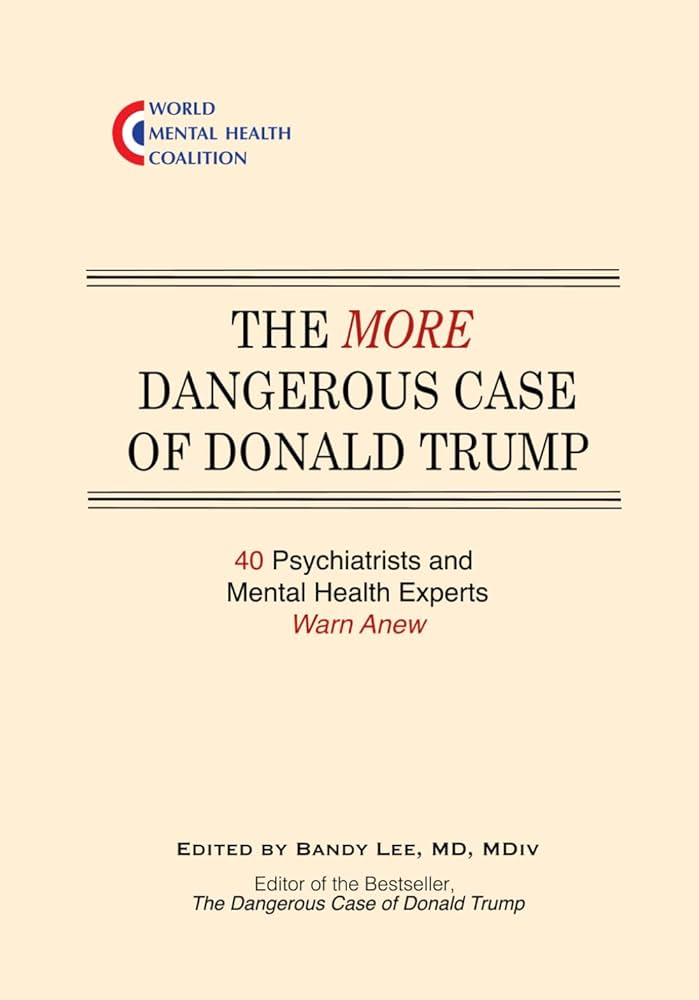
Read it.
Because the American courts say professionals should be doing exactly this.
The opposition to this bridge has always been about protecting the Moroun toll monopoly, and Trump is the latest instrument. Former Governor Rick Snyder, a Republican, wrote that there is exactly one “big winner” from Trump threats: the Moroun family. That’s a Republican governor saying it directly. It has nothing to do with China, or even Canada. It’s just flat greed.