
First of all, let’s just admit that the British love the spectacle of suffering and gore. London is littered with “museums” glorifying the worst chapters in human history, almost as joyful interpretations of others’ suffering.
Perhaps you could call it the “keep calm and carry on” being a deeper cultural pun about “keep calm and carrion”? Or perhaps I spent too much time in the dank, dark corridors of the London Dungeon.
Notably, a compelling new Samurai exhibit is being held away from Japan.
…some of the country’s most formidable warriors were a group of female samurai called the Onna-bugeisha.
They were every bit as deadly and powerful as their male counterparts and were trained using the same self-defense and offensive maneuvers. They used a special weapon called a naginata…
Eeeeeek. Nails on chalkboard?
This weapon analysis is bullshit. The naginata polearm was used by samurai, foot soldiers, and warrior monks from the Heian period onward.
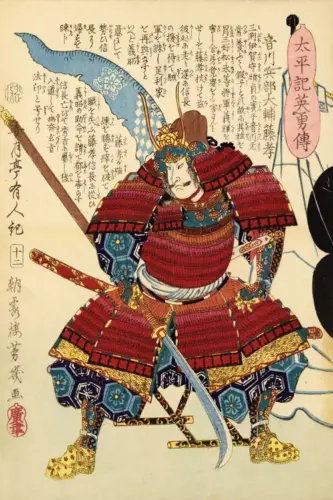
It was a primary weapon during the Genpei War (1180–1185) and Nanboku-chō period (1336–1392). When it became associated with women, it was centuries later during the Edo period’s long peace (1603–1868). The weapon was dated, as they always are, and lost battlefield relevance. Women of the samurai class carried it when it had been repurposed as a status symbol and for self-defense. The association therefore was a Tokugawa-era development, not an origin story.
Dare I say this exhibit’s source material retrojects a gendered identity onto a weapon that spent centuries as a general-purpose military tool primarily used by men, because a fraudulent “designed for women” framing creates modern narrative more useful than the actual history?
So, second of all, this exhibit sees ideology in the past but not in its own mirror. It tells us why it deconstructs Meiji myth-making, while it is performing 2026 myth-making.
This British exhibit could have led with the insight that the West fundamentally misunderstands what being a “samurai” meant. It could have used the women’s history to blow open that misunderstanding for everyone, male and female. Instead it drives deeper into a narrow definition and pushes women into it. That makes it representation without revision.
Notice the reporters who focus on fierceness and brutality of woman, which I’m not sure is the correct path towards redeeming women in history.
“It’s a surprise that comes from a narrow use or a narrow understanding of the word samurai, because samurai doesn’t mean warrior,” Dr Rosina Buckland, Asahi Shimbun curator of Japanese Collections, told The Independent.
According to the exhibition, the most celebrated female samurai was Tomoe Gozen who died in 1247, and whose exploits are the subject of The Tale of the Heike. She was reported to have ripped off the head of the samurai Uchida Saburo leyoshi who tried to capture her for ransom.
The curator literally says “samurai doesn’t mean warrior”, an arguably radical claim because it reframes everything, and then the exhibit’s marquee story becomes a woman warrior ripping someone’s head off. I’m only left wondering if she also shit down his neck?
The corrective gets completely swallowed by the very framework it’s supposedly correcting.
The exhibit claims “women made up half of the samurai class” by expanding “samurai” to mean social class rather than warrior caste, then promotes the exhibit with gorified stories that rely on a narrow warrior definition. It’s using both definitions simultaneously depending on which one serves the current sentence.
That’s not scholarship, it’s rhetoric.
Third, something smells off about this whole thing. The Huo Family Foundation sponsorship is a buried detail. A China-based foundation sponsoring an exhibit in Britain to re-frame Japan’s martial identity raises, well, red flags. The funding source may be the context.
Others have pointed out the curation within context is problematic. The object selection gives us a tsuba with a world map (exceedingly rare) cherry-picked to suggest Edo-period global consciousness that wasn’t representative. It offers ornate ceremonial armor that the Japanese don’t consider authentic to samurai identity. Neither curator is a weapon or armor specialist, a fact I find almost impossible to believe given the British adoration of weapons and armor in their exhibits. They seem to have set up evidence which coincidentally fits a Chinese thesis about Japan, rather than building from evidence.
To be fair, Broderick and Buckland clearly agree that the samurai meant more than warrior. The failure becomes that their exhibit couldn’t commit to this story without also promoting gratuitous violence to seek attention in the British market.
Fourth, and finally, this is a familiar pattern: women are admitted to the canon by demonstrating they can meet criteria, not by challenging whether those criteria are correct. The Onna-bugeisha become legible to a museum audience not because samurai culture encompassed governance, education, estate management, arts, and social organization — important recognition of the proper definition and all things women were deeply embedded in — but because a woman ripped the head off someone. The entry ticket to historical recognition is unnecessarily reset to brutality.
It reminds me how Hillary Clinton worked for Goldwater. She didn’t enter politics by articulating an alternative vision; she entered by proving she could operate within the most aggressive, unfit for rule, existing framework available, then spent decades unable to fully shed her origin story. The price of admission shaped the thing it would allow her to be.