

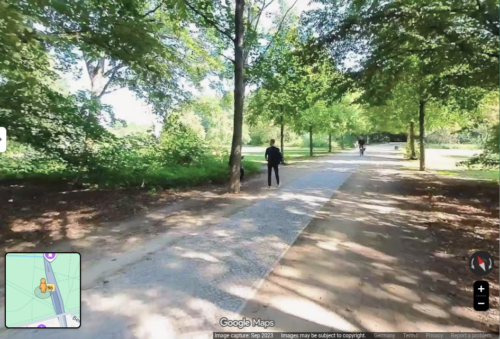
People leaving the 48th Christopher Street Day on 25 July 2026, around 22:00, were attacked by a white van that entered the Great Animal Hunting Garden (Großer Tiergarten) in Berlin and drove deep into the middle of the park along a pedestrian path, the Ahornsteig, near Lennéstraße by Potsdamer Platz, striking people along it before crashing into a tree. One woman died at the scene.
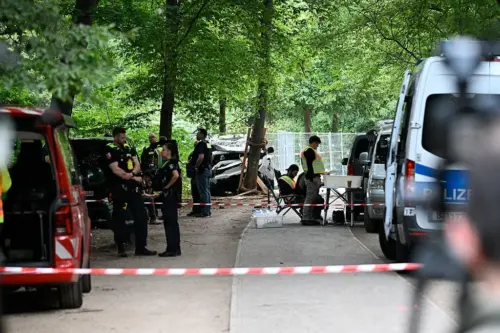
The joint release of Polizei Berlin and the Generalstaatsanwaltschaft records further injuries from the vehicle and from stabbing tools. There is still disagreement on the harms: Bundesinnenminister Alexander Dobrindt said twenty-nine injured, the fire service itemized three life-threatening, eight severe and five light. Scene photographs show a white Citroën van-bodied passenger vehicle with Berlin plates, a Pkw by registration and a Transporter by body; police call it a private vehicle against early reports of a rental. It was abandoned at the scene, the suspect on the run with a stabbing weapon after striking at people on foot, his phone left behind in the van. Overnight police arrested a second man they describe as his suspected passenger.
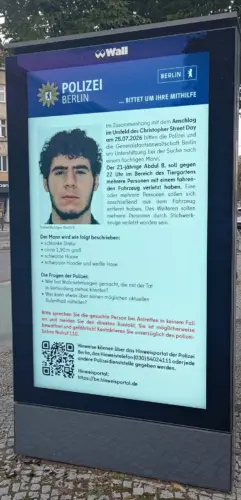
On Sunday around 18:00 a police special unit located Abdul Ballout in a Spandau allotment colony; police say he ran at officers with a stabbing weapon and was shot dead.
The location of the attack is clear. The van drove deep into the park on a wide path, outside the demonstration area, after the demonstration had ended while the crowd was still reveling in the night. 22:00 after CSD official events means near peak density for the night festivities.
CSD Berlin is a registered assembly. Berliner CSD e.V. files it annually under Article 8 of the Grundgesetz, and Berlin assigns assembly protection to its police. Brokdorf (BVerfG, 1 BvR 233/81) obliges the state to shield an assembly against external attack.
The CSD event area itself sat inside a police barrier concept under Polizeipräsidentin Barbara Slowik Meisel, and that concept held. The attacker use of the Ahornsteig lies outside it, a Grünanlage path maintained by the Straßen- und Grünflächenamt of Bezirksamt Mitte in the Geschäftsbereich of Stadtrat Christopher Schriner. The office responsible for the park sits at Straße des 17. Juni 31, inside the park. Its trucks use the paths. The entrances the attacker exploited are built for maintenance, and apparently unguarded despite the high risk for the kind of attack Germany has become known for failing to prevent.
The responsibility for the entrance vulnerability was established on 11 December 2025. The Senatsverwaltung für Inneres und Sport answered Schriftliche Anfrage 19/24467 on vehicle barriers at Christmas markets, the same threat class as CSD. Asked whether Zufahrtsschutz belongs to counterterrorism, to general Gefahrenabwehr, or to an organizer’s civil duty of care, Senator Iris Spranger’s administration answered over the signature of Staatssekretär Christian Hochgrebe:
Eine von den Umständen des jeweiligen Einzelfalls losgelöste allgemeingültige Abgrenzung ist nicht möglich.
EN: It is not possible to draw a generally valid distinction that is independent of the circumstances of each individual case.
The document lays out divisions of responsibility. Organizers of private events carry the civil Verkehrssicherungspflicht for the event ground. Everything beyond falls to the Bezirksamt as Ordnungsbehörde. The police advise, decide nothing, and bear, in the Senate’s words, neither competence nor obligation to erect vehicle barriers at private events, reserving only emergency action and case-by-case exception.
The same five pages date the controlling judgment (OVG 11 B 6.19) to two different dates: 6 August 2020 in the questioners’ quoted preamble, 15 June 2022 in the Senate’s answer to question six. The discrepancy went to print unreconciled. For assemblies the organizer’s share falls away entirely, because assembly law forbids charging protection costs to people exercising a constitutional right. Berlin’s Grünanlagengesetz, amended in 2024, ties park protection duties to Sondernutzung permits (GVBl. 2024 S. 475, § 6 Abs. 5 S. 2). A dispersing crowd holds no permit.
| Ground | Owner | Instrument |
|---|---|---|
| Demonstration route and rally, for the duration | Polizei Berlin | Assembly law, police barrier concept |
| Event ground at private events | Veranstalter | Civil Verkehrssicherungspflicht |
| Everything beyond, including park paths | Bezirksamt as Ordnungsbehörde | General Gefahrenabwehr, Grünanlagengesetz |
| The doctrine | Senatsverwaltung für Inneres und Sport | Drucksache 19/24467: case by case only |
The deployment on the night of CSD then gets clarified by the police’s own statements. Spokesman Florian Nath told reporters that 214 Okta concrete blocks and 40 further Zufahrtsschutzelemente stood guarded around the entire Veranstaltungsgelände, the standard package, and that driving onto the event ground was not possible.
Onto the event ground. Note that detail.
He located the attack on the access paths between Lennéstraße and the Ahornsteig, near the event ground.
Near the event ground. Note that difference.
Regierender Bürgermeister Kai Wegner said the same: outside the secured area. Both statements are accurate, and together they explain a failure to protect people attending the event. The 254 elements enclosed the rally ground as formally defined. That defines the crowd at 22:00 on pedestrian paths deep inside a park as “outside” the event grounds, even though common sense would say it’s the most plausible place to be for CSD at that time.
Lennéstraße runs open along the park’s southern edge for half a kilometer, lined with entrances sized for maintenance trucks. The western edge is the former Entlastungsstraße roadbed over the B96 tunnel, a paved corridor open at both ends, and the Ahornsteig’s mouth opens off their junction. An eyewitness told AFP the van turned off Lennéstraße at speed; the police say the entry point is unidentified and the vehicle arrived unnoticed on partly unlit paths.
Asked how it got through, Nath answered: “Das fragen wir uns auch.” (EN: We ask ourselves the same thing.) No rule required the barriers to cover the space the crowd actually occupied, so nobody was responsible for checking whether they did. The standard measures protect moving onto the event ground and leave the crowds open to attack near the event ground, despite being deep inside a park where no vehicles should enter.
The escape of the driver also needs examination. He ran into a dark park filling with thousands who were also fleeing in every direction. The year’s largest police concentration was a few hundred meters away, facing inward. Earlier in the day the police had focused on heavy scrutiny of what the crowd was saying, yet with a terrorist on the loose the police suddenly went slack. There was no cordon to run into after a terror attack, because the ground he crossed sat inside nobody’s assignment. A ring around a fleeing man must exist to stop him, yet the police allegedly told everyone to leave, having the opposite effect and making it impossible to catch him. Thermal imaging over the Tiergarten and GSG 9 through Anhalter Bahnhof produced nothing for twenty hours. How the police found him, they have not yet explained; per a Bild report it was a tip from the attacker’s personal circle.
When police ended the CSD the crowd was sent out of the barriers and onto streets and unprotected paths. The van was dead against a tree. The driver had stepped from the wreck with a stabbing weapon, struck at people on foot, and vanished into the dark, and whether a second attacker moved in the crowd was, at that hour, unknown. The decision to disperse faced genuine uncertainty. Dispersal without a filter answered it badly.
Flushing a sector and filtering it are incompatible without a filter, and the outflow ran without checkpoints. Tens of thousands streamed across exactly the class of ground where the attack had just occurred, and the flow that carried them out carried the attacker with it. Holding the hardened ground against emptying it was a judgment call under pressure; a filter on the exits was a plan that had to exist beforehand, and it was absent from the concept the way the Ahornsteig was absent from the barrier map. Why the call was made, and against what alternatives, the police have yet to explain. An attack aimed at an assembly, that ends the assembly, obtains its object.
Earlier in the day, a stark contrast is worth considering. A few kilometers north, at the Internationalist Queer Pride, police monitored very closely every move and word in a march of 7,000 and made nine arrests, most for propaganda offenses tied to the “river-to-the-sea” chant; a year earlier the force put about 1,300 officers on the 10,000-person version. Slogan enforcement has a statute, a court-maintained standard, assigned listeners, and a measured output by morning. The full stack of instant threat assessment exists for words. For a giant white van driving through a park at night, two tons of moving mass at the edge of the largest gathering of the year, the police appeared unprepared and unaware of how to protect the public.
The gap follows from two planning methods. Since the Love Parade deaths in Duisburg, German event planning models crowd flow so that people can leave fast and spread wide. On the other hand, barrier planning follows the permit process for the event and the event schedule. The unprotected area is the difference between the human movement model and the formality of a space permit, and it is largest during departure, when egress design spreads people across many routes at the moment the barrier plan stands down. Currently no German planning document reconciles the difference between reality and bureaucracy.
The same boundary failure has been repeating in successive configurations.
| Date | Site | Boundary that failed |
|---|---|---|
| 19 Dec 2016 | Berlin, Breitscheidplatz | Market flank without barriers |
| 7 Apr 2018 | Münster, Kiepenkerl terrace | Permanent public space, no event boundary existed |
| 1 Dec 2020 | Trier, pedestrian zone | Permanent public space |
| 20 Dec 2024 | Magdeburg, Christmas market | Gap kept open for rescue vehicles inside the barrier plan |
| 13 Feb 2025 | Munich, ver.di march | Moving assembly, perimeter existed only where the march stood |
| 3 Mar 2025 | Mannheim, Paradeplatz | Permanent public space |
| 25 Jul 2026 | Berlin, Großer Tiergarten | Departure area beyond the assembly boundary, after the assembly ended |
In three of the seven cases the driver already sat in state threat files, Breitscheidplatz, Magdeburg, the Tiergarten, and in each the file changed nothing. The other four had at most ordinary police contact, which is the impulsive-attacker profile prediction cannot reach.
The Breitscheidplatz driver was a registered Gefährder under observation.
The Magdeburg driver had years of warnings on file.
When Ballout attacked CSD he already was polizeibekannt, and his file, like Amri’s, had been handled in the Gemeinsames Terrorismusabwehrzentrum, most recently in its working group for the highest-risk cases.
The surveillance argument says increasing more and more knowledge enables interception: detect, decide, interdict, chain complete before contact. Surveillance ran at maximum on Ballout and delivered zero interdiction. The chain broke at its final link, and expanding the first link repairs nothing.
A two-ton van among pedestrians is visible to any camera and any bystander, and here the condition was not an instant but a duration, sustained driving through the park interior, deep among people walking home, the violation in continuous existence for the length of the run. If you can’t identify a giant white van speeding through a park immediately, then expanding detailed surveillance with highly sophisticated markers makes no sense at all.
No one was assigned to watch the park at 22:00, because the 254 elements watched the polygon’s edge and the park interior was on the other side, in a park that should not have had cars inside at night. This is not a time for scoring and inference, because the answer is simple. Vehicles do not belong in crowd space, rescue and maintenance being known exceptions, everything else is denied. The infamous plain white van that would fail every allow list is not a generic object awaiting assessment. It is the hazard itself, the object the term Überfahrtat was coined for.
Stopping two tons at fourteen meters per second takes counter-mass (barriers) placed in advance; no dispatch is fast enough. German law already knows this and takes kinetic energy seriously: machine-safety law requires guards between moving mass and bodies, and the Eisenbahnkreuzungsgesetz mandates separation where rail crosses road, with costs divided by statute (§ 13 EKrG). Nobody proposes to solve railroad-crossing deaths with better locomotive driver registration and detailed monitoring.
If the security test collapses on the most visible object under the simplest rule, the argument for finer inputs and more expensive surveillance will repair nothing. A face at fifty meters or a phone location is a weaker signal than a white van approaching a crowd, and it feeds the same missing step.
The math also proves this point. There are fifty million registered cars in Germany, single-digit attackers per year, so individual prediction floods its operators with false alarms while the class rule misses no vehicle attacker by definition. The rule owns the mass-casualty vector. The blade phase that followed the crash belongs to police response, and the van did the mass harm.
And prediction assumes the wrong attacker, a plotter who emits signals over weeks. Münster’s investigators pointed to documented psychological problems; Trier’s trial turned on the driver’s mental state; Ballout left his phone in the crashed van, hid twenty hours in a garden hut, and ran at armed police with a knife.
The record so far shows no tradecraft to pierce with intelligence operatives and no planning beyond the obvious indicators the Germans already had for Ballout. He was impulsive. He wanted to commit a terror act and join a terror group. An impulsive attacker means prediction gets lost in bureaucracy, while a barrier to highly likely and highly severe attacks prevents it by design.
Perhaps more to the point, the high-cost unpopular prediction platform also justifies its own expansion with every miss. The less it works the more it claims to need an erosion of opposition. However, the simple perimeter concept ends the problem and the spending together. In every listed case the risk signal converted into a report. It did not result in better perimeters or physical control, because that required an agency that owns the ground to deploy and maintain it on. No such agency seems to exist for the space the CSD terrorist attacked.
That is the standard a federal response requires, and the hook sits in federal law. Article 73 Absatz 1 Nummer 9a of the Grundgesetz hands the Bund defense against the dangers of international terrorism through the BKA, the BKAG carries it into statute, and the GTAZ that circulated Ballout’s file sits under the Bundesinnenministerium. Dobrindt claimed the ground himself when he announced a review of security concepts the day after the attack. A minister who claims the review claims the standard. His ministry’s legislative output this term consists of identification and analysis powers: the Sicherheitspaket drafts for automated biometric matching and merged analysis platforms, a federal Palantir deployment under review, and in January a push to soften the EU AI Act guidelines constraining exactly these systems.
That’s right. Palantir, the infamously fascist company with extremist founders whose German police deployments already produced a Bundesverfassungsgericht ruling striking down their legal basis (1 BvR 1547/19, 16 February 2023). Dobrindt has been talking about removing legal safeguards on surveillance while partnering with fascists, which of course won’t turn out well, while the absence of physical safeguards on the ground of course hasn’t turned out well already.
Nothing in the ministry’s output says he will get any better at keeping a vehicle away from a crowd, despite that being the known and repeating threat vector.
Either the agencies lack the mandate to enforce a crowd perimeter, which is the law the Drucksache describes, and the failure belongs to the ministers and legislators who left it unwritten through nine years and seven attacks. Or the mandate lives in the discretion the agencies already use, the 254 barrier sections prove the capability, and the failure is that nobody is measured on coverage, because a voluntary measure has no target to miss.
Not empowered, or not measured. Both are a failure of Dobrindt’s leadership.
Both belong to the offices now announcing reviews, and the exposure continues. Who is the owner of the paths off Lennéstraße, in terms of a terror attack on tens of thousands of people in the middle of a park? After the suspect’s death, Dobrindt said on ARD that authorities assume no further danger, adding in the same breath: “Aber das ist alles immer eher eine Momentaufnahme.” (EN: But all of this is always more of a snapshot.) That assessment refers to the suspect being killed. But the condition that admitted his vehicle, like all the vehicular attacks before his, seems to sit unchanged in Dobrindt’s speeches.
That declaration of no further danger needs a basis, and a snapshot concedes it has none. A minister who declares the public safe without a standard to measure safety against is not reporting a condition. He is manufacturing one to an unaccountable level. The blame that Dobrindt has assigned is also on the record: in the ARD interview he said he’s focused on how a Gefährder can receive a suspended sentence. He didn’t mention how a giant van can drive through the middle of a pedestrian path in a park. Wegner aimed at the wrong target too with “mir fehlen da schon die Worte,” (loss for words) with references to custody, deportation detention and preventive detention plus IP retention and surveillance law.
Let me be clear here, because these are political statements detached from all reality. Deportation detention has nothing to do with a citizen born in Berlin. Surveillance of the German man could not have been more available or higher. He already was known and tracked, which proves the surveillance isn’t the fix.
Sure, they say they would have put Ballout in a cell, but the problem is still that the Ahornsteig entrance is open for the next driver, one of fifty million, whether they are under full surveillance or not. Huge crowds no longer subjected to vehicular threats is the lowest cost fix for the absolute highest safety gain.
The targeting talk also diverges from what was known using surveillance. The FBI warned publicly in 2024 of attacks on Pride events. Any head of safety with basic competence levels would have anticipated this exact threat as high or highest probability.
In May 2025 the Gelsenkirchen CSD was called off minutes before start over a threat the LKA judged serious; in February 2026 the Islamist motive was confirmed. The protective control was cancellation, serving the attackers. The BKA ledger lists 420 Islamist Gefährder, and Ballout was among them at the GTAZ’s top tier.
So if the surveillance target class already was named in advance, and the exact individual was named in advance, what would any more surveillance achieve? Nothing. If Sunday’s safety declaration is valid, the capability behind it ran before Saturday and delivered exactly zero protection against the van driving through the park.
In other words, the failure proves the why and how safety leadership has to change. Look back now at how the IMK put the subject on its agenda in June 2018, TOP 19 of its 208th session, Schutz öffentlicher Räume vor Überfahrtaten, and a joint Bund-Länder working group was established that August. Over six years it produced two DIN SPEC standards, a handbook, a planner qualification catalog, and a KfW financing option. Every instrument was voluntary, with no duty assigned, and no coverage required. The prevention literature of Bund and Länder names Grünanlagen explicitly. And then what happened?
By 2024 the programme literature reported the group’s work complete and its dissolution put forward; whether the IMK formally dissolved it is not in the published record, which releases only a subset of decisions.
Magdeburg followed within months, then Munich, Mannheim, the Tiergarten. All of it preventable.
The first regular IMK after those three, 82 items in June 2025 with Dobrindt attending for the first time, released decisions on drones, knives, civil defense and identity management, and no duty on the ground.
Under Article 65 of the Grundgesetz the minister answers for his portfolio. A conviction for his failures apparently rests on three counts.
Count one, the escalation. Ballout escalated through every stage the state records, violent offenses, IS sympathy, the Syria attempt, the § 89a conviction, the Gefährder classification, the GTAZ’s highest-risk tier, counselors who found him inscrutable, a search three weeks out, and the minister’s fourteen months in office added watching capacity and no converting capacity.
Count two, the attack. His level studied ground protection for six years, produced voluntary standards, declared the work finished, and released nothing after three further attacks put the question back. The attack that followed required one unstable man, one van, and one open park entrance, the most basic entry level of the discipline whose leadership he claims. On a similar note, he was publicly ridiculed after he claimed “left-wing” threats were increasing from 11,200 to 11,200. That wasn’t a typo or an accident, as he also tried to dismiss the actual rise in “right-wing” threats. The actual numbers were being made irrelevant to his unmoored, political beliefs.
Count three, the aftermath. He certified safety without a measure, aimed the inquiry at a court whose reversal would have protected nobody but the instance, announced a review of his own portfolio, and did not once name the entrance, the mandate, or the coverage. His record on consequence is documented: the Pkw-Maut he designed was ruled unlawful by the European Court of Justice, causing a 243 million euro settlement, which he dumped on his successor. Somehow his failures have allowed him to rise up instead of being accountable. A review he commissions of a failure he presided over is not independent enough to be trusted.
Germany treats the prosecution of such an attack as federal and its prevention as local. The Generalbundesanwaltschaft took over the investigation within a day, while the question of who guards the ground stayed where it fell. Per the Generalstaatsanwaltschaft, Ballout was a German citizen born in Berlin, arrested at BER in late 2025 returning from an attempt to reach the Islamic State, sentenced by the Amtsgericht Tiergarten on 12 May 2026 to one year and ten months of Jugendstrafe with remand credited, and released with the judgment under appeal, against the prosecution, which had sought a non-suspendable sentence and continued custody. Counselors reportedly found him inscrutable and claimed he posed no acute threat; his third session with them was set for the Monday after the attack. The credibility of Berlin’s professional threat assessors does come into question.
The sentencing court and appeal chamber are the independent Berlin judiciary, Gefährder monitoring runs through the Berlin LKA, the counseling program is a Land instrument, and the GTAZ, where the BKA sits under the Bundesinnenministerium, coordinates and decides nothing. The custody chain deserves its inquiry, however fixing it fixes a case, if not the institutional failure. With Ballout dead, criminal proceedings against him end and the Generalbundesanwaltschaft carries what remains, including the case of the suspected passenger; examination of the officials who held the protection question isn’t likely to come from a federal-level review of themselves.
The better analysis is that every large gathering files an Abströmanalyse, modeled crowd density over space and time from arrival until dispersal below a threshold, using the simulation practice already standard for evacuation planning. Protection attaches to the modeled crowd, because it’s discrete and well known how to do it effectively. Every vehicle access point in open pedestrian areas enters a register with a closure state and a named owner; open edges where a vehicle can leave the road are closed as lines, by curb, ditch or barrier; rescue access is a staffed gate, the lesson of Magdeburg’s unsupervised gap. An auditor checks one thing: no part of the modeled crowd area outside the protected area. The audit stays internal.
The fix is an assignment to a level of authority that oversees the whole crowd. The Länder extend the police protection duty through the departure phase, until modeled density falls below threshold. Brokdorf grounds the duty in the assembly itself, and safe dispersal is part of the assembly; the extension writes into statute what the judgment already implies, which makes 25 July read as breach of an existing constitutional duty rather than a gap awaiting a law. For events and permanent pedestrian areas, Germany adopts the structure the United Kingdom enacted on 3 April 2025 in the Terrorism (Protection of Premises) Act, a legal duty, one named duty holder per site, a regulator, with one correction: the UK law leaves open public space uncovered, and the German record concentrates there. One named authority per Land, districts implementing, costs divided by fixed statutory formula on the § 13 EKrG model. The equipment is ordinary: certified removable barriers, closed by default on days the police event calendar lists a large gathering, under standing agreements, so that closing them requires no new decision by anyone.
Bottom line, is the state knew the threat actor and had been watching him in great detail for a long time. And the state surveillance didn’t mean a thing when the hallmark vehicle attack on a crowd became an impulse in Berlin at 22:00 on a Saturday.
Three weeks before the attack he posted a photo of himself with a gun. Police pounced, searched his home, found a toy pistol, and then closed the case. Surveillance at work. Then he got into a van and drove it into a crowd. That weapon was allowed near the crowd by default, because unclear reasons. That is the real finding, yet again.
Surveillance mattered little to not at all, because the weapon was not only allowed it was ignored. How did he drive so far into the park, and so easily walk away, given the huge police presence? The announced federal review is completely inverted from what matters in the case. The threat is not from masterminds who justify precision intelligence tools to decipher. It is from anyone in a bad enough state to drive into people, a population that would forever be ahead of any surveillance capability. The perimeter to stop vehicles, when designed right, is infinitely faster than any surveillance system. Until the law names a responsible agency and requires that proper perimeter, the German leadership simply enables the same attack again.