
All posts by Davi Ottenheimer

Seven Months After The Boy That Cried Mythos

It’s been over six months since I wrote “The Boy That Cried Mythos“, and Anthropic’s vulnerability dashboard has been growing.

Let’s take a look at the 8,527 findings added in its latest month. During this same month, human reviewers checked 253 findings and maintainers pushed 113 patches. These three numbers come from Anthropic’s own counts. I got them by comparing the 2 November snapshot of its disclosure dashboard with the 2 October snapshot.

In April, in my section 8 of “The Boy That Cried Mythos”, I presented eleven things that a security capability claim should carry (things the Mythos system card lacked). Seven months later Anthropic’s own dashboard and Patrick Garrity’s November audit at VulnCheck reveal where we are now.

Missing in April November Review
CVSS distribution Anthropic reports 88% severity agreement between Claude and its external triage firms on 1,868 findings. Against maintainers, VulnCheck’s September cut had Claude at 91.5% critical or high and maintainers at 51.3%.
CVE enumeration VulnCheck traces 442 CVEs to Anthropic, 0.5% of the 93,450 published this year. Anthropic’s dashboard counts 230.
Disclosure timeline A public ledger of 7,349 entries, updated in bulk batches. The other 30,617 findings, 80.6%, have no ledger entry.
Comparison baseline Still absent. Anthropic now describes its OSS Scanner as inspired by Google’s OSS-Fuzz.
False-positive rate 94.2% true positive, measured on the 6,376 findings that humans reviewed. That is 17% of 37,966. The other 83% are unreviewed.
Rediscovery ratio 1,654 ledger entries are marked duplicate, up from two in September.
Patching velocity 629 patched, which is 1.7% of findings. The month to 2 November added 113 patches and 8,527 findings.
Independent replication curl published all 45 Anthropic reports with its verdicts. Seven were confirmed, all low.

Then in May I laid out the funnel behind the headline: 23,019 findings, about 8% of them checked by a human, and a true positive rate that described only the checked ones. The funnel continues to have a similar look in November. It has 37,966 findings and 17% are checked, where the dashboard’s patched count has gone from 97 in May to 629. That’s not nothing, but it’s still hardly something to get excited about. I feel like I’m reading about a security team doing security work, which usually has to pay to get a press release.

The true positive rate is the number Anthropic naturally leads their overheated marketing with, and it rose from 92.7% to 94.2% in a month. That’s a 1.5. Over that month the reviewed count rose by 253, from 6,123 to 6,376. The confirmed count rose by 335, from 5,674 to 6,009. That seems to show the confirmations were higher than reviews by 82. The dashboard shows a single snapshot instead of explaining the trend line. It does state that a duplicate counts as valid finding, and on that note the same update marked 1,654 entries as duplicates.

I’m not sure why duplicates are valid except as an attention inflationary tactic. Accountants know better, and so does every bug bounty program that credits the first report and cancels every single duplicate as nothing to see.

The dashboard’s count of findings reported to maintainers fell in the same month from 6,157 to 5,087, and Garrity’s own count reaches even lower to 4,866. The count that maintainers replied to fell from 5,103 to 3,635. The 94.2% covers only findings that went through triage. Of the 5,087 the dashboard counts as reported, 3,225 went out untriaged and carry this rather inconvenient label:

May contain false positives.

Yeah. Probably should say will contain false positives.

Anthropic’s two versions actually disagree on fixes. Garrity counts 217 marked fixed in Anthropic’s ledger while Anthropic’s dashboard says 629 patched. In September the same pair read 202 and 421. This interesting integrity gap has nearly doubled. I use the larger number in the table because it is the most generous reading available, and it still comes to only 1.7%.

I think it makes sense to check curl, because it has been so well documented.

First, in May a Mythos report claimed five confirmed vulnerabilities in curl and one survived as a low.

Second, in October the scanner found a real one. Daniel Stenberg called CVE-2026-92392, a high-severity use-after-free in HTTP/2 uploads, “one of the worst vulnerabilities in curl in a long time” and credited it to Luna Tong at Anthropic using OSS Scanner. curl fixed it in 8.23.0 on 14 October. That is a scanner working as a patch accelerator, which is exactly what section 10 of the April post predicted.

Third, this month Stenberg received 45 more reports from the scanner, each filed as a vulnerability, with one rated medium and 44 rated low. He estimated four hours of triage per report, so about four weeks of full-time work, and published all 45 as GitHub issues. His tally on 10 November accounts for all 45: seven confirmed at low severity, 37 “just a bug” and one completely false. Seven of 45 is 16%. Anthropic told maintainers at launch to expect a true positive rate above 90%.

The scanner can claim 44 real defects out of 45 as a headline driving announcement, while curl can count seven vulnerabilities, all low. The difference between them is the marketing, because Anthropic filed all 45 as vulnerabilities. It’s like when Ed Bernays ran propaganda to get people to eat more fatty, unhealthy bacon. He had a doctor ask 5,000 physicians whether a hearty breakfast beats a light one, about 4,500 agreed, and the newspapers ran it as 4,500 physicians urging hearty breakfasts, with bacon and eggs served up as the example. Nine out of ten doctors recommend. Recommend what? Look away, don’t check the details. That’s how disinformation tactics in America made bacon so popular, manipulating a report that never said eat bacon.

One report claimed request smuggling. Hah, gotta love that phrase. Stenberg’s verdict:

Sounds like a bug, not a vulnerability.

Classic. Every security professional hates to hear that. It’s like nails on a chalkboard. Each report now arrives with a reproducer and candidate patches, which answers some of what I was talking about last May. It still drops a bill of four hours on a maintainer. The same morning Stenberg counted 218 bugfixes merged from 49 authors in the 27 days since the last curl release, with 19 CVEs queued for the next one. Anthropic accounts for at most seven out of those 19.

We focus on curl when it is among the most fuzzed and audited C codebases known. The May report and this month’s batch produced eight lows between them, and October produced the one high. Results on other targets are notably different. Grav, a PHP content management system, turned 99 scanner findings into 22 advisories, and wolfSSL’s founder told Anthropic that 72 of 74 reports were valid. Stenberg wrote in May that any project new to this generation of tools will find a large pile of bugs, because that’s how technology works. New tools, new batches of bugs. It’s the obvious progression. A new analyzer behaves newly on code it has yet to see. By August Stenberg posted that Mythos was delivering nothing more in curl, and AISLE says its own tool still produced 29 reports and six CVEs. AISLE is the firm in April that reproduced the Anthropic launch showcase bugs on small open models, throwing a wet blanket on the whole announcement. Each tool, each pivot, will deliver bugs that others missed. In other words, finding bugs continues to be a commodity market.

Attackers are also ignoring the marketing, making use of bugs found by other means. Jeremiah Grossman’s Vulnpocalypse Report for Root Evidence went looking for an AI surge in exploitation across 253,912 CVEs published since 2018, of which 3,769 were exploited. The exploited share held flat to falling and the median time from patch to exploitation widened. Its conclusion:

AI has changed one group so far, and we can name it: researchers.

That’s basically what this blog has argued since April. The proof is in. A follow-up Root Evidence chart of this year’s CVEs entering VulnCheck’s exploited list shows weekly additions rising from six in the first quarter to 16 in the third, with WordPress plugins left out. The bars sum to roughly 500 exploited CVEs through 8 November. Root Evidence notes that later weeks draw on a larger pool of CVEs, so part of the climb is just dumb math. VulnCheck’s list holds two CVEs credited to Anthropic. Glasswing launched on a claim of thousands of high-severity vulnerabilities in every major operating system and browser. Shocking if true! But then all but two of the bugs that attackers used this year came from NOT the cartel of Anthropic. When Mythos 5 came out in June, the successor to the preview that had been billed as too dangerous to release, Anthropic put the same underlying model on general sale as Fable 5 behind a filter.

Also in June I set a test for the 90-day report Anthropic promised at launch. A verified CVE list with reproduction steps would substantiate the claims they had made. Headline figures restated without independent verification would confirm the pattern. The deadline passed by July 6th and the May update remained our only report to chew on. What exists for us since is just the dashboard and an October announcement. The open source side of the program met part of it with 230 CVE records on the dashboard and scanner reports that ship with a reproducer. However, the partner side is what the consortium launch was supposedly all about, and it closed with… a survey. Glasswing ended as a named program on October 6th (what is it about the 6th?), when Anthropic merged it into its Cyber Verification Program. The closing number was 129,000 verified vulnerabilities found by partners, based only on a survey from some of those partners. It all seems shady, because the two partner counts I checked earlier both shrank against the published advisories. Mozilla’s 271 reconciled to three Anthropic-credited CVEs, and Palo Alto’s 26 falls to 20 once its own exclusion is applied.

Section 9 of my Cried Mythos post said this about speed:

A tool that accelerates discovery without accelerating remediation grows the backlog; it does not shift the threat model.

In May I called the result a firehose in a blizzard.

Section 10 of my Cried Mythos post said a defensive tool calls for a CVE velocity report in place of a fire alarm. The dashboard is that report, and it reads 113 patches against 8,527 new findings.

On 8 October Anthropic wrote that verifying, disclosing and fixing vulnerabilities “is slow and still depends on people”.

The billions and billions of dollars spent on Anthropic now pumps out raw sewage reports unreviewed to the projects that opt in, while the humans cleaning up the spill are volunteers known as maintainers.
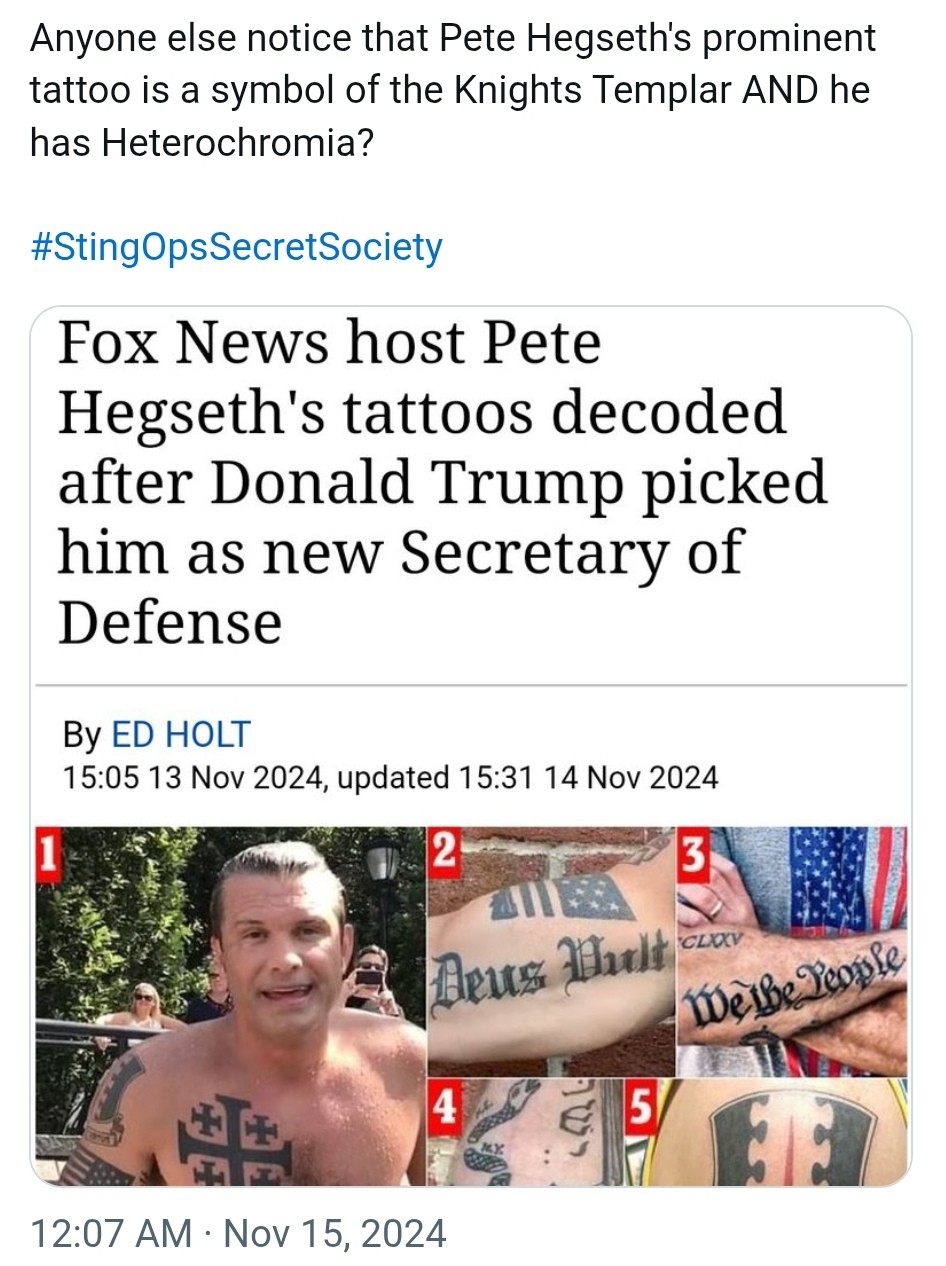
Democrat Empty Seats Keep Hegseth’s Deus Vult Running the Pentagon

The creed Pete Hegseth wears is Christian holy war over Jerusalem. Jews were among its first victims. His support for Israel sits inside that theology.

Source: Twitter

“Deus Vult” is a white supremacist whistle tattooed on his bicep and stamped on the Bible he swore his oath on. He explained the phrase himself in his 2020 book American Crusade, where he calls it

the rallying cry of Christian knights as they marched to Jerusalem

It gets the last words of the book. He says he is proud to belong to the church network that Doug Wilson founded. Doug Wilson says giving women the vote was a bad idea, and his churches teach wives to submit to their husbands. Hegseth shared a video of the network’s pastors arguing that women should not have the right to vote.

Hold that thought, because it’s especially important for this story.

The crusade’s first mass killing was in the area today known as Germany. In May 1096, on the road east, crusader bands targeted the Jewish communities of Speyer, Worms and Mainz for total destruction. Solomon bar Samson’s chronicle describes Count Emicho’s men entering Mainz on May 27 and killing the Jews who had taken shelter in the archbishop’s palace. Emicho’s bands were destroyed in Hungary. The armies that followed took Jerusalem three years later and killed its Jews as well. That crusade is what Hegseth is tattooed with. The first people it killed were Jews.

Christians also created Zionism as a means of calling Jews outsiders and forcing them to leave (remigration). Lord Shaftesbury campaigned in 1840 for the powers of Europe to push the Jews to Palestine, and Foreign Secretary Palmerston listened. William Blackstone, a Chicago evangelist, petitioned President Harrison in 1891 with the question, “Why not give Palestine back to them again?” Theodor Herzl published The Jewish State five years after that. Jewish writers such as Moses Hess and Leon Pinsker made their own case for a return in those decades. Or course it was the Christians who reached government authority on this first. Blackstone read Jewish settlement in Palestine as a sign that the end times were near. For these men the return of the Jews was a step in their own Christian prophecy, where the Jews were the disposable means.

I have written here before about how Christians built Zionism and pushed Jews into it. Hegseth continues that tradition. In Jerusalem in 2018 he told an Arutz Sheva conference that rebuilding the Temple on the Temple Mount was a “miracle” that could happen. A miracle of antisemitism. A year later he went up to the Mount with the international director of the Temple Institute. These views are his own, and he published them loud and proud years before he was confirmed to head the Pentagon.

Israel’s government clearly has a use for this. Netanyahu told 60 Minutes that he wants American financial support drawn down to zero, and he described the replacement to a congressman as “my plan.” As usual with him, it’s a big bag of misdirection and corruption.

The plan moves the relationship out of State Department aid, which Congress votes on every year, and into Pentagon procurement. So the “zero” of the plan is in terms of accountability, not spend. NPR reports that AIPAC supports the arrangement, while experts expect less congressional oversight. Trump announced on November 3 that the $4 billion a year in aid is “stopping” at the end of 2026, meaning it loses proper visibility.

The bill text directs the Secretary of Defense to set up a joint defense technology initiative “with the concurrence of the Minister of Defense of Israel.” The House passed it in July as Section 219 of the defense bill, and the Senate bill carries it as Section 1217. The Secretary who would run this Israeli integration into the Pentagon is … wait for it … Hegseth. He told Israeli Defense Minister Katz in March, “Keep going to the end, we are with you.”

I wrote back then about his $200 billion war supplemental. Netanyahu’s plan looks like it’s about to put Israel’s funding under a crusader, a true believer in his own holy war.

Now, to the point of all this. On November 10 the House voted 211 to 204 to send Thomas Massie’s eight articles of impeachment to committee, which ends them for this Congress. Four of the eight concern the war on Iran that the United States launched with Israel. I had already posted the case for trying Hegseth in No Quarter.

Against Massie is AIPAC’s super PAC, which spent $3.58 million against him this cycle. Republican Don Bacon explained his vote by describing Massie as “anti-Iran, anti-Ukraine, anti-Israel.” Bacon said in the same breath that he is no fan of the secretary. He voted to fan Hegseth, while saying he wasn’t a fan, just to oppose Massie.

The part that seems to really matter, more than Republicans talking nonsense, is that eleven Democrats missed the vote, more than the seven-vote margin. Seven Republicans missed it too. Marcy Wheeler argues the “maths”, that the absences changed nothing because Republicans kept spare members nearby to deploy as necessary. The House floor record shows how many. On the next roll call Republicans had one more member than on the Hegseth vote, and on the one after that they had three more. Eleven Democrats would have made 215 against a Republican best of 214. Several said traffic held them on the way back from a reception hosted by Elect Democratic Women.

Remember when I said hold that thought? Women. In government. Something Hegseth very clearly opposes, along with the founder of his church network, who calls women’s suffrage a bad idea.

That women group’s super PAC also took $2.4 million from AIPAC’s super PAC, close to a third of what it raised. Most of the eleven Democrats have given their reasons for leaving Hegseth, from traffic to a medical procedure. Stevens is a different case. AIPAC’s super PAC put more than $30 million behind her in her Senate primary. She lost, endorsed the Republican two days before the election, and spent the votes of November 9 in the Republican cloakroom.

Sean Casten, an Illinois Democrat, put it down to lateness:

You’ve got to be on time for votes. No excuses.

He blamed Republicans for the outcome and said the House has yet to build the political case. That is the complicated explanation. It requires professional politicians to arrive late on the evening that their votes decided the result. Their leaders had chosen to leave the vote unwhipped. Caucus chair Pete Aguilar told reporters before the vote, “We didn’t put our finger on the scale.” And we’re not talking about just any old vote here. Trump and JD Vance both blamed the Iran War for the Republican losses in the midterms. Democrats failing to make the Hegseth vote are going to deserve harsh scrutiny for exactly the reasons we’re discussing here.

The simple explanation for the failure to vote starts with the reception called Elect Democratic Women. It was billed for new members from 4:30 to 6:30, with remarks at 5:00 and the House vote listed for 5:30. Drop Site obtained the RSVP list, which names 132 lobbyists, at least two of them from Lockheed Martin. Katherine Clark, the Democratic whip, is a founder of the group, and she voted against the motion. Julia Brownley sits on its executive board and Melanie Stansbury on its board of directors. Both were at the reception with Brittany Pettersen, and all three missed the vote. These are experienced members who know when the House votes. An empty seat on a motion that passed by seven counted the same as a yes. A group whose political arm takes AIPAC money held a reception that kept members of Congress from an impeachment vote, and that is corruption at work whatever each member intended.

Democratic women in a reception that interrupted their vote against one of the most openly mysoginistic leaders in history.

The filings show where the AIPAC money went this year. It went against the congressman who wrote the articles and into the group that hosted the reception. AIPAC supports the funding plan and Netanyahu calls it his own. Hegseth kept the job that would administer it.

The Christians who first lobbied for Zionism treated Jews as instruments of their own prophecy. Netanyahu’s plan hands Israel’s funding to a crusader’s office. Each side has reason to believe it is using the other.

But the real story here is the Elect Democratic Women reception. Six of the missing Democrats were voting again within twenty minutes, and eleven would have beaten every Republican who voted that evening.

Hegseth Claims Every Boat Strike as His Own Order

Pete Hegseth spent sixteen minutes at the Pentagon podium praising his own wars and attacking Rep. Thomas Massie, the Kentucky Republican pressing articles of impeachment against him.

When the worst Defense Secretary in history reached the articles themselves, he answered them in one sentence:

Iran, the cartels, Maduro, Yemen, everyone was a lawful operation ordered by the commander-in-chief, then ordered by myself, notified to Congress and executed by American warriors who did their jobs.

That sentence closes the door on a case that the White House had kept open. The boat campaign began on September 2, 2025 with a strike that left two survivors clinging to the wreckage, and a second strike killed them. A war crime, or murder.

The White House had named Admiral Frank Bradley as the officer who ordered the second strike, and Hegseth told reporters he had moved on to his next meeting before it happened.

That same week Hegseth repeated that he had left the room before the order, and in the same answer said he would have made the same call.

Now he claims the whole cartel campaign, war crimes and all, as his own order.

The administration chose the legal frame for these unlawful killings. Its October 2025 notice to Congress declared a “non-international armed conflict” with the cartels and called their members unlawful combatants. That frame carries the Pentagon’s own rulebook with it. Section 18.3.2.1 of the DoD Law of War Manual requires every service member to refuse clearly illegal orders, and its example is “orders to fire upon the shipwrecked would be clearly illegal.” The War Crimes Act, 18 U.S.C. § 2441, makes the intentional killing of people placed out of combat a war crime in a non-international armed conflict, and 18 U.S.C. § 2 makes whoever willfully causes an offense punishable as a principal.

Hegseth delivered a death toll as his extrajudicial verdict: “218 narco terrorists dead where they should be.” The running count passed 230 in September. At least 22 of the dead survived an initial strike and were then hit again or died at sea. The families of two Trinidadian men killed in a strike have sued in federal court, and the relatives of a Colombian man say he was fishing when his boat was hit.

With regard to civilians, Hegseth focused on a charge easiest to deny.

As to the claim that the American military targets civilians, well, that is a lie.

He said he would “dignify this claim no further.”

Massie’s article is actually specific enough to withstand such amateur statements, and isn’t affected by such empty protest. The resolution says Hegseth cultivated a culture he boasts of as “maximum lethality, not tepid legality,” which chilled the offices responsible for preventing and responding to civilian harm, and it names the Shajareh Tayyebeh girls’ elementary school in Minab. A preliminary Pentagon investigation found that a US Tomahawk hit the school on the first day of the war, using target coordinates Central Command built from outdated Defense Intelligence Agency data. Senators put the dead at about 120 children and at least 175 people in total, and senior military leaders have held the finished investigation since April while those senators press for its release. Massie charges that the safeguards Hegseth dismantled foreseeably cost civilian lives.

Hegseth tried to shift focus to a charge of intent.

He counted the Iran war as “under 40 days of sustained combat”, which is a patently absurd way to describe months of war from the Department he insists on calling War. It’s not the Department of Sustained Combat. And he cited Reagan in Lebanon and Clinton in Kosovo as War Powers disputes that ended short of impeachment:

War powers resolution or not.

Congress is different, and went much further, this time. Invoking section 5(c) of the War Powers Resolution, the House voted 215 to 208 on June 3 and the Senate voted 50 to 48 on June 23 to direct the removal of US forces from hostilities with Iran. A concurrent resolution bypasses the president, so the vote was symbolic by design. The blockade imposed after the ceasefire remains in force, and by October MOAA was describing the Iran conflict as in its seventh month. The War Powers Resolution relies on Congress for enforcement, through funding and through impeachment. Massie’s first three articles are that enforcement.

The Hegseth torture of American history depends on one word.

In the 250 years of our American Republic, no Secretary of War or Secretary of Defense has ever been impeached for carrying out lawful military operations.

The first cabinet officer ever impeached was a Secretary of War. Arguably the rename to the Department of War should have jogged his memory of the impeachment. The House impeached William Belknap unanimously on March 2, 1876, over kickbacks from a frontier trading post, and a Senate majority voted against him on all five articles. It ran short of the two-thirds needed to convict. Belknap’s offense was graft, which Hegseth excludes with the phrase “military operations.” Then he tosses in the word “lawful.” It’s of course telling, since that is the exact word the articles dispute.

His other claims aren’t looking so good either:

Hegseth Statement Reality
“Biden had let it happen.” (Houthis) Biden launched Operation Poseidon Archer against the Houthis on January 11, 2024.
“We didn’t start this war. Iran did.” The US and Israel launched the strikes that began it on February 28, 2026.
“Nothing has gotten through.” (blockade) Iran-linked tankers ran it using fake flags, shell companies and disabled tracking.
“We control the Strait of Hormuz.” After the ceasefire Iran kept routing ships through its own waters (CRS).
“Maritime smuggling down at least 65%” The DEA found cocaine price and availability unchanged by the strikes.
“We, along with them, control the canal.” The sites stay under Panama’s control, and Panama can end the deal on six months’ notice.
NATO “committed to 5% of GDP for their own defense” 3.5% for core defence and up to 1.5% for infrastructure and resilience, by 2035.
“Biden couldn’t recruit anyone.” Every DoD branch met its FY2024 recruiting goal.
“Nobody was lost in the mission in Venezuela.” About 75 people died in the raid, including 32 Cuban officers.
“Senators, in cute videos, have suggested the same.” A grand jury declined to indict them, and a federal judge ruled Hegseth violated Kelly’s First Amendment rights.
“defeated ironically by a Navy SEAL” Hegseth campaigned for that SEAL on the eve of the primary.

In the question period he described the doubt he says critics want to plant in the partner governments of his counter-cartel coalition:

if you go after these cartel members in your country, maybe someone will go after you later.

His answer to that was “we’re working really hard with these countries to prevent that kind of lawfare.” Really hard? Is that the best description he could come up with? He closed his statement with a message to the troops:

don’t blink, ignore the noise, please, never hesitate.

The Law of War Manual he oversees requires a sailor to refuse an order to fire upon the shipwrecked. Hegseth’s message to the same sailors, like a poison pill presented from the podium without blinking, is to never hesitate. This, minutes after attacking the patriotic senators who reminded troops they can refuse illegal orders.

Port 502 is French for Iran

France has accused Iran of sabotage. I love a good attribution, so I went looking for the evidence.

I found a port number.

One port number on one night.

A port for a day.

Are you Frenching kidding me?

That took me back to an incident briefing I led in San Francisco many years ago. The room was packed. Everyone was on the edge of their seat, except one guy. He slouched back and kept shaking his head no. I was walking the room through what we had found when suddenly he stood up and said he had seen the classified version, we don’t get it, and he marched out smiling at us like a Cheshire cat. He declined to say anything useful. He declined to say what the classified data corrected. He flamboyantly checked out, and the room was left to choose between the evidence and the confidence of a man who wanted us to believe it wasn’t enough.

The absence of evidence isn’t the evidence of absence.

France has just played that annoying man at the back of the room with his giant shit eating grin, and people have been taking the report way beyond face value.

A port number. Let me say it again.

An accusation built on a port and covering one night has been read as some kind of grandiose verdict on a month of attacks across a dozen countries. The gap between what Paris published and what the press now believes is the big story here, and it is easy to drag out of its neanderthal cave of lizard brain attribution into the sunlight of modern science.

Start with the official statement. On 9 November the foreign ministry named the Revolutionary Guard unit Shahid Kaveh for the attack on refrigeration controllers at about 700 French stores on the night of 11 October, called it “inédite par son ampleur et son niveau d’agressivité,” and announced it at a G7 press briefing minutes after Reuters reported that investigators privately suspected Iran. The five-agency C4 published a five-page note the same day. It calls its evidence a faisceau d’indices, the French legal term for circumstantial evidence.

It covers one country, and one night. That’s it. Here is the whole case:

  • The attack infrastructure also scanned Schneider Electric equipment over Modbus on port 502, a technique the note associates with Shahid Kaveh from April 2026.
  • The operators used FOFA, a Chinese commercial search engine for internet-connected devices.
  • The propaganda channel CyberbanNews relayed the attack on 13 October. The note’s word is relayée.
  • Farsi traces appeared in the attack infrastructure.

The port. Oh, the port.

CISA AA26-097A of 7 April 2026, signed by six US agencies, tracks CyberAv3ngers as the Shahid Kaveh Group and lists its traffic on ports 44818, 2222, 102, 22 and 502. Those are ports that any control-systems scan is going to reference. The American advisory ships indicators of compromise, the addresses a defender can match against logs. The French note matched the technique and kept the indicators. Had the infrastructure matched, the note would say infrastructure. It says technique.

FOFA is a subscription product and Farsi strings are the easiest artefact of all to plant; Olympic Destroyer carried a forged header copied from North Korean malware for the same reason. It’s like meeting a Russian guy with a beard glued on speaking a few words in Farsi. Speaking of which, on Halloween I met an Iranian teen who had personally made his own very authentic looking Soviet-era army general uniform, complete with insignia and Afghanistan war medals. He knocked and then refused candy, saying it was a bribe against Communist principles. Talk about a convincing costume.

That leaves the repost, the one item specific to Iran, and the note undercuts it itself: the unit’s avatars exist to claim attacks, and for this one their outlet relayed.

The prosecutor added a fifth item when she gave her presentation of the report, IP addresses pointing to terminals located in Iran.

The C4 note has Iranian addresses in one place, the 2024 Olympics kiosk case, under a different unit. For the October attack her own agencies list none. Her fifth item is absent from the document she was presenting. Two of the three names in the annex are on the US Treasury list of 2 February 2024. The names came from Washington, and this evidence says the same about where the verdict comes from. France is relaying an American judgment, which it is leaving as unverifiable.

Of course, it’s only cyber champagne if it comes from the Champagne region of France. Otherwise it’s just sparkling American intelligence. I mean this seems like a case of appellation d’origine contrôlée: the label is French, the grapes were pressed in Maryland. By French law it’s only Iran war attribution if it comes from Fort Meade.

Some of my readers may remember over a decade ago when Russia stood as the accused and I batted the other direction. In 2014 Bloomberg reported that US intelligence officials believed Russia blew up the Baku–Tbilisi–Ceyhan pipeline in 2008 by hacking its cameras. I pointed to the Corner House analysis attributing the blast to the PKK, and Süddeutsche Zeitung later reported an audit showing the cameras were installed after the explosion. “Unprecedented” has the same history: Ralph Langner, who reverse engineered Stuxnet, called the attack very basic, and Maroochy had put sewage in Queensland’s parks a decade earlier.

Same test, whoever is accused: publish what can be checked. Don’t laugh at the room and say you have a secret squirrel solution in your hideout nobody can see.

Now the merger. The same evening a Wavestone partner told the Guardian: “Given that recent cyber-attacks on supermarkets and the blood bank in France concerned freezers it is reasonable to think Iran is directly linked to both.” One night became a month based on the simple fact that both one day and many more days involved freezers. The EU High Representative said the incidents “if attributed” called for a strong response. That’s a strong conditional, and unfortunately she seems like the only official using it.

The method belongs to everyone.

Forescout cites a Danfoss newsletter recording hacktivist attacks in 2022 on 16 Russian supermarkets and 40 Israeli stores, and tracked more than twenty claimed refrigeration attacks between January and October 2026, chiefly in Spain and Italy, with the pro-Russian Z-Pentest Alliance and NoName057(16) the most active. By the time France was hit, Russian-aligned groups had spent nine months rehearsing on European cold storage.

Nine months of Russian attacks isn’t for nothing.

The October attack and the November wave are written up here already.

It belongs to everyone because the vendors built it that way. This is one of the most annoying parts to this story. The vendors need to have WAY more accountability. Regulators really need to get on them like how PCI DSS hammered card systems in the 2000s to force safety innovation in both the distribution and acquisition ends of their industry. Known weakness? Don’t ship weak devices. Don’t connect weak devices. If you do, no more shipping and connecting for you.

On 20 May 2025 CISA published CVE-2025-41450 for the Danfoss AK-SM 8xxA, an authentication bypass “caused by datetime-based password generation.” Claroty’s Team82 published the mechanism in August 2026: the controller accepts a code of the day in place of the administrator password, and the code is derived from the device’s own calendar. Copeland’s XWEB Pro, the other platform on CERT-FR’s list, has the same design, CVSS 10.0. Most of the October victims ran Danfoss models the vendor stopped updating in 2021 and 2016. And France had the most of them: IPinfo found 1,331 Danfoss dashboards open in France five days before the attack, against 1,197 in the other 72 countries combined, on the same firmware mix as everywhere else.

The vendor decides the controller attaches to the internet. The store that owns the food has no way to force safety on the vendor.

The vendor decides.

The vendor.

Decides.

November looked different. More than 100 stores in at least nine countries, plus cold rooms at three sites of the French blood service through a rental contractor. Ransom-ISAC logged one XWEB site hit with the factory login. Sekoia’s Danfoss honeypots the same evening caught an undisclosed exploit. Two operators at least. Sekoia is the only vendor to have published an infrastructure analysis spanning both waves, and it judges the two “may have been conducted by the same threat actor” while stating that “no technical indicators currently link this incident to that cluster,” the cluster France named. One actor, with nothing technical to link it to Tehran. Sekoia’s motive hypothesis, France’s deployment of troops and air defence to the Yanbu oil terminal as announced 24 September, gives Iran a reason. But it gives a defender nothing to verify.

Then the Russian claim arrived and vanished. Poof!

Or as I like to say, the poof is the proof.

NoName057(16) and Z-Pentest claimed November in a Telegram video and deleted the channels. Sekoia calls the claim unsubstantiated on three grounds. Two describe NoName, its history of false claims and its DDoS profile. The third is that the leaked credentials look like infostealer logs, which is also how an attacker gets contractor logins for these controllers. Z-Pentest made the claim too, and Z-Pentest is the group known for control systems; Forescout tracked it as the year’s most active claimant on refrigeration, and Denmark’s Defence Intelligence Service attributed a 2024 waterworks attack to it. The groups that practiced this all year claimed it, then erased the claim. That is the pattern: the operation that succeeds leaves the case open and the blame elsewhere.

France could be right about Iran. Could be… but what they published is a port number, and that ain’t right. It undermines credibility, if anything.

Imagine someone saying that some moldy cheese must be from France just because it tastes like old socks. Ok, but shouldn’t we have some actual tests before we slap a “made in France” label? The UK has actually landed in this spot already when they discovered that 100% of their real English honey from real English bees labels are bullshit, and they’ve been swallowing sweet impostor sauce for years. Literally 10 out of 10 jars failed the authenticity test, which should have been required a long time ago. Regulation is the mother of innovation:

Honey is one of the most adulterated food items on the market. We provide full traceability; we highlight 1. the location – area, country – from which we source our honey; and 2. the communities that manage our hives.

Anyone talking about a month of attacks solved is skipping all the parts where we prove who the attacker actually was and will be. The actual known culprits already proven are the vendors. They shipped a calendar password into internet-facing fridge controllers. And they forced it to be used in an unsafe state. Who should be blamed? The vendors. And probably Russia, if we get to that state of evidence. But in the meantime, the vendors.