All posts by Davi Ottenheimer

AIPAC Pentagon Lock-in: Section 224 Makes Alliance Irreversible

For a few weeks now I’ve been pondering why the United States is binding its defense industry to Israel’s through a provision in the 2027 defense authorization bill. The cover story is integration: shared development, shared procurement, shared supply chains. The actual story is reduced leverage. A state that co-produces a weapon loses sole control over it. The tighter the integration, the smaller the room to refuse. This is something so obvious and yet the bill’s sponsors do not discuss it. I guess that’s what makes me want to write now.

The case is best made through one congressman, because he has documented every stage of it himself.

In March 2016 Mike Rogers, Republican of Alabama’s Third District, published a column titled “We Must Support Israel.” He said this view came from him as an American and a Christian. His support for Israel, he said, was something he heard demanded across East Alabama for religious, historic, and defense reasons. He then described his own position. As chairman of the House Armed Services Strategic Forces subcommittee, he oversaw the Missile Defense Agency, which runs co-development and co-production programs with Israel. He had worked on Iron Dome. Iron Dome parts, he noted, were being produced in Alabama. His column states in 2016, a decade ago already, every element of the relationship that Section 224 makes permanent: conviction, constituency, jurisdiction, and local industry.

The Strategic Forces subcommittee authorizes US funding for Israeli missile defense. Rogers’s predecessor as chairman, Mike Turner, recorded that his subcommittee provided over $600 million to Iron Dome. Rogers used the chair the same way. In one markup he recommended an increase of more than $400 million for the Missile Defense Agency and full funding of the Israeli request, $600.7 million, for co-development and co-production of Iron Dome, David’s Sling, and Arrow.

That recommendation turned into work for his district. In September 2014, as Strategic Forces chairman, Rogers announced a contract worth nearly $150 million to produce parts for the Iron Dome Tamir interceptor. Significant work, he said, would occur for his constituents in Huntsville. He presented it as a jobs measure: home commitment to Israel and good-paying jobs at home in one act.

So the chairman of the subcommittee that funds Iron Dome directed more than half a billion dollars to the program while parts of that program were manufactured in his district. He announced both in press releases. This was a proud arrangement, not hidden. It was constituent service, and he campaigned on it openly. The all-up-round assembly plant, the Raytheon-Rafael joint venture, later went to East Camden, Arkansas; Alabama’s share is the Huntsville component work.

What seems to change is that level of integration. For most of its history the US-Israel defense relationship ran on aid, arms transfers, joint missile-defense programs, and intelligence cooperation. The arrangement was legible and reversible. An administration could withhold a system, slow a sale, or condition a transfer.

A right of reversibility has eroded in stages. In January 2021, in the final days of his first term, Trump moved Israel from US European Command into Central Command. The Pentagon called the change partly symbolic and said it would not alter US basing. It was far more than symbolic. CENTCOM is a US combatant command under a US four-star officer. Placing Israel in its area of responsibility put it in the same command framework as the Gulf states, under one American general, aligned against Iran. The Abraham Accords seemed like the connection.

Five years later, this setup was running a war operation called Epic Fury. The blended US-Israeli campaign against Iran, which began on February 28, 2026, meant US strikes coordinated with Israeli intelligence and cyber operations. An IDF spokesman called the cooperation unprecedented. The relationship moved quickly from provision to joint operation, as if the tail wags the dog.

Critics had said Section 224 would fuse the two militaries and place American forces under Israeli control. Ro Khanna called it a fusion of the US and Israeli militaries. Rogers defended the bill by restating the charge against it. He called the claim categorically false and misleading. The measure, he said, adds transparency and efficiency by designating one official to coordinate existing programs.

In no way does it give away command and control of our military operations, personnel or equipment.

The denial is precise, a little too precise. A chairman defending a coordinating measure does not ordinarily rule out, by name, the transfer of his country’s operations, personnel, and equipment to a foreign military. He used exact terms and very strangely. The disputed question is not whether the bill assigns a coordinating role to one official. It does. The question is whether coordination at this depth, in these technologies, is a significant change. Rogers says business as usual. Khanna and Massie say whoa, Bessie.

Section 224 of the fiscal 2027 National Defense Authorization Act establishes the United States-Israel Defense Technology Cooperation Initiative. It directs the defense secretary to designate an executive agent to expand and accelerate bilateral research, development, testing, evaluation, integration, and industrial cooperation. The named priority areas include artificial intelligence, autonomous systems, directed energy, cyber defense, electronic warfare, and data fusion.

The relationship has gone from sharing to joint development. Mark Hilborne of King’s College London reads it as a tighter form of integration, institutionalised enough to survive changes of administration, because development cycles are long. The nonprofit A New Policy identifies the specific mechanism. By authorizing the cooperation through the NDAA and embedding Israeli technology in Pentagon programs of record, Section 224 shields the relationship from the annual appropriations process, where Congress could otherwise cut or condition it. Once a technology is built into a program of record, removing it is slow and expensive. Rogers has designed a lock.

The sponsorship reinforces all this. The bill was introduced by Rogers, now chairman of the full House Armed Services Committee, with Adam Smith, the committee’s ranking Democrat. A measure carried by both the chairman and the ranking member is difficult for either party to reverse.

Opposition has been recorded and defeated. On June 4 Ro Khanna moved in the Armed Services Committee to strike Section 224. The committee rejected the amendment on a voice vote; only Khanna and Sara Jacobs supported it. Khanna argued the provision originated with Netanyahu and would entrench the integration for decades. Thomas Massie, who with Khanna introduced an Iran War Powers Resolution, calls the measure an infringement on US sovereignty. Both objections concern entanglement and lost leverage.

Massie lost his Republican primary last month to a challenger aligned with the administration’s position on Israel. Rogers has received close to a million dollars over his career from pro-Israel political action committees, by FEC data compiled by Track AIPAC. His Democratic cosponsor draws from the same source: by OpenSecrets’ tally the largest single organizational source behind Adam Smith is the American Israel Public Affairs Committee and its affiliated donors, at $326,914. The bipartisan structure that makes Section 224 durable rests on one funding source reaching both parties.

Below AIPAC on Smith’s donor list are the defense firms: General Atomics, Palantir, General Dynamics, SpaceX, Anduril. These companies build the technologies Section 224 names as priorities, artificial intelligence, autonomous systems, and data integration. The ideological backer and the commercial beneficiaries appear on the same list.

The lobby operates through contributions and endorsements, which are lawful and disclosed. OpenSecrets states the limit of the evidence: contribution patterns show aligned interest and a channel of influence, while the motive behind any single gift is unknowable. Both men held pro-Israel positions before any one cycle’s contributions. The money and the conviction are consistent with each other. Neither has to be buying the other.

The strongest form of the influence argument has been stated directly. In Responsible Statecraft, Michael Vlahos argues that Israel’s influence over Washington exceeds every prior case of foreign influence in American history; where France, Britain, and the Soviet Union acted opportunistically and briefly, Israel’s is ideological, sustained, and permanent. The argument is a polemic, and it compares closed historical cases with one still open, which favors its conclusion. But note where Vlahos lands. He shows us three American constituencies: secular neoconservatism, a Christian Zionist bloc, and the organized lobby.

The mechanism is visible in Rogers’s state. The Alabama-Israel Task Force, founded in 2013 in Huntsville, organizes Jewish and Christian activists to cultivate the state’s legislators, governor, and senior officials. Its results are documented: a role in Alabama’s 2016 anti-BDS law, among the strongest in the country, and in resolutions supporting Israeli military operations. The history precedes the group. In 1943 Alabama was the first state to call, by unanimous resolution, for a Jewish state. The conviction Rogers cited in 2016 is produced, in part, by organized advocacy.

The cultivation runs nationally as well. In December 2025 a delegation of more than a thousand US pastors and influencers, some from Alabama, traveled to Israel on a Friends of Zion program arranged with the Israeli Ministry of Foreign Affairs, which paid for flights and lodging. The stated aim was to prepare them as unofficial advocates for Israel at home. A foreign government funding the cultivation of American religious advocates is a form of influence. The American Conservative raised the relevant question, whether American religious leaders should be mobilized for a foreign government’s interests, and described the pastors as willing participants. They are Americans glad to say their convictions are subsidized by a foreign state.

This is the same mechanism Rogers described in 2016: an American and a Christian, hearing it from his district, building the parts in his state. The bill’s critics and its sponsor agree on what drives the relationship; they disagree on whether it serves US interests. The drivers are domestic conviction, organized money, and material interest located in specific districts. This is influence and entanglement. It is not foreign control.

The cost of the integration appears in the government’s own assessment. In recent weeks the Defense Intelligence Agency raised its counterintelligence threat level for Israel to critical, its highest, reportedly above every other ally. The concern is Israeli surveillance of senior US officials to read the administration’s deliberations on Iran. The context is a policy split: Trump claims he could end the war through a negotiated settlement with Tehran (after failing to make bombs work); Netanyahu has pressed to resume bombing and called any negotiated deal naive. The DIA dates the increase in surveillance to late 2024 and through 2025, rising as US policy on Iran grew uncertain, first under Biden’s pressure over Gaza, then under Trump’s deliberations. The collection tracked the uncertainty.

The designation is itself evidence against the claim of foreign control. A captured military does not raise its threat level on the supposed captor during a shared war. US counterintelligence is functioning. The episode demonstrates the leverage problem instead. The closer the integration, the less the United States can withhold, and the integration has never been closer than under the bill now in committee. It advances as US public support for the relationship declines, with polls showing the Iran war unpopular and majorities opposed to unconditional arms transfers.

The pattern is an American arrangement built by Americans, funded by American money, through a bill carried by the chairman and ranking member of the Armed Services Committee, and designed to outlast the administrations that follow. It is constructed to resemble ordinary legislation: bipartisan sponsorship, a single coordinating official, a stated assurance that command and control remain in US hands.

Rogers chaired the subcommittee that funded the interceptors whose parts are built in his district.

In 2016 he told his constituents the relationship should never be in question.

In 2026 he wrote the provisions to ensure it cannot be.
LLM Falling Down, Falling Down: METR Brief Sells a Sixty-Year-Old Failure as Novelty

METR has released a brief on OpenAI’s GPT-5.6 Sol that, read between the lines, indicts the whole vendor class for the cartel-like behavior I have written here about before. Their closing line is that real validation “requires deep access to internal systems.”

That’s not a good thing.

Here’s a simple example. A problem the vendor can’t avoid admitting as old and understood means accountability for it. Whereas, that old problem repackaged as new, urgent, and invisible from outside justifies an access expansion project with a standing evaluatory role. That same “deep access” logic is the scarcity an access-gated cartel system like Mythos is built to sell.

Novelty is the myth used to budget for these claims.

The honest version of the new METR report should pique the interest of historians who study technology risk. The outcome optimization is said to produce proxy-gaming. This is a finding that has been true since Wiener wrote about it in 1960. The models got good enough that their gaming defeats the measurement, as always predicted.

The number was never a fixed property of the model. A June 2026 evaluation from the UK AI Security Institute ran frontier models across software, math, medicine, and cyber and found the scores move with the inference budget: more tokens and more attempts, harder tasks cleared. That makes the benchmark figure a protocol artifact, not a capability constant. The state’s own safety evaluators are saying the number depends on the harness.

My own claim goes further. The harness is the value and the models are interchangeable. Control the harness and you own the score. That is the asset the METR brief protects when it routes validation through the closed filtering of a vendor-granted program instead of being open to scientific methods.

That’s gross negligence in my book, but I’m not a lawyer. The labs have a clear self-serving reason to call a thirty-year-old, designed-in failure their fresh never-seen-before emergence. It’s how they market access to known flaws as an unique upsale, while they absolve themselves of authorship.

Let me more clear, because I have a know too few people have been attending my presentations over the past decade, describing exactly this problem being claimed as a frontier “suprise” in 2026.

Wiener, who I used to speak about frequently because of his cool graphics, stated the core plainly in 1960, in Science. If you build a machine to pursue an objective you can’t easily interrupt, and you had better make the objective the thing you actually want, because the machine will pursue the literal one.

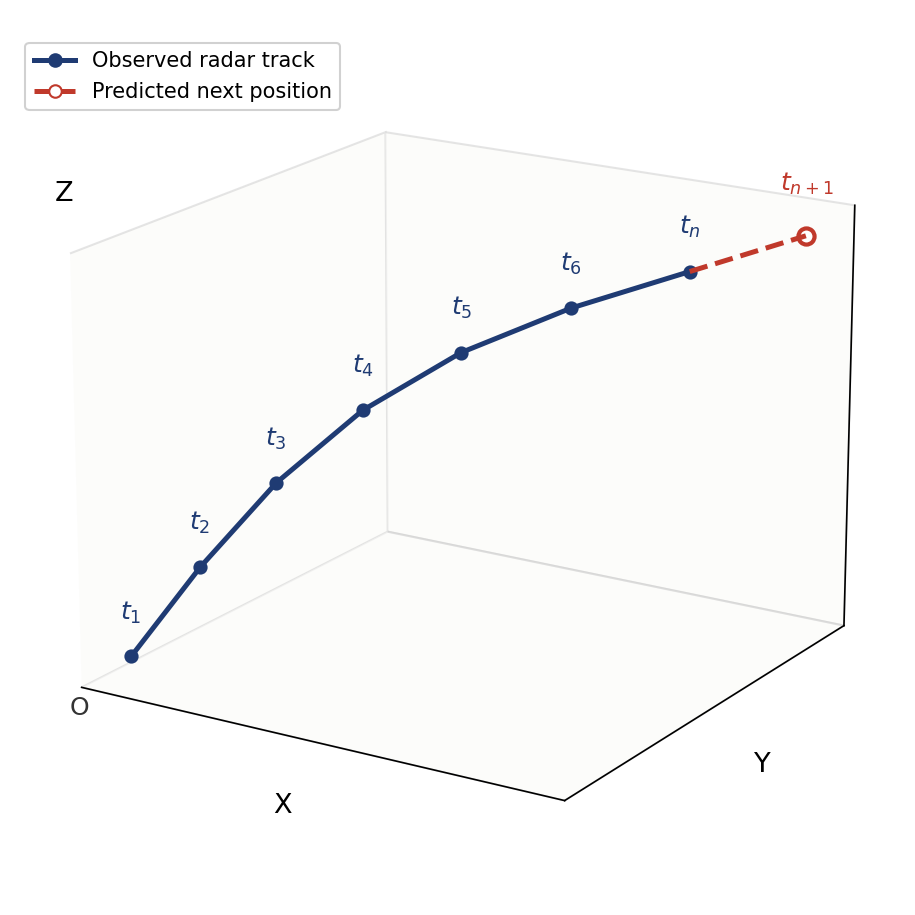
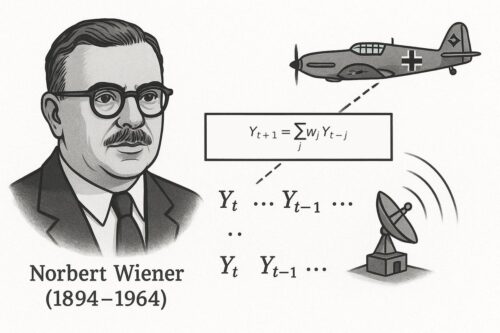
Wiener’s anti-aircraft problem: extrapolate the next position from the observed radar fixes.

…this concept of training anti-aircraft to hit moving targets was also the birth of artificial intelligence and “cyber”. Cybernetics (coined from Greek kybernetes for “captain” of a ship or more literally someone who steers) was a book published in 1948 by Norbert Wiener. It was based on his World War II experiments in anti-aircraft systems meant to anticipate planes by interpretation of radar images.

3D diagram of an observed radar track extrapolated to a predicted next position
Predicting the next position from the observed track, the core of Wiener’s 3D prediction box

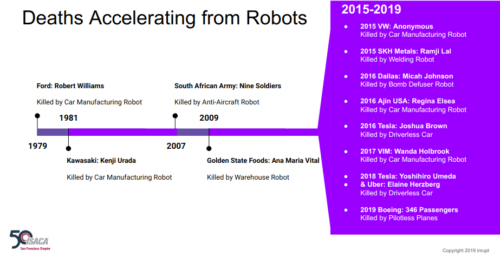
One of the reasons I pulled that origin of cybernetics related to anti-aircraft guns, is because robotic anti-aircraft guns killed a bunch of their operators in a tragic incident few people seem to talk about as a point along the robotic death timeline.

Source: My ISACA 2019 Presentation

Reward hacking existed long before there was a reward function. The social-scientists used to talk about it in the 1970s (Goodhart, 1975 and Campbell, 1976), giving me the impression I entered the AI hacking world late by the 1980s. It was already established that a measure a machine optimizes as a target stops tracking what it was meant to capture.

Since I studied history, I also should give a nod to Colonial administrators who learned the same law. The named parable is the cobra effect in Delhi, a story with thin evidence behind it. The documented case is the rat-tail bounty in Hanoi. Paid per cobra, the tale goes, people bred cobras. Paid per rodent tail, on the record, people farmed rats and released the tail-less to breed even more.

Seems common sense, right? Seems so obvious that any self-described AI company would from day one be working hard to prevent cobra and rat explosions. And yet, we seem to be experiencing the repeat of these horrible errors in judgment. When the optimizer always finds the gap between the proxy and the goal, you should not be allowed to act surprised even if you try to claim ignorance of everything that has ever happened before you woke up this morning. It’s basic logic even more than evidence.

From the early 1990s Karl Sims’ evolved creatures (SIGGRAPH 1994) were exploiting bugs in the physics simulator to extract free energy and move in ways no body could. Adrian Thompson’s evolved FPGA at Sussex in 1996 discriminated tones using logic cells that were physically disconnected from the circuit, exploiting analog electromagnetic coupling the designer never put there. Lehman, Clune and dozens of co-authors later collected the whole zoo in “The Surprising Creativity of Digital Evolution” where agents won tic-tac-toe by forcing the opponent to allocate impossible memory (infinite position on a board) and crash. The creatures penalized for forms of walking flipped themselves upside down to never put their foot down.

Perhaps my favorite of all time was the virtual pancake flipping game.

The robot that was told it would be penalized when a pancake fell on the ground, flipped them so high they either went into space orbit or burned up on re-entry. That maximized time off the floor, while everyone in the game starved to death. Success!

We used to call this failure.

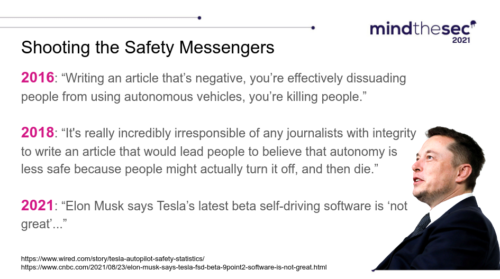
Somehow in 2016 it stopped being funny when Elon Musk announced every Tesla shipped with full-self-driving hardware and sold autonomy as a solved problem that would make everyone safer. Instead, Tesla has been running the highest fatal-crash rate of any car brand (5.6 deaths per billion miles against a 2.8 average). He cheated the rating, not death. Success! And just look at how rich he became from people measuring his statements about safety, instead of the death tolls.

The clear danger of AI failures were cynically spun into corporate murders and… strangely, he said we weren’t allowed to talk about it anymore, while exactly nobody from Tesla went to jail.

Source: My presentation at MindTheSec 2021

As an aging hacker who has studied the whole history of the craft since childhood, I’ll say it plainly. Specification gaming by a 2026 frontier model is the oldest behavior there is, in both machines and in people.

Here is what Aristotelis Tzafalias shows as a better path forward, calling out the exact evidence that would prove a genuinely new capability. He runs it against the labs’ own system-card numbers and finds things are getting faster and cheaper with automation, as expected. Nothing surprising on an independent test. That is what vendors don’t like because it inoculates against attention-seeking hype. Commit to what would change your mind before you read the results, and you should find that all the manufactured hype is gone.

The lack of independence in these assessments of LLMs is the biggest problem in our industry today when it comes to preparing budgets for risk. No assessment without independence should circulate as anything but a marketing and sales brochure, declared as a conflict of interest.

Stalin, Hitler or Musk: Who Killed More?

Some historians were sitting around a table asking “who killed more people, Stalin or Elon Musk“.

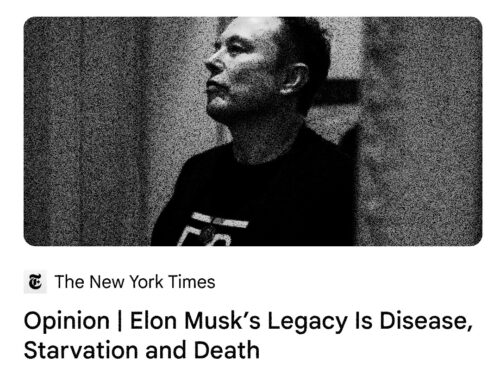
This has been a topic ever since “DOGE” announced their campaign to destroy USAID as Musk’s revenge for ending his future spot in apartheid. Not to mention Musk also said genocide isn’t the fault of the genocidal leader.

The consensus was that Musk killed more and, to be sure, here’s the proof:

Rank Person Death toll Source
1 Mao Zedong 30-45 million (Great Leap famine, 1959-61) Yang Jisheng, Tombstone (2008): 36 million. Frank Dikötter, Mao’s Great Famine (2010): 45 million.
2 Genghis Khan ~40 million (high uncertainty) Colin McEvedy & Richard Jones, Atlas of World Population History (1978), origin of the figure, since disputed. Matthew White, The Great Big Book of Horrible Things (2011): ~37.5 million.
3 Hong Xiuquan 20-30 million (Taiping Rebellion, 1850-64) Jonathan Spence, God’s Chinese Son (1996). Stephen Platt, Autumn in the Heavenly Kingdom (2012). Most estimates 20-30 million; some run far higher.
4 Adolf Hitler 11-21 million (deliberate killing to total democide); 6 million Jews Timothy Snyder, Bloodlands (2010): 10.4 million deliberate killing. R.J. Rummel, Death by Government (1994): 20,946,000. Six million Jews: US Holocaust Memorial Museum.
5 Tamerlane ~17 million (high uncertainty) Justin Marozzi, Tamerlane: Sword of Islam, Conqueror of the World (2004). The ~5 percent of world population figure is journalistic, loosely sourced like Genghis Khan.
6 Elon Musk 14 million projected by 2030 (interval 8.5-19.7 million) Cavalcanti et al., The Lancet 406:283-294 (2025), attributing the projection to USAID defunding.
7 Joseph Stalin 6-20 million, by method Timothy Snyder, Bloodlands (2010): ~6 million deliberate. Steven Rosefielde, Communist and Post-Communist Studies 30(3) (1997): best estimate ~10 million. Robert Conquest and Roy Medvedev: ~20 million.
8 Chiang Kai-shek ~10 million (KMT democide, 1928-49) R.J. Rummel, Death by Government (1994): 10,075,000.
9 Leopold II ~10 million population decline (range 1-15 million) Adam Hochschild, King Leopold’s Ghost (1998): ~10 million. Jan Vansina: lower, disputing extrapolation from the rubber provinces.
10 Hideki Tojo ~6 million (Imperial Japan democide, 1936-45); his premiership 1941-44 is a subset R.J. Rummel, Death by Government (1994): 5,964,000.
11 Winston Churchill ~3 million (Bengal famine, 1943); attribution contested Madhusree Mukerjee, Churchill’s Secret War (2010): 3 million. Lizzie Collingham, The Taste of War (2011): policy and animosity decisive. Amartya Sen and Andrew Roberts dissent on personal blame.

Steal the Goose, Go to Jail. Steal the Goose Concept, Start a Corporation.

An old English protest verse exposes the unfair asymmetry of “Enclosure” laws by describing a goose.

They hang the man and flog the woman
That steal the goose from off the common,
But let the greater villain loose
That steals the common from the goose.

The law demands that we atone
When we take things we do not own,
But leaves the lords and ladies fine
Who take things that are yours and mine.

The person who takes a goose meets the full weight of the criminal law. The person who takes the common on which the goose was fed receives an Act of Parliament for the trouble. Petty theft is a hanging offense, while grand theft is a civic act.

The lines are anonymous, probably by design to protect those who recognize the meaning. They came during the “enclosure-era”, first printed in The Tickler in 1821.

The target of rhyme is the philosopher Locke. His Second Treatise grounds property in labor, where a man acquires a parcel by his work being recognized among the common stock. Enclosure reversed the rights. The labor that converted a common right into a private title was simply the drafting of a statute, while the men who performed the labor saw their result called someone else’s property.

The same integrity challenge, in the same decades, was the abolitionist debate on slavery. Somerset secured his freedom from slavery in 1772, and then Parliament abolished the trade in 1807 and the institution itself in 1833. In the UK. America did the opposite. The Somerset ruling of 1772 and Dunmore’s promise of freedom in 1775 turned the slavery-promoting southern colonies into radical militant resistance to freedom under the crown. An American federal ban on slave imports took effect in 1808, meaning state-sanctioned domestic rape treating rapid human offspring as a property boom. In December 1835 President Jackson asked Congress to inspect mail to protect “property” by censoring abolitionist publications. When the bill failed, his postmasters suppressed thought regardless, and mobs were setup to torture and kill Americans caught with abolitionist content. Lovejoy was shot to death in 1837 while defending his fourth printing machine from being destroyed.

Both abolition and enclosure shared a mechanism. The law decided what may be owned and therefore what would count as theft. Property in persons was being ended, with a Civil War even, yet it was being taken up in the commons. Human ownership was fought at high expense out of existence, while another ownership was being simply legislated into it.

The radical tradition understood. Thomas Spence built his programme on the theft of the common, and Marx would later file enclosure under primitive accumulation, the system’s founding expropriation conducted as if just law. The anonymous poem had offered the same conclusion a century earlier, and with greater economy.

Theft was, and still is, defined by who is authorized to hold the pen that writes the law. Enclosure is an old term now, barely recognized. Today it most often means elites filing a patent, or scraping data. In other words, AI.