Category Archives: History

Cryptocurrencies are digital blood diamonds, driverless cars are loitering munitions

For many years now I’ve been telling people cryptocurrency is a modern form of blood diamonds.

One of the important lessons from Nazi Germany and its derivative regimes like the South African apartheid government (e.g. two countries where Peter Thiel is from) is that money laundering can be a powerful means of evading global sanctions against rights violations (e.g. how Peter Thiel made his fortunes at PayPal).

It therefore should be obvious from history lessons that cryptocurrency serves a well-known anti-humanitarian pattern. Or maybe it’s easier to see the problem as popularized in “fascist pig” movies and books.

He has vices. He doesn’t have any real virtues. If you think James Bond is a fascist pig then Fleming seems largely on your side.

A very long time ago a bank that ran a large regional power company (common in America) called me to consult on security as ethics. Their risk team asked me if they should approve a plan for excess power generation during idle production to be poured into an on-site Bitcoin mining operation.

My answer was a simple question: “Do you really want to fund ICBM development in North Korea?” I guess I could have asked if they wanted to generate more fascist pigs.

The bank seemed genuinely surprised, which reminded me of the Sierra Leone lyric

I thought my Jesus piece was so harmless
’til I seen a picture of a shorty armless

They asked a few questions, thanked me for explaining international history, and said they had to reject the plan.

Fast forward to today and more and more proof of the problem finally is reaching the news.

North Korea Used Crypto to Hack Its Way Through the Pandemic. The isolated country continues to find ways to evade sanctions and generate income while operating on the fringes of the global financial system.

To be fair blood diamonds for money laundering are just the start of the problem… the laundered money is used for laundered technology sold by Americans.

That’s why I often remind people the American NRA played an essential role in South Africa by importing guns to prop up the illegal white police state in direct violation of international sanctions.

Now who is the digital NRA?

So maybe think of crypto even more as digital blood diamonds to buy digital arms, such as access to algorithms in a Tesla to kill people by weaponizing cars.

As I’ve said in my presentations for at least a decade, it’s far easier these days to direct 40,000 loitering “driverless” vehicles (really munitions) to destroy a city than to launch missiles from far away.

American Cowboy Hat True Origins: The Mexican Sombrero

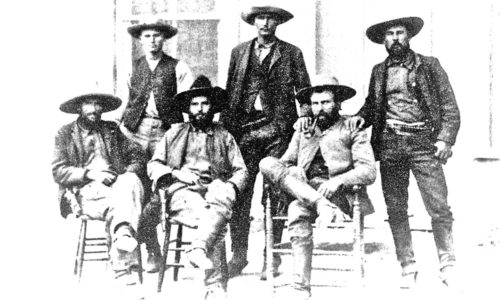
“Do these Mexican hats make us look Mexican?”

True West magazine alleges that the cowboy hat was a product of shameless appropriation — white immigrants stealing everything they could from Mexicans.

As Texian cattlemen appropriated Mexican cattle and land, they adopted elements of the vaquero’s working attire. Modern buckaroos throughout the Southwest inherited much of their forebearers’ culture, including their name—an imprecise rendering of the word vaquero.

The dimensions of the sombrero overwhelmed the anglo interlopers who wore small-billed caps, slouch hats, bowlers and derbies. In 1865, Philadelphia hatmaker John B. Stetson designed a more modest version that still sheltered its wearer from the sun and rain. Stetson’s “Boss of the Plains,” originally a hand-felt design meant to amuse traveling companions on a tour of the American West, quickly became the first, and arguably the most distinct, identifiable part of a cowboy’s ensemble.

And on a related note, Atlas Obscura wants us to know the bad guys wore white hats (if not hoods).

Go digging into the history of black hats vs. white hats, and you’ll find that good guys wore black, bad guys wore white. “There is no trope or consistency in who wears white or black,” says Peter Stanfield, who’s studied the B-westerns of the 1930s.

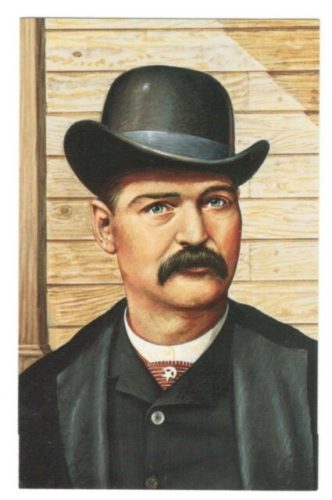
For one obvious example, the “legend of the West” and lawman (Sheriff and Marshall) Bat Masterson wore the true working-man’s hat, the British black bowler.

Source: USPS Commemorative Stamp

In fact the black bowler was by far the most popular hat in the West and favored by cowboys and railroad workers for its obvious advantages — designed in 1840s as protective gear for hard-riding British horsemen it was firmly fitted to the head and durable. No wonder Butch Cassidy, Black Bart, Billy the Kid, Curly Howard, Shemp Howard, Roscoe Arbuckle, Charlie Chaplin, Stan Laurel, Oliver Hardy… all were known to wear the bowler.

Some might even argue the Stetson “American cowboy” hat company fame came directly from combining the British bowler tough guy design with the Mexican sombrero hot sun features (sombra in Spanish means “shade”), yet that also traces back to the British.

Miller Christys’ hat factory in Frampton Cotterell (moved near Bristol from London “as a result of labour troubles”) indeed recorded that it had fought a patent dispute against J. B. Stetson and WON the case.

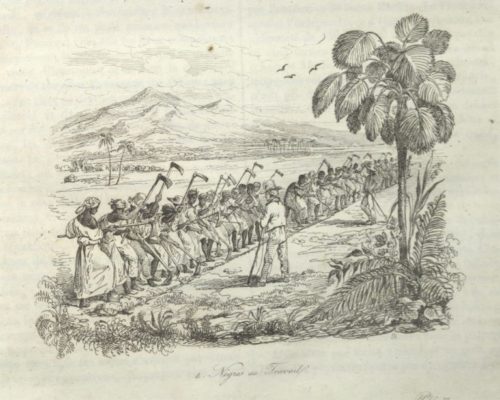
The British hat maker had designed their wide brimmed fur felt hats long before Stetson, for the 1800s slave plantation “Boss” in the West Indies.

Source: Leverhulme Trust project “Runaway Slaves in 18th century Britain”, University of Glasgow.
Source: British Online Archives

Christys barely mention this major detail on their history page where they also show the “Boss” design that Stetson obviously took from them.

1849 The Bowler hat is invented by Lock & Co and The Bowler Brothers. Christys, from its factory in Bermondsey, London, becomes one of the largest manufacturers of this iconic British styles.

[…]

1886: JB Stetson visits the Christys’ Stockport [Manchester, England] factory and writes to enquire ‘How Christys maintains such a productive workforce? Stetson use Christys’ design for the Ten Gallon hat – for which Christys received an on-going royalty.

The original “Ten gallon” hat designed by Christys was stolen by Stetson. He was forced to pay royalties after being sued in court. Source: Christys’ official history pages

Stetson literally had to pay a foreign company a license fee to market his most famous hat that Americans somehow were led to believe wasn’t entirely foreign (when really both Christys and Stetson should have paid far more respect to Mexican hat makers).

I have yet to see anyone in America really admit the point that a slave plantation “Boss” hat of Christys is where Stetson even got his idea for a “Boss of the Plains” marketing campaign WHEN U.S. CIVIL WAR ENDED.

That’s right, in 1865 the Civil War is over and slavery is abolished. That was the year Stetson claims to have started his design — appropriation of a British felt big brimmed “Boss” design that symbolized riches for a white population, based on violent power to expropriate labor and wealth from enslaved people.

It’s easy to explain why, as some historians already have in books like How the South Won the Civil War:

Once Reconstruction ended, and with it black voting in the south, Republicans looked west. Anti-lynching and voting rights legislation lost because of the votes of westerners, and new states aligned for decades more “with the hierarchical structure of the south than with the democratic principles of the civil war Republicans”, thanks to their reliance on extractive industries and agribusiness. […] [Pro-slavery politicians] mythologized the cowboy, self-reliant and tough, making his way in the world on his own”, notably ignoring the brutal work required and the fact that about a third of cowboys were people of color.

Reagan, George W. Bush, Trump all have tried to convey themselves as “cowboy” Presidents, meaning embrace of a Southern plutocracy/oligarchy-wild west grabbing and conquering approach to governance.

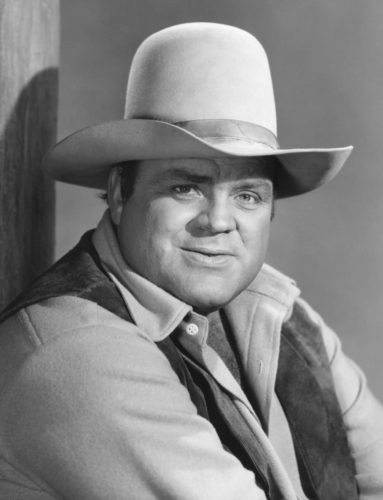
The character “Hoss” on the fictional TV show “Bonanza” (1959-1973) helped to popularize a British slave plantation hat based on a Mexican design as somehow being American.

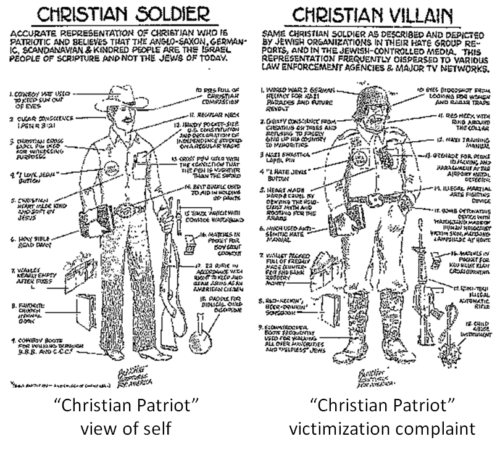
Americans today thus should probably associate their “cowboy hat” with a desire to continue Civil War more than anything, which isn’t any kind of secret if you peruse flyers from domestic terror groups.

Source: Skousen manual for white militias

You might be wondering where the two “dimples” on the top of a Stetson came into being… but yet again the Mexicans wore a pinched sombrero, long before Stetson stole that idea too.

Anyway the next time someone in security calls themselves a white hat, perhaps ask them if they meant to say the dumb bad guy “Boss” wearing a British imitation of a Mexican idea.

Which sombrero indicates the bad guy?

As I wrote here a while ago…

…Texas “exceptionalism” and “frontier” spirit meant slavery. Again, Texas was Mexico until white immigrants came with slaves and said no white man could survive the harsh conditions without non-whites to do all the hard work for them. They usurped power and seceded from Mexico (and later from America) just to avoid hard work and keep slaves instead. Being “free to be stupid” is thus a dog-whistle to slavery, which is not freedom at all.

“Humility Makes a Great Intelligence Officer”

Marc Polymeropoulous has published a new leadership book. He describes it as a revelation about his failures in the first two thirds of his career, which he then credits for making him into a good leader in the last third of his career.

These things stuck out for me in his CSPC interview (118 views):

He refers to intelligence like going to bat in baseball, where a .300 hitting average is great even though we know it’s a 70% rate of being wrong. I actually like this as I tend to define intelligence, especially artificial intelligence, as the ability to hit a target.

An example he gives of this is chilling, however, since Marc’s best agent in Afghanistan was tortured and killed because of a very simple and predictable operations mistake.

Maybe then the 70% failure rate in baseball is not really applicable more widely in other fields, especially high risk ones. Instead such standards of quality in sports are ok to be low because by design outcomes shouldn’t really matter — it’s just a game.

As Calvin and Hobbes put it a long time ago, next to their snowman made from only two balls, “the fastest route to success is lowering expectations”.

Something tells me the .300 might need to go way up to a number more like .900 when lives are on the line every day, because nobody should want to go to bat repetitively knowing it has 70% chance of death! But who in history has ever batted .900? That’s where gaining an upper hand using modern information warfare comes in, right?

Even more confusing is “employ the dagger”, a notion Marc offers the audience as evidence that “competition is good”. He says when officers did something desired he would award them a physical token of appreciation, a souvenir knife he’d buy at the market for $10.

In corporate circles this is a well-known tactic. Give people a snow globe after x years of showing up to work and they’ll work more, right?

In baseball I guess this is the idea that a coach could give out a $10 trophy bat for hitting a ball, instead of expecting the team to find enough satisfaction in achieving a 70% failure rate.

It’s thus interesting to see him conflate a well-tread concept of internal appreciation and reward systems to affect morale with a raw “good” of competition. What if the competition is toxic because teams are in fact killing each other instead of targets?

Something obviously sounds not right about generic praise of competition. Perhaps Marc is using some kind of over-compensation act (surrounded by hyper-competitive personalities in the killing fields) to cover up his softer anti-competitive leadership messages of inclusion and unity.

He’s obviously a master at fitting in. I wonder if him floating these ideas about 1) pointy sharp tool and 2) competition is meant to disguise his true message that is rather blunt and collaborative.

There is neither any uniqueness or shortage for such inexpensive daggers (hey, even I have at least TWO from my time in… Nepal) nor any real scarcity to his approvals. Competition for an award and attention isn’t a fair description of any system that could operate just fine without using any competition (with each other) at all.

He goes on to say his leadership success grew by including more people into communications, a larger tent for collaboration. This suggests he valued the opposite of pressing everyone into competition (e.g. bringing finance officers and kitchen chefs into his planning).

From there he digs further and hits the empathy button hard, which takes the listener further from his opening salvo on competition culture.

In other words, he’s basically saying competition works if people are kind instead of selfish, aligned instead of oppositional.

His big tent mindset (he calls out nostalgically for everyone in competition to hold a sense of unity) combined with his points on empathy and repetitive reference to humility being a core ingredient for great intelligence… it all seems his love of competition comes with some pretty huge caveats.

Humility is presented as competitive advantage in intelligence — hitting a target without pride or arrogance, just like some African tribes have advocated for thousands of years.

When a young man kills much meat, he comes to think of himself as a chief or a big man – and thinks of the rest of us as his servants or inferiors. We can’t accept this … so we always speak of his meat as worthless. This way, we cool his heart and make him gentle.

While Marc’s leadership advice sounds good in principle, there’s a moment in the interview where he boasts about delivering news of a successful assassination. Oops.

Such hubris about targeted hits not only is a swing and a miss according to his own doctrine, it’s unfortunately a widespread problem he could be making worse. Just look at some of the latest American Army PSYOP and Department of State messaging (while Frank Church rolls in his grave).

In all seriousness, how would baseball exist if hyper-competitive batters could assassinate a pitcher, sort of like how Walter “Steel Arm” Dickey was killed in 1923 with a dagger?

By the time he was 17, he was a pitcher who threw so hard and fast that he gained the nickname that followed him the rest of his life. […] “He was as good as I ever saw throw a baseball,” Roy recalled to James, “I remember one time that Steel Arm brought in his whole team to the dugout. No one was left except him and the catcher. He then struck out three straight men, daring them all the time to hit. They could not do it.

Such questions about lawfulness in competition bring to mind the lessons behind a song called “Move on Up” as well as a film called The Rubble Kings.

Humility in the context of American history in fact might serve as an excellent gateway into discussing rule of law being far more important to real success in intelligence than arbitrary displays of power.

As an afterthought, has anyone at the NSA ever said humility is a good thing?

China Claims U.S. Aircraft Carriers Can’t Hide From New AI on Satellites

A new report out of China suggests it’s using AI on satellites to find and constantly track U.S. aircraft carriers, rendering them easy prey.

When USS Harry S. Truman was heading to a strait transit drill off the coast of Long Island in New York on June 17 last year, a Chinese remote sensing satellite powered by the latest artificial intelligence technology automatically detected the Nimitz-class aircraft carrier and alerted Beijing with the precise coordinates, according to a new study by Chinese space scientists.

This is a long predicted shift from “on the ground” processing power for analysis, working through logistics issues (e.g. bandwidth performance, data integrity), to instead doing “real time” analysis on-board sensors in the air.

A core tenant of aircraft carriers has been, of course, they sail hundreds of miles away undetected while unleashing massive airborne devastation.

The threat of constant tracking using new global sensor networks means in simple terms naval strategist have to expend far more effort to engage carriers safely.

Submarines and fast attack boats, beyond the reach of satellite technology and able to sail undetected more easily towards targets, become a more logical physical platform for launching airborne attacks from the sea. It’s the kind of thing both Iran and Ukraine have been proving grounds for lately.

Such developments mark a potential inversion of logic behind massive build-up of the U.S. Navy that stretch back to the 1980s. Allegedly a June 1977 dinner with Graham Claytor (Navy secretary under President Carter) led to a famous “Ocean Venture” exercise that reamins relevant even to this day.

Mr. Lehman notes, the U.S. fleet participated “in a sophisticated program of coordinated, calculated, forward aggressive exercises—all around the world.” The Soviets would thereby see that, with any aggressive move they made, “the might of the U.S. Navy would be off their coasts in a heartbeat.”

Over 250 ships and more than a dozen countries in 1981, then under the racist President Reagan, set out to demonstrate to Soviet leaders that a giant NATO alliance could achieve dominance of the sea such that Russia would not detect navies (aircraft carriers in particular) until it was too late.

That’s a premise China would like to believe they have finally shattered by following a long-coming trend of on-board image processing with inexpensive sensors in the air.

As a footnote on blustery news about advances in technology, if you dig into a “dominance” narrative of the U.S. Navy technology during the 1980s you’ll also find surveillance history gems.

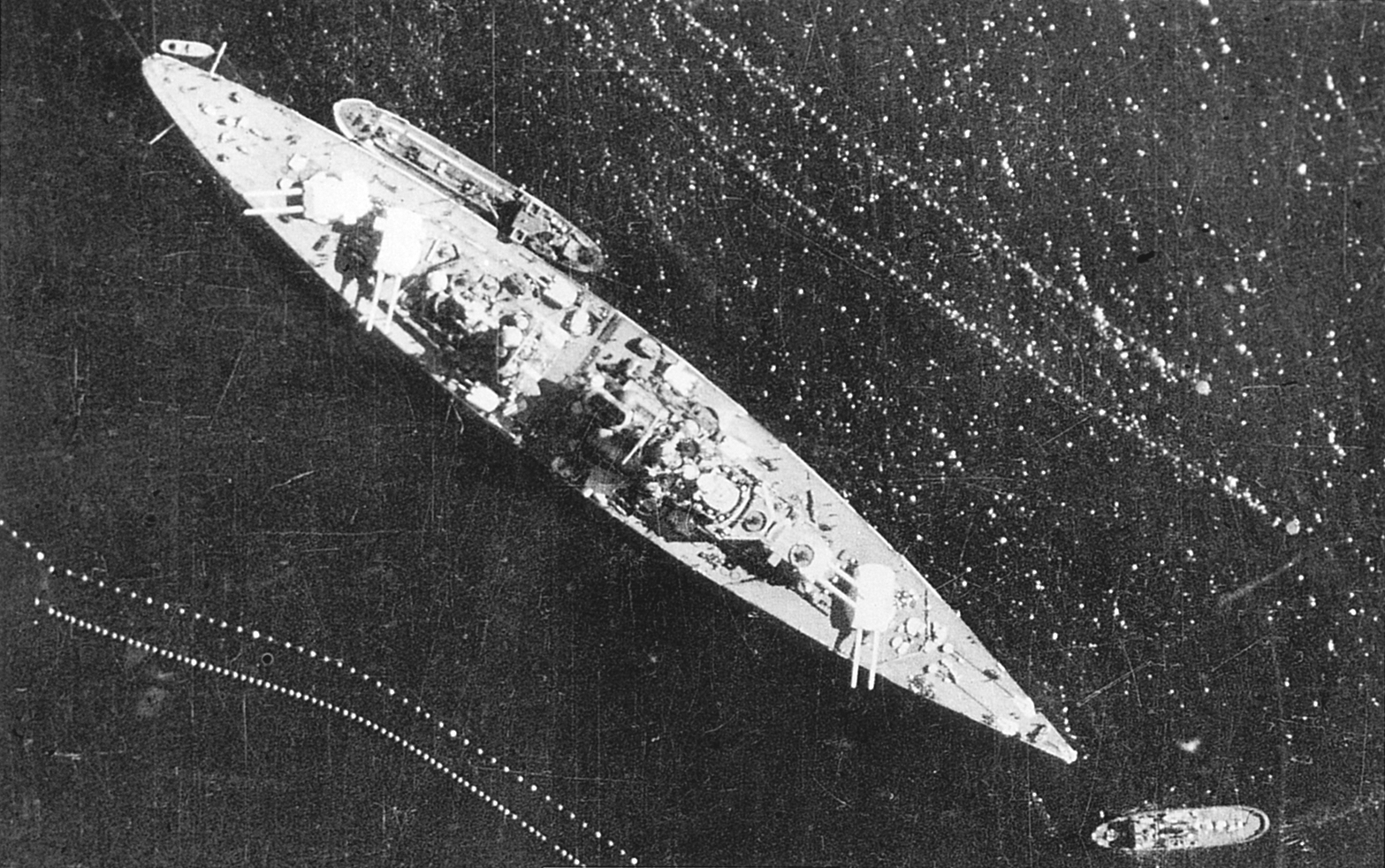
For example, ships in the Norwegian fjords were trivial to spot visually when covered in snow (bright white) sitting in deep dark waters yet at the same time hard to detect with even the best radar of the day because sitting beneath mountains.

British aerial reconnaissance of German battleship Tirpitz, near Bogen in Narvik Fjord, Norway, 17 July 1942. Click to enlarge. Source: IWM

This was well known in WWII and of course still true when NATO ships closed in on Russia in the Norwegian waters decades later. Moreover, nobody had bothered to heat modern ship antennas so NATO sailors had to climb in frigid weather to remove ice with hand tools.

There’s technology… and then there’s ignoring history while deploying technology into a world of already experienced variables. That’s a huge hint about why China is probably wrong, given how bad AI tends to be when pressed into actual service.

The reality of big data security (e.g. vulnerabilities in AI due to trivial integrity flaws, made even worse by satellite platform limitations) is another way to look at this.

China is doing what should be expected. They follow easy and obvious trends in big data, moving analytics to the edge and improving the sensor resolution. Yet China (let alone Russia) isn’t particularly known for being able to handle adversarial creativity and the unexpected (possible perturbations to defy expectations).

Carriers may sail another day, in other words, just by returning to the lessons of a bold “Ace” Lyons deception maneuver — ignore academic theorists decrying the end of carriers in 1981 by flying a dozen jets 1,000 miles from the USS Eisenhower to surprise buzz adversaries right in the middle of their naval exercises.

[Soviets] were particularly taken aback by the prowess of our commanders at sea in cover and deception operations. To kill a ship you need to find it first, and our commanders stayed up nights thinking up ways to bluff, trick, hide, and conceal their forces at sea so that they couldn’t be found.