Category Archives: History

The Security Paradox: Higher Investment Leads to Less Safety

A new history book called “Hidden Gifts” dives into the complexity of Middle-East stability and comes up with this enticing premise:

…embroiled in a paradox—an ever-increasing demand for security despite the increasing supply…

Except, this isn’t a paradox.

Unregulated increases in security have an inversion effect, which is exactly why Facebook boasting about its massive spend has made it also the worst platform.

Compare Facebook to Equifax, for example. The latter had tightly constrained/managed spend and efficiencies that stabilized it and made it a leader in safety. The difference is the ethics of supply.

This is how the “imperial interests” mentioned by the new history book make its paradox thesis… not a paradox.

Here’s the full thesis of “Hidden Gifts”, where you can see the crucial link to “interests” guiding the supplies.

From Napoleon Bonaparte’s invasion of Egypt in 1798 to the foreign interventions in the ongoing civil wars in Syria, Yemen, and Libya today, global empires or the so-called Great Powers have long assumed the responsibility of bringing security to the Middle East. The past two centuries have witnessed their numerous military occupations to ‘liberate’, ‘secure’, and ‘educate’ local populations. Consulting fresh primary sources collected from some thirty archives in the Middle East, Russia, the United States, and Western Europe, Dangerous Gifts revisits the late eighteenth- and nineteenth-century origins of these imperial security practices. It questions how it all began. Why did Great Power interventions in the Ottoman Levant tend to result in further turmoil and civil wars? Why has the region been embroiled in a paradox—an ever-increasing demand for security despite the increasing supply—ever since? It embeds this highly pertinent genealogical history into an innovative and captivating narrative around the Eastern Question, freeing the latter from the monopoly of Great Power politics, and also foregrounding the experience and agency of the Levantine actors: the gradual yet still forceful opening up of the latter’s economies to global free trade, the asymmetrical implementation of international law from their perspective, and the secondary importance attached to their threat perceptions in a world where political and economic decisions were ultimately made through the filter of global imperial interests.

Facebook’s security officer spent more on security because he wanted less safety, which would further balloon his own interests in self enrichment (and his friends). It’s no coincidence he purchased a $3 million home in the hills above Silicon Valley. Would anyone think of him as a descendant of Napoleon?

Before he was hired to drive Facebook’s infamous collapse of safety he was at Yahoo for only about a year, where he secretly pulled $2 million out of their budget to hand out to his friends and followers (under the line item: “bug bounty”), which did exactly nothing in terms of platform safety. Yahoo after he left had to report their biggest breaches of safety in their history.

It’s perhaps counter-intuitive, yet if you place an ethics filter over security spend you can see how sometimes massive investments proposed by immoral security leaders are in fact predictably going to reduce safety, giving them an excuse to demand more.

More investment therefore can lead to more safety, yet only if that investment has proper governance — adheres to principles of ethics like inherited rights and external accountability for harms.

I’m reminded of the days before “mutually assured destruction” had its total meltdown in the Cuban Missile Crisis.

The unregulated hawks of America were trying to cook up another fictional “knockout punch” with a weapon (Project Pluto) that would demoralize the Soviets by being so egregiously awful to them.

This is a good reminder that the Japanese considered the nuclear bombs to be nothing more than a drop of rain in a hurricane that had lasted many months. In fact, the actual reason for rapid capitulation of the Japanese at the end of WWII was a fear of Soviet troops walking into their territory and seizing control.

In addition, the cost to American lives of the Manhattan Project is estimated to have been higher than what the Japanese suffered from it. And obviously it led to even further harms elsewhere, as well as destabilization of the world afterwards…

An expensive nuclear-ramjet-powered missile nonetheless following the fictional narrative of nuclear bombing, was conceived to fly around the world four times, dumping toxic radiation as it went, while lobbing hydrogen bombs with questionable accuracy.

Insanity? An excellent reminder of how “security investment” can be totally out of control without some basic morality as its guide.
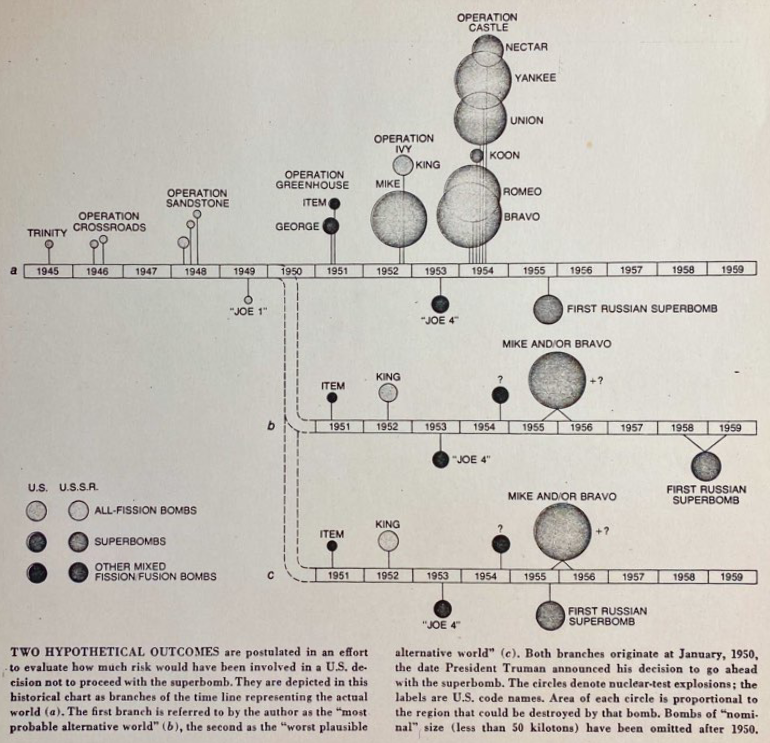
Source: Herbert F. York, “The Debate Over the Hydrogen Bomb,” Scientific American, (Oct 1975) p. 110. Click to enlarge.

Simple Guide to Regulating Social Media: How to Breakup Facebook

Separating communication and contents is like saying the water utility shouldn’t be in the business of turning your taps into coke machines. That’s the whole thing in a nutshell.

Status (like money, ideology and ego) is power, which is a question of authorization and consent. Very different from generic content.

Nobody should want 1950s “Mad Men” of advertising agencies to own and run all the communications infrastructure in the United States. It’s like saying nobody should want tobacco companies peddling literally cancerous “social entry” messages to be in charge of actual social entry requirements (e.g. you must smoke to enter).

Likewise, nobody should want the 1930s “America First” of media empires to own and run all the communications infrastructure in the United States.

This is a very different model from the plain delivery of information, which may or may not carry status and power-changing content. I’ve written about this many, many times here. The Carterfone fight with AT&T is a perfect example of this fight in the 1960s, since it centered on harm with regard to delivering content only; nothing to do with the content itself (Carter wanted to wirelessly receive calls while he rode a horse on his ranch, simply by adding a radio extender to his phone).

It was at this point the government split service providers from the hardware devices being connected to them, which unleashed the entire Internet by allowing modem and fax markets to be born.

America has a long tortured history in this aspect of regulation of communication, such as during the Andrew Jackson administration when he pushed “gag rules” and aggressively sought to intercept mail to censor abolitionist speech, including arresting sailors at ports to confiscate their books, imprison and torture them into disclosing social contacts.

History thus should be helpful in charting the course ahead.

It warns us plainly how decoupling infrastructure ownership from the tangled power struggles over its content (e.g. measures of benefits and harms) is what delivered far safer and better technology-driven market for ideas, especially because it reduced threat of monopolization by private entities’ harm-based business model.

Woodrow Wilson nationalizing infrastructure set off alarm bells for good reason, given he had just restarted the KKK from inside the White House. Yet at least within government the evil gag rules and inspection of mail, or the U.S. nationalization of its wires, these orders could be repealed. What option is there in monopolization such that the private company runs the government?

Thus when people ask what is to be done about the long documented and discussed harms of Facebook, the answer has always been somewhat obviously government regulation to remove those profiting from pollution from owning the plumbing too. Break these two incompatible halves apart immediately (applying criminal charges where relevant).

Explicitly deny public infrastructure providers from running harm for profit schemes.

In related news, the Swiss government has split service providers from the software devices that are being connected to them:

…providers of chat, instant messaging, video conferencing, or Voice over IP (VoIP) services, such as WhatsApp, iMessage, Zoom, Teams, and Skype cannot be classified as telecom service providers, but rather “over-the-top” (OTT) service providers.

You should be able to dump a chat application (and its toxic contents) without having to lose connectivity entirely.

In also related news, American “Big Tech” is feverishly attempting to create monopolies where none should exist.

…the very tech companies pushing this idea stand to profit from it, because the national hub would likely be housed in the same companies’ commercial cloud computing services. …little more than a cash grab by what’s effectively the next generation of military contractors. The plan also could entrench the very same tech companies that President Joe Biden’s antitrust enforcers are working to rein in, these critics say.

Why Would Vietnam War POW Jump From a Helicopter to Her Death?

Since the secrecy requirements of the American soliders of the Vietnam War have expired, new exposure is emerging with stories like this one:

[Military Assistance Command Vietnam-Studies and Observations] encouraged and incentivized prisoner snatching… There were no overarching standard-operating procedures… SOG commandos inspected their prisoner more closely, only to find that it was a woman. In their moment of surprise, the prisoner escaped, jumping from the helicopter to her death.

Why would this POW, aside from lack of standard-operating procedures, jump out of a helicopter to certain death? What exactly does “more closely” mean in terms of inspection being done during a helicopter ride after capture? Such stories deserve more thorough investigation.

More details are in a U.S. Army “The Indigenous Approach” podcast called “MACV-SOG: A Conversation with John Stryker Meyer” ( Part I )( Part II )

“A simple solution for transportation equity: bike lanes.”

Back in 2011 I wrote about cycling being a superior route to transportation equity. I even cited Victorian England since women’s liberation evidently was tied to the advent of modern cycling (could ride to work and be independent of typically male-dominated transit such as horse or carriage).

Now I see a fascinating new report on cycling in Chicago that says police are issuing more tickets against Black riders to prevent them from having mobility on bikes, despite data showing the majority of accidents are white riders.

In Chicago, cyclists in Black neighborhoods are over-policed and under-protected.

A simple solution for transportation equity: bike lanes.