Recently I wrote about an Enigma encryption machine that showed up in a pigsty. The argument back then surely was nobody would find it.
Now we can add a new twist to the list of places thought safe for disposal: an Enigma was found in the Baltic sea.
“A colleague swam up and said: there’s a net there with an old typewriter in it,” Florian Huber, the lead diver, told the DPA news agency.
The team quickly realised they had stumbled across an historic artefact and alerted the authorities.
Dr Ulf Ickerodt, the head of the state archaeological office in Schleswig-Holstein, said the machine would be restored by experts at the state’s archaeology museum.
The delicate process, including a thorough desalination process after seven decades in the Baltic seabed, “will take about a year”, he said.
After that, the machine will go on display at the museum.
Dr Jann Witt, a historian from the German Naval Association, told DPA he believed the machine, which has three rotors, was thrown overboard from a German warship in the final days of the war.
One of her four copies of the Signalbuch der Kasierlichen Marine (SKM), the German navy codebook, was burnt and two thrown overboard. However, the Russians recovered the latter two from the sea and the fourth from the captain’s safe.
One would think they’d know better by WWII, although to be fair the Enigma sank and a codebook floated.
Actually, as another aside, when the Germans in WWI put their secrets in something that would sink it also was recovered.
The British obtained the third German naval codebook, the Verkehrsbuch (VB), when a trawler caught a lead-lined chest on 30 November. It had been thrown overboard by a German destroyer sunk on 17 October.
And as a general reminder, it was the Polish mathematicians who intercepted and systematically cracked the Nazi encryption machines before WWII started, not the British.
The Polish work was disbelieved by the British until Germany invaded Poland and all the dynamics changed. Details of cracking the machines had to be necessarily dumped by the fleeing Polish (via France) onto the ungrateful and arrogant British intelligence operations.
Interesting development in Germany to restore phonetics that were erased by the Nazis
Before the Nazi dictatorship some Jewish names were used in the phonetic alphabet – such as “D for David”, “N for Nathan” and “Z for Zacharias”.
But the Nazis replaced these with Dora, North Pole and Zeppelin, and their use has since continued with most Germans unaware of their anti-Semitic origin.
Experts are working on new terms, to be put to the public and adopted in 2022.
Discover magazine has just published a review of the 1980s phenom known as the 414s (Milwaukee area code, adopted by teenage hackers)
While the 414s’ antics didn’t spark a nuclear conflict, they did ignite a national conversation on computer security…
The youngest of the 414s on the cover of Newsweek, September 5, 1983
They get called pioneers, which I suppose is reasonable when compared to those today who habitually forget the 1980s, although frankly Discover magazine ignores the 1970s pioneers.
WarGames (1983),the first mass-consumed,visual representation of the internet,served as both a vehicle and framework for America’s earliest discussion of the internet.
I made a similar case about movies being a vehicle for the discussion of tech risks in my 2011 presentation on Stuxnet (Dr. Stuxlove), although there I referenced movies from 1968.
In other words I still would argue the earliest true discussion of Internet risks was in the 1970s. If you can get into the 414 story, you might be interested to know who came before them.
…one of the worst atrocities ever perpetrated on Native Americans… Sand Creek was the My Lai of its day, a war crime exposed by soldiers and condemned by the U.S. government. It fueled decades of war on the Great Plains. And yet, over time, the massacre receded from white memory, to the point where even locals were unaware of what had happened in their own backyard.
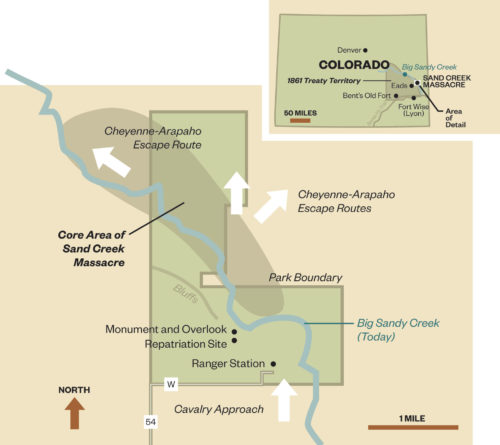
In brief, on November 29, 1864 at Sand Creek, Colorado a small peaceful non-threatening group of Southern Cheyenne and Arapahoe Native Americans (who believed they were under protection of US forces) were suddenly and brutally massacred at dawn by approximately 700 of “Colonel John Chivington’s Colorado volunteers”.
Chivington had fashioned himself as a “Christian” soldier. It was under his orders that nearly 150 Native Americans were tortured, murdered and badly mutilated. Three-fourths of his victims were innocent women and children butchered alive as they tried to escape. His men took human parts as “souvenirs” and tried to convince the American public such genocide was righteous.
WARNING: Explicit Depictions of the Massacre
In reality the treacherous “Colorado volunteers” viciously hunted down the Native Americans, often small children or elderly, and set fire to their villages despite white flags flying above.
Soldiers slashed open a pregnant woman’s belly, one soldier reported, “and took the Cheyenne child out and cut his throat.”
And while all this obviously criminal conduct of Chivington and his troops eventually was documented by whistleblowers and investigated, the Sand Creek Massacre Foundation points out no criminal charges were brought by the US against him!
Here is the kind of language found in the Joint Committee on the Conduct of War (Source: Hearing Before the Committee on Indian Affairs United States Senate One Hundred Tenth Congress First Session on Indian Health Care Improvement Act), which clearly documented depraved crimes of the US military:
Having full knowledge of their friendly character, having himself been instrumental to some extent in placing them in their position of fancied security, [Chivington] took advantage of their in-apprehension and defenceless [sic] condition to gratify the worst passions that ever cursed the heart of man,
Instead, an outstanding soldier in the US Army who had served under Chivington in Colorado and refused the genocidal orders and testified against Chivington was then assassinated by Chivington’s followers…
Silas Soule was later also murdered in Denver, but not before writing a graphic letter describing the atrocity to superior officers, gaining attention in Washington D.C.. Despite the ongoing Civil War, three federal investigations followed, in which Soule and other participants testified, resulting in condemnation of Chivington’s actions as an unjustifiable massacre. Cheyenne and Arapaho people honor Silas Soule today, and many say that were it not for his and others’ heroism, many Cheyenne and Arapaho descendants would not be here today.
Interesting to note that Soule has not been celebrated far more widely and regularly. He was already an American hero before he was placed under Chivington. Some speculate the US Army refusal to condemn Soule for disobedience was a passive criticism of Chivington.
As a former conductor on the Underground Railroad, and veteran of the fight in Kansas against domestic terrorists, Soule had helped lead the fight in Colorado to protect it from annexation by slaveholders (something the self-obsessed and thieving Chivington tried to claim credit for doing).
Soule stood against Chivington at a crucial moment. In today’s terms, he was a staunch defender of America against corrupt leadership:
The military, created to block slaveholder invasion, was being fraudulently converted (arguably Chivington had lost his remit before he gave orders) into a greedy for-profit extermination campaign waged illegally against Native Americans.
The complete and genocidal removal of the Arapaho and Cheyenne peoples from eastern Colorado by the very forces established to prevent removal of Americans from Colorado was peak hypocrisy and Soule documented it as such.
The National Park Service has published Captain Soule’s letter, condemning Chivington’s criminal crusade in chilling first-person witness details.
I saw two Indians hold one of another’s hands, chased until they were exhausted, when they kneeled down, and clasped each other around the neck and were both shot together.
Soule was the true American hero in every sense.
Captain Soule kneeling front row on the right. Sept 28, 1864. Source: AIM
His biography is a must read, albeit a tragedy among many successes in security (from jail-breaks to masterful tactics in battle) that were pivotal in American history.
He tried to stop and liberate John Brown, yet failed.
He tried to stop and convict Chivington, yet failed.
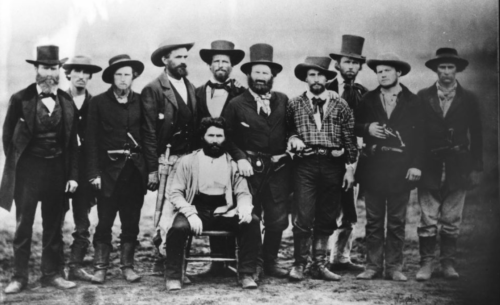
Jayhawker Ten, named for a fictitious bird, was a Kansas abolitionist militant group of Silas Soule
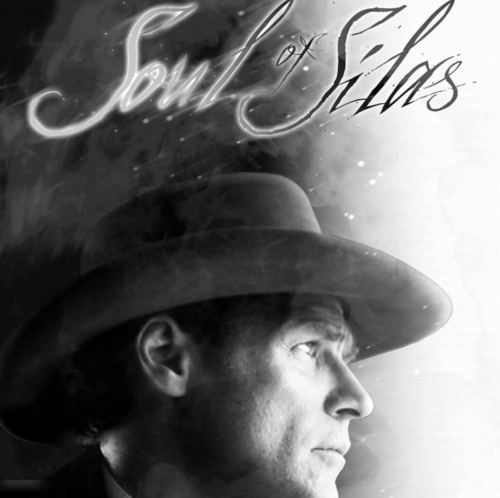
A low-budget movie recently was made about Soule, which really shows just how strangely unknown he is despite his amazing story.
Based on the horrific massacre at Sand Creek, Soul of Silas is a dramatic black and white Western Noir. The film chronicles the final brave acts of one of America’s unsung heroes from the Wild West: Captain Silas Soule. Soule was no stranger to the battle for justice.
The massacre makes for gruesome reading, and this history of the US might seem ancient. However, it also reminds me of what recently was exposed under the Reagan administration, given its documented 1982 brutality towards native Americans.
Reagan’s support led to a fundamentalist Christian taking control of Guatemala in a March 1982 coup d’etat. General Efrain Ríos Montt seized power and announced a policy of “rifles and beans” — either eat beans quietly in obedience to dictatorship or be killed by rifles. In response Reagan described him as “a man of great personal integrity”.
…more than 600 Indian villages in the Guatemalan highlands were eradicated or occupied by the military. The slogan “rifles and beans” meant that pacified communities would get “beans,” while all others would be the target of army “rifles.”
It makes sense to me that streets, schools, parks, etc be named for Soule. Why aren’t they?
…it is people like Soule and Cramer who truly deserve to be remembered through monuments and memorials, and can be a source for a different kind of historical understanding: one based not on abstract notions of justice and right, but upon the courage and integrity it takes to breathe life into those virtues.