Category Archives: History

“Media is more more dangerous to the state than the state is to the media”

Here is some telling history from an article about Russia’s approach to media control and its “rage” against YouTube.

The history of media subjugation in Putin’s Russia reaches back to the early days of his regime, and to his first Press Minister, Mikhail Lesin. “I don’t agree with the thesis that the state is more dangerous to the media than the media is to the state,” he told reporters in 1999, “I believe quite the opposite.” By 2003, most major domestic media lay in the hands of state enterprises, while CNN and the BBC remained “information weapon[s]” beyond state control. Lesin countered with the establishment of Russia Today, now RT, in 2005. “It’s been a long time since I was scared by the word propaganda,” he said of his creation.

That same year saw the founding of YouTube.

The real money quote comes much later, expressing just how critical data integrity is to Russian concepts of information security:

Tens of billions of times, YouTube has brought Russian propaganda into homes worldwide and has made millions in the process. For the U.S. company, that may represent little more than a boost to growth and engagement metrics. But for the Russian government, that represents a keystone of “information security.”

Integrity is a keystone! And yet American security professionals rarely work on it, let alone build tools or try to solve for vulnerabilities.

Food for thought, given how American police have been arresting children…

…a video had appeared on YouTube… The police were at Hobgood because of that video. But they hadn’t come for the boys who threw punches. They were here for the children who looked on. The police in Murfreesboro, a fast-growing city about 30 miles southeast of Nashville, had secured juvenile petitions for 10 children in all who were accused of failing to stop the fight. Officers were now rounding up kids, even though the department couldn’t identify a single one in the video…

Information weapons. Who controls them?


Update October 18: Police are not yet arresting people caught on train surveillance video doing nothing to stop rape.

A woman was allegedly raped on a suburban Philadelphia train last week while police said there were “a lot of people” around who “should have done something.”

Police said they had arrested a man connected to the rape that allegedly happened on a SEPTA El train on Wednesday. Fishton Ngoy, 35, has been charged with rape and several other counts.

According to authorities, the incident was caught on surveillance video that showed bystanders on the train when it happened who “did nothing.”
The 1945 Soviet DeNazification of Bicycles

After Soviet soldiers had walked on foot an estimated 2,500 km from Stalingrad to Berlin, their sentiment went something like this:

Commandeering a bicycle from Nazis (who literally had stolen everything while initiating illegal war) wasn’t entirely unexpected even if unapproved.

In fact, it was reported that Soviets inside Berlin would not take anything let alone a bicycle away from someone if that person clearly was a victim of Nazis.

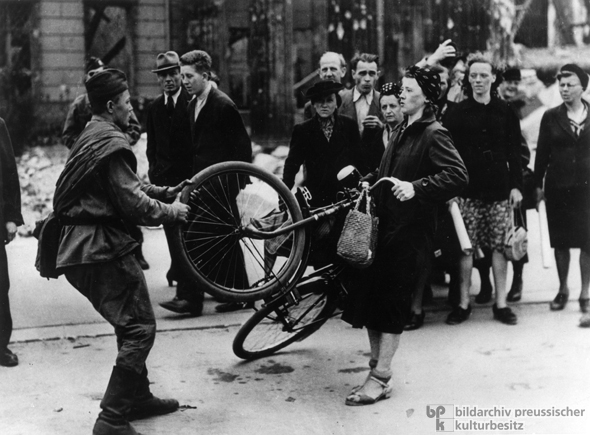
I say this all up front because an archival photo below represents something of a de-nazification problem within a constant false victim narrative by fascists.

What do you see here?

1945 war das Fahrrad ein begehrtes Fortbewegungsmittel und in Berlin brauchte man zum Fahren eine Sondererlaubnis. Hier versucht ein sowjetischer Soldat, einer deutschen Frau in Berlin ein Fahrrad zu entreißen. Anscheinend hatte sie keine Erlaubnis oder Beweise dafür; Unbekannter Fotograf.

Note a crowd stands aside and looks silent (a failure to Raleigh — pun obviously intended), which gives a rather obvious clue about this woman.

Nazis were notorious for stealing bicycles even before and throughout WWII, particularly in rural areas and from elderly women (people who needed them most).

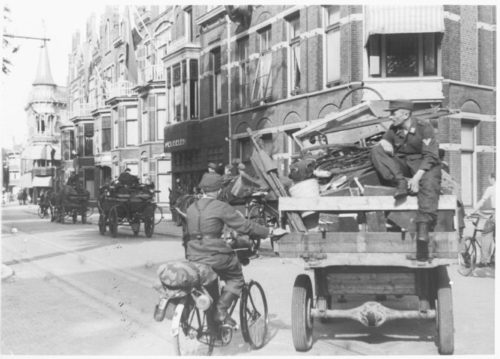
Nazis fled The Hague on September 2, 1944 (Mad Tuesday), terrified by rumors that Allied armies were coming. They stole far more than just bicycles. Note the cyclist stealing a ride instead of pedaling.

Or as they say in Dutch…

“Hé, waar is mijn fiets”? […] Het klopt dus dat de Duitsers de fietsen van veel Nederlanders inpikten. Want in laten leveren en niet teruggeven is een vorm van stelen.

Roughly translated:

On July 28, 1942 the Nazis stole all the bikes in Amsterdam by demanding the Dutch “surrender” them forever. Allegedly after invading and occupying a city Nazis would forcibly collect all the bikes not least of all to monopolize mobility and send metal back to Germany to be melted into weapons to invade more cities… a vicious cycle (pun obviously intended).

In Copenhagen when Nazis stole all the bikes it was reported as being luckier than those in Amsterdam:

…Hitler personally approved mass bike theft in Denmark. And it could have been worse as his original orders had been for all bicycles to be taken.

Sentiment about Germans stealing bikes is particularly bad because very overt campaigns intended to centrally control all rights including freedom of movement.

Liberating Soviet soldiers thus were seen as restoring freedom in Germany by prying hands off bikes where there was no proof of ownership (e.g. stolen by Nazis). Credentialed owners of bicycles, especially the victims of German crimes, were allowed to ride again thanks to this process of denazification.

For more insight into the situation after liberation, a book called “Unbroken Chain” by Holocaust survivor Henry Oertelt explains from a personal view — in Berlin he rode one around without any hassle from Soviets.

Oertelt, H. A., Samuels, S. O. (2000). An Unbroken Chain: My Journey Through the Nazi Holocaust. United States: Lerner. Page 146

Guess where that “beautiful shiny bike” came from? Probably stolen.

More to the larger point about Nazis, they had given Germany a reputation of being lazy, petty thieves who hated hard work and invaded neighbors in every direction to loot everything.

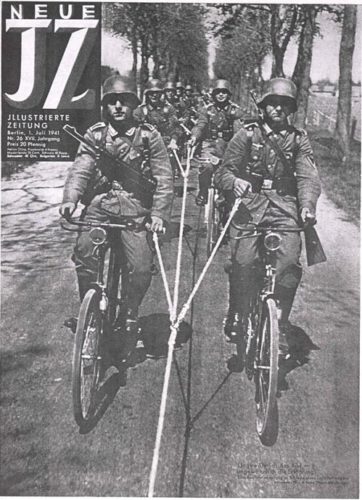
Also consider this WWII photograph:

Nazis behind bars before they were put behind bars.

Who today looks at that horse-hitch-looking thing and thinks “taking a hand off the bars of a stolen bicycle to hold onto short rope with no room to ride (instead of just pedaling) seems like a great idea”? It’s like a bad joke from someone whose army in 1942 was 80% un-mechanized and relied on horses.

How would these men scatter? It’s actually a good illustration of bicycle formations in war leading straight to failure.

…when a Japanese bicycle unit of about 300 moved on the Luzon Plain on Manila in December 1941 they were easily handled by defenders. Filipino riflemen accompanied by American armor made quick work of Japanese cyclists as they attempted to ride into withering fire. Even as bikes scattered or turned to ride in retreat nearly all were eliminated.

Seriously, anyone with an ounce of common sense would never do this. Instead they should just stack people and bikes on a motorized/armored rack/trailer. It’s not like Nazis didn’t know how to rack and stack bikes for a long haul since that’s exactly what they were doing when stealing everyone else’s. Of course that goes back to the problem that the Nazis didn’t even know what to do with the bicycles after they stole them, as they had the least modern military in WWII — only about 1/4 mechanized.

Now what do you see in that first image?

The German woman appears to be a common criminal in Berlin refusing to give up a stolen bike. It’s a good lesson for disinformation analysts.

Yale’s Disturbing Ties to Slavery

Yale itself published an expose in 2014 about Yale’s terrible reputation:

The evidence establishing Yale’s involvement in the slave trade is clear and compelling.

There were many interesting points made in an excellent write-up, yet the most interesting one for me was this:

Historians have long pointed out that Yale (the University) is deeply implicated in the institution of slavery. Many of its prominent buildings are named after slaveholders or slavery apologists. It housed so many southern students that it briefly seceded from the Union at the start of the Civil War.

Yale seceded? Amazing detail.

The Clash: “…find an Afghan rebel the bullets missed and ask him what he thinks…”

This is from a song called Washington Bullets on The Clash’s 1980 Sandinista! triple album:

‘nd if you can find a Afghan rebel
That the Moscow bullets missed
Ask him what he thinks of voting Communist

Dare I say one of the best albums of all time, and one of their best songs? Yet it has only 30K views on their official channel for a beautifully remastered version?