A recent post I published gave some of the backstory of modern intelligence and information warfare in America, from 1930s through WWII. That post actually culminates on this day in 1947, when the CIA was established officially.
The history department of the CIA doesn’t put things lightly when it describes their founding in the 1947 U.S. National Security Act (NSA):
President Harry S. Truman signed the National Security Act of 1947 (P.L. 80-235, 61 Stat 496) on July 26, 1947. The act – an intricate series of compromises – took well over a year to craft. […] The importance of the National Security Act cannot be overstated. It was a central document in U.S. Cold War policy and reflected the nation’s acceptance of its position as a world leader.
Speaking of the State Department, their historian is far more muted in assessment of the NSA and takes a weird tangent that leaves the CIA to a secondary story:
Each President has accorded the NSC with different degrees of importance and has given the NSC staff varying levels of autonomy and influence over other agencies such as the Departments of State and Defense. President Dwight D. Eisenhower, for example, used the NSC meetings to make key foreign policy decisions, while John F. Kennedy and Lyndon B. Johnson preferred to work more informally through trusted associates. Under President Richard M. Nixon, the NSC staff, then headed by Henry A. Kissinger, was transformed from a coordinating body into an organization that actively engaged in negotiations with foreign leaders and implementing the President’s decisions. The NSC meetings themselves, however, were infrequent and merely confirmed decisions already agreed upon by Nixon and Kissinger.
This overstates the changes made. While Truman had a particular take on it, those following him into office haven’t been entirely different. The Act created a National Security Council (NSC) with an Executive Secretary to advise the President indirectly (arguably through Department of State), yet did not say anything about a National Security Advisor (NSA). Nonetheless after Eisenhower’s appointment of Robert Cutler in 1952 to be “Special Assistant to the President for National Security Affairs”, which elevated/oversaw the Council, every president since has appointed a NSA.
The Air Force historian, for some additional perspective, takes an opportunity to thumb its nose at the Army and Navy, while pumping up its own balloon and ignoring the CIA altogether:
This act officially established the United States Air Force as a separate and co-equal branch of the United States Armed Forces. The U.S. Air Force’s quest for independence was a long and often contentious struggle between air-minded officers and the entrenched Army and Navy bureaucracy.
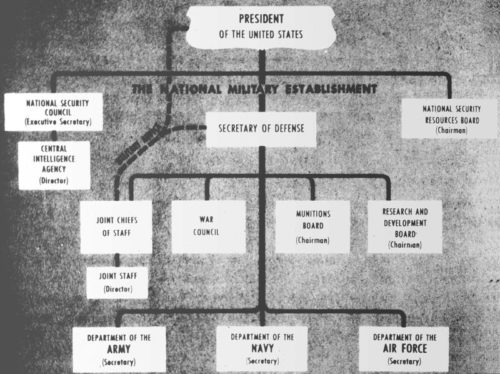
To be fair, the NSA also replaced the Department of War (started in 1789) with an Army Department in a new National Military Establishment (NME). Seems petty and wrong for the Air Force to be talking about independence from an entrenched Army, given an Army department also was brand new and co-joined to the Air Force in NME (by 1950 called the Defense Department).
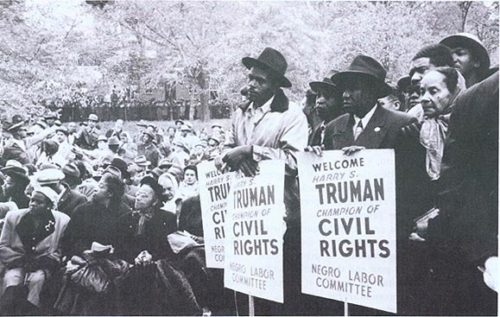
However, back to the CIA claiming acceptance of world leader position in 1947, it would take another whole year to this very same day in 1948 before Truman signed Executive Order 9981 to formally push Civil Rights and declare an end to discrimination in its own military.
The CIA historian is not wrong about the NSA being a significant event in American history. It completely shifted the entire country to discussion of National Security along the lines that the CIA’s father Donovan in “room 109” had envisioned. It seems obvious now because the shift is complete but back in 1947 it was revolutionary for the term “security” to bring more expansive thinking than prior terms such as defense, adversary or threat.
Somehow both this creation of the National Security mindset and the seminal Civil Rights order for it to work properly always have taken a back seat, if mentioned at all. Almost all narratives given about America during the Cold War focus instead on the Truman Doctrine and Marshall Plan. Check out my BSidesLV presentation called “Hidden Hot Battle Lessons of the Cold War” for more on this topic of American security, leadership and civil rights.
Spoiler Alert: Hungarians allegedly threw this enigma machine into a pig sty near the Czech/Polish border. Literally sloppy.
While this is called the G-110, the Crypto Museum has a special page dedicated to the G-111 version of the Enigma, which notably has support for five wheels and a 1929 design for connecting a printer (unique features found also in the 1939 Italian Alpha).
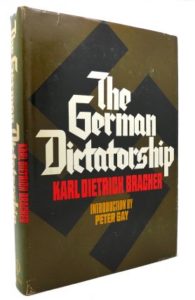
Important insights come from reading “The German Dictatorship” by Karl Dietrich Bracher, who was a German professor of politics and history at the University of Bonn:
The German dictatorship did not mean ‘law and order.’ The Third Reich lived in a state of permanent improvisation: the ‘movement’ once in power was robbed of its targets and instead extended its dynamic into the chaos of rival governmental authorities.
Nazi Germany was a state of permanent improvisation.
Today this method of unaccountable governance is seen in headlines such as “[White House occupant] and Woody Johnson act as if the rules don’t apply to them”.
Bracher goes on to say in his 1969 book that foundations of prosperity are to be found in democracy — regulation and governance that provoke meaningful innovations — because it offered a level of stability to developers (true order based on justice).
The Atlantic wrote in 1932 that Hitler was effectively a regressive tribal leader, in his addiction to acceleration coupled with rejection of any and all regulation.
Not seeing that civilization is a structure slowly built up by orderly procedure and respect for law, he is all for immediate action. He wants to apply his ideas at once by violation of law, if need be. The right of private judgment (that is, his right) is to be unlimited, beyond law. Thus, in thought, Hitler is still in the tribal stage.
Fail faster?
Perhaps the next time someone says they love the techbro “fail faster” culture of Tesla or Facebook, ask them if they also see it as a modern take on the state of permanent improvisation favored by Hitler.
Facebook’s staff now claim to be in opposition to their own failure culture “Hurting People at Scale“:
“We are failing,” [a seven-year Facebook engineer] said, criticizing Facebook’s leaders for catering to political concerns at the expense of real-world harm. “And what’s worse, we have enshrined that failure in our policies.”
The failures and real-world harm are intentional and orchestrated by Facebook officers who somehow manage to escape responsibility:
…growing sense among some Facebook employees that a small inner circle of senior executives — including Chief Executive Mark Zuckerberg, Chief Operating Officer Sheryl Sandberg, Nick Clegg, vice president of global affairs and communications, and Joel Kaplan, vice president of global public policy — are making decisions that run counter to the recommendations of subject matter experts and researchers below them, particularly around hate speech, violence and racial bias…
It begs the question again, can the Security Officer of Facebook be held liable for atrocity crimes and human rights failures he facilitated?
After reading Bracher’s wisdom on Nazi platform design, and seeing how it relates to the state of Facebook, now consider General Grant’s insights of 1865 at the end of the Civil War when Lee’s treasonous Army of Northern Virginia surrendered:
I felt like anything rather than rejoicing at the downfall of a foe who had fought so long and valiantly, and had suffered so much for a cause, though that cause was, I believe, one of the worst for which a people ever fought, and one for which there was the least excuse.
It should be no surprise then that it was Grant who created the Department of Justice.
The unregulated state of permanent improvisation — a fast-fail culture used to avoid accountability for real-world harms for profit at scale — needs to end.
Tesla is a killing machine.
Facebook is a digital plantation (slavery).
Their “fail faster” turns out to be just “fail” without accountability, which turns out to just be privilege to do known wrongs to people and get rich.
Grant wasn’t opposed to change or failure, of course given how he radically changed himself, he just put it all in terms of values/morals and being on the right side of history, which he forever will be (PDF, UCL PhD Thesis) and unlike Tesla and Facebook executives who should be sent to jail:
My failures have been errors in judgment, not of intent.
The 18th Chairman of the Joint Chiefs of Staff, General Martin Dempsey, frames Grant’s memoirs for us like this:
Our intentions matter. They reflect our motivations, our beliefs, our character. If we start with good intentions, and hold ourselves accountable to them, we start in the right place.
Intentions are hard or impossible to prove, yet I see the point. Harms are much easier to orient around, regardless of intent, as noted since 2016 with Tesla’s inhumane and unacceptable response to predictable ADAS deaths.
Facebook management perhaps can be proven to have first conceived as a platform for men to amass power and do wrongs (a failed attempt to invite crowds into physically shaming women who refused to go on a date with the founder).
…opened on October 28, 2003—and closed a few days later, after it was shut down by Harvard execs [due to complaints by women of color]. In the aftermath, Zuckerberg faced serious charges of breach of security, violating copyrights, and violating individual privacy. Though he faced expulsion from Harvard for his actions, all charges against him were eventually dropped [and Harvard execs instead invested in his private company].
Bad intentions? Some still might say bullies are just having fun. But again in terms of predictable and avoidable failure, it spells out no justice for victims.
Watch now for the people intending (or even not) to get away with harms, and then create labels to demonize anyone who might threaten them with accountability. Elon Musk should be expected any minute to blame the Jews for everything, just like his family always has done.
Fast forward to today, and officers of Tesla and Facebook (unlike Enron) haven’t truly been held accountable. They definitely did not start in the right place and they continue to wrong people around the world. Their state of immoral and permanent improvisation has been a human rights disaster and needs to be stopped and sanctioned.
Typically told in terms of reconstruction and establishing rights of black Americans after the Civil War, an 1873 court decision about the meat industry (e.g. wet markets, the kind infamous today for spreading COVID19) offers useful insights into modern culture of health and safety in America.
1868 the 14th Amendment was passed to provide and protect emancipated slaves with citizen rights that had been denied them by America.
1869 a set of lawsuits were brought in New Orleans to test the 14th. Five years later (1873) these so-called Slaughterhouse Cases were decided in Supreme Court, undermining civil right protections.
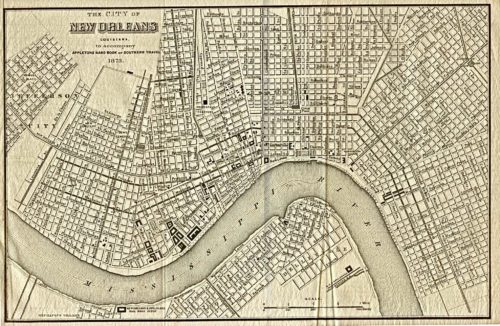
New Orleans in 1873. Source: Perry-Castañeda Library Map Collection, University of Texas at Austin
The key to seeing the parallel to today’s “Anti-mask” movement is in reference to slaughterhouses contaminating New Orleans drinking water:
The Slaughterhouse Cases (1873) was a supreme court case which became the first to interpret the thirteenth and fourteenth amendments. After slaughterhouse practices continued to contaminate New Orleans drinking water, Louisiana state legislature passed an act that allowed the city to create a company which essentially monopolized the slaughterhouse industry. All butchers interested in slaughtering meat had to do so at Crescent City Livestock Landing and Slaughterhouse Company. The Butchers’ Benevolent Association, an organization of New Orleans butchers, assembled in multiple cases to sue on the grounds that the government, by creating the company, violated their privileges or immunities and deprived them of their liberty and property without due process as protected by the fourteenth amendment. Additionally, they claimed that Crescent city violated the 13th amendment, referring to their actions as “involuntary servitude.” They appealed after losing in all trial cases. The supreme court affirmed and held that neither their 13th or 14th amendment rights had been violated. The narrow reading of Privileges or Immunities in The Slaughterhouse Cases rendered the clause nearly insignificant.
Newly developing science of healthy water found that white slaughterhouse companies were in the practice of systemically wronging residents by dumping waste upstream of the black neighborhoods.
In response to the polluting of the river, a New Orleans grand jury recommended that the slaughterhouses be moved to the southern portion of the city; however, since the majority of the slaughterhouses were outside city limits, the grand jury’s recommendations held little weight. The city later appealed to the state legislature and as a result, the Louisiana legislature passed a law that allowed the city to create a centralized corporation that consolidated all slaughterhouses in New Orleans.
Thus a city tried to regulate local harmful practices by organizing a system that mandated reducing pollution, much in how today we have sewer systems designed to route waste away from drinking water. Perhaps look at it like wet market (slaughterhouse) regulation for health and safety in modern terms of COVID19: Americans recently have tried to demand China shut their wet market down while demanding American ones have to remain open, meaning COVID19 spread in America, which led China to ban American imports of meat… it’s complicated.
Anyway, in response to the novel health and safety mandates of 1869 trying to stop disease contagion, powerful lawyers who had recently tried to fight a war to expand slavery took up that cause again by fabricating a strange defense of white slaughterhouses polluting black neighborhoods.
The argument was privileged whites operating businesses were being treated as slaves when they were forced to pay into social safety measures, and also violated when regulated on health and safety (risks organized into a platform and monitored).
Sound familiar? It should, the occupant of the White House has pushed dangerously false propaganda that compares good safety measures that protect society (wearing masks) to slavery:
“Masks aren’t about public health but social control,” a conservative columnist tweeted, linking to a Federalist piece. “Image of Biden in black mask endorses culture of silence, slavery, and social death.”
The lawyers in 1869 very strategically fought a pitched battle that would ultimately attack and water down the new protections of freed slaves.
The Supreme Court ended up extremely narrowly defining rights and protections from the 14th Amendment.
…in limiting the protection of the privileges and immunities clause, the court unwittingly weakened the power of the Fourteenth Amendment to protect the civil rights of blacks.
Let me put this another way, because I often find people confused about the man who led this battle to weaken the 14th: John A. Campbell.
Campbell was openly in favor of owning slaves as a “Jacksonian Democrat” (white supremacist) attorney who was serving on the U.S. Supreme Court before the Civil War.
Then when slave owners declared Civil War to forcefully expand their human trafficking (apparently peaceful protest wasn’t the preference of white supremacists), Campbell resigned his lifetime appointment to join their cause. He abandoned his oath to defend the Constitution in order to fight in the war against his own country… to kill Americans.
He was the only justice to commit treason and his true self became clear as he took the top appointment as Assistant Secretary of War in an attempt to keep alive the violent expansion of slavery.
In October 1862, with the Confederacy struggling to survive, he accepted an appointment as assistant secretary of war, overseeing the Confederacy’s draft laws.
After Campbell lost the war he was imprisoned for six months as the violent traitor he was, which was a far better outcome than the hanging for treason that he clearly deserved.
In 1865 leaders of the war to expand slavery such as Campbell had tried an appeal to Lincoln, begging him for an agreement in the face of imminent military defeat, yet refusing to surrender.
“Mr. President, if we understand you correctly, you think that we of the Confederacy have committed treason; that we are traitors to your government; that we have forfeited out rights, and are proper subjects for the hangman. Is that not about what your words imply?” With brutal frankness Lincoln replied: “Yes, you have stated the proposition better than I did. That is about the size of it.”
To put this in perspective it was just a few months later, after high death tolls in the war to expand slavery had continued because refusal of the Confederate South to surrender, that Campbell sat in jail.
It was release from jail of this traitor to the Constitution that really should be seen as the exact where and when that Slaughterhouse Cases began.
Released from prison, the treasonous Campbell went straight back to trying to get his shamefully racist ideas into the Supreme Court. This is when he cooked up an extremely crooked lawsuit to challenge the 14th Amendment.
Campbell obviously had an uphill battle in the Slaughterhouse Cases. After all, the states were empowered to enact laws to protect the “health, safety, morals, and welfare” of the citizenry. Clearly, this law related to protecting the people of New Orleans from polluted water.
What did Campbell do? He took the language of the Fourteenth Amendment and created an ingenious argument…that there were certain rights that were so fundamental that the government could not take them away even if the correct procedures were followed.
[…]
What was the fundamental right that the Louisiana legislature was infringing upon? That right was economic liberty [of whites that]… trumped the police powers of the state [to protect blacks].
So the whites were arguing under Campbell that blacks gaining rights as citizens should be seen as privileged white people becoming victims, on the “fundamental” concept of white people losing their economic “liberty” to wrong blacks.
When someone in US says they want to pollute others as a fundamental privilege and refuse to wear a mask on the principle that to do so would be “slavery”… please remember the tactics started by pro-slavery white supremacist lawyers in 1873; a way to perpetuate racist war via the courts and destroy civil rights for blacks.
Also keep in mind the New Georgia Encyclopedia doesn’t think it important to mention Campbell was a slave owner.
However, his tax records show in 1841 how Campbell owned eight humans and within five years he had expanded that to fourteen humans enslaved. In 1857, five years after being nominated to the Supreme Court the records show he again purchased three humans and then seven more the following year.
Campbell was firmly in the camp of slavery as the country slid towards Civil War by secession. He was actively engaged in wealth accumulation through human slavery and jumped to the side preserving human trafficking. Moreover he kept it going while leading anti-American forces to expand slavery, as their Secretary of War.
This hopefully gives some important context for the man who drove a Supreme Court case to undermine the 14th and harm blacks. A man who falsely tried to argue government regulation of health measures that improve social welfare and protect black communities are the exact opposite; that good health is slavery.
Perhaps if he were alive today he would be forced to issue an apology like this one recently posted by an ill-informed and angry COVID19 “Anti-mask” protestor:
My intent was to take a stand for the freedom of all human persons and I mistakenly held a sign that conveyed the opposite.
Indeed. Not wearing a mask conveys the opposite of being for freedom of all human persons. Wear your mask to support freedom.
a blog about the poetry of information security, since 1995

 Important insights come from reading “