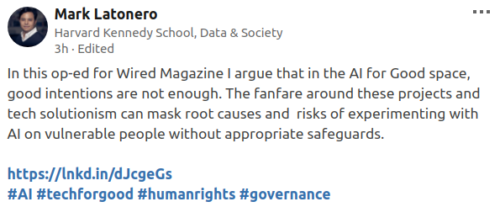
A Harvard man walks into a wildlife protection demo and an AI system made by Intel labels him a poacher. His reaction is fascinating (which I will detail below). He criticizes machines in a way that seems just as fitting for humans. Would he have reacted the same to a human labeling him in this manner? Even more interesting is the man labeled a poacher is from an institution (Harvard) that has been known to perpetuate injustices like poaching.
This incident begs the question of whether we should expect human intelligence to be criticized as often or vocally as machine intelligence. I mean is it right to expect more of machines than humans in this scenario? I’d like to explore with this post whether humans of “Harvard intelligence” could be expected to pass the bar set by Harvard for a machine of “Artificial intelligence”.
In other words what if people who graduate from Harvard, who claim to be intelligent, exhibited the same or worse behavior as a machine labeling people poachers in the wildlife protection demo?
Definitions
POACHER: A poacher is generally defined as someone who unfairly or dishonestly takes and uses something for themselves when it belongs to someone else. Here’s some insightful data on poaching and regulation:
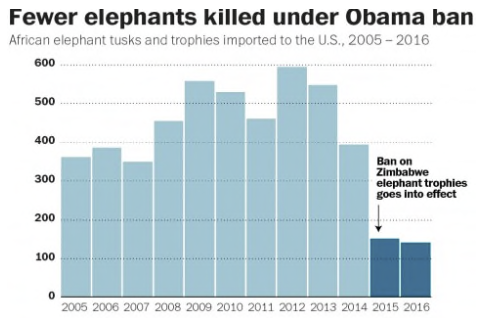
Here’s a hint from students of Data/Society/DecisionMaking: “No”
HARVARD: Harvard is generally defined as a school with a tarnished legacy that today remains affiliated with white men in positions of power who display very questionable ethics (Pompeo, Kobach, Zuckerberg…). Here’s a perfect example:
Harvard University is profiting from of one of the earliest known photographs of an enslaved man, despite requests by his descendants to stop doing so, the man’s great-great-great-granddaughter says in a lawsuit…
A little deeper inquiry into that lawsuit reveals that Harvard was heavily invested in perpetuating white supremacy doctrines even after the US Civil War forcefully decided blacks should no longer have their bodies taken unfairly or dishonestly for use by white men.
In 1865, just as emancipation was being secured in the United States, [Harvard professor] Agassiz had more than a hundred photos taken of nude African-descended Brazilians to build support for white supremacy and polygenesis. With slavery in the United States ended, Agassiz’s work became even more critical: In a moment when America’s future regarding race was highly malleable, building a scientific foundation to support continued white supremacy was even more of an imperative.
Harvard has been extremely slow not only to address its racist and unethical foundations, which supported unfair and dishonest practices, it should concern everyone the number of white supremacists even today who have Harvard degrees. Shouldn’t they fail tests of intelligence?
INTELLIGENCE: Intelligence is defined here with Gottfredson’s perspective that it relates to a broad and deep capability for comprehending surroundings, such as making sense or figuring out what to do. For example, what should Harvard do when asked to stop unfairly or dishonestly taking and using something for themselves?
Example of Harvard “intelligence”
Kris Kobach of Kansas (KKK) is a good example as he earned a BA degree in Government in 1988, earning distinction for being top student in his department. We also should include Kobach’s adviser (trainer, if you will), the director of Harvard’s Center for International Affairs, Professor Samuel P. Huntington.
Huntington infamously taught Kobach nativist doctrine such as how to block non-white participation in government. One of the crazy theories was that people of Central and South America who enter the US pose an existential threat to the “American identity.”
Mexican intellectual Enrique Krauze described Huntington’s method as a “crude civilizational approach.” Carlos Fuentes called Huntington “profoundly racist and also profoundly ignorant” and accused him of adopting the favored fascist tactic of creating a generalized fear of “the other.” Henry Cisneros noted that Professor Huntington was “hand-wringing over the tainting of Anglo-Protestant bloodlines.” Andres Oppenheimer of Miami called Huntington’s work “pseudo-academic xenophobic rubbish” and called for national protests against Harvard University and publisher Simon & Schuster. Even those sympathetic to Huntington’s anxiety about Mexican immigration stood their distance. Alan Wolfe said that at times Huntington’s writing bordered on hysteria, and that he appeared to be endorsing white nativism. The editors of the British magazine The Economist questioned Huntington’s notion of Anglo Protestant culture, noting that it had been “a long time since the Mayflower.”
Kobach earned top honors in government theory in the late 1980s, and trained under this obviously racist and xenophobic adviser. Can you can guess, based on world political events at that time, what came next?
In 1990 (given the fall of South Africa’s apartheid was still four years away) Kobach published a pro-apartheid book titled “Political Capital: The Motives, Tactics, and Goals of Politicized Businesses in South Africa” (University Press of America).
Kobach wrote about a white police state as good for business. He seemed to think beating down non-white populations (those seeking equal rights with white police) was how to push wealth into white hands just as a matter of “peace keeping”.
Technically speaking he wrote “strict Verwoerdian apartheid enforced with an iron fist can be seen as a route to a more stable South Africa”. You can see it even on page 28 from his Harvard thesis:

After graduation and publication of pro-apartheid screed Kobach then embarked on a life quest “to enact a nativist agenda, often from within the government.”
In other words, intelligence doesn’t seem like the right word to describe a top student from Harvard. He did the wrong things over and over. What if a machine made these same mistakes? He literally made a career out of falsely labeling humans and declaring them a threat based on completely debunked white supremacist theories of species preservation (nativism).
Harvard criticism of Artificial “intelligence”
Fast forward to today’s debate on AI ethics and we have a Harvard man saying an “intelligent” system has unfairly labeled him a poacher, much to his astonishment.
Hey, did that system read history and know he was from Harvard, an institution known for its unauthorized appropriations? No.
Does looking at someone’s training environment, and probability of learning selfish supremacy doctrines, seem like a good way to find people who favor poaching? Maybe.
Those ideas are far more complicated as learning models than what actually happened. The label of poacher turns out to be very easily explained.
First, Kudos certainly go to Latonero for speaking out from within the horribly tarnished halls of Harvard.
His article does seem a little overly “why me” and primarily concerned for his own welfare, yet it makes a fair point that he doesn’t understand the authority or perspective of the system labeling him.
Walking through the faux flora and sounds of the savannah, I emerged in front of a digital screen displaying a choppy video of my trek. The AI system had detected my movements and captured digital photos of my face, framed by a rectangle with the label “poacher” highlighted in red. […] I couldn’t help but wonder: What if this happened to me in the wild? Would local authorities come to arrest me now that I had been labeled a criminal? How would I prove my innocence against the AI? Was the false positive a result of a tool like facial recognition, notoriously bad with darker skin tones, or was it something else about me? Is everyone a poacher in the eyes of Intel’s computer vision?
Second, at no point does he say, for example, 35,000 poached elephants is a catastrophe worthy of solving. Is there a case to be made for labeling ever? Perhaps this is one place where simple labels make sense, as a piece of a puzzle that trends towards more sophisticated answers and broader actions.
Those deaths are approaching extinction level threats, and the elephants are in natural prisons where no human should be…hold that thought.
Latonero gets a good and clear answer to his question and just brushes it off as insufficient.
When I reached out to the head of Intel’s AI for Good program for comment, I was told that the “poacher” label I received at the TrailGuard installation was in error—the public demonstration didn’t match the reality. The real AI system, Intel assured me, only detects humans or vehicles in the vicinity of endangered elephants and leaves it to the park rangers to identify them as poachers.
There we go. Intel clearly says a simplistic algorithm is looking for humans within a space that is authorized only for animals. When a human enters the space they are labeled a poacher because they do not have authorization, and it is assumed they entered unfairly or dishonestly.
I can understand Latonero was shocked to be labeled “unauthorized”. He probably wouldn’t have thought twice if the screen said that, or even just said “human”, instead of making the logical connection to unauthorized access being a poacher.
Walking around at a “MIT conference on emerging AI technology” he felt entitled to enter a space and approach the sensor. He did not appreciate being told his actions were a violation and linked to extinction-level threats.
It sounds perhaps like what a Mexican immigrant to Texas (a state forcibly taken from Mexico) might feel when being labelled by Kobach as a violation and an extinction-level threat.
Using the Harvard critique of intelligent systems to assess Harvard graduates
Ok, now imagine Kobach is that AI system that Latonero walks up to. Let’s say Latonero is an American migrating into the US. Kobach would then label Latonero a threat and…nothing seems to happen. Am I right here?
I don’t see any Harvard ethics experts lining up to warn us of the “intelligent” people emerging from Harvard training who use simplistic and dangerous labels to harm society.
Again, I can give kudos to a Harvard expert calling attention to simplistic labeling and calling it less than intelligent, yet I have to point out his warnings would be far more appropriate to issue a take-down on Kobach and ban him from any authority or office.
Graduates of Harvard who perpetuate its awful past and poaching ways are far worse than the AI system that Latonero is warning about.
We should fix both humans and machine, and by comparison we have easy solutions ready for the latter…but the real question here is whether an AI system designed to protect humanity from poachers would be seen as accurate if it labels Kobach as existential threat to society.
After all, a Harvard affiliation really could get classified as probable poacher
And on that note the parallels are closer than you might realize:
…Kris Kobach is having a tough time finding support for a plan that would allow the [2012 Kansas] governor to distribute 12 big-game hunting permits at his discretion.
In other words Kobach literally tried to pass a law to bypass wildlife safety authorities, which would shield himself/associates from being labeled a poacher. He could literally hand out a sort of get-out-of-jail card, the sort of thing the KKK were famous for using during prohibition to limit alcohol to whites only.
Kobach’s failure to pass a self-entitlement bill led to this embrace in early 2016 with an infamous elephant killer:
Kansas Secretary of State Kris Kobach sports an orange hunting cap, a long gun and a wide grin as he stands alongside the president’s son and 20 dead pheasants.
And that meeting was followed by this 2018 policy failure at the national level:
…Trump announced that the lifting of the ban [on import of dead elephant] was on hold, pending further review. In a follow-up tweet, he went on to say he’d “be very hard pressed to change my mind that this horror show in any way helps conservation of Elephants or any other animal.”
Hopefully this post has helped explain that Harvard makes the best case yet that Harvard should be criticizing Harvard more.
Update March 2021: The Crimson Klan
Despite Bond’s appeal to take [Harvard’s racist] history seriously, it is unclear the extent to which the University has, or will, reckon with its troubling ties to the Ku Klux Klan throughout the 20th century, which do not begin or end with the 1952 cross burning.