Historian after historian knows and tries to relate the same basic story.
Putin’s job in East Germany for the KGB was to recreate Nazi cells in West Germany during the Cold War. He literally served Russia by surreptitiously growing far-right violent “sports clubs” after WWII, as if he saw breathing new life into Nazism as his preferred path to power.
If you derive Putin was a big fan of Nazism the evidence certainly agrees, even despite the fact West Germany continually blocked his fantasy.
Keep this in mind every time Putin tries to tell his worn out and false story that a target country is full of Nazis and needs liberation. He pulls this same tired thread so often everyone by now should be comfortable admitting the emperor’s trousers are gone.
What he really stands for, his ugly pants increasingly flapping in the cold breeze, is to breed Nazism and corruption in foreign nations as a step towards weakening and exploiting/annexing them.
When Putin says “I see Nazis” you can confidently reply “yeah, yours, now get out of here and take them with you”.
…Adolf Hitler, in his first move of conquest, annexed Austria in March 1938, claiming it as a historical part of the German Reich, and then held a plebiscite in which 99.75 percent of Austrians officially voted to join Germany. Putin’s first move in this war was to annex Crimea in March 2014, claiming it as a historical part of the Russian Empire, and then hold a plebiscite in which 97 percent of Crimeans officially voted to join Russia.
That writer goes on to suggest, absolutely on target, that Germany sending tanks to Ukraine today is an opportunity to correct its past. German tanks will be used in defense against agression, ridding a country of Putin’s Nazi dreams.
Think about it like how General Ludwig Beck, head of the German Army, wanted to forcibly remove Hitler from power by 1938. He resigned his post and instead became the center of German military resistance to Hitler.
Imagine if Beck’s vision for German armor had done back then to Nazism what it can do today.
An American advocating for anti-corruption and moral capital perhaps put it best:
Take nothing less than the supreme best
Do not obey for most people say
’cause you can pass the test
So what we have to do is
move on up and keep on wishing
Remember your dream is your only scheme
so keep on pushing
Putin won’t invoke the Widerstand when he speaks, and that should tell you everything. The Germans now are rising to roll out an ignored chapter in their own military history, to restore honor to Germans who served against Nazism.
The era of the telegram came to an end in Germany with a final flourish of thousands of the once-popular message service, the country’s main postal service, Deutsche Post, said Wednesday.
Deutsche Post said that 3,228 telegrams were dispatched on the final day of service on New Year’s Eve.
Kinda curious if the last word someone paid to send was “stop”? The cost of operating and using it had gotten quite high.
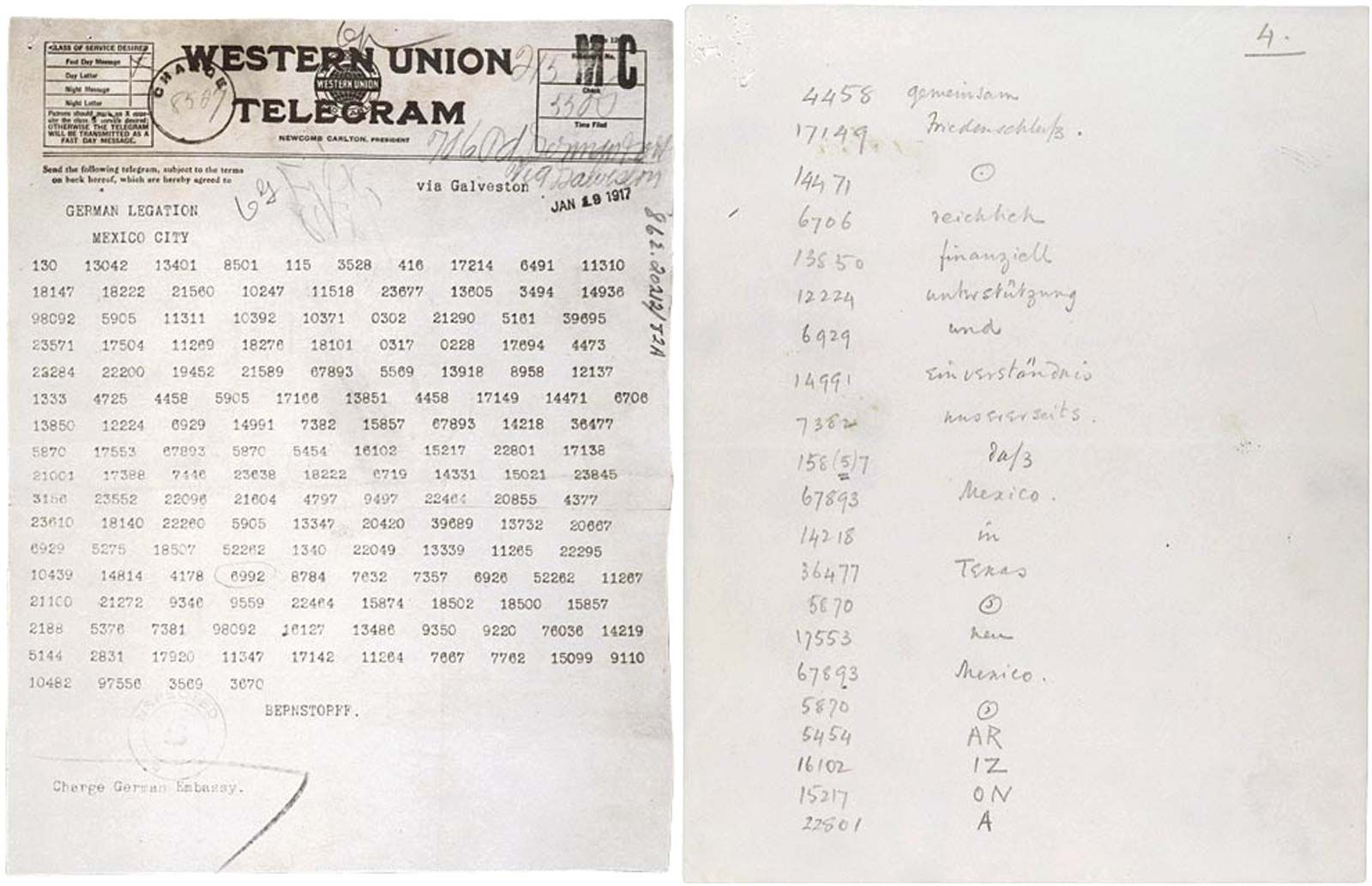
The canonical example is when German foreign secretary Arthur Zimmermann sent the following encrypted text to Germany’s minister in Mexico on January 16, 1917.
Encrypted left. Decryption work right. Click to enlarge.
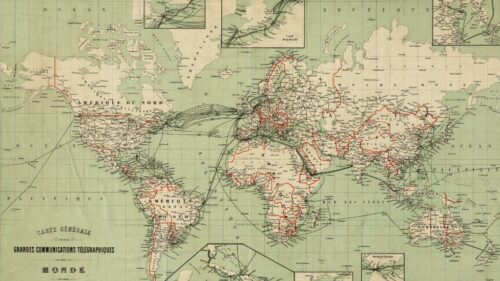
You may notice the telegram says “via Galveston” (Texas) but more importantly it routed through England. The British at the start of WWI severed cables connecting Germany to the world in order to intercept all its telegrams.
WWI map of global telegram cables. Source: BBC
The British delivered a decrypted version of Zimmerman’s telegram to the U.S. government on February 24. The text also was exposed by the press on March 1, raising public anger immediately about a German military alliance with Mexico and Japan carrying threats of invasion.
Public knowledge of these secret German plans was how the British government helped American public opinion overcome powerful leaders trying to aid Germany (i.e. Henry Ford) and shift the balance of power to better men.
Most notable, perhaps, was that former President Theodore Roosevelt along with the U.S. Army Chief of Staff (former commanding officer of the famous “Rough Riders”) had heavily promoted active response to aggression. Roosevelt objected since the start of WWI to America being passively in alignment with Germany, and objected even more in 1915 when “America First” became Wilson’s racist campaign for re-election (including a restart of the KKK).
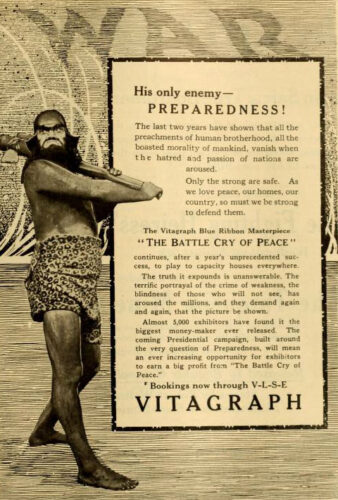
Roosevelt instead campaigned for a civilian Preparedness Movement to ready America for defense of freedom.
1915 film “The Battle Cry of Peace” promoted by U.S. Army General Leonard Wood and former President Theodore Roosevelt
Basically, in the two years before the Zimmerman telegram exposed Wilson’s treachery, Americans had watched their President fraudulently blame “leftists” and “labor” for a growing “holocaust” of German attacks bombing cities, burning factories and sinking ships.
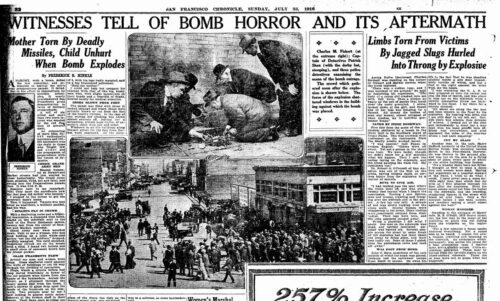
When a Preparedness Day parade was bombed by German military intelligence, for example, Wilson had for years before secretly been advised of this and related plots. On July 22, 1916 (just eight days before the infamous Black Tom explosion in NYC) a massive explosion rocked downtown San Francisco and killed 10 people.
Source: SFGate
Authorities under Wilson, despite strong counter intelligence, intentionally ignored their known and obvious German suspects and instead falsely used the violence as pretense to target “leftist organizers”. Today it’s known as a “one of America’s darkest miscarriages of justice”.
Think about the outrage then if Wilson had been caught enabling a foreign military to kill Americans so he could win elections (e.g. what Richard Nixon also did).
If that sounds like something the GOP still would do today, you know now exactly why Donald Trump calls himself America First when he invites Russian attacks and divisively blames “leftists” for everything. Separatist movements in 2016 America driven by foreign adversaries? Sounds like a memo straight out of 1916 Germany.
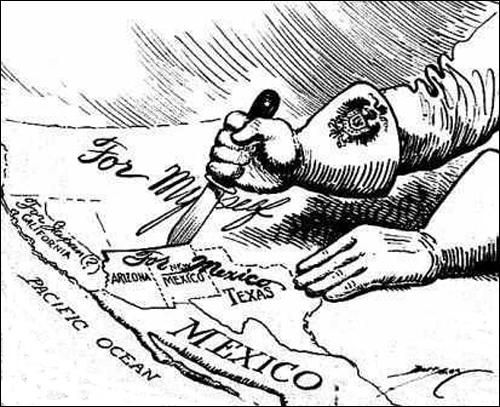
Public knowledge of secret German military plans abruptly destroyed best attempts by Henry Ford and Woodrow Wilson to side with the enemy of America. Note how California was labeled as property of Japan, an often overlooked detail that foreshadowed internment camps 30 years later.
After the British vociferously exposed the public to German secret communications, Wilson no longer could sustain such devious German alignment meant to fraudulently blame foreign military attacks killing Americans on domestic political opponents.
In April 1917 the unpopular U.S. President finally had his hands tied and Americans very quickly joined the war against Germany, with thanks to the leadership of Roosevelt and England, not to mention poets such as Alan Seeger (American soldier in Foreign Legion of France) who in 1916 wrote “I Have a Rendezvous with Death”.
I have a rendezvous with Death
At some disputed barricade,
When Spring comes back with rustling shade
And apple-blossoms fill the air—
I have a rendezvous with Death
When Spring brings back blue days and fair.
It may be he shall take my hand
And lead me into his dark land
And close my eyes and quench my breath—
It may be I shall pass him still.
I have a rendezvous with Death
On some scarred slope of battered hill,
When Spring comes round again this year
And the first meadow-flowers appear.
God knows ’twere better to be deep
Pillowed in silk and scented down,
Where Love throbs out in blissful sleep,
Pulse nigh to pulse, and breath to breath,
Where hushed awakenings are dear …
But I’ve a rendezvous with Death
At midnight in some flaming town,
When Spring trips north again this year,
And I to my pledged word am true,
I shall not fail that rendezvous.
Powerful stuff, and Roosevelt was a legend (pumping out preparedness books, movies, speeches), but nothing overcame Wilson’s secret executive alliances and elevated American public sentiment into active defense like that decrypted Zimmerman telegram.
Well done England.
Another interesting footnote is that the KKK had pushed for suffrage (white women voting) as a means to dilute Black votes, especially in “young” states like Montana.
This effect was seen clearly in 1917, after Germany had bombed major American cities, when Jeannette Rankin of Montana (first woman elected to Congress in her first term) voted against war authorization. Again in 1941, after Japan had bombed Pearl Harbor, Rankin voted against war (placing the only no vote). She expected America could align itself with Nazi Germany and Hitler.
Historians recently have pointed out something to better frame Rankin’s hard edge politics; “anti-labor” actions in 1917 were in fact planned attempts at ethnic cleansing or even genocide.
…after all of this research, the deportation was not a response to a labor action. It was that to a limited extent, but it was also in the nature of an ethnic cleansing.
Obviously she did not in any way represent Americans who weren’t white. She was especially toxic to Black women who had been rebuffed by racism of most white women’s organizations including Rankin’s suffrage groups.
Black women by comparison famously supported the war efforts and many served with distinction, despite attempts by Rankin’s carefully crafted role to erase them and their communities. This divide is what led into the tragic Red Summer and Wilson sending troops to massacre non-white Americans who had supported the war and even served in it.
Thus, one decrypted telegram from Germany also changed entirely the course of Civil Rights in America. Who knows what damage Rankin might have done if she hadn’t been exposed as part of American systemic racism.
The toxic America First platform in both WWI and WWII, a barely concealed front for the KKK, actively manipulated sentiment using highly targeted propaganda pushing white women to make their sons serve German interests instead. Obviously those efforts failed under the reality of German aggression that grew after WWI (modeling itself on Wilson and Ford), such that by WWII any mention of America First was labeled seditious.
Perhaps, with great subtlety, the fizzle and end of the historic German telegram thus signals something wider: the long overdue end to Wilson’s racist America First platform as well.
An experiment on trust was conducted by dropping 192 physical wallets in 16 cities.
Helsinki, which also boasts that it doesn’t believe in comparing itself to neighbors, seems to be very proud that 11 out of 12 wallets there were returned to the owner.
As the famous Finnish poet Eino Leino once wrote: “Kell’ onni on, se onnen kätkeköön” (Don’t compare or boast about your happiness).
Kell’ onni on, se onnen kätkeköön,
kell’ aarre on, se aarteen peittäköön,
ja olkoon onnellinen onnestaan
ja rikas riemustansa yksin vaan.
Ei onni kärsi katseit’ ihmisten.
Kell’ onni on, se käyköön korpehen
ja eläköhön hiljaa, hiljaa vaan
ja hiljaa iloitkohon onnestaan.
How can you trust the Finns if they boast about happiness while telling everyone they’re so happy because they don’t boast about being happy?
“Being honest is a characteristic of Finnish culture – at least if we compare to other cultures,” said Johannes Kananen, a lecturer at the Swedish School of Science at the University of Helsinki.
Uh huh, compare to others again?
Returning a wallet in Finland might be symptomatic of something besides trust, such as a security that comes from sustainability (lack of want).
How about this for a translation of the poem?
If there is luck, let it be your luck,
when there is treasure, may it be hidden treasure,
and let him be happy with his happiness
and rich in joy alone.
No luck comes in being seen as lucky.
If you’re lucky, let it be
and live quietly, just quietly
and silently rejoice in your happiness.
Accepting where you are, what you are, means something quite different from cities where people go to acquire, change and become something else.
In that sense, Finland may feel secure about things happening to them, rather than having trust to make things happen. They reject change, if you’ll pardon the easy pun.
They return wallets as symbolic of things they have come to believe should and will happen (as a matter of faith), not because they have more trust.
Compared to 11 other European countries, Finnish residents with African backgrounds experience the most racism, according to a new EU report.
Racism is clear evidence of lack of trust, and also can be resistance to change.
Germans rightfully expect vehicle drivers to be intelligent.
As their old saying goes…
Der Mensch denkt,
der Chauffeur lenkt
A man thinks, a driver steers.
Tesla has flagrantly violated this German saying on both ends by telling customers they don’t have to think when they sit in a “driverless” box that can’t steer.
Unfortunately, the overtly fraudulent Tesla still seems to sell cars. And it’s buyers, especially Americans, sometimes believe any crazy thing they hear instead of checking the NHTSA records.
The latest news is a Tesla driven by a man in Germany under some unspecified influence (social media, drugs, alcohol, etc.) had to be removed from the Autobahn.
Police have described how the Tesla driver ignored a safety check, then completely ignored their chase from in front of him.
Der Fahrer war gegen 12 Uhr auf der A70 von Bamberg in Fahrtrichtung Bayreuth unterwegs, als die Polizeistreife ihn einer Verkehrskontrolle unterziehen wollte.
Teslas have a very sad reputation for ignoring safety lights and signs but this case is a new low.
The NHTSA is currently investigating at least 40 crashes involving faulty Tesla software.
Checkpoints to remove Tesla from roads seem like a great idea, until you factor they’d have to be staged as moving interceptions over many miles since Teslas are too blind and dumb to stop on any normal notice.
Apparently the driver confidently entered his vehicle unfit to drive (typical for Tesla owners), set cruise control then went to sleep.
While we can blame him for being the kind of person who would buy a Tesla in order to do the wrong thing, it also sounds like he was doing exactly the sort things the CEO has repeatedly encouraged.
Police sirens and lights failed to wake this man or disable his machine for fifteen minutes. They tracked the vehicle from in front observing a blindingly obvious inability to think.
When the driver finally was alert and forced to avoid disaster, he was charged with thoughtless endangerment. The police also noted Tesla’s safety feature to prevent drivers being “inattentive” had been trivially bypassed; yet another design flaw.
His driver’s license then was revoked. But when you really think about the design flaws and CEO messaging… all Teslas should have had their license revoked.
This incident follows German regulators warning since 2019 that Tesla’s abuse of the term “autopilot” is misleading to the point of being negligent fraud (the safety troll phrase “full self driving”, of course, is even worse).
More recently, German regulatory investigations this year reported unsafe “abnormalities” in Tesla software, highlighting unethical engineering practices.
Tesla manche Funktionen nur freischalte, wenn der Fahrer eine bestimmte Punktzahl in Abhängigkeit von seinem Fahrkönnen erreicht. Ein Fahrzeug müsse so sicher sein, dass es von allen Fahrern bedient werden kann, hieß es beim KBA.
Cars are meant to be safe for anyone to drive, yet Tesla introduced “political” points systems in their cars to deliberately curate a false sense of privileged access to safety.
They may as well have been charging $15K for Elon Musk bobble head dolls while telling owners it makes their car invincible.
Neither the points systems nor the high cost have any correlation to achieving basic safety. Tragically, this means “safety warnings” given to Tesla drivers makes them LESS safe because they falsely believe the CEO and think they don’t need the warnings.
I warned about this here way back in 2006, if you will, the year Tesla was founded by copying the tzero EV design:
…countermeasures sometimes may increase danger, rather than diminish it [because] in the rare event it is [needed], the warning will no longer be received and there may be a victim. […] A warning that is not perceived as needed will not be heeded–even when it is needed.
The news therefore continues to be about Tesla owners falsely believing the CEO he is personally elevating them into privilege (again, the “luxurious ignorance” often associated with fans of dictators), when in fact they are a threat to themselves and everyone around them.
Tesla engineering has in this regard always been quite predictably and uniquely toxic to road safety.
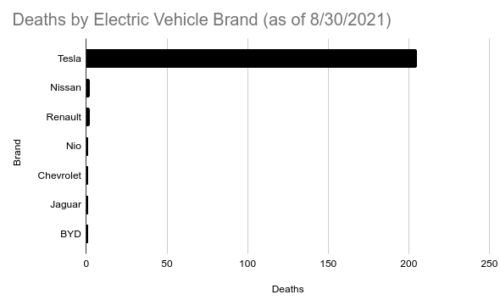
Source: tesladeaths.com
This brings me back to 2016 when I very publicly (BSidesLV keynote) explained how Josh Brown would not have been killed by Tesla if he hadn’t been misled by the CEO’s bogus “crash avoidance” propaganda.
Taking away one license isn’t going to solve this problem until that license is the one that gets all Tesla off the roads.
a blog about the poetry of information security, since 1995