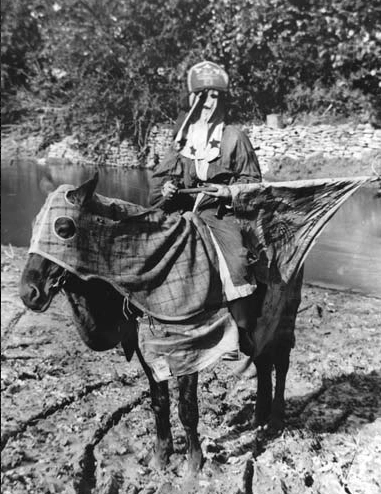
A while ago I wrote about Reagan’s use of racism to win elections. Even longer ago I wrote about his cold hubris. He was undeniably more racist than even Nixon, which is a remarkable achievement for a “popular” American President.
Reagan simultaneously used “dog-whistle” methods to trigger fears and also deny he was being racist. His under-recognized under-emphasized racism is an American tragedy; we are fools if we do not talk about it for what it really was. We must speak about it honestly if we hope to stop its harm to America, let alone democracy elsewhere.
Also I have written about Reagan’s attachment to dictatorships, such as his mass human rights violations in Guatemala and El Salvador (creating a refugee flow toward the United States, which he then inhumanely turned away), not to mention Chad and even the coup in Seychelles.
Lately I see people citing Reagan’s “Shining City on a Hill” speeches as evidence of positive vision for America.
Like his racism, however, this phrase somehow has evaded real scrutiny or being discussed more rationally.
Nobody so far seems to have pointed out, for example, that Reagan’s November 3, 1980 Election Eve Address “A Vision for America” was peddling “color-blind” racism.
I have quoted John Winthrop’s words more than once on the campaign trail this year—for I believe that Americans in 1980 are every bit as committed to that vision of a shining city on a hill, as were those long ago settlers … These visitors to that city on the Potomac do not come as white or black, red or yellow; they are not Jews or Christians; conservatives or liberals; or Democrats or Republicans. They are Americans awed by what has gone before, proud of what for them is still… a shining city on a hill.
This form of racism, unlike its predecessor (Jim Crow racism), is far more subtle and encoded to avoid responsibility (which obviously has worked for Reagan).
This has been all explained clearly recently such that Reagan’s speech can be decoded easily as racist:
The idea of a color blind society, while well intended, leaves people without the language to discuss race and examine their own bias. Color blindness relies on the concept that race-based differences don’t matter, and ignores the realities of systemic racism.
It is essentially Reagan saying he is intolerant of race, claiming negation of race as a benefit; when in reality it is a systemic attempt to cancel discourse about races because it would expose Reagan for being racist.
Take for example a tepid reaction to his “Remarks at the Annual Convention of the National League of Cities in Los Angeles”, California, November 29, 1982:
“Standing on the tiny deck of the Arabella in 1630 off the Massachusetts coast, John Winthrop said, “We will be as a city upon a hill. The eyes of all people are upon us, so that if we deal falsely with our God in this work we have undertaken and so cause Him to withdraw His present help from us, we shall be made a story and a byword throughout the world.” Well, we have not dealt falsely with our God, even if He is temporarily suspended from the classroom. … We are indeed, and we are today, the last best hope of man on earth.”
It is past time we admit such Winthrop “city on a hill” references by Ronald Reagan were an intolerance reference — a vision of cities with signs up to cancel races other than white (e.g. a city known as a Sundown Town).
To be fair, a lot of politicians fall into a lazy camp of citing the same Winthrop reference “A Model of Christian Charity“; for a time it was treated generically as a kind of political speech stepping stone, to emphasize being on board (pun not intended) with America’s “chosen” path of exceptionalism.
So here is a fun historical fact: archivists tell us Winthrop probably didn’t say what people think he did.
[Winthrop used a] biblical reference from Matthew 5:14 “that wee shall be as a citty upon a hill.” Closely associated with this ascent into the canon of foundational American texts is the ongoing misuse of that quote as an embryonic statement of American exceptionalism. In contrast, Winthrop was merely admonishing his fellow Puritans that failure would be apparent to all…
Misuse?! Harsh words for anyone thinking about invoking this phrase today, given what it really meant.
Winthrop was warning that he had zero tolerance.
Yet, for purposes of this blog post, I think it very fair to say nobody has gone so far in their usage, nor has misused Winthrop’s alleged words with such impact, as Ronald Reagan. In fact many people today reference it as a Reagan phrase, omitting Winthrop altogether. So I’ll continue to investigate it in those terms.
Reagan lifted the phrase intact from his readings of a Winthrop sermon several times, including both a bid for his second term as President of the US and his farewell address.
With that in mind, here are some very important problems with Reagan’s misuse of a phrase from Winthrop (I mean aside from it not meaning what people think).
Winthrop hated democracy
First, John Winthrop hated democracy with religious fervor. He literally said it was the worst:
A democracy is, amongst civil nations, accounted the meanest and worst of all forms of government…and histories record that it hath always been of least continuance and fullest of troubles.
Guido Palazzo, a professor of business ethics in Lausanne, has pointed out Charles Taylor wrote a book called “Sources of the Self: The Making of the Modern Identity” that explains on page 230 what Winthrop was talking about.
Their theology of predestination told them that the elect were a few rescued from the mass of the ungodly. Thus, they could feel like a people beleaguered and embattled, just as ancient Israel had been They could find inspiration, hope, and promise of ultimate triumph in the Old Testament. The sombre side of this is that they could also be unfeeling and unmerciful to those defined as standing without.
It sounds almost identical to what Mussolini was writing in the 1930s to explain his lust for fascism, although he tied his false elitist victim mentality to a toxic “strong man” mythology (rather than the Old Testament).
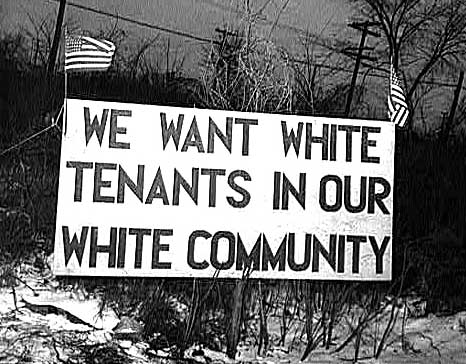
Also the “we want white tenants in our community” sign seems like the very definition of an unfeeling and unmerciful city. In that sense “shining city” is anti-democratic because, as with the fascist doctrine, it represents an “elect few” amass power at the expense of the many and enforce it through cruel oppression that silences dissent (e.g. secret police).
Winthrop hated dissent
Second, from that perspective Winthrop took the Gospel of Matthew (Sermon on the Mount, Matthew 5:14-16 “A city set on a hill cannot be hid…”) and derived an intolerance that he framed with the extremist narrative of being exposed/vulnerable thus having no room for dissent
…for we must Consider that we shall be as a City upon a Hill, the eyes of all people are upon us; so that if we shall deal falsely with our God in this work we have undertaken and so cause him to withdraw his present help from us, we shall be made a story and a byword through the world, we shall open the mouths of enemies to speak evil of the ways of God and all professors for Gods sake…
Honestly this reminds me of a “Kansas God and Country Rally with U.S. Congressman Mike Pompeo” where he says things about being a “Christian warrior” like “we shot abortionists and called it justifiable” and refers to multiculturalism or diversity of views as an intolerable “worshiping other gods”.
In early America a politician such as Pompeo probably would have written laws like we see in actual early texts (e.g. Capitol Laws of Massachusetts where Winthrop opposed democracy):
Deut. 13. 6, 10., Deut. 17. 2, 6., Ex. 22. 20: If any man after legal conviction shall have or worship any other god, but the lord god, he shall be put to death.
We’re a City on a Hill that shoots to death anyone who dissents from our righteous view so we don’t look bad… is probably the more accurate way of stating Winthrop’s actual meaning.
Do you see the problem yet with calling these intolerance screeds some sort of great future vision of America instead of a troubled and awful past that needs to be called out for being anti-democratic?
It’s a subtle step from the idea of illumination being helpful, which kind of makes sense, into calling darkness something villainous and evil that must be stamped out by a religious elite.
Winthrop hated women, especially women who dissented to establish democracy
Third, Winthrop’s formulation of intolerance meant he referred to women as an “agent of the devil” when they dared to have a dissenting voice. The life of Anne Hutchinson is a crucial insight for anyone talking about City on a Hill as presented by Winthrop.
Page 959 of Great Lives from History probably says it best:
Winthrop believed that the disunity in the colony was the result of evil, and evil was associated with women. Therefore, he concluded, Hutchinson must be an agent of the devil.
It’s pretty easy to see here that anyone following Winthrop’s thinking would say acknowledging a gender or a race is a form of disunity, disunity is evil, therefore that gender or race is evil.
See the Winthrop in Ronald Reagan? Saying that we can only speak about Americans, and not speak about black Americans, is an encoded way for Reagan to easily signal to his followers that he believes blacks are evil.
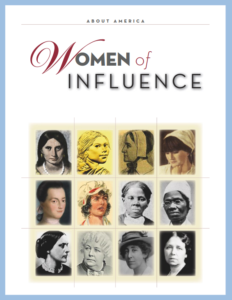
No, quite the opposite. Hutchinson is a huge figure in American history.
US embassies around the world proudly hand out “Women of Influence” pamphlets with her in them. They detail the life of this “influence” that Winthrop banished from the colony while calling her an agent of the devil.
America literally presents a woman to the world as a hero of democracy because she fought an exceptional battle to establish democracy… because she was a beacon of hope against Reagan’s beloved City on the Hill intolerance.
…“Courageous Exponent of Civil Liberty and Religious Toleration” says the inscription at the bottom of a statue raised in her honor in Boston. But the most fitting tribute to Anne Hutchinson’s influence — proof that her ideals ultimately prevailed over her opponents’ — is the First Amendment to the U.S. Constitution: “Congress shall make no law respecting an establishment of religion, or prohibiting the free exercise thereof.”
Hopefully you see how if we carry on saying that Hutchinson is a founding member of democratic thinking in American history, then Winthrop (and Reagan) come across as the exact opposite. Why do you suppose Reagan was so attached to Winthrop (intolerant, hateful of democracy) and overlooked or omitted the significance of Hutchinson (foundational American courage with ideals like freedom of speech)?
Reagan did not dissent from Winthrop
The counter to all these points I’m bringing up, of course, has been that Reagan was crafting his own unique meaning when he used the phrase and just cited Winthrop as a sort of starting point.
Reagan gave us his best attempt at re-framing meaning and asserting his own interpretation in a Farewell Address:
I’ve spoken of the Shining City all my political life. … In my mind it was a tall, proud city built on rocks stronger than oceans, windswept, God-blessed, and teeming with people of all kinds living in harmony and peace; a city with free ports that hummed with commerce and creativity. And if there had to be city walls, the walls had doors and the doors were open to anyone with the will and the heart to get here. That’s how I saw it, and see it still.’
Sounds nice but it doesn’t get rid of the problems I pointed out already.
Saying “all kinds living in harmony and peace” doesn’t in any way remove Winthrop-themed intolerance campaign to destroy dissent; it easily could mean a state of tyranny known as “just shut up and take the abuse“.
Reagan indeed emphasizes “free ports that hummed with commerce and creativity”, which doesn’t get anywhere close to Hutchinson-level ideals of freedom from oppression or liberty from tyranny. Again, Reagan never, ever mentions American founders like Hutchinson who fought against Winthrop. Only Winthrop is cited and for all the wrong reasons.
The Atlantic paints an even more stark example of how Reagan used slight misquotation to shed any notions of allowing freedom, literally baking in the worst possible facets of Winthrop.
Along the way to the presidency in 1980, Reagan dropped the apocalyptic terror of a “thousand years of darkness” and instead brightened Winthrop’s “city on a hill” into a “shining city on a hill.” That creative misquotation changed the meaning of the phrase in potent new ways. The destiny of the city on a hill was uncertain. But if the city was already shining, then its destiny had been achieved. Hopes had been fulfilled, the dream had been realized, and now the task shifted from creation to preservation, or possibly restoration—to scrub off any grime that dimmed the shine.
No “grime” allowed in a “shining” city, no diversity or freedoms in harmony and peace.
Reagan’s creation and support of tyranny spoke even louder than his words
What I mean by this slight of hand is Reagan in reality willfully created humanitarian disasters around the world like in Guatemala and Chad while promoting it as good for unity and commerce.
As a country committed to the respect for human rights and the pursuit of justice, this is also an opportunity for the United States to reflect on, and learn from, our own connection with past events in Chad,” [Secretary of State Kerry] said, apparently referring to [Reagan] support for Habre in the 1980s…
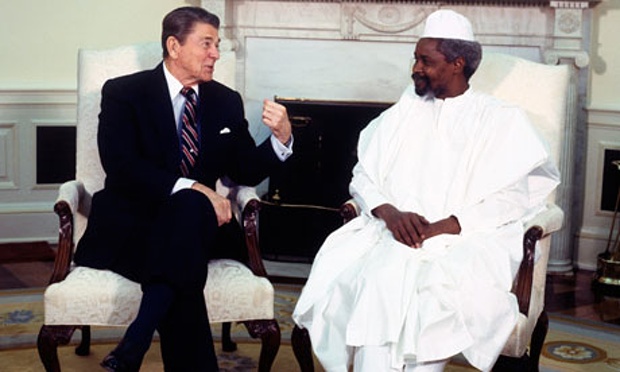
Reagan in 1981 pushed a tyrant into control of Chad with a one party regime despite evidence of widespread atrocities including targeting ethnic groups. The awful results of this were easily predictable.
To be precise June 19, 1987 Reagan was giving speeches that emphasized Habre had “laudatory goals” for Chad and could count on Reagan’s support.
Chad now knows it can count on its friends. For our part, the United States is committed to maintaining an appropriate level of security assistance to Chad. In our meetings, President Habre and I also looked to his country’s future economic and development needs.
This 1987 talk about economic development was a full six years after Reagan had covertly installed Habre to rule Chad despite widespread objections from experts that he was genocidal.
In early 1981, President Reagan issued a still-secret presidential finding authorizing covert operations to bring Hissène Habré to power. Members of the Intelligence Committee of the US House of Representatives opposed the decision.
Habre was deposed two years after Reagan’s “laudatory goals…count on friends” speech (as Reagan left office in 1989) and eventually was tried for crimes against humanity, convicted for having a direct role in torture, rape and deaths in tens of thousands.
…a former senior U.S. official said. “[Habre] was also a bloodthirsty tyrant and torturer. It is fair to say we knew who and what he was and chose to turn a blind eye.” …a veritable genocide…
Insert New Yorker-style cartoon here where a dictator on trial complains to the judge “sure it was genocide, but how else is my city on the hill supposed to achieve harmonious unity?”
Case closed. Reagan’s encoded tyranny in speeches manifested in tyranny
What should jump out here is how Reagan gave speeches with freedom-sounding words (e.g. a city with open doors, free ports that hummed with commerce), yet in reality he went out of his way to impose despotic intolerance and purposefully slam (previously open) doors shut on people who were legitimately seeking asylum from the hell he was creating in their countries.
Like President Trump, Reagan systematically denied asylum to people from El Salvador and Guatemala by refusing to consider those fleeing violence and arriving at the U.S.-Mexico border as refugees.
So Reagan turned a blind eye to violent human rights violations by men he put into power yet he blocked refugees they created… he talked about a city of open doors while denying entry to those he forced to flee their own cities.
Where’s that light coming from again and who is watching?
For another great perspective on Reagan’s failed use of metaphor, consider the new “Hill We Climb” poem from the 2021 Presidential inauguration.
We’ve seen a force that would shatter our nation, rather than share it.
Did Reagan want to share his Shining City on the Hill? Everything I’ve found says no, he only would share it with a small cadre of people like himself.
The Hill We Climb poem admits we’re not there yet as a country, very much the opposite of Reagan saying he’s hanging out on top holding a door “open to anyone with the will and the heart to get here” as if arrogantly watching from above and judging others’ attempts to get in as not good enough for him.
The City on a Hill linked to Winthrop’s hands may in fact signal that if you happen to disturb the harmony and peace (or come with “wrong” attributes, such as seeking refugee status, being “too liberal”, having dark skin, floating like a duck, or having a carrot covering your nose…) then like “woman of influence” Hutchinson you will be classified agent of the devil and treated as such.
Related: