Spoiler alert. Inarticulate Grief is a poem by Richard Aldington about WWI that is still relevant today.
Let the sea beat its thin torn hands
In anguish against the shore,
Let it moan
Between headland and cliff;
Let the sea shriek out its agony
Across waste sands and marshes,
And clutch great ships,
Tearing them plate from steel plate
In reckless anger;
Let it break the white bulwarks
Of harbour and city;
Let it sob and scream and laugh
In a sharp fury,
With white salt tears
Wet on its writhen face;
Ah! let the sea still be mad
And crash in madness among the shaking rocks —
For the sea is the cry of our sorrow
Now read Inarticulate Grief, by Sean Patrick Hughes, a beautiful prose about America’s endless Bush-Cheney Wars.
No deployment I had was hard enough to make me deal with the pain it caused. Someone always had it harder. No loss suffered; no trauma absorbed was bad enough to acknowledge. Someone always had it tougher. Acknowledging it, in some way, dishonored them.
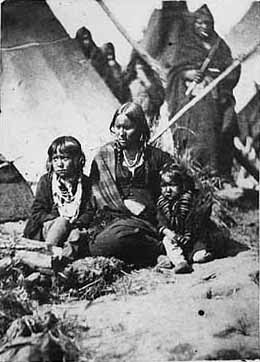
Minnesota’s concentration camp of 1862 was setup to abuse and kill the Native American elderly, women and children. Source: Minnesota Historical SocietyFor some in America the “Holiday” weeks of December are an extremely painful time of American history.
The state of Minnesota, for example, was founded on deception and violence to steal land from Native Americans and culminated this month in 1862.
The Minnesota Historical Society (MNHS) explains how the encroaching U.S. sparked an intense war with Native Americans that ended in an unfair trial with a very large number of unjust executions:
The trials of the Dakota were conducted unfairly in a variety of ways. The evidence was sparse, the tribunal was biased, the defendants were unrepresented in unfamiliar proceedings conducted in a foreign language, and authority for convening the tribunal was lacking. More fundamentally, neither the Military Commission nor the reviewing authorities recognized that they were dealing with the aftermath of a war fought with a sovereign nation and that the men who surrendered were entitled to treatment in accordance with that status.
MNHS also relates how Dakota leaders have been recorded as clearly humane and civilized in their rationalizations of self-defense, yet received barbaric treatment by the white nationalist militants they fought against:
You have deceived me. You told me that if we followed the advice of General Sibley, and gave ourselves up to the whites, all would be well; no innocent man would be injured. I have not killed, wounded or injured a white man, or any white persons. I have not participated in the plunder of their property; and yet to-day I am set apart for execution, and must die in a few days, while men who are guilty will remain in prison. My wife is your daughter, my children are your grandchildren. I leave them all in your care and under your protection. Do not let them suffer; and when my children are grown up, let them know that their father died because he followed the advice of his chief, and without having the blood of a white man to answer for to the Great Spirit.
Those of the Dakota men who had fought in the war already had retreated for winter, or had been killed and very few captured. The U.S. military decided it wasn’t staffed to pursue the warriors.
In other words the only Dakota people brought into custody by the U.S. military were elderly, women, and children; nearly 2,000 people who had nothing to do with the war were seduced with a promise of care and then death-marched for days into a concentration camp to be abused and die.
They lost everything. They lost their lands. They lost all their annuities that were owed them from the treaties. These are people who were guilty of nothing.
Henry Whipple, traveled to Washington to meet with Lincoln; he explained to the president that Dakota grievances stemmed in large part from the greed, corruption, and deceit of government agents, traders, and other whites. Lincoln took what he called “the rascality of this Indian business” into consideration and granted clemency to most of those sentenced to die.
Minnesota History Magazine further relates that a prominent leader of the Dakota people a year later was murdered by white settlers who simply noticed him eating wild raspberries and decided on that basis alone to illegally hunt, kill, decapitate and scalp a human:
Even if a state of war had existed in 1863, the Lamsons’ action could not be defended as legal. They were mere civilians, who under international law have no right to take up arms against the enemy and who will be
hanged summarily if they do. The ordinary law of murder would apply to them. […] If killing in reliance upon the adjutant general’s orders would be murder under the law in force in 1863, obviously killing before any orders were issued would be an even stronger case of murder. Thus Little Crow was tendered a posthumous apology. One must reach the conclusion that in strict law the Lamsons were provocateurs and murderers.
Shot on sight without any questions. Think about that. Little Crow was a man nationally recognized and celebrated, a hero of America who had negotiated the Treaties of Traverse des Sioux and Mendota in 1851.
Yet he was illegally shot dead on sight without question because… he was not white.
Back to the start of this blog it also was Little Crow who had negotiated a band of Dakota from their massive 25 million acre territory into a tiny (20 mile by 70 mile) reservation.
There were many tens of thousands of Native Americans said to be in the region at the time, although soon they were vastly outnumbered and under constant threat.
In 1850, the white population of what would soon be the state of Minnesota stood at about 6,000 people. The Indian population was eight times that, with nearly 50,000 Dakota, Ojibwe, Winnebago and Menominee living in the territory. But within two decades, as immigrant settlers poured in, the white population would mushroom to more than 450,000.
In other words, by the war of 1862 (and after he was coerced into an even worse treaty in 1858), Little Crow was known as the Dakota leader who had taken a principled and fair stand to protect his followers against his former trading partner U.S. General Sibley.
The U.S. government allegedly had offered the Dakota only a few cents per acre for their entire ceded territory space in treaties, and gave promises of annuity payments and food supplies.
Yet while the Dakota land was taken away, those agreed upon payments and food never arrived.
It was this context behind the fact that white settlers flooded the area historically inhabited by Dakota, backing the Dakota into a corner and literally starving them out.
Congress passes the Homestead Act, a law signed by President Abraham Lincoln on May 20, 1862, offering millions of acres of free land to settlers who stay on the land for five years. The act brings 75,000 people to Minnesota over three years. To qualify for 160 free acres, settlers have to live on it for five years, farm and build a permanent dwelling. Those able to spend the money can buy the 160 acres at $1.25 an acre after living on it for six months.
The federal government was effectively buying land for cheap and then selling 160 acre parcels of it at either $200 (20X the cost) or for five years of farming and construction.
Since the tiny allocated reservation space for the Dakota wasn’t producing any food, and the U.S. government was intentionally withholding payments and supplies to survive on, huge numbers of Dakota faced a starvation-level situation. No wonder they demanded quick restitution.
On top of that white settlers illegally had been violating the agreement by encroaching into even the tiny Dakota reservation area.
The Dakota faced no choice but to reassert rights to their money, food and land that they already had negotiated.
Tension grew from the U.S. refusing to help, withholding food and money from the now trapped Dakota population in an attempt to “force conformance to white ideals” of a “Christian” lifestyle.
While Dakota parents watched their children starve to death, pork and grain filled the Lower Sioux Agency’s new stone warehouse, a large square building of flat, irregularly shaped stones harvested from the river bottoms. […] “So far as I’m concerned, if they are hungry, let them eat grass or their own dung,” [warehouse owner] Myrick said.
The U.S. strategically reneged on agreements and intentionally starved Dakota populations into desperation, before ultimately using attempts at self-defense as justification for mass unjust executions and murder. This was followed by Minnesota settlers banishing the native population entirely from their own historic territory under penalty of death into concentration camps, offering rewards to anyone who could trap and kill the Native Americans (Minnesota’s government offered a reward up to $200 — roughly $4000 in 2019 terms — for non-white human scalps).
At a higher level the race in 1862 to settle territory inhabited and owned by Native Americans had been complicated the year before by militant southern states starting a Civil War to violently force expansion of slavery into any new states. Thus, just as John Brown’s attempt to incite abolition got him executed in 1859 as a “traitor” to America, the Dakota people fighting for freedom from tyranny three years after in 1862 were unjustly tried by Minnesota settlers and executed on December 26.
Old John Brown's body lies moldering in the grave,
While weep the sons of bondage whom he ventured all to save;
But tho he lost his life while struggling for the slave,
His soul is marching on.

John Brown was a hero, undaunted, true and brave,
And Kansas knows his valor when he fought her rights to save;
Now, tho the grass grows green above his grave,
His soul is marching on.

He captured Harper's Ferry, with his nineteen men so few,
And frightened "Old Virginny" till she trembled thru and thru;
They hung him for a traitor, they themselves the traitor crew,
But his soul is marching on.
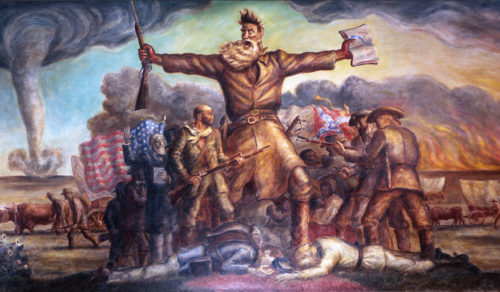
John Brown witnessed far too many Americans being murdered under the tyranny of expansionist slavery when he said there was no choice but fighting back, calling for wider armed defense and predicting war. Curry’s impressive mural called “Tragic Prelude” that depicts Brown’s conviction against tyranny can be seen in the Kansas State Capitol.
Just a month later, 500 Native Americans were massacred in Bear River, Idaho.
A talk I was watching recently suggested researchers finally in 2019 had cracked how robots could efficiently act like a swarm. Their solution? Movement based entirely on a light sensor.
That sounded familiar to me so I went back to one of my old presentations on IoT/AI security and found a slide showing the same discovery claim from 1953. Way back then people used fancier terms than just swarm.
W. Grey Walter built jelly-fish-like robots that were reactive to their surroundings: light sensor, touch sensor, propulsion motor, steering motor, and a two vacuum tube analog computer. He called their exploration behavior Machina Speculatrix and the individual robots were named Elmer or Elsie (ELectro MEchanical Robots, Light Sensitive)
The rules for swarm robots back then were as simple as they will be today, as one should expect from swarms:
If light moderate (safe)
Then move toward
If light bright (unsafe)
Then move away
If battery low (hungry)
Then return for charge
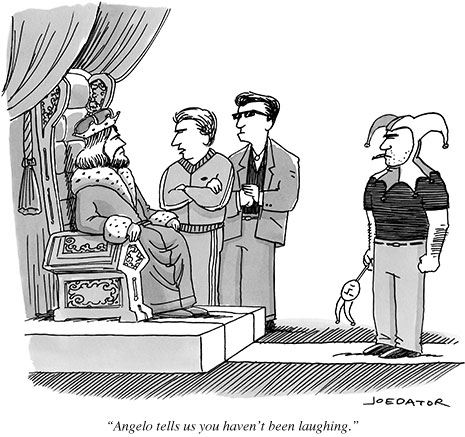
This New Yorker cartoon perhaps says it best, although a problem with this simple cartoon is it may go a bit far by implying like Batman the jester has enforcers, rather than the other way around — enforcers have a jester:
The “official website for BBC History Magazine, BBC History Revealed and BBC World Histories Magazine” presents some graphic details for Medieval messaging protocols:
…jesters were often required to go to the battlefield with their masters to carry messages between the leaders of warring armies, demanding that a city surrender to a besieging army or delivering terms for the release of hostages. Unfortunately for the jesters, the enemy did sometimes ‘kill the messenger’ as an act of defiance (especially if they regarded the terms being offered as an insult) and some used a catapult or trebuchet to hurl the unfortunate messenger (or his severed head) back into his own camp as a graphic illustration of what they thought of the message.
The story ends with this “grave warning” from a certain jester’s final resting place:
If chance has brought thee here, or curious eyes
To see the spot where this poor jester lies
A thoughtless jester even in his death
Uttering his jibes beyond his latest breath.
a blog about the poetry of information security, since 1995