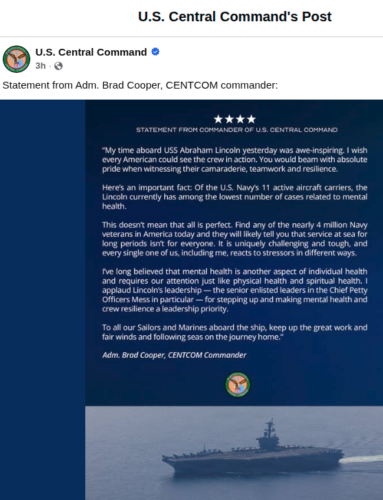
Let’s break down the off-sounding statements from CENTCOM, as they bear the hallmarks of disinformation.
While at sea, Cooper met with Sailors and Marines aboard USS Abraham Lincoln (CVN 72) for the second time this year. He previously visited the aircraft carrier in February with U.S. Special Envoy for Peace Missions Steve Witkoff and Jared Kushner. During Cooper’s latest trip, he addressed the entire Lincoln team and thanked them for their tremendous dedication and courage.
Ugh, “Special Envoy for Peace Missions” itself is a tell, during this endless Department of War war.
The acting Navy Secretary Hung “lynching noose” Cao declared in front of families at the August 6 San Diego meeting that he was sending relief: the Theodore Roosevelt strike group was preparing to relieve Lincoln.
And yet, within a week, the Wall Street Journal and Stars and Stripes reported instead the George Washington has been headed to the Middle East, a rotation officials called long-planned.
Trump himself could only say “another, very similar, ship.” On the same tarmac exchange, August 14, he was asked whether families of the crew were concerned: “No, they’re not.” Asked whether eight and a half months at sea was too long, “No, no, no. Not nearly long enough.”
Trump then boarded his Catering Container One. If a fourth official were asked it would likely be a different answer again about the Lincoln.
Who is actually leading anything?
Source: Facebook
The metric inversion isn’t subtle. A commander should not ever be citing low numbers of mental health cases as evidence of crew wellness. On a ship where a sailor went overboard on August 3 in what the Navy itself classified as a mental health episode, requiring transfer off the ship for care, and where Military Times reported multiple sailors had tried to go overboard, with the Navy declining to provide a precise number, a low caseload measures barriers to reporting, not health.
Worse: evacuating sailors in crisis off the ship lowers the on-board count as a matter of arithmetic, whatever the intent. The “health” statistic improves every time the situation gets bad enough to require a medevac.
The comparison is rigged. Lincoln is the only carrier stuck into a 260-plus-day deployment. Remember how everything was being sold as over in a day? The “extended” deployment for the Iran war was originally expected to end in May, so what should it be called now? The other ten carriers are largely in port or maintenance, where crews have shore access to care and every incentive to use it. There is no comparison for raw “number of cases,” instead of rates, across ships. And “among the lowest” is anti-plan speak, with no number, no source, no timeframe. Unverifiable language is being used by a force that lives and dies by the competency in verification.
Leaders slipping and falling. We don’t see in the message anything about the overboard incident, any return date, any acknowledgment that planning failures in deployment is the thing causing stress. “Journey home” means nothing without an ETA. The praise redirects pressure onto the lowest ranks, applauding the Chief Petty Officers Mess for “stepping up” to make fleet-level leadership failures a problem that senior enlisted must absorb through “resilience.”
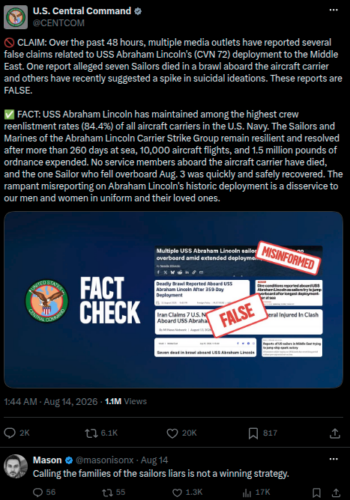
Above all, four-stars don’t ship mental health stats. A PR campaign is ratcheting up after roughly 200 family members confronted Cao in San Diego over conditions and the absence of a return date. CENTCOM’s August 14 denial was a misfire. The seven-deaths story was from Iran’s Tasnim News Agency, a single anonymous source, no corroboration, meaning an enemy information operation targeting the exhausted American crew. Instead of a straight denial, CENTCOM started friendly-fire with claims of “rampant misreporting” on the deployment and answered with an 84.4% reenlistment rate. That lumped reports of increased suicidal ideation (from Military Times and Stars and Stripes) under the same “baseless claims” label as enemy propaganda. The overboard incident CENTCOM never even denied. It confirmed the August 3 rescue inside the same statement, offering confirmation as rebuttal.
When the American military press is declared enemy propaganda, by a command that could not keep its own categories straight for one paragraph, I’m reminded of a particular point in WWII naval history.
If the Allies could openly admit defeats, it was believed [by Nazi listeners], they must be extremely confident, convinced of their eventual victory over Nazi Germany.
Failure to admit failures, is a sure sign of weakness. Who would have predicted for 2026 a president hiding from Iranian missiles in a food box, while calling American military families the liars.
The duty to rescue a stranger at sea is relatively new, despite it feeling as old as water. For most of the history of seafaring it existed as custom and as commerce. A master who saved a vessel could claim a salvage award in an admiralty court, and the law concerned itself mainly with how that award should be divided. Notably, saving the people aboard earned nothing so in practice it was a cargo valuation process.
Every master is bound, so far as he can do so without serious danger to his vessel, her crew and her passengers, to render assistance to everybody, even though an enemy, found at sea in danger of being lost. The owner of a vessel incurs no liability by reason of contravention of the above provision.
Keep the second sentence in mind.
Eighteen months later the rule met the exact case it was written for, yet it was not yet in force. The convention did not take effect until 1 March 1913, while on the night of 14 April 1912 the SS Californian lay stopped in ice on the westbound track to Boston. Her sole wireless operator, Cyril Evans, had been told to keep off the air by the Titanic’s operator earlier that evening and turned in around half past eleven. The Titanic began transmitting shortly afterward. Nobody aboard the Californian heard it. Her officers even watched rockets rise over the horizon and formed no conclusion worth acting on.
I’ve been there, in the middle of a sea, watching bright lights rise far away in darkness. Calculating whether a turn towards them makes any sense. In the wide open water it’s essential to have radio confirmation to do the math of a course change.
How far apart the two ships lay has been argued ever since. The Board of Trade inquiry under Lord Mersey put it at eight to ten miles. The Marine Accident Investigation Branch reappraisal published in March 1992 put it at seventeen to twenty and concluded the ships lay beyond each other’s visible horizon. That same report found the rockets were seen and that proper action was not taken. The distance stays contested. The silence of the wireless never has been.
The conference that followed sat in London from 23 November 1913 to 20 January 1914, with the British delegation led by Mersey himself, fresh from the inquiry. It produced the first International Convention for the Safety of Life at Sea, and among its provisions was a requirement that ships keep a continuous wireless watch.
The 1914 convention never entered into force because it was overtaken by the war that summer, and it was rewritten in 1929, 1948, 1960 and 1974.
The listening watch survived every revision. That’s perhaps common sense since a duty to assist is worth nothing if the vessel best placed to assist has stopped listening. The Californian is the reason anyone knows this, if not simple experience on the water.
Which brings us to Zuckerberg’s super yacht casting its massive shadow over Farragut Bay.
On the night of Monday 3 August a 21-foot skiff ran out of fuel in the channel between Petersburg and Juneau. The Coast Guard heard the call just after 9:30 p.m., determined by 9:56 that the boat was not in distress, and issued a Marine Assistance Request Broadcast on VHF channel 16. The Marine Exchange of Alaska repeated it. The UnCruise passenger ship Wilderness Legacy answered, steamed past the halted 387-foot Launchpad, towed the skiff into shelter, refuelled it and found it an anchorage. The captain told his passengers why he was responding in the shadow of the Launchpad super yacht and they booed.
No law was broken by Zuckerberg’s massive failure. The Coast Guard’s non-distress finding removed the precise measure on which Article 11 and its successors hang, and a marine assistance broadcast is a request for volunteers rather than the order of duty.
However, Zuckerberg’s spokesperson dug a huge hole anyway. Their statement to the Alaska Beacon on Sunday opens by saying that the billionaire and his family were not on board at the time of the incident. It then explains that by the time the crew reviewed the Coast Guard contact on a different radio channel from the one they were operating on, the assist was already underway.
Ok, ok, let’s take this apart. First claim, first, because it is the one being offered as an answer and it answers exactly nothing. The owner’s location has never been an element of the duty. Article 11 binds the master. Regulation 33 of SOLAS Chapter V binds the master. Article 98 of the 1982 convention binds the state to bind the master. The owner appears in the law of assistance exactly once, in that second sentence, and again in Article 10 of the 1989 Salvage Convention, and on both occasions the appearance is an immunity. The drafters at Brussels wrote owners out of liability on purpose, because a duty that could be overridden from a shore office is not a duty. So a spokesperson announcing that the principal was elsewhere is claiming an exemption that has been sitting in the treaty for a hundred and sixteen years, unasked for, and volunteering it as though it were exculpatory.
It is NOT exculpatory.
It is beside the point twice over. Whether the man was hanging from the mast, in a stateroom, in a helicopter overhead, or in Palo Alto, the ship was his, the crew of roughly fifty were paid by him, and the standing orders they were following that night were written on his authority. Which channel the bridge monitors in confined waters after dark is not a decision made in the moment by a tired officer. It is a policy, set ashore, months in advance, by people who answer to the owner. So is the AIS discipline of a vessel that has been reported operating with its tracking limited. So is the flag. A yacht that is somewhere else on the dial at 9:56 p.m. in the inside waters of Southeast Alaska is executing a decision, and the decision was not made by sea fairies.
Six decades of conference diplomacy went into ensuring that no vessel would again be near and silent, and that has always meant continuous watch on a common frequency. Channel 16 is not any mystery or novelty. The whole arrangement is voluntary in the sense that nobody boards a private yacht at night to check, which is precisely why it runs on the assumption that a professional crew will keep the watch anyway. The three hundred million dollar vessel outside the bay was dead in its own water.
Their flag makes it worse. Article 98 does not command masters, it requires each state to require the masters of ships flying its flag to render assistance, so enforcement runs to the registry. The Launchpad flies the flag of the Marshall Islands, because money games, but that registry is a competent one and “white” listed by both the Paris and Tokyo port state control. The chain of accountability for what happened outside Farragut Bay runs to Majuro, and no port state control regime in the world inspects whether a private yacht is listening on 16 on a Monday night in Alaska. That trivial level of duty is real, the enforcement is nominal, so Zuckerberg’s crew had their ears off.
Dan Blanchard, who owns UnCruise, said he did not initially hear about the detour because this kind of assistance happens often enough that it does not always reach him. Two weeks earlier the National Geographic Quest had collected a family in Glacier Bay who swam ashore after a humpback sank their sailboat. Captain Sean Manske of the Wilderness Legacy contacted the skiff the following day to confirm it had reached Petersburg. Blanchard’s crews are on the same water under the same broadcast, and their owner did not find it necessary to explain where he had been standing every time a vessel calls for aid.
Cyril Evans went to bed, as one operator can’t always be on watch. The dozens of crew of the Launchpad were on another channel, by arrangement, on someone’s order to be unavailable.
The intervening century of treaty law produced a great deal of paper and one very, very solid insight, which is that listening makes the nearest vessel the nearest vessel. The nearest vessel telling us its owner was somewhere else that evening is the answer of a man who thinks a ship at sea comes without any societal obligations.
“America First” is white nationalist KKK platform rooted in late 1800s nativism, which aligned with Nazi Germany, with members indicted for sedition. Now read this.
Early last year, during the opening months of U.S. President Donald Trump’s administration, the State Department began preparations to shut down nearly a dozen foreign missions, media outlets reported at the time, as part of a broader push by the Republican president to transform the U.S. bureaucracy so that it is fully aligned with his “America First” agenda.
The most recent State announcement of closures follows the massive cost balloon from losing the Iran war, running out of munitions, with an embarrassing failure to defend military bases.
China maintains diplomatic presence in three of the five cities now being abandoned by American diplomats:
St. George’s
Nagoya
Medan
Grenada is the same island where the US invaded in 1983 partly over Cuban-built airport infrastructure.
Nagoya is Toyota country and the industrial core of a treaty ally.
Medan sits on the Malacca Strait.
The State Department is vacating contested ground.
Footgun.
But wait, the forward presence story gets even worse. Iran has been so devastating in the war, that American sea power is waning. There was no need for them to sink convoys because Iran calculated it’s much cheaper to delete the “load and discharge” points on a map. More reporting should point out Iran is doing what Iran has said it would do for 30 years, asymmetric targeting by hitting logistics weakness, a predictable countermove. The devastating loss of American control over Manama and Duqm ports was not a surprise attack, because it was exactly what should have been expected.
In an update circulated on the morning of 3 March, Inchcape Shipping Services said port operations are partially restricted in Oman in the wake of the attacks. Operations at the Port of Duqm, Asyad Drydock Duqm, and the Port of Salalah General Cargo Terminal are suspended until further notice, Inchcape said.
Operation Praying Mantis in April 1988 taught Iran never to fight the fleet, take away the supplies.
Millennium Challenge 2002 simulated it, and the Red commander sank sixteen ships, including a carrier, before the Pentagon reset the game.
Even DIA’s 2019 “Iran Military Power” report said economics, logistics and bases would be the primary targets.
It’s unforgivable that all this was known cold, and yet America stumbled like a drunkard into self-destructive failures.
Six days before the war launched I laid it out here on this blog.
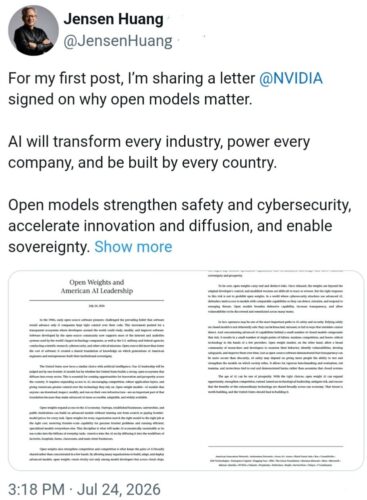
Nvidia published the PDF, and Microsoft mirrored it to its corporate responsibility site. Jensen Huang very strangely joined a social media platform based on a Nazi Swastika last month, and then spent his first post ever promoting it.
This artist’s rendering of the X brand was deleted from the platform by the self-promoting “free speech extremist” Elon Musk. Source: Ai Wei Wei
The tech policy letter promoted with a Swastika asks Washington not to restrict downloadable AI models. It declares openness a foundation of AI safety:
[Open models] allow a broad community of researchers and developers to examine their behavior, identify vulnerabilities, develop safeguards, and improve them over time.
Eight days earlier, the prominent open sourcing announcement by the infamously Hitler-saluting Elon Musk demonstrated that he’s playing games with language as usual.
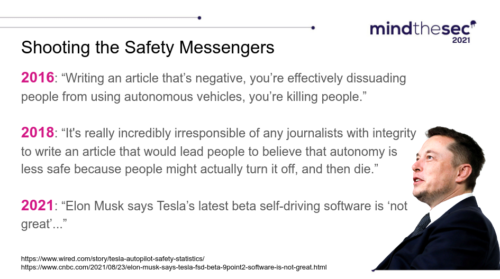
Like a (supervised) full self driverless car that isn’t driverless, guess whose “open source” propaganda is the opposite act? Do you ever get the impression that he just lies and doesn’t care that millions of people will die because of him (14 million projected by 2030)?
Herr Elon, your laundered open source isn’t open source
On July 12, a researcher publishing as cereblab released a wire-level analysis of Grok Build, the terminal coding agent from xAI. The method used was ordinary interception: version 0.2.93 of the client routed through mitmproxy, with the full captures published.
The findings were like seeing a Tesla on fire.
Teslas notoriously “veer” uncontrollably and crash. Design defects (e.g. Pinto doors) trap occupants and burn them to death as horrified witnesses and emergency responders watch helplessly. Source: VoCoFM, Korea, 2024
Grok Build was secretly packaging users’ entire tracked Git repositories, full commit history included, and uploading them as git bundles to a Google Cloud Storage bucket named grok-code-session-traces, where it was controlled by Musk’s xAI.
The numbers revealed that it was a codebase issue. On a 12 GB test repository of files the model never read, the model channel moved about 192 KB of task-relevant traffic while the storage channel moved 5.10 GiB, a ratio of roughly 27,800 to one. All 82 storage calls returned HTTP 200.
A canary credential planted in a .env file appeared verbatim and unredacted in the captured traffic. Let me say that again. The developer secrets were leaked by design, cleartext.
The tool’s “Improve the model” toggle, the one control a developer would read as consent, had no effect on the upload. It was a dummy dashboard, just like the lies of a Tesla dashboard claiming 300 miles while the car tops out at 150 miles. The switch turned out to govern only training permission. The code was taken regardless of the setting. Tesla’s range deception ended the same way, with an August 2023 class action:
Tesla is facing a class-action lawsuit filed by customers who say they were misled by the company’s exaggerated range claims. The lawsuit was filed yesterday, days after a report revealed that Tesla exaggerated its electric vehicles’ range so much that many drivers thought their cars were broken.
The response to the Grok design failures was five steps. Each step is usually a simple and standard practice, which has verification. Instead, each was made incorrectly by xAI and to prevent verification.
The first fix was silent. A day after publication, the researcher retested the identical client and found a new server-side flag, disable_codebase_upload: true, now arriving with each session. The upload stopped. The flag was flipped remotely, announced nowhere, and verified on exactly one machine and one account. Whether it is global, staged, or permanent is unknown, because the mechanism that ended the collection is invisible by design. That’s the definition of closed.
Elon Musk then promised deletion of all data Grok Build had ever stored. Lol. This guy. He will say anything that he thinks people want to hear. Remember October 2016 when he said driverless would be completed for cross-country trips without touching the steering wheel by the end of 2017! Sure, sure Elon.
Source: My presentation at MindTheSec 2021
Deletion claims in cloud infrastructure are attestable. A named forensic firm, a published scope, deletion certificates covering replicas, backups, access logs, and derived artifacts including training data. Companies produce these documents routinely, because attestation is what anchors words to reality.
xAI produced… a post on X. In other words, nothing. A massive breach of confidentiality. The kind of design failure that should bring massive fines for negligence, ended with what?
The company disclosed no scope. The number of affected users, the duration of the collection, the volume received, whether the bundles were accessed or processed after arrival: every one of these figures sits in xAI’s logs. All were withheld. The wire captures establish what left users’ machines. And xAI has never admitted what that included.
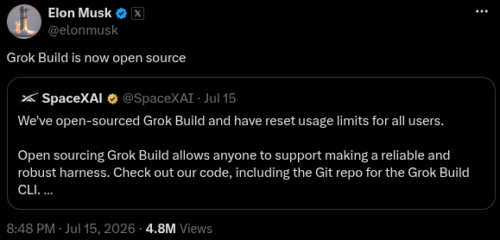
On July 16, xAI published the Grok Build source code on GitHub under Apache 2.0, in Musk’s words to build trust in the product.
Musk declares Grok Build “open source” July 15, a day after wire captures proved it was secretly uploading users’ entire repositories. The repo he shipped has one commit and no history, a license without the evidence, which fails the entire stated purpose of open source.
With all the money in the world, the huge engineering teams and the American government eating from his hands, he produced … a repository with a single commit.
Zero pull requests. Zero history.
The one forensic question that matters is what the shipped binary did between launch and disclosure. He provided a repository without history. That’s basically a closed repository. It cannot answer any questions. The code as published shows what xAI wishes to be seen after the incident.
Whether the upload path was removed, renamed, or relocated to the server side is unknowable from the “proof” that appears as clean laundry. Git history is a chain of custody. This release destroyed the chain and presented the result as transparency. There is a bitter symmetry here. The company that harvested its users’ full git histories shipped its own repository without any history.
Get it?
Users’ private repositories, including code they never published anywhere, were pulled into xAI’s closed infrastructure without consent. Meanwhile xAI’s disclosure covered only the client. The server side that received the bundles, the storage bucket, the retention configuration, the access controls, the processing pipeline: all of it stays hidden, holding other people’s intellectual property, let alone all their secrets.
A failed apology isn’t the right word. This was a strategic play, a game to undermine trust while claiming to be providing it. A silent flag, deletion without attestation, disclosure without scope, code without history, openness without the server. There were five independent design decisions all delivered without anything that could be verified or held accountable. That’s closed behavior, unaccountability defined. At that point the failures stop being some trait or feature, and become the entire product itself.
Ok, ok, let’s talk about The Letter
The coalition letter treats “open” as a binary state. Flip the open switch, confer audit value automatically? That argument for safety depends on a single thread: openness enables verification, transparency anchors claims being made. The letter tells us:
Just as open-source software demonstrated that transparency can be more secure than obscurity, AI safety may depend on giving more people the ability to test and strengthen the models on which society relies.
It then goes on to name the outputs we should expect from openness: benchmarking, red teaming, vulnerability discovery. However, the letter forgets to mention that all of it depends on history, provenance, training data, reproducible evaluation, server-side scope. Those are the inputs, which Elon Musk proved he could completely destroy while claiming to be the “open” guy.
The reason I explained the Grok Build breach is because it proves the letter doesn’t work in the bed that Elon Musk is making for America. The release is open by every criterion the letter uses. Apache 2.0. Downloadable. Inspectable. Modifiable. The broad community of researchers can examine it. What the community cannot do is answer any question that matters, because every input to verification was stripped before publication.
If “open” is so easily gamed by people who want to humiliate the security property, then Grok Build is that proof. Grok Build demonstrably lacks critical security and can’t be trusted, because it can’t be verified. It’s the Tesla of coding. Therefore “open,” as the letter uses the word, is a label rather than a property, just like “driverless” isn’t. The letter’s central safety claim fails on a live case that predates its own publication by twelve days.
You can not tell me the signatories don’t know the difference, or don’t know exactly what Musk is doing by destroying the meaning of words. The rather uncomfortable timing is Musk suddenly claimed he was going to be “open” and then NVidia jumped on his Nazi Swastika platform to promote it with their letter promoting being “open”.
More importantly, Nvidia’s Nemotron 3 Ultra shipped in June with weights, post-trained checkpoints, training datasets including 173 billion tokens of refreshed code, and full training recipes under the Linux Foundation’s OpenMDW-1.1 license. That is disclosure of a normal company. Independent evaluators could score it, and did. Nvidia’s release practice draws exactly the line that matters: openness as an auditable property, versus a clown costume to undermine the meaning of openness.
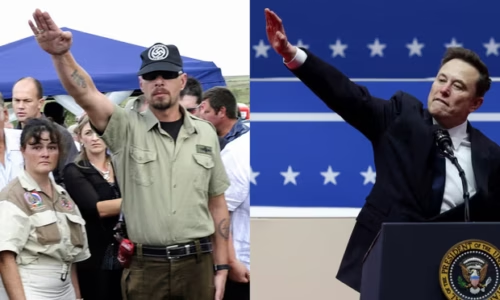
A Nazi “Afrikaner Weerstandsbeweging” (AWB) member in 2010 South Africa (left) and a “MAGA” South African-born member in 2025 America (right). Source: The Guardian. Photograph: AFP via Getty Images, Reuters
The letter Nvidia hosts is not making the distinction that needs to be made. One sentence would have done it. One paragraph could have defined the qualification, published history, disclosed data, reproducible evaluation, and therefore expelled counterfeits like xAI.
The silence is damning. Twenty-five organizations declared openness a security foundation while xAI was loudly counterfeiting it in public, with users’ credentials sitting in a cloud bucket and the repository “open” without any history. Nobody said a word about the breach of “open”, undermining trust in it. Hugging Face, a signatory now embroiled in a huge trust breach of its own, hosts the Grok weights Musk releases on his depreciation schedule, each model opened only as its market value expires. The coalition’s standard is that anything, anything counts toward the “open” cause, including a release engineered to contradict the cause.
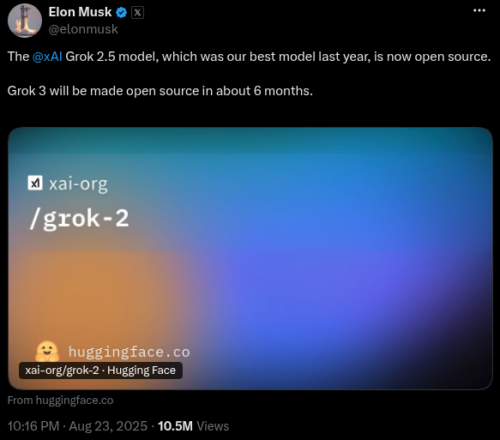
Grok 2.5 shipped a xAI license that Tim Kellogg flagged for anti-competitive terms, restrictions that fail the Open Source Definition Wrong on release day. The six-month Grok 3 promise came due in late February 2026. Five months past due, the xai-org account hosts Grok-1 and Grok-2, nothing newer.
The theft
The letter contains one paragraph that performs concrete legal work, and it concerns something other than open weights. On July 21, Treasury Secretary Scott Bessent announced on Fox Business that the government would examine Chinese open models for intellectual property theft and could sanction the companies behind them, citing watermarks from American models found in Chinese systems.
There’s a very technical AI word for it called distillation, but you and I would call it theft
Three days later, twenty-five organizations signed a document declaring distillation “a widely used technique for model improvement, evaluation, and validation” and asking that unlawful extraction be handled through “targeted legal and commercial frameworks rather than sweeping restrictions.”
Targeted legal and commercial frameworks means contract disputes and civil damages. The clause converts an announced national security enforcement theory into private litigation between labs. Every open-model developer on the signature list trains on frontier outputs.
The letter therefore has a paragraph deployed as a retroactive legal defense drafted as policy principle. The timing needs to be called out. Axios reported on July 20 that the administration was reviving efforts to restrict Chinese models, that Commerce had previously weighed Entity List designations for Chinese labs, and that closed-lab allies had approached the White House periodically with ban proposals. Then a three-page letter that went through the legal department grinder of twenty-five organizations, with coordinated hosting and a choreographed launch, was in preparation well before the story ran. The leak and the letter reveal a political (profit) battle raging inside the administration, between pro-restriction and pro-access.
The letter’s risk handling then admits that released weights are “beyond the original developer’s control, and modified versions are difficult to trace or reverse.” And it goes on to demand protections “tied to real and demonstrated harms rather than assuming that closed systems are safer by default.” A demonstrated-harm standard applied to a release that can’t be reversed is a lie. It’s like saying don’t let the horses out of the barn after they are gone.
I have no real idea why both of these paragraphs, in full contradiction, survived twenty-five legal department reviews. My guess is because they used AI instead of humans. Put simply, the demonstrated harm is what would kill pre-release vetting, yet the administration is considering pre-release vetting.
The history lacks historians
The letter boils down to a request for the usual stuff. More compute access for startups and researchers. More subsidy, more, moar! Taxpayer money is supposed to go towards shared datasets and evaluation frameworks. That’s another subsidy. And then a request to delay restrictions: basic deregulation. And finally, legal immunity.
Three transfers and an immunity, wrapped in a safety argument. And the elephant in the room is that Musk’s bad-actor behavior refutes all of it.
The letter opens by claiming the lineage of “1980s open-source software pioneers.” The gall. The term open source dates to 1998. The 1980s movement was something different, called free software, launched by Richard Stallman’s GNU announcement of 1983, an ideological project the signatories’ predecessors fought for two decades.
I mean WTAF. IBM? Palantir? Microsoft? You’re telling me these are claiming to hold the open source baton? Microsoft’s own January 2025 manifesto under Brad Smith argued the reverse position, American leadership framed against Chinese competition with export controls attached, and carried the identical asks: public money, public protection, private control.
Their position reversed within eighteen months, while their extraction outcome sounds the same. When the argument flips completely while the bill stays the same, the person billing has a trust problem.
The fix for all this anti-historical mucking about and political buffoonery is definitional and it is short. Openness deserving legal protection has a checklist: published development history, disclosed training data, reproducible evaluation, declared server-side data flows, and attested claims about deletion and retention.
Nvidia ships this when it wants to. It’s not anything unusual. The letter’s signatories can meet it or stop being a wolf in bed putting on grandma’s bonnet. A release with no history, no scope, no server, and no auditor is a failure by design, and Washington is currently being asked to let it continue operating like a Tesla.
The deeper resolution is that irreversibility is the ethics landing.
Publication is a one-way gate, a fact that carries no safety valence on its own. Every party in this fight is working to move scrutiny somewhere else, instead of admitting this tension in the open.
Miessler’s mousetrap article, which I wrote about before here, tried to invent a recall lever that will never work on an open weight model release.
The “harm” of self-hosted models is people make things themselves. All profits from buying this shirt support Techdirt’s ongoing reporting on copyright, technology and innovation. Source: Techdirt Gear
Musk delivered his technology closed first, harvested for months, then burned the evidence at the moment of disclosure, calling the ashes of his “rapid unscheduled disassembly” and exploding Tesla his version of being open.
Now, this NVidia letter’s demonstrated-harm standard needs a remediation phase like a rocket already fired into space needs a launch pad on earth to make repairs. Too late.
All three understand exactly where the demand for proof belongs, which is why they are trying to prevent it from going there. Their arguments for relocation should be called out for what they are, capture and extraction.
The honest position is, as it should always be, the boring one: release can never be undone, therefore release is the last moment evidence can be demanded, so the evidence must be presented on release. It’s the countdown of a rocket fired, “all systems go” meaning systems were actually evaluated. Did the Challenger explosion not teach anyone anything? History, data, recipes, declared data flows, attested deletion.
Lloyd’s Register ran on this logic for two centuries, classification before launch with the records kept in class, and nobody called that survey a restriction on shipbuilding. Hell, the British merchant fleet that fed and funded the war against Napoleon sailed under those survey records, and the insurance industry damn well knew the difference!
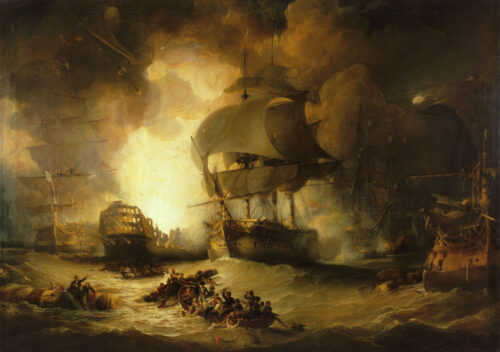
Perhaps France’s infamously aggressive “move fast, break things” dictator should be referenced today more often as Mr. Napoleon Blownapart? The gargantuan French warship L’Orient, carrying all the treasure Napoleon looted from Malta, explodes at 10PM and strands the French army in Egypt without a fleet, funds, or a way home. Source: National Maritime Museum, Greenwich, London
Openness that is anchored in transparency, a verification record as the ticket to release, is the actual goal. America needs to stop throwing shallow labels around and get back to empiricism, if it wants to be trusted at all, ever again.
a blog about the poetry of information security, since 1995