Category Archives: Security

Papers, Please: Who Does Your Browser Engine Actually Belong To?

Schnauzer | Deutsche | English

Every German who renews a passport, files taxes through ELSTER, fights for a Bürgeramt appointment, or signs into a statutory health insurer does all of it inside a rendering engine they do not control, cannot audit, and that rewrites itself overnight from a server on the American west coast. The browser engine is the most widely deployed piece of foreign software in the whole of German public life. And it is not on a single critical-infrastructure list.

The thing nobody puts on the list

KRITIS, the German critical-infrastructure regime overseen by the BSI, names everything: energy, water, food, telecommunications, health, finance, and transport. NIS2 widened the perimeter across the EU. And the browser engine? It is the door into every one of those sectors — the layer through which the citizen actually reaches the services — and it sits outside everything we have ever designated.

Three engines run the open web. Google’s Blink carries roughly three-quarters of all traffic, through Chrome, Edge, and nearly all the rest. Apple’s WebKit has iOS locked down. Mozilla’s Gecko, the heart of Firefox, now languishes below five percent. All three are steered from the United States. The European Commission’s June 2026 tech-sovereignty package admits it outright: for the important digital technologies, the Union depends on sources outside Europe for over eighty percent. That is no longer a dependency, it is a relationship.

And here is the point: this is not ownership anxiety. It is an open barn door in governance. An engine that updates itself is a remotely controlled write channel into every public machine that runs it: whoever controls the update server decides what gets pushed onto those devices tonight. We would never tolerate that for an electricity meter or a telephone exchange. But for the layer through which the entire state meets its citizens, we look the other way — because it “works.” That is exactly what every captured piece of infrastructure looks like. Right up to the day it stops working.

Three engines — two of them you’ll never build yourself

Take the romance out of the word and an engine is an assembly of seven parts in a loop: networking, HTML parsing, the DOM, the CSS cascade together with style computation, layout, rendering and compositing, and the bindings that couple JavaScript to the tree. The trick is to grasp that the deepest and most expensive of those parts are commodities. A JavaScript engine, a stack for text shaping and font rasterization, and the GPU primitives beneath rendering — each is person-millennia of work, and rebuilding them buys you exactly zero sovereignty. Nobody controls the web because they own a font rasterizer.

What actually belongs to you — the sovereign silver — is the layout engine, the rendering pipeline, and the security boundary around them. That is the part money is worth spending on, and you do not rebuild it on a greenfield. Servo already exists: a memory-safe engine in Rust, stewarded by the Linux Foundation Europe, taken by a five-person team at Igalia from 41 to 62 percent on the Web Platform Tests, with its first tagged release in 2026. A German engine is therefore a problem of forking and funding — on a European foundation, not a blank page. The full accounting, including the costs below, is laid out in this excellent reality check on browsers and sovereignty.

The shopping list, all in Rust

Here is the stack a funder should actually pay for — selected by a single rule: no American platform gatekeeper in any load-bearing part.

Subsystem Sovereign choice What it replaces
Language Rust memory safety as the foundation — and the whole ecosystem beneath it
JavaScript engine Boa V8 (Google), JavaScriptCore (Apple), SpiderMonkey (US)
GPU rendering and compositing WebRender + wgpu Skia and platform-native graphics stacks
TLS rustls Google’s BoringSSL, OpenSSL
Layout built in-house, on the Taffy framework for Flexbox/Grid the one part nobody will sell you
Text and i18n rustybuzz, fontations, ICU4X HarfBuzz, FreeType, ICU (the old C libraries)
Accessibility AccessKit the platform’s accessibility APIs
Base codebase Servo a from-scratch rewrite

The one component that decides whether the word “sovereign” survives the reality check is the JavaScript engine. Embed Google’s V8 or Apple’s JavaScriptCore and you have merely rebuilt the dependency with a nicer logo. Mozilla’s SpiderMonkey is the honest bridge — open, embeddable, the fastest path to a running browser — but it is still code from the US. Boa is the target: an embeddable engine in Rust, MIT-licensed, community-maintained, and already at roughly 94 percent conformance on Test262, the official ECMAScript suite. It is further along than anyone gives it credit for — its Temporal library for dates and times is good enough that V8 itself now uses it. The gap to V8 and SpiderMonkey is real, but it lies in raw speed and in the thousand edge cases, not in correctness. And a gap of exactly that kind is the sort of work a state initiative is good at: bounded, affordable, no black magic. Fund Boa up to web grade, and the JavaScript layer of the European stack contains no foreign-controlled code at all.

Where the money actually goes

The honest engineering picture is the opposite of frightening. Almost everything on the list is either a commodity you wire in once or a bounded problem you solve once. There is exactly one barrier that money only buys down slowly, and that is web compatibility — concretely: it has to behave like Chrome. Layout is loosely specified at the edges, so “correct” in practice means “behaves like Blink, including where Blink departs from the spec” — because the world’s websites are tested against Chrome and not against the specification. There is no elegant shortcut. It is long, stubborn testing against the Web Platform Tests, and that is where the lion’s share of the work will sit over time.

Two other problems are genuinely hard, and both are security problems where a Rust engine can be better than the incumbents rather than merely catching up: the renderer sandbox and the trust boundary between it and the privileged process — and the lifetimes of the DOM objects the JavaScript garbage collector tracks, the classic source of exploitable use-after-free bugs, the very thing memory safety was invented to kill.

The money for all of it? Estimated at roughly 50 to 70 million euros a year — for developers, testing, security audits, and standards work. Set that next to the European Space Agency’s 7.8-billion budget, or the 300 billion the EuroStack initiative wants to pour into digital infrastructure, and a browser engine is a rounding error. It was never about the money. It is about permanence: an engine is not a project that finishes, it is a commitment that has to outlive the ministry that paid for it.

In public hands — and federally

Germany already builds sovereign public software, and already does it federally. ZenDiS, the Center for Digital Sovereignty of Public Administration — a federally owned company founded in late 2022 and explicitly on its way to becoming a joint federal-state body — runs openCode, the public sector’s code forge, and openDesk, the sovereign alternative to Microsoft 365. When the heads of government of all sixteen states gathered for the Minister-Presidents’ Conference, they used openDesk — a week after launch. And at EU level the apparatus is taking shape too: an EU consortium for digital infrastructure and digital commons, with ZenDiS and Germany’s Sovereign Tech Agency set to carry the first projects. The chassis a browser engine would need is half-built before anyone has written a line of layout code.

So put the engine where the rest of the sovereign stack already lives: one upstream, sixteen stewards. A single federal browser authority would recreate the very thing you are running from — one point for political capture and one blast radius for every vulnerability. A federated model, maintained at the state level, distributes the security review, fits the subsidiarity the German state is built on, and ensures no single ministry and no single company holds the keys. Engines do not pool at Google because it would be impossible for everyone else. They pool there because no one else was willing to pay for permanence. A federated public mandate is the one structure that can fund permanence without raising a fresh monopoly under a European flag.

And now the plain truth about the real risk: it is not technical. Germany’s own open-source efforts have already been throttled because federal departments protected their legacy contracts — netzpolitik documented exactly how this agency got the red pencil. The threat to a German engine is procurement politics at home. It was never Rust.

A republic that cannot render its own government in a browser it controls has already handed the front door to someone else. The standards are open, the language is Rust, the foundation is Servo, the JavaScript engine is Boa, and the chassis to govern it is already standing. Fork it. Fund it. Put it in KRITIS. And the keys — those go to the states.

Für meinen Großonkel Lutz und seine Familie, 1941 – die wir nicht mehr aus Berlin herausholen konnten, bevor sie wegen der Angaben in ihren Papieren getötet wurden.

Europe No Longer Can Deny Moscow Routinely Ripping Up Sea Cables

As a life-long sailor, with extensive open water experience, let me try to explain why the Russian sabotage of sea cables is obvious. This is a story about “accidentally” dragging an anchor, in the same way a large truck could “accidentally” run over a Volkswagen and drag it 1,000 miles.

The story comes from a particular tanker called the Eagle S, taken to court over dragging its anchor. On a tanker of its size, anchor and chain together weigh roughly 100 metric tons. Dragging that load demands extra sustained engine power and generates continuous noise through the chain into the hull. The anchor mass and leverage, even swinging free undersea, works erratically against the rudder control and bleeds speed. Prosecutors in court argued that the Eagle S had all these signatures: they experienced falling speed and engine RPM. The crew came up with no plausible excuse to miss these factors. Even more to the point, fuel consumption is an unavoidable concern and anchor drag raises fuel consumption dramatically. On a shadow-fleet voyage that loss is a dominant variable always monitored.

The Eagle S ran one defense in court: the crew never knew the anchor was down, blamed it on winch failure made worse by weather. Basic physics make their claim impossible to believe, and the court did not let it float.

The more annoying line did not come from the ship at all. It came from a European official giving a strange excuse to The Record why drags like this could be an accident: an incompetent master knows the anchor is dragging and will not send crew onto an exposed foredeck in a storm to weigh it. A life-saving heroic decision. On a shadow fleet oil tanker. With disposable crew.

Are you f$%R#%ng kidding me?

The danger of the official European line is what it tries to drop on the unsuspecting reader. It concedes damage was noticed on board, concedes damage was unwanted, and then blames it all on a concern for human safety. They are weaponizing crew welfare on the least maintained, least caring vessels in the world. A tanker arguing they had an accident “because of how much we care about life” is a cynical joke.

Look at it like this: Swedish investigators have reconstructed an incident from the Vezhen ship’s voyage recorder and onboard video. They reported how three independent securing devices held an anchor, with two inoperative for some time. When the last one failed from a wave strike during a storm, the physics described above started to impact the ship. The Swedes say the autopilot compensated for the heavy yaw, and no alarm sounded. Sweden called it an accident of weather, mechanical failure, and poor seamanship. The accident was linked to a lack of care, where safeguards were failing and then gone, buried by ongoing negligence. That’s at least plausible.

The “we cared so much we didn’t care” is absurd on its face.

Now look at it like this: Dragged anchors account for about 30 percent of cable faults worldwide. It’s a thing we have a lot of data on already. A 2008 incident saw a ship drag anchor 180 miles across six cables. That sucked. A single long accidental drag is plausible, but it’s outside the norm because it’s negligent and counter to the variables the captain’s care about like fuel consumption (drag and direction). That’s why five cable drags in just eighteen months in one very particular sea of interest to Moscow is not plausible.

There is an expected baseline near 0.6 per year. One analyst put the observed cluster of five incidents at a once-in-108,000-years coincidence. Any attempt to look at these clustered anchor drags as isolated accidents is ignoring that they are collectively impossible. That’s what makes the “we cared about crew” so much worse as a defense. The high rate cluster isn’t an accident, and neither is “we cared”.

The legal record explains why cause becomes somewhat irrelevant to the undersea cable threat. The Helsinki court did not find the Eagle S crew innocent. It classified the event as an incident of navigation under UNCLOS Article 97 and assigned jurisdiction to the ship’s flag state. The damage fell inside Finland’s exclusive economic zone but outside its territorial sea, which stopped prosecution. Anchor-dragging is indistinguishable from negligence by official accounts, and the coastal-state had to admit incidents are outside their reach.

The Fitburg case gives us a comparison to weigh, because it was caught in the act and inside territorial waters. Their anchor was already damaged before the 130-kilometer drag. Prosecutors allege eight further cables were targeted before the ship was stopped. The coast guard intercepted it in the act, anchor still down, moving from the Estonian into the Finnish zone. Its case proceeds because it had two technical legal conditions the Eagle S did not.

The bottom line is that sailors could understand how incompetence such as lack of care accounts for any one ship in a storm. What does not add up is the regular sequence that indicates someone cares.

The persistence of the accident framing is the thing that dismisses the accident framing. Leaving these cases as unresolved only serves Moscow, which runs its flimsy deniability. European governments apparently want to avoid calling out that there has been a sustained campaign against their infrastructure, and it’s unclear why.

Prairieland Ruling by Activist Texas Judge Criminalizes Political Speech in America

This is Andrew Jackson in 1835, ordering the US mail inspected to suppress abolitionists, asking Congress to criminalize antislavery speech, and stoking state sanctioned mobs to arrest and torture Americans who opposed slavery.

Donald Trump’s favorite president: Andrew “white republic” Jackson. Historian Matthew Clavin says as terrible as Andrew Jackson was he likely would have despised Trump.

This is Stalin’s Article 58 (PDF) of the RSFSR code, where “anti-Soviet agitation” was a crime that meant whatever the interrogator needed it to mean.

This is Dennis v. United States, the 1951 McCarthy-era ruling that upheld the conviction of Americans for organizing and teaching political theory. Not for what they did. For what they taught.

This is South Africa’s Terrorism Act of 1967, which defined terrorism as anything that might endanger “law and order” and let the police hold suspects without trial.

This is Trump. Punishment is being elevated to deter all political opposition to a white police state.

America has criminalized political speech and identity again, in order to recharacterize lawful conduct. Owning a weapon, owning a book, using an app, knowing the wrong people, all of it becomes an overt act of an anti-Trump conspiracy.

To be clear, this is the exact grievance of the KKK, and of the January 6 mob. Prosecuted for their associations, their beliefs, their plans, they called it tyranny. Now they hold the power and have made it into their application of tyranny. Their violent attempts to replace democracy with dictatorship by overturning an election go pardoned, so that democracy will end. The people who oppose dictatorship draw harsh prison terms for having a legally bought gun and a printed paper. The standard that was angrily rejected, now the radical activist right-wing imposes on everyone else. Not an accident. Corruption.

…the biggest reason nothing in America functions in the public interest: rampant corruption…

The “agitator” label fits anything and everything the white police state decides on their whim, exactly as it did under Jackson, Stalin, McCarthy, and apartheid.

That’s how nine people in Texas just drew 30 to 100 years in jail for a Fourth of July protest at an ICE detention center.

Is a 30 year prison sentence for reading material the America you recognize? It’s very Jacksonian, and thus why Edgar Allan Poe sold so many copies of his 1843 guide to cryptoanalysis: “The Gold Bug“.

Poe’s cryptography from 1840 to 1841 was a newspaper challenge daring readers to send ciphers he would crack, which led to his 1841 essay “A Few Words on Secret Writing.” “The Gold-Bug” then became the most widely read work of his lifetime.

President Jackson was one of the most, if not the most unjust, immoral and corrupt men in American history

Tesla Vehicle Safety Report is Deadly Disinformation

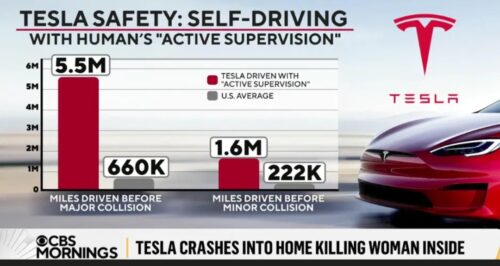
I was watching a report about the Tesla murder of a woman in Texas, and this chart popped up.

Source: CBS Morning

This is Tesla’s Vehicle Safety Report rebroadcast without a single control applied. CBS intentionally, openly, runs a fraudulent “safety” graphic claiming roughly 8x safer (5.5M ÷ 660K = 8.3, 1.6M ÷ 222K = 7.2) in a story about Tesla killing a woman, directly above a chyron saying as much.

The graphic asserts the exact inverse of the news it runs with, a perfect illustration of targeted disinformation. The Tesla numbers are inflated at both ends.

Numerator suppressed. Tesla counts a crash only inside roughly five seconds of disengagement where NHTSA’s reporting order specifies thirty, and counts mainly events at the airbag and restraint threshold. By the agency’s own finding Tesla captures data on around 18 percent of police-reported crashes. Fewer crashes counted means more miles per crash as an intentionally artificial construction.

The Tesla death headline is a cooked definition, not a measurement. It’s Enron, it’s WorldCom, it’s Bernie Madoff.

Denominator gamed. The 5.5M figure is supervised, highway-weighted miles in good conditions. The “US average” is every road, every condition, every vehicle age, including cars built before electronic stability control. Another artificial construction to lie about safety. New beats old carries no information about the system.

And their “active supervision” label is propaganda that concedes the rest: a human monitor was preventing crashes, so the number measures human plus machine, then it credits the unsafe machine instead of the actual safety from a human intervention.

Closed and unsafe. Singer testified there is no math and no science behind the Vehicle Safety Report. CBS ran the lie.

Waymo adjusts for road and neighborhood type, compares against human drivers in the same markets, and publishes through outside review; Tesla keeps the data secret and seeks none.

A self-attesting number, a lie, against an externally validated one. Run the apples-to-apples correction and the advantage collapses. Marco Benedetti matched airbag to airbag and got about three times, calling even that generous because Tesla measures a Tesla driver against the average driver and hides the rest behind fleet age. Three times worse, generously. The Tesla chart claims eight times better.

Here is the cleanest way to state the fraud. The latest 8x worse data from Tesla robotaxis is the same category of driving the CBS chart is bragging about: supervised autonomy with a monitor in the seat. Against NHTSA’s police-reported baseline of roughly one crash per 500,000 miles, the supervised fleet runs about eight times the human rate. On the tighter baseline the arithmetic is 7 crashes in roughly 300,000 miles against one per 700,000, which is 16.3x. Same multiplier, exact opposite result.

CBS broadcasts the fraudulent 8x safer slide for the exact driving mode that measures 8x more dangerous, once a real baseline is used. The two numbers describe the same thing and differ by a factor near sixty.

Another external check also proves the lie. LendingTree’s analysis of 30 brands put Tesla drivers first in accidents at 23.54 per 1,000. Fatal rate runs 5.6 deaths per billion miles against 2.8 for all brands. The marketing chart is a bald faced lie, which begs why a television segment ran it unedited instead of asking me. Someday, maybe.