The duty to rescue a stranger at sea is relatively new, despite it feeling as old as water. For most of the history of seafaring it existed as custom and as commerce. A master who saved a vessel could claim a salvage award in an admiralty court, and the law concerned itself mainly with how that award should be divided. Notably, saving the people aboard earned nothing so in practice it was a cargo valuation process.
The first general international obligation is from Brussels, 23 September 1910, in the Convention for the Unification of Certain Rules of Law respecting Assistance and Salvage at Sea. Article 11 is two sentences.
Every master is bound, so far as he can do so without serious danger to his vessel, her crew and her passengers, to render assistance to everybody, even though an enemy, found at sea in danger of being lost. The owner of a vessel incurs no liability by reason of contravention of the above provision.
Keep the second sentence in mind.
Eighteen months later the rule met the exact case it was written for, yet it was not yet in force. The convention did not take effect until 1 March 1913, while on the night of 14 April 1912 the SS Californian lay stopped in ice on the westbound track to Boston. Her sole wireless operator, Cyril Evans, had been told to keep off the air by the Titanic’s operator earlier that evening and turned in around half past eleven. The Titanic began transmitting shortly afterward. Nobody aboard the Californian heard it. Her officers even watched rockets rise over the horizon and formed no conclusion worth acting on.
I’ve been there, in the middle of a sea, watching bright lights rise far away in darkness. Calculating whether a turn towards them makes any sense. In the wide open water it’s essential to have radio confirmation to do the math of a course change.
How far apart the two ships lay has been argued ever since. The Board of Trade inquiry under Lord Mersey put it at eight to ten miles. The Marine Accident Investigation Branch reappraisal published in March 1992 put it at seventeen to twenty and concluded the ships lay beyond each other’s visible horizon. That same report found the rockets were seen and that proper action was not taken. The distance stays contested. The silence of the wireless never has been.
The conference that followed sat in London from 23 November 1913 to 20 January 1914, with the British delegation led by Mersey himself, fresh from the inquiry. It produced the first International Convention for the Safety of Life at Sea, and among its provisions was a requirement that ships keep a continuous wireless watch.
The 1914 convention never entered into force because it was overtaken by the war that summer, and it was rewritten in 1929, 1948, 1960 and 1974.
The listening watch survived every revision. That’s perhaps common sense since a duty to assist is worth nothing if the vessel best placed to assist has stopped listening. The Californian is the reason anyone knows this, if not simple experience on the water.
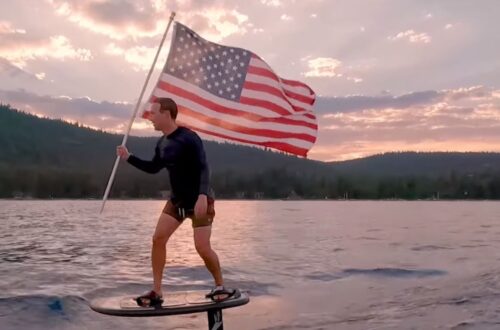
Which brings us to Zuckerberg’s super yacht casting its massive shadow over Farragut Bay.
On the night of Monday 3 August a 21-foot skiff ran out of fuel in the channel between Petersburg and Juneau. The Coast Guard heard the call just after 9:30 p.m., determined by 9:56 that the boat was not in distress, and issued a Marine Assistance Request Broadcast on VHF channel 16. The Marine Exchange of Alaska repeated it. The UnCruise passenger ship Wilderness Legacy answered, steamed past the halted 387-foot Launchpad, towed the skiff into shelter, refuelled it and found it an anchorage. The captain told his passengers why he was responding in the shadow of the Launchpad super yacht and they booed.
No law was broken by Zuckerberg’s massive failure. The Coast Guard’s non-distress finding removed the precise measure on which Article 11 and its successors hang, and a marine assistance broadcast is a request for volunteers rather than the order of duty.
However, Zuckerberg’s spokesperson dug a huge hole anyway. Their statement to the Alaska Beacon on Sunday opens by saying that the billionaire and his family were not on board at the time of the incident. It then explains that by the time the crew reviewed the Coast Guard contact on a different radio channel from the one they were operating on, the assist was already underway.
Ok, ok, let’s take this apart. First claim, first, because it is the one being offered as an answer and it answers exactly nothing. The owner’s location has never been an element of the duty. Article 11 binds the master. Regulation 33 of SOLAS Chapter V binds the master. Article 98 of the 1982 convention binds the state to bind the master. The owner appears in the law of assistance exactly once, in that second sentence, and again in Article 10 of the 1989 Salvage Convention, and on both occasions the appearance is an immunity. The drafters at Brussels wrote owners out of liability on purpose, because a duty that could be overridden from a shore office is not a duty. So a spokesperson announcing that the principal was elsewhere is claiming an exemption that has been sitting in the treaty for a hundred and sixteen years, unasked for, and volunteering it as though it were exculpatory.
It is NOT exculpatory.
It is beside the point twice over. Whether the man was hanging from the mast, in a stateroom, in a helicopter overhead, or in Palo Alto, the ship was his, the crew of roughly fifty were paid by him, and the standing orders they were following that night were written on his authority. Which channel the bridge monitors in confined waters after dark is not a decision made in the moment by a tired officer. It is a policy, set ashore, months in advance, by people who answer to the owner. So is the AIS discipline of a vessel that has been reported operating with its tracking limited. So is the flag. A yacht that is somewhere else on the dial at 9:56 p.m. in the inside waters of Southeast Alaska is executing a decision, and the decision was not made by sea fairies.
Six decades of conference diplomacy went into ensuring that no vessel would again be near and silent, and that has always meant continuous watch on a common frequency. Channel 16 is not any mystery or novelty. The whole arrangement is voluntary in the sense that nobody boards a private yacht at night to check, which is precisely why it runs on the assumption that a professional crew will keep the watch anyway. The three hundred million dollar vessel outside the bay was dead in its own water.
Their flag makes it worse. Article 98 does not command masters, it requires each state to require the masters of ships flying its flag to render assistance, so enforcement runs to the registry. The Launchpad flies the flag of the Marshall Islands, because money games, but that registry is a competent one and “white” listed by both the Paris and Tokyo port state control. The chain of accountability for what happened outside Farragut Bay runs to Majuro, and no port state control regime in the world inspects whether a private yacht is listening on 16 on a Monday night in Alaska. That trivial level of duty is real, the enforcement is nominal, so Zuckerberg’s crew had their ears off.
Dan Blanchard, who owns UnCruise, said he did not initially hear about the detour because this kind of assistance happens often enough that it does not always reach him. Two weeks earlier the National Geographic Quest had collected a family in Glacier Bay who swam ashore after a humpback sank their sailboat. Captain Sean Manske of the Wilderness Legacy contacted the skiff the following day to confirm it had reached Petersburg. Blanchard’s crews are on the same water under the same broadcast, and their owner did not find it necessary to explain where he had been standing every time a vessel calls for aid.
Cyril Evans went to bed, as one operator can’t always be on watch. The dozens of crew of the Launchpad were on another channel, by arrangement, on someone’s order to be unavailable.
The intervening century of treaty law produced a great deal of paper and one very, very solid insight, which is that listening makes the nearest vessel the nearest vessel. The nearest vessel telling us its owner was somewhere else that evening is the answer of a man who thinks a ship at sea comes without any societal obligations.