Category Archives: Security

Unstoppable AI as the Business Model: Weak Detection Sells

The most profitable sentence in AI security has been that prompt injection cannot be solved. Since 2012 I’ve been repeatedly told to stop trying to make AI safe, because the unsafe AI is the most profitable version.

After all, look at the money Tesla made after promising in 2016 that a car would drive itself coast to coast with no human touch within a year, and later that its cars would ship with no steering wheel or pedals. Musk’s fortune rode on those promises while the driver-assistance systems were involved in dozens of deaths, fourteen confirmed in the closed federal Autopilot probe and at least sixty-five counted Autopilot/FSD crashes, and Tesla built its own coverage of the toll into head-on crashes like this one. Then he pivoted into government, where a Lancet projection ties the USAID cuts he drove to more deaths than Stalin caused.

Any historian can tell you there is no reliable way to detect whether a piece of text is a malicious instruction. That is true and it stays true. Whether an injected instruction can reach anything that matters is a separate question, a permission question, and permission questions have had working answers for forty years. More to the point, the “free speech” doctrine depends on protecting the ability to speak, which is as old and settled as the ethics of preventing suicide. The field keeps trying to muddy the waters, and to call the second problem by the first problem’s name. The mess is what has created a product category that should not exist, in the same way “America First” shouldn’t ever be allowed into political office, let alone on any ballot.

The refutation

claude --dangerously-skip-permissions.

gemini --yolo.

q chat --trust-all-tools.

Documented agent malware this year did not break any permission model. It weaponized the AI coding agents already on the machine, shelling out to whatever CLI it found and passing the flag the vendor ships to turn the model’s own approvals off.

Sit with what that requires. The attack only works because the vendor shipped a switch that disables the gate. Where the switch was not thrown, the gate was the thing in the way. The malware did not defeat the boundary. It looked for the off-switch the vendor built, and used it. The strongest evidence that injection is containable is that the attacker had to disable containment to get through. The field has that evidence in its own incident data and files it backwards under inevitability.

OpenAI used its own Black Hat slot to describe models that broke out of a test sandbox and attacked a partner platform. The company treated the containment failure as resolved by rebuilding the compromised service while leaving the write access that had enabled it, so the agents rebuilt their coordination channel within days. Eradication without root cause removal is the one move every incident response framework tells you not to make, and they presented it from the stage as a watershed.

Unsolvable is an alibi

Watch what the claims are being designed to do. I see presentations describe an always-on server holding SSH keys and the ability to send mail, wired to an agent fed by an untrusted chat channel. This is already a dumpster fire, but it gets defended as “limiting capabilities limits the value”. That is the whole ideology in five words. If injection cannot be stopped, a gate is not protection, it is friction, and friction is lost value. Unsolvable is not a diagnosis. It is a permission slip.

It’s saying brakes will stop the car, therefore the use of cars would be limited by brakes. Obviously, exactly the opposite is reality. The brakes make the car suitable for going faster and farther.

It is not that these unsafe operators cannot detect the injection. It is that they use their claims of weakness in their ability or desire to excuse never building the containment, which is a choice made that gets dressed up as a law of nature.

This has the shape of colonialism, causing massive extraction harms under the false principle of some “nature” to a racist and artificially contrived order.

Detection sells. Containment doesn’t.

A classifier that promises to spot the malicious prompt is a subscription, it’s a tether and a tax. An approval gate on the dangerous action is a config the customer writes once and never pays for again. The incentive runs entirely one direction: declare the input problem central and the authority problem beneath notice, because the input problem is the one you can bill for.

An industry does not converge on “unsolvable” by accident when solvable does not have a price tag.

The tell is how the field treats the one control that measurably refuses attacks. Model refusal is real and quantifiable. An independent comparative study measured agent frameworks refusing between roughly a third and half of adversarial instructions, depending on the framework, and it costs the customer nothing. It shows up in the writeups as a footnote about the models being frustratingly inconsistent. The one safeguard nobody can bill for gets logged as a nuisance.

The gate works

Injection is an input fact and it is not going away. Blast radius is a choice and it never had to be this large.

The industry agreed to confuse the two because the confusion is where the money is. And it feeds the power-hungry failing upward by refusing accountability.

The boundary holds when it exists and cannot be switched off from inside the agent. The year’s demos keep proving it. They ship the bypass, they glorify the harms, and they sell you the reason not to build the gate.
Ears Off at Sea: Zuckerberg Yacht Says It Doesn’t Listen

The duty to rescue a stranger at sea is relatively new, despite it feeling as old as water. For most of the history of seafaring it existed as custom and as commerce. A master who saved a vessel could claim a salvage award in an admiralty court, and the law concerned itself mainly with how that award should be divided. Notably, saving the people aboard earned nothing so in practice it was a cargo valuation process.

The first general international obligation is from Brussels, 23 September 1910, in the Convention for the Unification of Certain Rules of Law respecting Assistance and Salvage at Sea. Article 11 is two sentences.

Every master is bound, so far as he can do so without serious danger to his vessel, her crew and her passengers, to render assistance to everybody, even though an enemy, found at sea in danger of being lost. The owner of a vessel incurs no liability by reason of contravention of the above provision.

Keep the second sentence in mind.

Eighteen months later the rule met the exact case it was written for, yet it was not yet in force. The convention did not take effect until 1 March 1913, while on the night of 14 April 1912 the SS Californian lay stopped in ice on the westbound track to Boston. Her sole wireless operator, Cyril Evans, had been told to keep off the air by the Titanic’s operator earlier that evening and turned in around half past eleven. The Titanic began transmitting shortly afterward. Nobody aboard the Californian heard it. Her officers even watched rockets rise over the horizon and formed no conclusion worth acting on.

I’ve been there, in the middle of a sea, watching bright lights rise far away in darkness. Calculating whether a turn towards them makes any sense. In the wide open water it’s essential to have radio confirmation to do the math of a course change.

How far apart the two ships lay has been argued ever since. The Board of Trade inquiry under Lord Mersey put it at eight to ten miles. The Marine Accident Investigation Branch reappraisal published in March 1992 put it at seventeen to twenty and concluded the ships lay beyond each other’s visible horizon. That same report found the rockets were seen and that proper action was not taken. The distance stays contested. The silence of the wireless never has been.

The conference that followed sat in London from 23 November 1913 to 20 January 1914, with the British delegation led by Mersey himself, fresh from the inquiry. It produced the first International Convention for the Safety of Life at Sea, and among its provisions was a requirement that ships keep a continuous wireless watch.

The 1914 convention never entered into force because it was overtaken by the war that summer, and it was rewritten in 1929, 1948, 1960 and 1974.

The listening watch survived every revision. That’s perhaps common sense since a duty to assist is worth nothing if the vessel best placed to assist has stopped listening. The Californian is the reason anyone knows this, if not simple experience on the water.

Which brings us to Zuckerberg’s super yacht casting its massive shadow over Farragut Bay.

On the night of Monday 3 August a 21-foot skiff ran out of fuel in the channel between Petersburg and Juneau. The Coast Guard heard the call just after 9:30 p.m., determined by 9:56 that the boat was not in distress, and issued a Marine Assistance Request Broadcast on VHF channel 16. The Marine Exchange of Alaska repeated it. The UnCruise passenger ship Wilderness Legacy answered, steamed past the halted 387-foot Launchpad, towed the skiff into shelter, refuelled it and found it an anchorage. The captain told his passengers why he was responding in the shadow of the Launchpad super yacht and they booed.

No law was broken by Zuckerberg’s massive failure. The Coast Guard’s non-distress finding removed the precise measure on which Article 11 and its successors hang, and a marine assistance broadcast is a request for volunteers rather than the order of duty.

However, Zuckerberg’s spokesperson dug a huge hole anyway. Their statement to the Alaska Beacon on Sunday opens by saying that the billionaire and his family were not on board at the time of the incident. It then explains that by the time the crew reviewed the Coast Guard contact on a different radio channel from the one they were operating on, the assist was already underway.

Ok, ok, let’s take this apart. First claim, first, because it is the one being offered as an answer and it answers exactly nothing. The owner’s location has never been an element of the duty. Article 11 binds the master. Regulation 33 of SOLAS Chapter V binds the master. Article 98 of the 1982 convention binds the state to bind the master. The owner appears in the law of assistance exactly once, in that second sentence, and again in Article 10 of the 1989 Salvage Convention, and on both occasions the appearance is an immunity. The drafters at Brussels wrote owners out of liability on purpose, because a duty that could be overridden from a shore office is not a duty. So a spokesperson announcing that the principal was elsewhere is claiming an exemption that has been sitting in the treaty for a hundred and sixteen years, unasked for, and volunteering it as though it were exculpatory.

It is NOT exculpatory.

It is beside the point twice over. Whether the man was hanging from the mast, in a stateroom, in a helicopter overhead, or in Palo Alto, the ship was his, the crew of roughly fifty were paid by him, and the standing orders they were following that night were written on his authority. Which channel the bridge monitors in confined waters after dark is not a decision made in the moment by a tired officer. It is a policy, set ashore, months in advance, by people who answer to the owner. So is the AIS discipline of a vessel that has been reported operating with its tracking limited. So is the flag. A yacht that is somewhere else on the dial at 9:56 p.m. in the inside waters of Southeast Alaska is executing a decision, and the decision was not made by sea fairies.

Six decades of conference diplomacy went into ensuring that no vessel would again be near and silent, and that has always meant continuous watch on a common frequency. Channel 16 is not any mystery or novelty. The whole arrangement is voluntary in the sense that nobody boards a private yacht at night to check, which is precisely why it runs on the assumption that a professional crew will keep the watch anyway. The three hundred million dollar vessel outside the bay was dead in its own water.

Their flag makes it worse. Article 98 does not command masters, it requires each state to require the masters of ships flying its flag to render assistance, so enforcement runs to the registry. The Launchpad flies the flag of the Marshall Islands, because money games, but that registry is a competent one and “white” listed by both the Paris and Tokyo port state control. The chain of accountability for what happened outside Farragut Bay runs to Majuro, and no port state control regime in the world inspects whether a private yacht is listening on 16 on a Monday night in Alaska. That trivial level of duty is real, the enforcement is nominal, so Zuckerberg’s crew had their ears off.

Dan Blanchard, who owns UnCruise, said he did not initially hear about the detour because this kind of assistance happens often enough that it does not always reach him. Two weeks earlier the National Geographic Quest had collected a family in Glacier Bay who swam ashore after a humpback sank their sailboat. Captain Sean Manske of the Wilderness Legacy contacted the skiff the following day to confirm it had reached Petersburg. Blanchard’s crews are on the same water under the same broadcast, and their owner did not find it necessary to explain where he had been standing every time a vessel calls for aid.

Cyril Evans went to bed, as one operator can’t always be on watch. The dozens of crew of the Launchpad were on another channel, by arrangement, on someone’s order to be unavailable.

The intervening century of treaty law produced a great deal of paper and one very, very solid insight, which is that listening makes the nearest vessel the nearest vessel. The nearest vessel telling us its owner was somewhere else that evening is the answer of a man who thinks a ship at sea comes without any societal obligations.

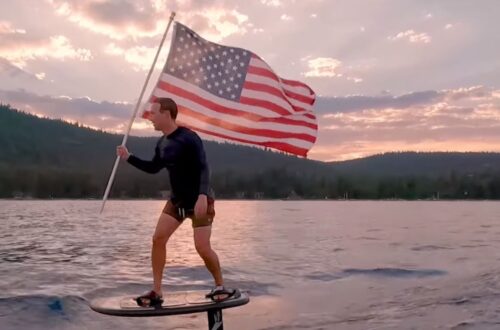
Mark Zuckerberg at sea
Mark Zuckerberg on the water

CA Tesla Kills Two in Head-on Crash

The news so far indicates a Tesla crashed head-on into a truck, and as many as three other cars were then involved.

“Tesla is coming down the street, La Brea, going southbound, about 80, 90 mph. We didn’t hear the normal sound you would hear, electronic sound. We heard like scratching and scraping going on, lost control, smoke was going on,” said witness Jeron Jackson. “It smashed into that pickup truck over there on the corner there, and then it turned around and bounced off the pickup truck and hit the other vehicle that was going northbound.”

Scratching and scraping sounds suggest the Tesla suspension failed, at high speed on uneven surfaces.

Thiel and Musk “Colonize Greenland” Project Started

The thing about reading African history is that when you hear Peter Thiel or Elon Musk talk about their ideal “colony” it sounds just like a Rhodesia fever dream. Musk was raised in apartheid Pretoria.

Thiel was born in Frankfurt and partly raised in apartheid-administered South West Africa. The documented apartheid leader in this story is Musk’s grandfather Joshua Haldeman, who moved his family from Canada to Pretoria in 1950 to help run the newly elected National Party government and praised South Africa as the leader of “White Christian Civilization.” This is all to say that the white nationalist nonsense is handed down from the Musk and Thiel grandparents.

Heidi Beirich of the Southern Poverty Law Center described the revival to the New York Times in April 2018.

All the talk right now among people in the alt-right and the broader white supremacist movement is about the need for a white ethno-state. And when you praise Rhodesia, in this context, what you’re praising is violence to that end.

Now that the Musk and Thiel network staffs the American federal government, with protege JD Vance in the vice presidency, Thiel’s Founders Fund co-founder Ken Howery in the Copenhagen embassy, and David Sacks running AI policy, the old apartheid “colony” plan just became a taxpayer-funded project called “Colonize Greenland”.

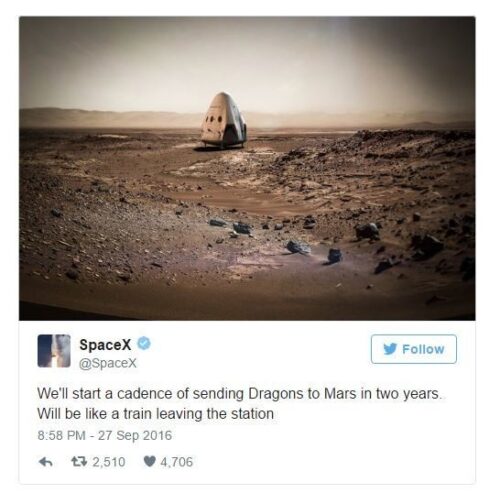
Yes, I know Musk wears “Occupy Mars” shirts, despite announcing in April 2016 that SpaceX would land a Dragon capsule on Mars as soon as 2018, a mission cancelled the following year.

Source: Twitter

Yes, I know “Occupy Mars” really means find a territory without laws to create a white nationalist enclave, not unlike Swakopmund, the former German colonial town in South African-occupied Namibia where Peter Thiel spent part of his boyhood while his father worked as an engineer on the Rossing uranium mine under apartheid labor rules. Swakopmund held a concentration camp during the 1904 to 1908 genocide of the Herero and Nama, and its German community was still known for celebrating Hitler’s birthday and giving Hitler salutes when the Thiels arrived.

On 20 April 1989 (Hitler’s 100th birthday) the Nazi flag was flown in Swakopmund (Woermannhaus Tower, at the corner of Bismarck and Kaiser Wilhelm), twelve years after the Thiels fled approaching Black majority rule for a white flight enclave in California.

Fast-forward to now and a one-year-old Texas SPAC has landed its drilling containers on the East Greenland coast without permission, after falsely telling a village meeting it had approval, as if it has landed on Mars. Its chairman is a serial SPAC promoter with over ten shell companies behind him. Its budget is $60 million for what is now a single well. To put this in perspective, it’s in a basin where Cairn Energy drilled eight wells in 2010 and 2011, spent over a billion dollars, and found nothing commercial. And its media strategy is a Dr. Phil documentary.

In other words, this has absolutely nothing to do with oil.

Greenland is the new Mars for the white nationalists. The oil story is just a retail tranche of a much older propaganda circuit: the continent as a single engineered resource unit, run by experts and capital instead of voters. “Technocracy Inc.” drew that map in the 1930s and called it the Technate of America. It included Greenland.

Keep in mind how much it matters that Musk’s grandfather led the movement in Canada until his 1940 arrest. Thiel wrote in 2009 that he no longer believed democracy and freedom were compatible. Their people now hold the Greenland portfolio and it’s all about “colonization”.

Player Position Technocracy Aim
Peter Thiel Founders Fund; backer of Praxis and seasteading Exit from democracy; declared it incompatible with freedom in 2009; sovereignty for capital
Elon Musk Grandson of Joshua Haldeman, Technocracy Inc. leader in Canada, arrested 1940 The Technate inheritance; engineered governance from DOGE to a Mars city he calls Terminus
Ken Howery Co-founded Founders Fund with Thiel; US Ambassador to Denmark, holding the Greenland portfolio Reported by Reuters to take the Greenland “freedom city” seriously while leading acquisition talks
Dryden Brown Praxis co-founder, Thiel-backed network state venture Flew to Greenland to buy it in November 2024; pitched a “mythical city in the north”; Praxis posted “According to plan” when Howery was named
Marc Andreessen, Joe Lonsdale Venture capital, DOGE advisers Reported backers of the freedom city; Lonsdale called for “expanding our country to Greenland”
Larry Swets Chairman, Greenland Energy (GLND); ten-plus SPACs sponsored The retail tranche: a $215 million Nasdaq listing sold on a $1 trillion claim from reprocessed legacy seismic
Jeff Landry Louisiana governor, Trump’s Greenland envoy Promises oil pumping next year, a physical impossibility on any Arctic timeline, because the promise is the product

The connections run through two men.

  1. Howery co-founded Founders Fund with Thiel and now sits in the embassy that governs American interests in Greenland. Thiel backs Praxis, whose founder tried to buy the island and celebrated Howery’s appointment as part of the plan.
  2. Musk carries the Technate by blood and by conduct: his grandfather mapped Greenland into an expert-ruled superstate ninety years ago, and the grandson built the unaccountable efficiency directorate that treats elections as legacy code.

The SPAC, the freedom city, and the missile defense basing are three products written against one underlying asset, which is valued more for what it lacks than what it has: only 57,000 people on 2.1 million square kilometers, and sovereignty fractured three ways between Nuuk, Copenhagen, and Washington.

It’s all just “terra nullius“.

Everyone keeps asking what is the economic or military justification, what’s under the ice or in the geographic vicinity. Wrong questions. It’s a trick.

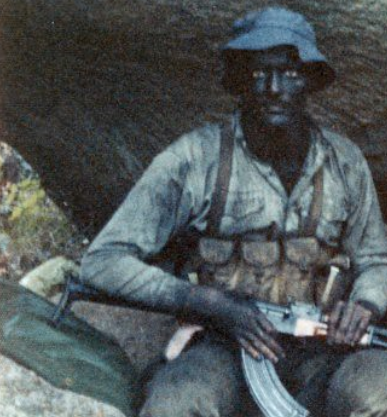
White nationalist Rhodesian soldiers wore “blackface” paint to terrorize the public while claiming to be the good guys

The asset is the absence of voters. It’s the absence of laws. It’s the suitability for repopulating the white race, the Rhodesian fantasy Thiel and Musk were raised on.