Category Archives: Security

Russian “Simpler Job”: Sabotage Price Lists and the Dutch Rail Outage

Russian intelligence will offer you two hundred dollars to take some photographs of an address. Tens of thousands to kill a man. When the money fails, sabotage is asked. The numbers are public now because the Southern District of New York unsealed charges on 15 September against five members of a network run for the intelligence services of the Russian Federation. The indictment lists the going rates.

Photograph a target address $200
Pre-operational surveillance $1,000 to $1,500
Kill a man in Lithuania $25,000
Eliminate a dissident in the United States $40,000
Burn a food warehouse or a substation the simpler job

Read the sequence of that list, beyond their individual numbers. An FSB officer recruits a US citizen for two hundred dollars of photography. The assignment is completed, but it escalates. The officer introduces his boss, a colonel, who offers twenty five thousand dollars to murder the man in the photographs and suggests gasoline or a knife.

When the recruit declines, the colonel immediately offers something simpler to suit motivations: set fire to a warehouse of property or food, or throw a bottle of gasoline at an electrical substation. He explains that the purpose is to target all the countries helping Ukraine, and that he is offering serious money for serious work.

The same thing happens with the second recruit. A thousand to fifteen hundred dollars buys surveillance of a dissident’s home. Forty thousand for the killing meets a refusal, at which point the recruiter asks whether the man knows somebody else who would. They seek people motivated by money, although something else could motivate as well.

Two approaches, two refusals at the same threshold, with a downgrade to attacking infrastructure both times. Money was taken for reconnaissance and offered for arson. It did not get murder from either case, which makes higher motivation a question worth asking.

The services know where and how to look, thanks to chat apps and social media. RUSI’s work on sabotage financing records that ideological motives reinforce payment among people already consuming extremist or pro-Kremlin material. The head of the BND told the Bundestag that recruiters watch pro-Kremlin Telegram channels to identify candidates for small tasks. Recruitment samples a primed population, because priming is the part money cannot purchase.

Franz von Rintelen understood this in 1915 for purposes of stopping munitions from reaching a war front in Europe. Half a million dollars did not buy strikes at American munitions plants. It bought Labor’s National Peace Council, a vehicle in which real grievance produced them. The money supplied targets, timing and infrastructure. The motivation was already American, and that is exactly why the sabotage read as a domestic labor dispute.
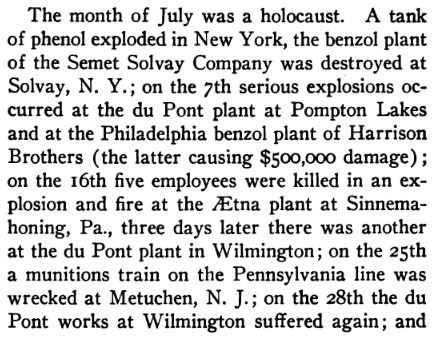
The German Secret Service in America, 1914-1918, 1918.

Which brings us to what a motivated domestic actor does afterward.

European rail sabotage by the ultra-left announces itself to draw attention. The September 2023 arson on German rail cable ducts came with a claim on an extreme-left site. Anarchists published a manifesto two days after the Bologna and Pesaro attacks in February 2026. French investigators examining an October 2025 cable sabotage went to a post on Indymedia Nantes that tied the rail attack to the same-night burning of construction plant beside the track. The communique is the product, because making the argument is the point. They are pushing a message.

Now the opposite list. France, July 2024, three high speed lines. The Hague, June 2025, thirty rail cables burned as the NATO summit opened. Cléon, September 2026, a rail fragment on the track and forty four injured. The Netherlands, 15 September 2026, pipes fastened to the rails across the central and eastern network.

France shows how a false flag of intelligence then unfolds. Gérald Darmanin named the ultra-left within forty eight hours and posted the link to an arrest at Oissel on X. The Rouen prosecutor said no damage had been found. The Paris prosecutor said there was no arrest in that investigation. The man was convicted in November of entering a railway area closed to the public. Trespass. That’s it. The gendarmerie stood up a national investigation cell named Sabotage SNCF in March 2025, eight months after the attack, and by December 2025 the case had produced no suspect and no mise en examen.

Darmanin had asked the right question on France 2 before his own attribution overtook it.

The question is whether they were manipulated or is it for their own account.

Two years later the French state has not answered its own interior minister, and has not published an assessment of Russian capability for false flags. Germany has run the same play for fifteen years with zero convictions.

The political scientist Sylvie Ollitraut supplied the test everyone skipped. Claimed ecological sabotage in France has targeted construction that harms the environment, while rail is the mode ecologists promote. The claim of motive did not fit the target.

Now look at the Dutch farmer grievance against Dutch rail. They are angry about nitrogen policy, forced buyouts and land expropriation. They are described as anti-government, anti-coordination, loosely organized if at all. Simultaneous placements across the central and eastern network stop a commuter service between Putten and Ermelo, for what? That advances nothing for them and reaches nobody who decides any of it. The hay bales burning along motorways on Tuesday afternoon are the farmer action that announces farmer grievance clearly, attribution wanted. NOS reports the call for the hay bale fires came from farmer activists. Visible, known, symbolic anger, on the roads farmers use. The pipes on rails with a big mystery to solve serve none of those aims.

Farmers Defence Force secretary Sieta van Keimpema told WNL that farmer involvement cannot be ruled out, that the national organisation coordinates nothing, and that regional groups prepare regional actions. Voorman Mark van den Oever said the group is not involved and individual farmers are not excluded. NOS found sources in agricultural circles confirming that a local tractor group discussed the rail sabotage, including how the pipes should be fastened. A constituency was offered, their coordination was denied, so responsibility remains unclaimed.

That combination of the two is what the Rintelen design produced during WWI, the foundations of intelligence operations to this day.

German federal security services published the recruitment template in September 2025. Foreign intelligence, mostly Russian, hires Wegwerf-Agenten through social media and messenger apps for small sums, and the BKA target list names transport and rail.

So the Dutch investigation has three questions with answers to be checked.

  1. Whether the fastening technique entered those channels from somebody with no farming history.
  2. Whether the pipe stock was uniform across the sites, which means a supplier, or improvised at each, which means scrap.
  3. Whether anyone in those groups received money.

The third question is the one the Germans keep answering, the one the Americans just published, and one that nobody in the Netherlands has spoken about yet.

ClickFix for CISOs: How to Stop Running With Scissors

The danger of the ClickFix attack is how it exploits user behavior: a user will run with scissors if running is allowed, and ClickFix tells them to go faster. Windows ships with three such behaviors that are allowed, none of which a standard user needs.

Close them.

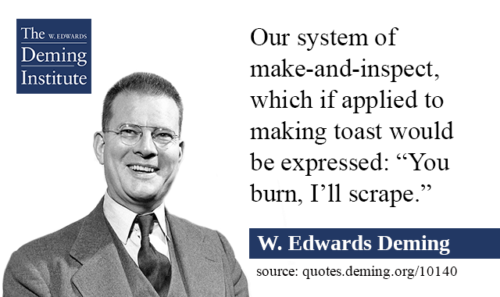
Seven steps are provided below using a ShouldDo-HowTo-Check triad, with apologies to Shewhart’s “specification, production, inspection” cycle. It occupied post-war Japanese engineers recast as the famous Plan-Do-Check-Act (PDCA) that Deming technically preferred to teach as Plan-Do-Study-Act.

Download as PDF –>

During World War II, Deming was a member of the five-man Emergency Technical Committee. He worked on the American War Standards Z1.1 and Z1.2 of 1941 and Z1.3 of 1942 and taught statistical process control to wartime production workers. The same methods rebuilt Japanese industry through his lectures of 1950.

The following steps apply to the User OU on their machine OS and to the session host image on VDI and thin-client estates.

1. Disable Run

Do: Remove the Run dialog for every standard user.

How: Group Policy, User Configuration > Administrative Templates > Start Menu and Taskbar > Remove Run menu from Start Menu: Enabled. Apply to the Users OU. The same policy removes New Task from Task Manager and blocks UNC paths and drive letters typed into the Explorer address bar; test file-share workflows first.

Check: As a standard user, Win+R does nothing. reg query HKCU\Software\Microsoft\Windows\CurrentVersion\Policies\Explorer /v NoRun returns 0x1.

2. Disable Win+X

Do: Remove the Win+X terminal shortcut for standard users.

How: Group Policy Preference, User Configuration > Preferences > Windows Settings > Registry: HKCU\Software\Microsoft\Windows\CurrentVersion\Explorer\Advanced, string value DisabledHotkeys = RX. Win+E and Win+D keep working. Confirmed on Windows 10; test on Windows 11 before rollout. The blunt alternative removes every Windows-key combination: User Configuration > Administrative Templates > Windows Components > File Explorer > Turn off Windows Key hotkeys: Enabled.

Check: After sign-out, Win+X does nothing.

3. Deny interpreters to standard users

Do: Block powershell.exe, pwsh.exe, cmd.exe, mshta.exe, wscript.exe and cscript.exe for the Users group. Allow them to one named group.

How: AppLocker scopes rules to users and groups: publisher rules, deny on Users, allow on the named group, executable and script collections both enforced, Application Identity service set to Automatic. App Control for Business is the stronger enforcement and is device-wide, so the named group’s machines get their own policy. Both run on Pro, Enterprise and Education from Windows 10 version 2004. Two weeks in audit mode, read events 8003 and 8006, then enforce. Remove the PowerShell 2.0 engine: Disable-WindowsOptionalFeature -Online -FeatureName MicrosoftWindowsPowerShellV2Root.

Check: As a standard user, powershell.exe and cmd.exe are refused. In any PowerShell host that still opens, $ExecutionContext.SessionState.LanguageMode returns ConstrainedLanguage. Get-WindowsOptionalFeature -Online shows the V2 engine Disabled.

4. Keep the paste warning

Do: Leave the Windows Terminal paste warnings on.

How: Both ship enabled. settings.json: “multiLinePasteWarning”: true and “largePasteWarning”: true. No policy exists; a user can turn them off. macOS 26.4 Terminal warns on a pasted command, once per session, with an override.

Check: Paste two lines into Windows Terminal. The warning appears.

5. Log the attempt

Do: Enable script block logging and command-line auditing. Ship both to the SIEM.

How: Computer Configuration > Administrative Templates > Windows Components > Windows PowerShell > Turn on PowerShell Script Block Logging: Enabled. Computer Configuration > Administrative Templates > System > Audit Process Creation > Include command line in process creation events: Enabled. Advanced Audit Policy > Detailed Tracking > Audit Process Creation: Success. Two alerts: powershell.exe with explorer.exe as parent; Invoke-RestMethod piped to Invoke-Expression.

Check: Microsoft-Windows-PowerShell/Operational shows Event 4104. Security shows Event 4688 with a command line. A member of the named group pipes irm of an internal URL to iex; the alert fires within five minutes.

6. Name the exceptions

Do: Put every account that needs Run, Win+X or an interpreter into the named group.

How: Ticket, owner, 90-day review, membership change logged.

Check: The group has an owner and every member has a ticket.

7. Train last

Do: Tell users a captcha never asks them to press Windows keys or paste into a terminal.

Check: The phishing simulation includes one ClickFix lure per quarter.


References:

Illustration of the Deming warning.
Berlin, Germany, August 2026: one paste into Windows Terminal, interpreters left open to every user, egress goes unmonitored and 5.8 terabytes are exposed in five days, set to a ransom, resulting in 1.44 million files published.

Dutch Rail Sabotage Four Days After NATO Staged Trains for the Russian Front

Germany in WWI ran a sabotage campaign against American factories and shipping while America was still officially neutral. Franz von Papen infamously organized it out of the embassy from 1914. Wilson expelled him in December 1915 and leaked the Albert papers to the press that August, but he pointed the domestic investigative apparatus at labor and “left wing” political targets.

Berlin by January 1915 had instructed the Secret War Council in New York to stop munitions reaching the Entente by any available means. Incendiaries went into ship holds to explode at sea. Plants were burned. One 1937 accounting said 43 American factories had explosions or fires of unexplained origin between early 1915 and spring 1917, alongside sabotage devices on roughly four dozen munitions ships. It was called a “holocaust” where German assets roamed.

The German Secret Service in America, 1914-1918, 1918.

Wilson knew, as he leveraged it for the false pretense to investigate left-wing leaders instead and target his political opposition, cynically enabling foreign enemies of the state as his personal allies.

The cover is the part worth studying. Franz von Rintelen spent half a million dollars standing up Labor’s National Peace Council, a false flag front built to generate strikes and slowdowns at munitions plants. He went after the actual labor organizer Samuel Gompers.

The design of the operation made German strategic sabotage read as American labor grievance, because a neutral country arguing with itself about wages and war profiteering looks nothing like a foreign operation against a supply line. The charge that eventually stuck to Rintelen at his trial was a conspiracy to restrain trade by inducing dockworkers to strike.

The evidence was never hidden. The Albert briefcase ran on the front page of the New York World. The Providence Journal published German sabotage exposures through 1915. Black Tom shook windows across Manhattan. Americans could read all of it and still filed foreign sabotage as a domestic radical problem, which is the part worth carrying forward.

Labor and anarchism were the available flags in 1915. The history is useful today because the Dutch farmer protest movement is the flag already being offered, with climate and anti-militarism in reserve. They supply a real domestic constituency with real grievances about exactly the thing that a Russian operation wants stopped, and both hand investigators a “local politics” file to open instead of the more relevant counterintelligence one.

Germany has been running that mistake for fifteen years with zero convictions, if you wonder how well it’s been going.

The Netherlands and Poland agreed in December 2025 to deepen military mobility and logistics, moving troops through the Netherlands and Germany toward Poland. That builds on the January 2024 declaration among the Netherlands, Germany and Poland to run a corridor from the North Sea ports to the eastern flank, including priority for military trains over civilian traffic. On 11 September Dutch Defence moved 16 NS ICRmh carriages to the Vlasakkers military rail facility at Amersfoort, routed Arnhem to Deventer to Amersfoort. Those carriages become casualty evacuation trains. Medical evacuation capacity running west out of Poland not the kind of component in the corridor attracting public notice, while it is the one that Russia monitors as what NATO expects to need on the front.

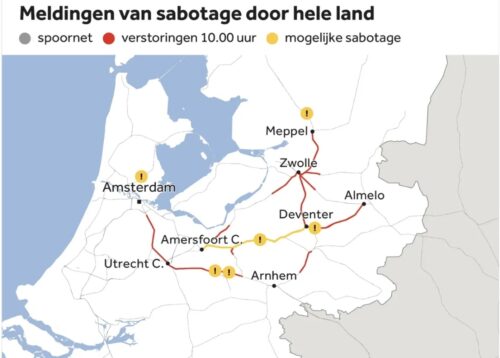
Four days later pipes were fastened to the rails at Barneveld, Twello, Brummen, Putten, Lunteren, Ermelo, Veenendaal, Olst and Steenwijk. Barneveld sits on Amersfoort to Apeldoorn. Twello sits on Apeldoorn to Deventer. Brummen sits on the Arnhem to Zutphen approach to Deventer. Three points on the 11 September path. NOS mapped Amersfoort to Deventer as the one segment classified as probable sabotage rather than knock-on disruption.

Source: NOS

The pipes bridge the rails and short the track circuit. Relay de-energised therefore train present is an inference the system cannot verify, and a shunt satisfies it. The section reports occupied and signals hold at danger. Integrity of the input fails and availability of the corridor goes down with it. ProRail knew which baanvak was reporting and not where the object sat, which put crews on foot across kilometres of track for hours.

Large metal pipes cost almost nothing to source and drop, which is why material alone identifies nobody. Nine of those sites are named. Placements in one night across four provinces takes planning and more than one pair of hands. What the method establishes is that the Dutch signalling layer carries no integrity check on its own input channel. Anyone working a classic target of intelligence operations (because it’s so hard to prevent) can hold the corridor closed.

German federal security services published the template in September 2025. Foreign intelligence, mostly Russian, recruits Wegwerf-Agenten through social media and messenger apps for small sums, and the BKA target list names transport and rail.

Within hours, the Farmers Defence Force secretary Sieta van Keimpema told WNL that farmers being behind it cannot be ruled out, that the national group coordinates nothing, and that regional groups prepare regional actions. Agractie chairman Erik Luiten said he does not know and is waiting for the investigation. It’s a claim of motive coupled with the denial of coordinated methods, which sows political points yet leaves responsibility unclaimed.

With no claim of responsibility, the Netherlands has been here before. Some thirty rail cables burned as the NATO summit opened at The Hague in June 2025, cutting train services to the country’s main airport, with pro-Russian denial of service against summit municipalities the day before, and no claim of responsibility then either.

Caretaker Justice Minister David van Weel told the NATO Public Forum:

It could be an activist group. It could be another state. It could be anything.

The absence itself is notable. A domestic group is motivated to have its grievance heard. That was the point of Labor’s National Peace Council: a front publishes their cover. Silence fits a different operation, where the outage itself is the message, for the people who scheduled military trains to reach the front lines of war with Russia.