Category Archives: Security

IOC Flies Russian Flag and Bans Ukrainian Athlete Memorial

The pattern is hard to miss. An Italian can compete wearing the Russian flag on his helmet — a flag that’s explicitly prohibited at these Games — with zero consequences.

An Israeli skeleton racer can put the names of terrorism victims on his head.

An American can hold up photos of dead parents in the competition area.

And yet, three Ukrainian athletes were sanctioned. Why? For doing what anyone else seems able to do. It is clear that Ukrainians referencing the 660 fellow athletes and coaches who have been killed are being held to a very different standard.
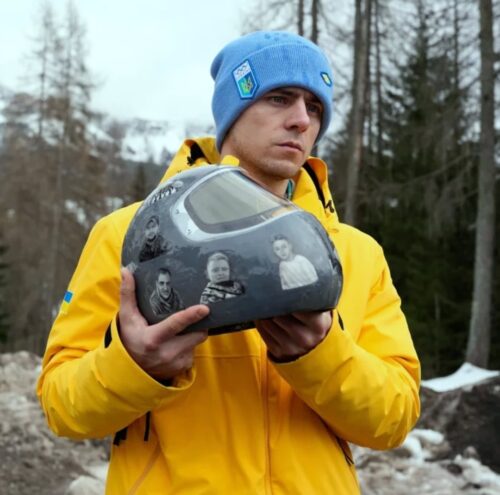
Vladyslav Heraskevych at the 2026 Winter Olympics, Italy. Source: Alessandra Tarantino/AP

The IOC’s stated objection is that Heraskevych’s act was “premeditated” while others were “spontaneous”, which doesn’t survive contact with reality.

Firestone had his religious memorial cloth custom-made long before the Games. Linton’s helmet was pre-painted. Fischnaller has been wearing that barred Russian flag a decade, since 2014. Every one of these was planned long in advance.

Only Ukrainian athletes are being censored.

Athlete Games Expression Consequence
Jared Firestone (Israel) 2026 Kippah with names of 11 killed at 1972 Munich Games. Worn on his head None
Maxim Naumov (USA) 2026 Photo of parents killed in 2025 plane crash, held in kiss-and-cry area None
Jessica Linton (Canada) 2026 Helmet reading “I ski for Brayden” honoring deceased skier None
Roland Fischnaller (Italy) 2026 Helmet displaying Russian flag, which is explicitly banned None
Matthias Steiner (Germany) 2008 Photo of late wife on gold medal podium None
Raven Saunders (USA) 2020 X gesture on podium for “all people who are oppressed” Investigated, no sanction
Gwen Berry (USA) 2020 Raised fist protesting racial injustice None
German hockey captain 2020 Rainbow armband during matches None
Multiple football teams 2020 Took a knee before matches None
Smith & Carlos (USA) 1968 Raised fists on podium Expelled
Heraskevych (Ukraine) 2022 “No War in Ukraine” sign after final run None
Kateryna Kotsar (Ukraine) 2026 Helmet reading “Be brave like Ukrainians” Banned
Oleh Handei (Ukraine) 2026 Helmet quoting poet Lina Kostenko Banned
Manizha Talash (Refugee) 2024 Cape reading “free Afghan women” Disqualified
Heraskevych (Ukraine) 2026 Helmet with photos of athletes killed by Russia Disqualified

Accommodating Russian flags while banning Ukrainians memorializing their dead athletes and coaches is the story. The IOC allowed 13 Russian athletes into the Games by labeling their appearance “neutral individuals” while banning Ukrainians from bringing their dead into the games as neutral.
The poem that freed a child from ICE

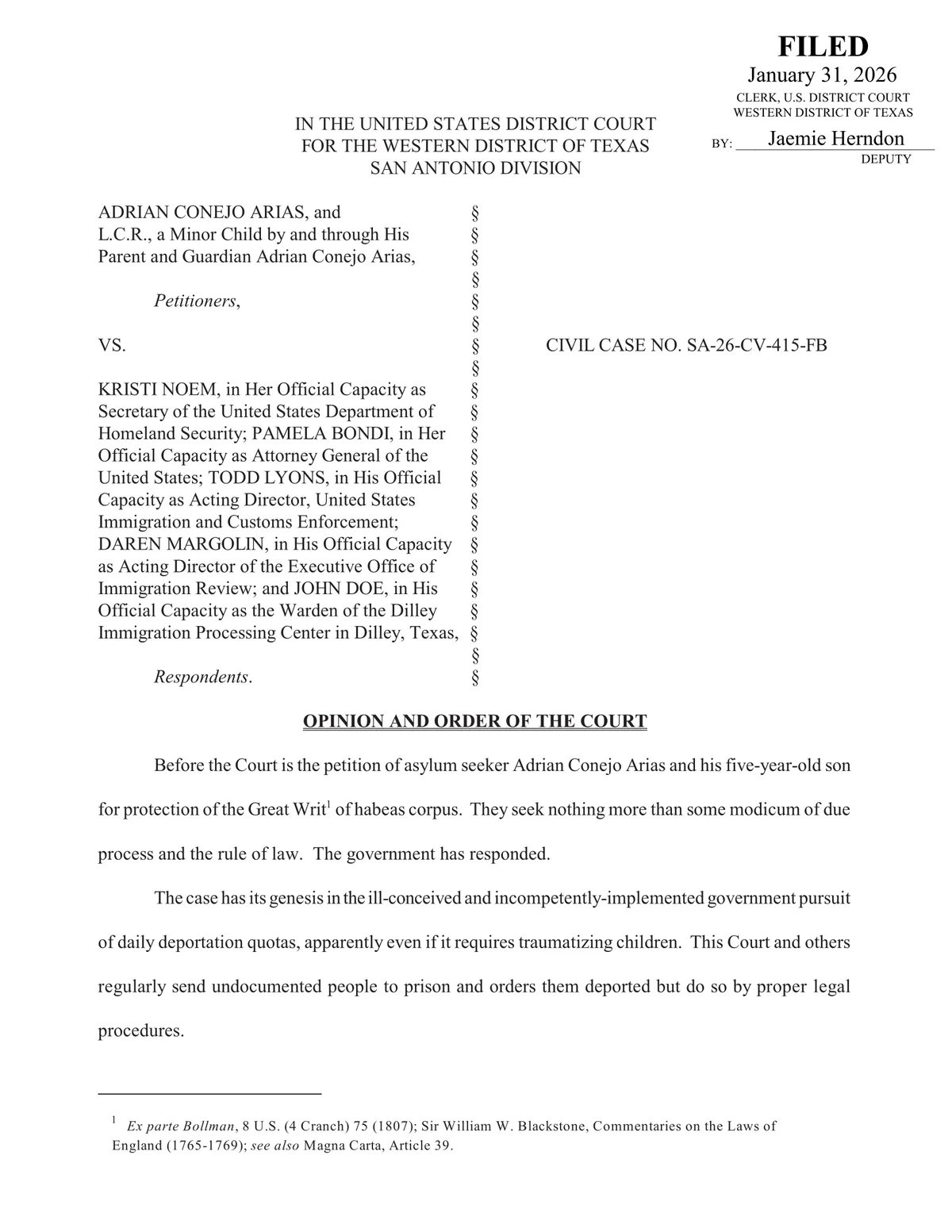
Legal orders free people all the time. Poems move people all the time. Judge Fred Biery’s habeas corpus ruling freeing 5-year-old Liam Conejo Ramos and his father fused the two.

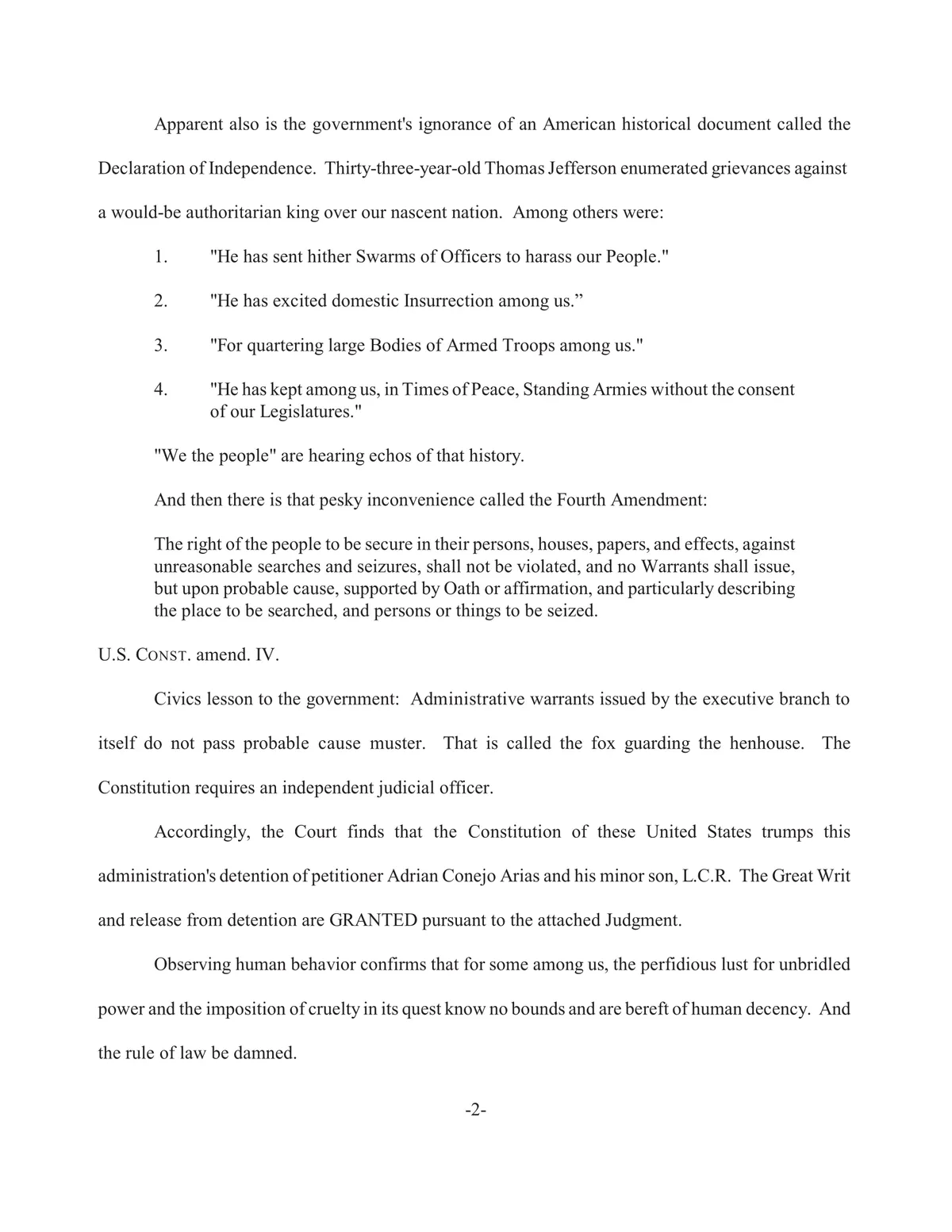
His poem is the operative legal instrument. The literary choices aren’t ornamental; they’re structural to the argument. His use of lowercase “trumps,” the Declaration quotes, the Franklin exchange, the biblical citations all do legal work and poetic work simultaneously.

Most judicial writing that gets called “literary” is literary in addition to being legally operative. Biery’s opinion is literary as the method of being legally operative. The craft is the argument. Strip the allusions and wordplay and you don’t just lose style, because you lose the constitutional reasoning.

His point is that the entire weight of Anglo-American legal and moral tradition stands against what the administration did.

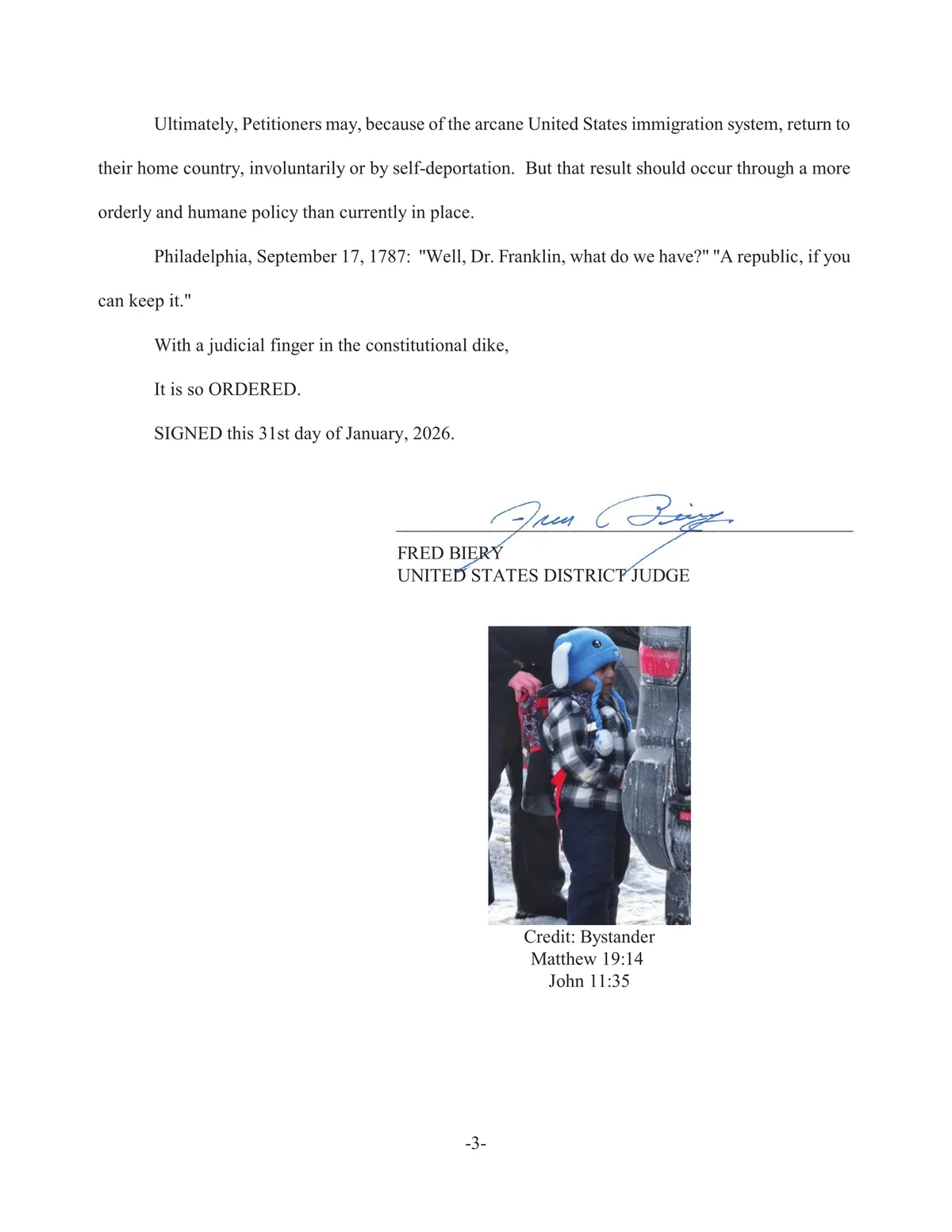
The ending, attaching the photo of Liam in his bunny hat, then the two scripture citations without quoting them, forces you to look them up or already know them. That’s a poet’s move. It trusts silence more than language. I get in trouble for it all the time on this blog and I feel a million times better seeing it in practice like this.

After 500 words of controlled fury, he lets “Jesus wept” do what no further argument could.

In a system increasingly governed by brute executive force, it took a 500-word poem by an 80-year-old judge to do what the entire institutional apparatus of American democracy couldn’t.

Boredom is the Cure for AI

A new AI “harms” article from Harvard basically proves a simple equation. Boredom is a signal to stop, and stopping is what lets you recover. Even more to the point, boredom is what makes us happy, like saying a vacation on a beach with nothing to do is a great way to become more productive again.

AI Doesn’t Reduce Work—It Intensifies It

AI eliminates the friction that used to trigger that signal. No large blank page, no unknown starting point, no waiting. Every moment is being curated by an army of “attention seeking” engineers to get you to sit longer and “just send one more prompt.” The stimulation never breaks long enough for boredom that would allow you to recover and regain happiness.

What’s particularly sharp in the article findings is the mechanism of denying happiness by replacing it with simulation. A chat doesn’t feel like work, yet it drains people as much if not more than work. Prompting feels like chatting, with someone who drains you. You end up training the thing that was supposed to show up trained. So the usual internal alarms like “I’m overworked, I should stop” somehow never fire. You’re wasted by the labor, but also you’re wasted by the absence of boredom. The recovery periods just evaporate.

The “AI practice” recommendations at the conclusion feel forced and formulaic. They read like telling someone to schedule boredom, which ends up being a contradiction that tells you how deep the problem goes. You can’t intentionally recreate the thing that only works when it happens unintentionally. I mean you could force people to take mandatory leave, but you aren’t achieving the purest form of boredom where it just shows up because there’s a natural barrier instead of a compliant one.

“Protected intervals to assess alignment” is corporate for “stare out the window for five minutes,” except now you’ve turned staring out the window into a compliance task to stress about. And if you get into a chat about when and how best to stare out the window… that’s the cycle.

Epstein’s Files Burn Elite School Faculty

The Epstein files keep landing at elite universities, and the pattern is so consistent it’s raising the story to national security levels.

How many kids going to college are exploited into a human trafficking system of powerful men running these institutions?

At Yale, computer science professor David Gelernter appears 563 times in the files. For example, he emailed Epstein in 2011 recommending a student for a job. He described her as a “v small goodlooking blonde.” This was three years after Epstein’s conviction for soliciting prostitution from a minor. When caught, Gelernter told the dean he was just keeping “the potential boss’s habits in mind” since Epstein was “obsessed with girls” like “every other unmarried billionaire in Manhattan; in fact, like every other heterosex male.”

Yale has barred him from teaching pending review.

At Duke, the world’s most famous researcher on dishonesty, already credibly accused of falsifying data in a study about honesty — appears 636 times. Behavioral economics professor Dan Ariely met Epstein at least seven times between 2010 and 2016. In one email he asked Epstein for the name and contact of a “redhead” who “seemed very very smart,” signing it “Honestly* yours, Dan.”

Duke shuttered his Center for Advanced Hindsight one week after the files dropped and claimed the timing was coincidental.

At Harvard, former president Larry Summers, the former Treasury Secretary and recent OpenAI board member, asked Epstein for advice on pursuing a romantic relationship with a woman he called a mentee. Epstein called himself Summers’ “pretty good wing man.” Summers’ strategy, laid out in emails to a convicted sex trafficker: make the woman conclude “she can’t have it without romance / sex.” He corresponded with Epstein until the day before Epstein’s 2019 arrest.

Harvard “opened an investigation.”

This is just three universities.

This is just three professors.

So far.

The same mechanism shows up every time: powerful men in hierarchical institutions treat young girls in their care instead as their currency in transactions with a convicted sex offender. Institutional language is leaned on to minimize it when emails expose them.

  • Gelernter says gentlemen don’t read each other’s mail.
  • Ariely says the contact was “infrequent, largely logistical.”
  • Summers says he’s “deeply ashamed” while Harvard investigates whether shame is sufficient.

.
Why did these universities respond identically? Reviews. Statements. Passive constructions. Yale “does not condone the action taken by the professor.” Well, that’s about a minimal as you can get. Duke’s center closure was “finalized in December.” Good. Harvard? Come on Harvard.

None of them rise to the level of admitting a convicted sex offender had years-long access, via their faculty, to harm students. They’re investigating the embarrassment to protect their reputation, not the evidence of a human trafficking pipeline.

Epstein stands out less as the one man causing the corruption of these institutions and more as the kind of man they invited because he wasn’t supposed to be caught. He recognized what was there, with the help of foreign intelligence, and preyed on older men who held authority over vulnerable young girls (and boys?).

I’m reminded of American universities who were “endowed” by South African apartheid, or the Vietnam War. The funding model apparently tries to ignore where the money comes from, so Epstein was welcomed to plug himself in to harm children.

The United States is the only country in the world refusing to sign the Convention on the Rights of the Child. Think about that. The ONLY country that won’t protect children. The Epstein files now are required reading for parents around the world, because they show the reason.