Category Archives: Security

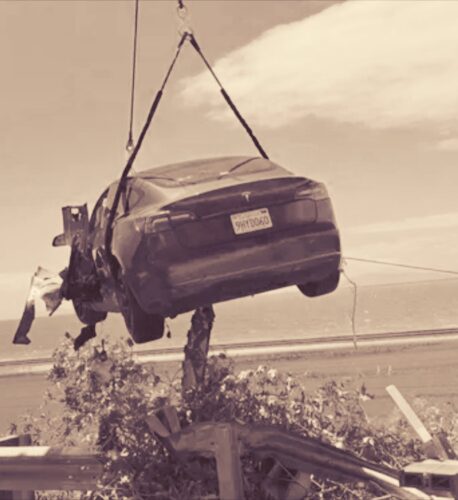
CA Tesla Kills One in “Veered” Crash Off Highway

A Tesla on Highway 101 veered across lanes, through a guardrail, and killed the occupant. Source: CHP
The facts reported from this crash so far point to a sleeping young driver, fatally allowing “driverless” to veer off a major Highway.

An 18-year-old driver from Thousand Oaks died in a crash on southbound Highway 101 outside Ventura April 26.

The California Highway Patrol said it responded to reports of a car going off the roadway south of Seacliff shortly before 9 a.m. Officers said they found a gray Tesla car on the right shoulder with an unresponsive driver, CHP officials said in a news release.

In its preliminary investigation, the CHP said the driver apparently let the car drift to the right where it struck a metal guardrail and went over the side of the highway. The driver suffered major injuries and was pronounced dead at the scene, CHP said.

Officer Christian Givens said April 27 that the driver veered from the No. 1 lane in the center of the highway all the way to the right.

Notably, this reads to me as a physical guardrail failed to stop AI from killing a human.

SC Tesla Kills One in “Veered” Crash Into Pole

Tesla is a decade into their promise to deliver driverless as a safety device, and yet it still seems to increase the chances of a sudden unexplained death.

One person is dead after a crash in Colleton County Saturday night.

The South Carolina Highway Patrol said the crash happened just before 11:30 p.m. on Highway 21 near Fireman Lane.

The driver of a 2026 Tesla sedan was going south on Highway 21 when they drove off the right side of the road, according to Cpl Nick Pye. The driver then hit a curb, a utility pole and a fence before the car overturned.

A decade of deaths just like this and no resolution in sight? A 2026 model? Tesla has only just begun to admit their hardware design was also flawed from the start, beyond recurring obvious deadly software failures.

There are millions of Tesla vehicles on the road today which were sold on the promise of full autonomy, but without hardware capable of doing so.

Incapable. Read that as a death-wish to those who believed the lies. The fact that 2026 models still exhibit the “veered” death pattern, suggests the big upgrade effort still won’t achieve the most basic expected capabilities.

NYT Launders Cohere in Fake-Sovereign AI Feel-Good PR

Disclaimer, I’m not a fan of anything Fei-Fei Li has ever done, especially when she started claiming nobody had ever heard of ethics before she discovered it in 2017.

Fun history fact, the 1950s invention of modern AI included serious concerns about ethics, doubled-down in the 1960s.

Her definition of competition is so unbelievably ruthless, yet she never gets called out for what it really is and does. Stanford launched the Human-Centered AI Institute in 2019 with Li as co-director, and pitched as if ethics in AI suddenly were their invention alone. Erasure much? That slap in the face was directed at Timnit Gebru, Joy Buolamwini, Safiya Noble, Ruha Benjamin, and Kate Crawford to begin with. Targeted erasure of the Black women and critical scholars who built the field, was repackaged by Li as Stanford thought leadership.

This is the same woman who thought she should build the foundational dataset of modern AI as an exploitation pipeline. It was an undeniably toxic, inhumane shift that she has never seriously reckoned with or been held accountable for. By her own admission on video, a Princeton colleague told her the labor practices were unethical, so she left for Stanford, an ethics desert.

Her whole dataset concept to “prove” deep learning was built with invisible piecework labor, later found to contain racist and pornographic categories. These finally were force-scrubbed in 2019, just as she appointed herself the first person to ever think of AI ethics.

Can’t accuse her of being unethical, apparently, because in her mind ethics didn’t exist before she came up with it. And at that point she defines it and serves as the judge. Talk about capture.

And then what did she do with her capture of ethics? She used her Stanford power, even becoming a Chief Scientist at Google Cloud, to launder AI use by the Pentagon. Internal emails surfaced of Google being advised to “avoid at ALL COSTS any mention or implication of AI” in Maven communications. Imagine that, Pentagon AI work squeezed past public scrutiny like some kind of amnesia.

AlexNet/ImageNet 2012 gross ethical violations were the moment AI capability went vertical and the labor pipeline that built it was already obscured, so the whole Maven obfuscation scandal reads to me like the same playbook at Pentagon levels of wrong.

So classify me not impressed when I saw the NYT pushing PR about her as one of the three high-profile American AI celebrities and NVidia backing a “non-American” AI contender Cohere merging with Aleph Alpha.

Cohere builds technology that other businesses can use to deploy chatbots, search engines and other A.I.-driven products. Founded in Toronto, it was seen as one of the few companies with the technology to challenge what was being built by OpenAI and others in Silicon Valley. Its backers included the well-known A.I. researchers Geoffrey Hinton, Fei-Fei Li and Pieter Abbeel.

Here we go again with the disinformation.

The real story here is Germany just tainted its independence, afraid of going it alone. The article positions Germans seeking a “sovereign alternative” to American AI dominance by linking up directly with these three rather American-anchored personalities.

  1. Fei-Fei Li is Stanford, Google Cloud, AI4ALL, World Labs.
  2. Geoffrey Hinton is University of Toronto and ex-Google.
  3. Pieter Abbeel ist Berkeley and Covariant.

Show me an actual independent, non-American, influencer or leader in the list, please. And tell me why this time Li won’t spoil the whole thing as she always does. I see three American-affiliated researchers underwriting the credibility of a non-American sovereignty play.

Let me explain even deeper what’s going on. Hinton spent over a decade at Google Brain (2013-2023), co-founded DNNresearch which Google acquired, and his Toronto affiliation runs through the Vector Institute, which itself takes substantial funding from US tech. So, is that actually being Canadian? Is Cohere hoping for an American-investor-led Google acquisition next?

Nvidia is then the full contradiction laid bare. A US chip maker funding the alternative-to-American-AI company? I see Schwarz Group add 600M, but that’s money now flowing away from the EU. The “sovereign” pitch holds only if you define sovereignty as data residency and procurement preference rather than capital stack or supply chain. US silicon is US, with far too much gravity from the Google pipeline (Stanford and Berkeley).

Aleph Alpha was Germany’s actual sovereign play. A Heidelberg pitch was explicit on European data sovereignty. This merger sounds like Germany conceding that the independent path had struggled to an uncomfortable degree for investors.

Governments announcing sovereignty should mean something real, instead of just a sucking sound of non-US investors backing US-adjacent AI infrastructure.

Another sad chapter in the Fei-Fei Li disinformation games.
Israeli Acoustic Surveillance Drones Deliver Targeted Water to the Thirsty

You may recall in 2023 a paper in Cell from the Hadany and Yovel labs at Tel Aviv University showed that drought-stressed tomato and tobacco plants emit ultrasonic clicks.

Who grows tobacco? Nevermind.

The sound is mechanical, from cavitation in the xylem. Air bubbles form as water columns break under tension from drying out and the collapse radiates a click into the air (20 to 100 kHz). It’s like anything drying out and cracking audibly, which becomes a signal.

A follow-up, released January 5, 2026 by Seltzer and colleagues from the same labs, asked if drying is audible then what might process the signal. Their answer is female moths.

Given a choice of where to lay eggs, moths avoid plants emitting clicks of drying and prefer the silent wet ones (intact water columns). Healthy hosts, healthy larvae. The moth treats acoustic emission of drying plants as an air traffic control signal. Without a plant present, moths preferred the playback side (treating clicks as evidence of plant presence at all). Only with hydrated plants on both sides did a silent plant win.

Of course, popular framing in 2023 was that plants scream. I mean, it’s hard not to want to believe, to see a face, hear a voice. Stare into the tomatoes long enough and you become one with the ketchup.

The authors did not speak about any speech of plants, and their report does not support it. There is no nervous system or nociceptor, let alone a pathway that evolved for signal transmission. The noise of cavitation is a physical consequence of negative pressure in a drying vascular system.

A drying plant cannot stop producing dryness sounds any more than cracking paint can stop looking like it’s cracked.

The moth study is interesting because it raises an ultrasonic adaptation to signals. Information considered hidden to humans can be extracted by anything with the receiver bandwidth to extract it. Moths already operated in ultrasonic because bats hunt them. Turns out their safety auditory hardware wasn’t just for defense, it also has a plant hydration offense as well.

We’re talking about Israel here, so it’s worth noting Tel Aviv University’s Ramot was granted US Patent 12,480,915 in November 2025 covering airborne acoustic plant monitoring across hydration, structural integrity, pathogen load, herbivore damage, and fruit density, including ground and aerial platforms. You can read that as a drone passing over a field listening for cavitation is a viable irrigation tool.

The farmer can automate the surveillance of thirsty tomatoes now just like a moth finds optimal hosts. I suspect the farmer also can broadcast signals of drying to keep moths away from wet ones, directing flight towards capture.

Given these developments have evolved since 2023 I find myself asking today why Israel tracks down innocent children with drones, keying on sophisticated (optical, thermal, and ML-based pattern recognition) signals, and shoots them in the back or head instead of detecting their thirst and offering them a drink of water.

Seems like we often talk about dual use military application of civilian tech in the exact wrong direction.

Come on Tel Aviv University. You know what to do.