A nicely written summary of the attack on Fort Sumter can be found on the Smithsonian’s page called “The Civil War Begins”
In December 1860, a little more than a month after Lincoln’s election, South Carolina’s secession convention, held in Charleston, called on the South to join “a great Slaveholding Confederacy, stretching its arms over a territory larger than any power in Europe possesses.” […] According to historian Douglas R. Egerton, author of Year of Meteors: Stephen Douglas, Abraham Lincoln, and the Election that Brought on the Civil War, “To win over the yeoman farmers—who would wind up doing nearly all the fighting—the Fire-eaters relentlessly played on race, warning them that, unless they supported secession, within ten years or less their children would be the slaves of Negroes.” […] Militiamen itching for a fight flooded into Charleston from the surrounding countryside. There would soon be more than 3,000 of them facing Fort Sumter, commanded by the preening and punctilious Pierre Gustave Toutant Beauregard, who had resigned his position as West Point’s superintendent to offer his services to the Confederacy.
This explanation of the war-mongering blood-thirsty slaveholders contrasts heavily with the description of calm and professional soldiers finding themselves surrounded by hostile enemies of America.
With communications from his superiors reaching him only sporadically, Anderson was entrusted with heavy responsibilities. Although Kentucky born and bred, his loyalty to the Union was unshakeable. In the months to come, his second-in-command, Capt. Abner Doubleday—a New York abolitionist, and the man who was long credited, incorrectly, with inventing baseball—would express frustration at Anderson’s “inaction.” “I have no doubt he thought he was rendering a real service to the country,” Doubleday later wrote. “He knew the first shot fired by us would light the flames of a civil war that would convulse the world, and tried to put off the evil day as long as possible. Yet a better analysis of the situation might have taught him that the contest had already commenced and could no longer be avoided.” But Anderson was a good choice for the role that befell him. “He was both a seasoned soldier and a diplomat,” says Hatcher. “He would do just about anything he could to avoid war. He showed tremendous restraint.”
After some negotiation and brinkmanship, the Confederates fail patience and begin the Civil War with America.
In the early hours of April 12, approximately nine hours after the Confederates had first asked Anderson to evacuate Fort Sumter, the envoys were again rowed [by their slaves] out to the garrison. They made an offer: if Anderson would state when he and his men intended to quit the fort, the Confederates would hold their fire. Anderson called a council of his officers: How long could they hold out? Five days at most, he was told, which meant three days with virtually no food. Although the men had managed to mount about 45 cannon, in addition to the original 15, not all of those could be trained on Confederate positions. Even so, every man at the table voted to reject immediate surrender to the Confederates.
The pride of these Americans surrounded and heavily outnumbered and outgunned, refusing to surrender, enraged the Confederates who responded by announcing they soon would begin war. Aiming for the American flag they managed to knock it down only to find it would be raised again, as the Americans defended their country valiantly for days.
Update April 13 (one day later!): LinkedIn has investigated and restored my post! Many thanks to the various teams working together to resolve this. They have explained a cascade of issues that caused the deletions and have been working on fixing things. I will share more details as soon as authorized.
One of my most popular posts on LinkedIn was about the logical fallacies, as well as some history, of Virginia Police. LinkedIn gave me an award for it…
Then the post was deleted, as well as all my comments on other posts about the Virginia Police. I had at least a dozen comments on this thread, for example.
All of my words gone without any notice or explanation.
My first sign someone was censoring me was traffic drop across posts, any post really. Flow suddenly went from thousands to just a few.
On a normal day I will see a post hit a couple thousand views. Suddenly, my posts had 10 views, or 7 views.
It’s a sure sign LinkedIn has a human poking around in your profile and timeline, reviewing posts, when traffic drops dramatically without any reason or notice. 7 views? I knew something was wrong.
My second sign was that I was given an award by LinkedIn and when I went to look at the post they awarded it was… deleted.
How nice of LinkedIn to notify me to go take a look at my post that nobody can look at because they erased it, while giving me a medal for the thing they destroyed.
I wasn’t saying anything shocking, mind you, just pointing out the basic logical fallacies.
And now here was my LinkedIn post in its entirety:
police can’t logically complain both windows are too dark and that the car was evading them to park in the most well-lit area. this is double-speak.
“ride the lightning” is not just police reference to execution by electric chair, it’s KKK term for lynching. it comes from 1915 claims president wilson called KKK “lightning” — more lynchings occurred under wilson in 1915 than in the previous decade.
police falsely try to excuse their violence on their target being reluctant to exit vehicle, while telling their target he should be afraid to get out. this is double-speak.
That’s it. And LinkedIn deleted that.
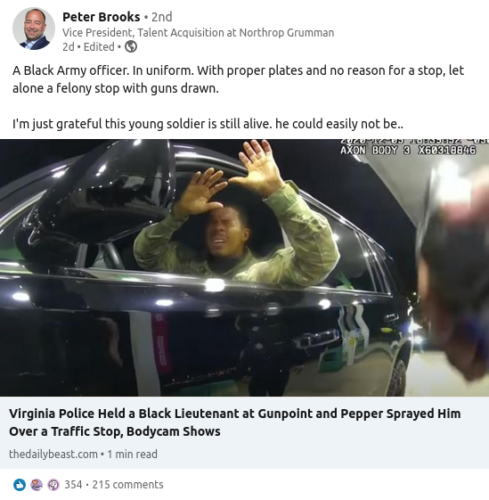
The police in this “traffic stop” clearly were speaking the language and using the basic procedures of a lynching.
No matter what their target said or did, he was judged wrong by them in order to intentionally escalate the situation into killing him.
The fact he survived is perhaps due to his professional military training that kept him calm and compliant in very logical fashion. It was clear to me (and others) he kept his hands out of the window even when he was told to reach inside and unbuckle, because to reach inside to the hip could mean he would be shot instantly on suspicion of having a weapon.
I’m not saying service members should get special treatment from law enforcement but usually there is a level of mutual respect and that clearly wasn’t the case here. I saw a soldier who despite being pepper sprayed had the sense of awareness to keep his hands up despite everything else. He didn’t want to reach down for anything.
Usually we have to assume it is only the police who are being trained and paid to know how to deescalate a situation. Here you can see how the police flagrantly escalate instead, violating simple principles. It is clear the target of police was in fact the one acting far more professionally (also having been trained and paid to remain calm and deescalate).
Sgt. Maj. of the Army Michael Grinston tweeted this:
He represented himself and our Army well through his calm, professional response to the situation – I’m very proud of him.
Agreed. Pepper sprayed in the face, violently hit from behind, the whole time keeping his calm and professional stance against these coordinated attackers using terror and incitement tactics.
Also I have to point out that a LinkedIn profile, which claims to be a US Army veteran from Colorado Springs (I’ll hide his identity here), was quickly spreading comments everywhere to discredit the victim of Virginia police.
The themes of this profile all were classic KKK talking points.
First, he used the false argument George Floyd committed suicide. The absurd theory is that police didn’t kill Floyd, he is the one who put himself into a situation that killed himself from police negligence. It’s clearly false but the KKK will try to argue black people are somehow not healthy enough to survive police abuse.
Second, he used the false argument that lawsuits are lucrative and bring payouts, thus black men are getting themselves lynched because they are greedy. Again it’s clearly false but the KKK will try to jump from saying black people won a case of injustice to therefore police and taxpayers are being harmed by having to pay damages when black people die.
Again these first two are the classic talking points of the KKK. They are parroting a simple fraud that blacks deserve to die at the hands of police officers no matter what because of being black, while substituting some other word and state of being for the word black.
Third, this US Army veteran kept saying that there was scant evidence and too little information to rush to judgment on the police actions yet he firmly believed the target of police was fully in the wrong and needed to be immediately kicked out of the military. He even slipped as used the phrase “I hope they are not attempting to hang the success of their case” in his comments.
All of these fraudulent talking points historically are used in the language of a lynching, which is why the police saying “ride the lightning” is particularly important reference.
Nothing about this “traffic stop” justified such gross excessive violence, and to even trained law enforcement it comes across as bizarrely unnecessary and strange escalation.
We have to shift frame to history, especially history of Virginia, and think instead of an attempted lynching. Then all of the steps fit right into place.
In fact, to be accurate, more black people are killed by police than were lynched during Jim Crow. Police in America kill on average 3 citizens every day.
The Town of Windsor prides itself in its small-town charm and the community-wide respect of its Police Department.
This town says it prides itself in respect of its Police Department? That’s their big public reaction? Wait, there’s more.
The Town of Windsor prides itself in its small-town charm and the community-wide respect of its Police Department. Due to this, we are saddened for events like this to cast our community in a negative light.
They are sad that their community is cast in a negative light.
Let’s review. An American is pepper-sprayed and beaten at gunpoint for committing no crimes other than a Jim Crow-era dog whistle crime of needing to show police “respect”. Then the town reacts to video saying yeah we are proud of people who respect the police. And they’re sad that people see attempting lynchings in a “negative light”. Think of the positives!
This was an attempted lynching and it was very clear police were escalating violence to force a black man show them “respect” or be killed by the “lightning”.
I mean a town that publishes an official “prides itself” and “respect of police” letter in reaction to an attempting lynching, really doesn’t bode well for any kind of meaningful justice or reform.
Or maybe we can put this another way, once again using their own words and actions as evidence?
In 2002 the Town of Windsor created a new emblem for its centennial. In the 100 years since 1902, this town decided to highlight… wait for it…
The centennial emblem, which was designed in 2002 for the centennial by the then town manager Kurt Falkenstein represents 100 years of Windsor History. […] Men of Windsor Station answered their call to serve the Confederacy, and the Isle of Wight Rifle Grays (symbolized by the crossed rifles) were drilling and registered in 1860. This unit, under command of Captain Watkins, served with Company D 16th Virginia Regiment. The 16th Regiment served in many major battles and was with General Lee at the surrender at Appomattox.
That’s right! To commemorate the time since 1902 the town of Windsor in 2002 added a pair of guns from the 1860 pro-slavery forces to their official emblem.Windsor town seal in 2002 added a pair of 1860 Confederate pro-slavery guns to its official seal as a “commemoration” for 1902. Figure that one out.
Maybe in 2022 we can look forward to the Town of Windsor adding another pair of guns to their emblem to celebrate the positive aspects of an attempted lynching? I mean they definitely didn’t think it would cast a negative light to have guns from 1860. We know it won’t show up on LinkedIn though.
Also it’s well-known that white nationalist groups try to promote the idea that killing people with cars has a higher chance of avoiding conviction (not to mention “kill bill” laws around America that criminalize pedestrians and allow drivers to hit them without consequence).
Tweets since 2016 have literally said “run them over you won’t be convicted” (murder blacks) as a response to people being in the streets to protest deaths of blacks.
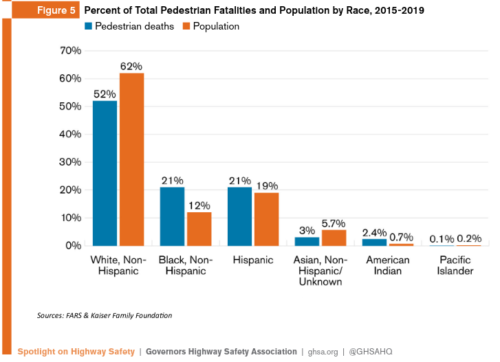
New data from the Governor’s Highway Safety Association in their preliminary 2020 report shows that black pedestrians in America are indeed being killed by cars at very alarming rates compared with whites.
This data brings to mind Henry Wallace (Roosevelt’s Vice President from 1941 to 1945) who wrote a powerful letter in April 1944:
If we define an American fascist as one who in case of conflict puts money and power ahead of human beings, then there are undoubtedly several million fascists in the United States.
Travis Kalanick who saw taxicab drivers not as solid middle class citizens, like many of us mistakenly did, but as a cabal of overpaid, rent-seeking obstacles.
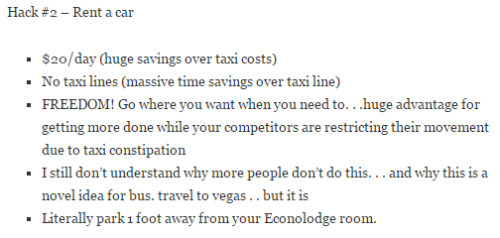
Kalanick himself said he was standing in line in Las Vegas and wondering why he didn’t have an inexpensive driver that would shuttle him from his cheap hotel so he could drink excessively on the strip and at parties he was crashing. His whole fratbro vision was how to recreate his mom driving him everywhere forever. None of that had anything to do with taxis really, which he didn’t think about or understand at all except to complain about waiting for them and compare it to his bowel movements.
And this is false history too:
…skinny nerdy guy who just wanted to sell us books over the computer…
That is not how to describe Bezos who himself said he wanted to corner book markets using unregulated tech because he was losing in a competition with Bernie Madoff to be the worst human.
But perhaps worst of all, the article willingly weaves an Emerson quote into a profile without any context. Thiel quotes Emerson deliberately and for a reason, not as some random thing.
Emerson is well known among white nationalists as their guy. You want to get real about Thiel, admit his thirst for power ties directly to history of white nationalist aspirations.
These men are privileged white men who enter tech to maintain and expand their privilege. This has nothing to do with Silicon Valley (Bezos isn’t even in Califorina, duh) and everything to do with history of colonization.
The men of Silicon Valley like to pose as more empathetic, philosophical and righteous than their brothers on Wall Street. But society will no doubt look back on the ascendancy of fratbro tech and see the same arrogance, perversion and disregard for human life.
Is there a difference in suicides and workers conditions at Foxconn and Uber drivers complaining they can’t make a living wage? It’s hard to argue on a human level.
Once we get the history right, such as Stanford’s legacy being genocide, stories like this one become easy to predict:
Verkada isn’t the only Silicon Valley startup in which employees — often young, single and flush with cash — have engaged in questionable behavior, including sexual misconduct and substance abuse. But Verkada sells security cameras that peer into offices, factory floors, intensive care units and other sensitive areas — the kind of product that demands professionalism and discretion.
Based in San Mateo, Verkada was founded in 2016 by three computer science graduates from Stanford University…
a blog about the poetry of information security, since 1995