People arguing that Facebook has a point (in suing Apple) are just more evidence of the problem in America. It’s like someone at Facebook packaged logical fallacies into bright colored candy and we all know how Americans do love their sugar.
Stop saying slippery slope. it’s a fallacy
Stop using tu quoque. it’s a fallacy
Stop the no true Scotsman. it’s a fallacy
A genocidal anti-democratic digital slavery plantation of Facebook that regularly peddles lies to escape regulation, is NOT directly comparable to any company that wants your business a little too much.
These are two very very very different companies. I have bashed on Apple flaws and crimes for over a decade now (don’t own a single product) but there is no way in hell I would distract attention to them from Facebook. It’s like saying General Lee might be the worst man on the planet (terrible general, terrible human who enslaves people) but have you looked at whether a company selling guns to the Union army is too dominant?
Come on. Americans need to get a clue here.
(And if in any logical debate you bring up “pigs love mud” I’m going to have to point you to classes on selective hearing flaws and why that phrase means the opposite of what you think).
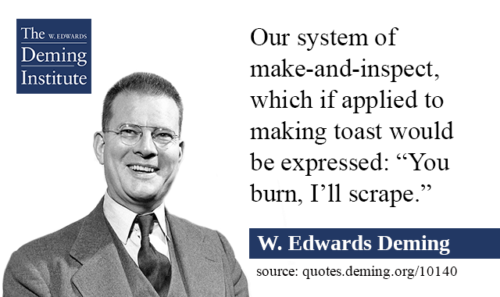
Deming, a pioneer of Shewart methods, sat on the Emergency Technical Committee during WWII that compiled American War Standards and taught statistical process control techniques during wartime production to eliminate defects.
People in information security circles tend to focus on the SolarWinds breach in a bubble, despite a far larger system integrity issue at hand in America.
To paraphrase Deming’s “toast” analogy, US Police and Military have been for a long time been made wrong in ways that don’t just “scrape” off after society is burned.
As the Chairman of the US government Civil Rights and Civil Liberties Subcommittee published recently:
Chairman Raskin released an unredacted version of a 2006 Intelligence Assessment by the Federal Bureau of Investigations (FBI) entitled, “White Supremacist Infiltration of Law Enforcement.” Previously redacted portions of the document, made public for the first time today, reveal startlingly prescient FBI warnings including: “white supremacist infiltration of law enforcement can result in other abuses of authority and passive tolerance of racism within communities served.”
The government itself has been harboring anti-American domestic white nationalist terrorists for decades, at the same time making it a crime to be black — as Nixon’s infamously racist and fraudulent “War on Drugs” was explained in 1994 by his man Ehrlichman.
We knew we couldn’t make it illegal to be either against the war or black, but by getting the public to associate the hippies with marijuana and blacks with heroin, and then criminalizing both heavily, we could disrupt those communities. We could arrest their leaders, raid their homes, break up their meetings, and vilify them night after night on the evening news. Did we know we were lying about the drugs? Of course we did.”
Blacks and whites in America were quantitatively using drugs at the same rates, yet blacks were put in jail at 3X the rate of whites.
Police notoriously focus militarized “drug searches” on disadvantaged black neighborhoods (geographic areas in America since the 1930s intentionally denied credit, loans and investments).
To put it another way, the city is 9% black yet 27% of people being searched are black; the city is 28% white, yet 18% of those being searched are white.
The resulting intentional race-based prison system of America is sometimes said to rank as worst in the world, not even exaggerating the data:
Human Rights Watch asked “How Different are US Prisons” given that federal judges have called them a “culture of sadistic and malicious violence”. Someone even wrote a post claiming half of the world’s worst prisons are in the US (again, North Korea is not listed). And new studies tell us American county jails are run as debtor prisons; full of people guilty of very minor crimes yet kept behind bars by court-created debt.
I mean talk about having root access and compiling evil binaries, or forcing corruption into supply-chain dependencies… if America were a computer operating system you wouldn’t be wrong to say it seems overdue for a fundamental integrity assessment.
Here are some sobering thoughts that should clarify, from The Century Foundation:
Quantifying the scope of infiltration and the threat it poses remains an urgent priority. However, currently, it is impossible to accurately gauge the scope of white supremacist infiltration, in large part due to government obstruction of such efforts, including the Pentagon’s refusal to grant interviews to investigative journalists or share data on personnel flagged for ties to white supremacy, as well as lack of responsiveness to watchdog groups’ calls to investigate suspected threats. Further complicating efforts to assess severity, the Pentagon lacks a centralized mechanism for tracking and reporting identified cases. Strong indicators, however, point to a pervasive problem with white supremacist organizational infiltration and ideological sympathies.
Likewise, Military Times gives their take on this well-known national security threat being ignored:
Military Times’ own polling has shown that, anecdotally, more than one-third of active-duty troops, and more than half of minority service members, have witnessed signs of white supremacy in their colleagues. Further, survey respondents ranked white nationalism as a bigger national security threat domestic terror groups affiliated with Islam, for instance.
The harms that armed law enforcement officers affiliated with violent white supremacist and anti-government militia groups can inflict on American society could hardly be overstated. Yet despite the FBI’s acknowledgement of the links between law enforcement and these suspected terrorist groups, the Justice Department has no national strategy designed to identify white supremacist police officers or to protect the safety and civil rights of the communities they patrol.
One of the most popular blog posts I’ve ever written on this site is about the Aesopian language found in Nazism, which has allowed terrorists to infiltrate and organize in America without much resistance.
In that blog post I mention how in the 1970s there was open racism in the Navy and Marines. The US military mostly responded to this by disciplining anyone who pointed it out, protecting or further obfuscating the white supremacists.
…Camp Pendleton in Oceanside, California was a hotbed of KKK activity–an open secret that was tolerated or aided by Marine Corps brass… white marine Klansmen openly distributed racist literature on the base, pasted KKK stickers on barracks doors and hid illicit weapons in their quarters…
A typical story from the 1970s shows how the topic can sometimes be framed into a “race-relations failure” in the military; as if blacks just couldn’t seem to get along with white insecurity cells that kept pushing the blacks around taunting them with discrimination.
What began in the enlisted men’s barbershop at 10 P.M. that Friday ended 56 nights later in the first mass mutiny in the history of the U. S. Navy. Were it not for military law, the incident might be passed off as a demonstration, as the Navy. prefers to interpret it. Indeed, unlike other ships that have had brawls between black and white sailors in recent months—notably the carrier Kitty Hawk—the Constellation managed to avoid a real riot. Nevertheless, the story of the mutiny, as reconstructed from interviews with the crew, presents a case study in the failure of the Navy’s race‐relations programs.
I’m reminded of the incredibly sad court-martial case of a Marine in 2019. Drunk, he kept pushing another around and brandishing a gun with hollow-point rounds until “accidentally” he shot him in the head.
I’m the guy that killed my friend
Can’t call this kind of stupid negligence towards others just a failure in relations programs.
And that reminds me of Marines who literally argued that they were too stupid to realize that buying an “SS” flag from a Nazi memorabilia site meant somehow that they now owned Nazi memorabilia. Really how stupid can one be yet remain authorized to point a gun?
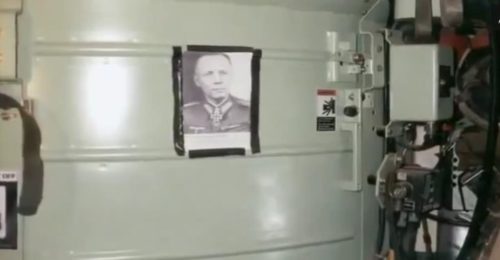
And that reminds me of US Army M2 Bradley staff taping up “Routed Rommel” posters during the first Iraq war, saying Nazis who lost and were forced to commit suicide are an inspiration to them.
Source: Iraq War documentary of US Armor
Speaking of history, I noticed a reference in The Century Foundation article about extremist militants in Utah, where the governor cracked down on white supremacists in the government’s “State Defense Forces” (SDF).
A minute later I found two very insightful explanations of this crackdown.
Utah towards the end of the Reagan administration tackled head on the racist infiltration of military and law enforcement that stemmed from… an intentional program under the Reagan administration, as reported in 1991 news:
“State defense forces” were spawned during the early Reagan years as a backup to the National Guard, which is a backup to the military. […] Three governors have reorganized or shut down their state defense forces when they got out of hand. Utah Gov Norman Bangerter removed all but 31 officers from the Utah State Guard after a probe revealed that the force was peppered with neo-Nazis, felons and mental patients. Some officers reportedly practiced assassination techniques, held desert commando exercises with live ammunition and outfitted one vehicle as a police car.
Here’s an even more detailed version of the same story from a book called “The American Home Guard“.
[Connolly] feared the SDFs to be a holdover from the Reagan years, when Attorney General Ed Meese and the Department of Defense quietly began to put pressure on state governments to create forces that would one day crush dissent on the streets of America. …these groups, which [Anderson] believed had ‘attracted some Rambo wannabees, neo-Nazis, and frustrated weekend warriors.’ still had supporters in Congress, specifically Rep Floyd Spence (R-SC) and Senator Thurmond, who had backed federal legislation to allow these ‘forces without a function’ to use federal military training facilities and be armed with leftover federal weapons.
Spence and Thurmond were supporting Nazis operating “crush dissent” militias who practiced assassination techniques to prepare to kill American politicians… let that sink in.
But wait it gets worse. These “crush dissent” militias were setup in 1986 as a reaction to anti-racism in a SPLC Intelligence report. The militias ostensibly became an intentional gathering for military personnel dismissed due ot association with hate groups and refusing to reject them.
In 1986, the Southern Poverty Law Center (SPLC, publisher of the Intelligence Report), wrote to Defense Secretary Caspar Weinberger to turn over evidence that active-duty Marines stationed at Camp Lejeune in North Carolina were providing equipment and paramilitary training to a violent Ku Klux Klan group known as the White Patriot Party.
Weinberger responded by issuing a directive stating that military personnel must “reject participation in white supremacy, neo-Nazi and other such groups which espouse or attempt to create overt discrimination.”
But many military commanders interpreted the rule as prohibiting only egregious forms of hate group activity, not mere membership or activities like distributing racist literature.
Sorry, really that means if military personnel “participated” they were in trouble, but if they belonged to the KKK and helped spread hate then somehow that was a loophole.
It seems from all this that infiltration won’t end before white supremacists are removed from the offices of power that have actively blocked removal of terrorists from law enforcement and the military.
Historical data from outside the government has suggested a correlation between military experience and right-wing terrorism. An academic analysis published in 2011 by the Justice Department’s Terrorism Research and Analysis Project found that right-wing terrorists have been significantly more likely to have military experience than other terrorists indicted in U.S. courts. They were also more than twice as likely to assume a leadership role in right-wing groups. One reason for the military’s limited understanding of the problem is that current rules permit troops to join extremist organizations, so long as they don’t become “active” members who fundraise, recruit or take part in other prohibited activities. While the distinction is rooted in troops’ First Amendment rights, it means supporters of extremist causes can go undetected.
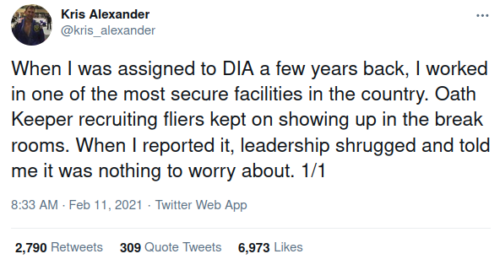
[US Veteran] held a top-secret security clearance since 1979, which required multiple special background investigations, according to Plofchan. Caldwell also ran a consulting firm that did classified work for the U.S. government, the lawyer said.
“He has been vetted and found numerous times as a person worthy of the trust and confidence of the United States government, as indicated by granting him Top Secret clearances,” Plofchan wrote. […]
Caldwell is one of three people authorities have described as Oath Keepers who were charged last month with conspiracy and accused of plotting the attack on the Capitol in advance. He has been locked up since his arrest at his home in Berryville, Virginia, on Jan. 19.
Update Feb 11, 2021: Mike Flynn exposed by his staff as an alleged member of Oath Keepers
History really does repeat. Just this week a story broke of a man arrested near San Francisco who was inspired by “America First” speeches of foreign-backed agents to plot domestic terror attacks.
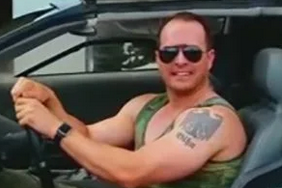
Napa resident Ian Benjamin Rogers, 44, was taken into custody by federal agents earlier this month following a tip that he was in possession of several illegal weapons. As KTVU reported, Napa County sheriff’s deputies served a warrant at Rogers’s business, British Auto Repair of Napa, on January 15, and found a cache of over 50 firearms, including illegal assault rifles and automatic weapons, as well as five homemade pipe bombs, 15,000 rounds of ammunition, and several pounds of gun powder.
For me this is a story straight out of 1916 San Francisco. And I’m sure most people have no idea what I’m talking about because who really studies history anymore?
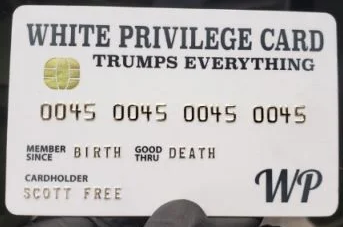
People might be tempted to laugh at the story because it says he was caught with an actual “white privilege card”, but even this is a repeat of American history.
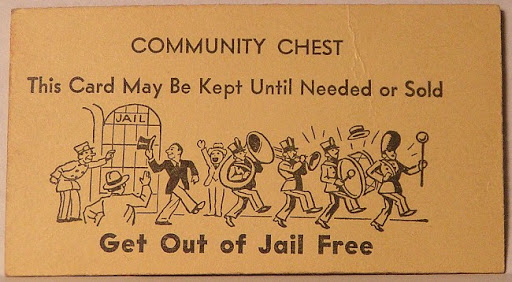
He literally carried a version of prohibition-era get out of jail free “white privilege card” with him.
I refer to it as the racist chapter of history called prohibition because Americans should all know already it was the KKK who pushed a ban on alcohol to criminalize being black, while distributing privilege cards so whites still could drink.
The famous game of Monopoly (driving your neighbors into bankruptcy for fun) even made a snarky representation of this concept in the 1930s:
The ongoing problem with having this kind of historian’s eye also means I can’t avoid noticing the alleged terrorist has a prominent tattoo displayed on Facebook in 2021:
The stamp on his arm is like this postage stamp from 1969 (“zwanzig” means twenty) very publicly explaining such a mark represents the thirty years following 1919 Weimar Germany (e.g. the rise of Nazism).
Someone probably shouldn’t have authorized that “celebratory” stamp set for Germany but such Aesopian language of Nazism serves now to demonstrate how they were afoot then and still today.
The burning question is really does it matter when researchers (such as myself, if you would agree) warn about suspicious data like this and point out who is to blame? An even deeper question is why imposters such as foreign spies and domestic terror cells are accommodated by a Wilson or Trump even when a means to prevent them (protect against American deaths) is easily within reach?
(Hint: politics)
I want to now take the reader back into the first years of WWI before America joined the Allies, when America kept calling itself “neutral” despite Germany violently and relentlessly using terror tactics.
Then I want to review how these same years became the foundation of an “America First” (KKK) platform, where domestic terrorists would relentlessly attack America, under a notoriously racist and anti-democratic President Woodrow Wilson.
Wilson not only failed to react appropriately in 1914 to the situation (he was elected in 1912 with around 40% of the vote and with barely any political experience). When America went to war with Germany in 1917 Wilson already had a direct hand in resurrecting the KKK.
Today we can perhaps even think of that shift as one from foreign to domestic attacks (like from Russians attacking Americans pre-2016 and Trump attacking Americans after).
Did you ever hear in school about this set of events, or just how awful Wilson was? That’s rhetorical. I know you never heard about this in school, yet you should have.
In a nutshell, a foreign country was exploding bombs all over America was described as a “holocaust” from 1914 to 1917 (as I explain below), and then America goes to war with Germans while the KKK expand terror campaigns domestically going forward.
It was a continuation of terror campaigns against Americans sanctioned by the U.S. President himself. Thus a “when will the KKK stop” framing today is a difficult question not just for the last four years, but the last 150.
The milquetoast story usually told in schools about WWI is that America entered in the spring of 1917 related to the sinking of the Lusitania two years earlier (e.g. new threat of unrestricted submarine attacks); or that it was a reaction to a January 1917 Zimmerman Telegram being intercepted (e.g. revealing Germany pressured Mexico to invade northward).
Both of those make a lot of sense for declaring war when you look at the records. Germany was using subs to destroy ships, and Germany was trying to invade America and destroy it.
However, there’s another angle lingering in the archives that seems to get not very much attention, which I hope to clarify here: Germany set out to inflame domestic tensions in America by exposing rifts, that led to many years after WWI of domestic terrorism.
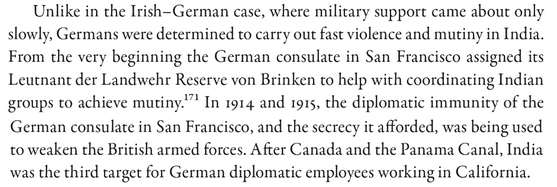
From at least the very beginning of WWI in 1914, if not earlier, Germany had started running clandestine terrorist operations throughout the U.S.. They organized information gathering as well as very violent terrorist activities (widespread mutiny and terrorism was being heavily promoted through German spies operating in America, Caribbean, Canada, and India to undermine Britain’s supply chains and their ability to focus on war with Germany).
Secret Wars and Secret Policies in the Americas, 1842-1929, Friedrich E. Schuler, 2011, Page 139
Some of the terrorism plots against America (very similar to what we hear in the news lately) included bombing downtown San Francisco, bombing the US Capitol, spreading anthrax in NYC and even assassinating J.P. Morgan.
President Wilson’s official War Message to Congress in 1917 only waxes poetic about this angle of… terrorism killing Americans for at least three years.
One of the things that has served to convince us that the Prussian autocracy was not and could never be our friend is that from the very outset of the present war it has filled our unsuspecting communities and even our offices of government with spies and set criminal intrigues everywhere afoot against our national unity of counsel, our peace within and without our industries and our commerce. Indeed it is now evident that its spies were here even before the war began…
Wilson both admits here that they knew spies were present since the onset of war, while also reveals nothing has been done about it because he uses the framing of unsuspecting and “now evident” as if some kind of surprise.
Take note that up to the point of America declaring war, German agents were not actively disabled (although lots of evidence seems to show they were infiltrated and federal agents at least collaborated with locals on criminal prosecutions).
Presumably Wilson worried that in exposing the threat, he’d lead his country to war sooner. That’s plausible if you give Wilson a lot of benefit of the doubt and ignore the fact that once the German terrorists were shut down, Wilson restarted the KKK to continue terrorism under a different name.
In effect, the failure of Wilson to react meant German spy activities and terrorism mostly were mishandled by local police who worried about “leftist” domestic groups far more than any foreign interference (Germans masquerading as “leftist” groups fed Wilson’s agenda of ignoring terrorism that killed Americans, when it suited his agenda to prosecute someone else instead).
Perhaps the most famous case is listed on the FBI site as the “Black Tom 1916 Bombing” July 30 in NYC.
Thousands of windows shattered in lower Manhattan and Jersey City. Shrapnel pock-marked the Statue of Liberty. Three men and a baby were killed by the explosive energy that erupted from this act of sabotage. The culprits? German agents who were determined to prevent American munitions shippers from supplying its English enemy during the First World War. Never mind that the U.S. was officially neutral in the conflict at this point.
Local police were absolutely sure this had to be domestic in nature and even arrested Americans, yet years later it would be proven to be all the work of German terrorists.
…federal authorities could not trace the fire to the pots, and reports ultimately concluded that the blasts must have been accidental—even though several suspicious factory explosions in the United States, mostly around New York, pointed toward German spies and saboteurs. As Chad Millman points out in his book, The Detonators, there was a certain naivete at the time—President Woodrow Wilson could not bring himself to believe that Germans might be responsible for such destruction.
I have trouble believing Wilson was so naive, especially given his own words saying spies were present from 1914.
Also Americans generally at the time were for siding with the Allies against Germany but Wilson kept saying the country had to remain neutral, and let German spies carry out terrorism around the world.
Wilson in effect ended up giving Germans both time and cover to attack Americans relentlessly. Nearly 40 American ships with military supplies were sabotaged with bombs while en route to Allied forces (none went to Germany because Britain had blockaded it). I’m not talking about submarines at sea; Germans placed time-delay bombs on board while in American ports that disabled them en route.
Journalist Howard Blum, who wrote a book called Dark Invasion about these events, has described it like this:
Ships are blowing up at sea, or catching fire, factories are blowing up. Are these accidents? Are these industrial sabotage? No one really suspected a spy network.
Blum goes on to call Germans the first terrorist cell in America, which is obviously very historically ignorant (KKK terrorism obviously predated this by over four decades). But he’s also wrong about the spy network being suspected.
In fact a book called The German Secret Service in America published in 1918 says quite plainly that the United Stated suspected spies early in the war because of intercepted German circulars.
This book delivers evidence from the exact day of November 18, 1914 for example, that the German Naval Headquarters had announced its global spy and terrorism mobilization:
…agents who are overseas and all destroying agents in ports where vessels carrying war material are loaded in England, France, Canada, the United States and Russia. It is indispensable by the intermediary of the third person having no relation with the official representatives of Germany to recruit progressively agents to organize explosions on ships sailing to enemy countries in order to cause delays and confusion in the loading, the departure and the unloading of these ships. With this end in view we particularly recommend to your attention the deckhands, among whom are to be found a great many anarchists and escaped criminals.
Further evidence is given in the same book that the Councillor General of the German Army sent a circular — intercepted in Stockholm by French secret service — with even more targeted language.
Inclosed [sic] is the circular of November 22, 1914, for information and execution upon United States territory. We draw your attention to the possibility of recruiting destroying agents among the anarchist labor organization.
Destroying agents.
Perhaps one could argue the Germans went with clandestine attacks to prevent “neutral” aid reaching the Allies while denying any role in the destruction. Makes sense that Germans would want to avoid pushing America into siding even more with the Allies.
Blum’s book contemplates how Germans believed that masquerading as “labor organizations” blowing up Americans would create a distraction from war with Germany, instead creating so much domestic strife it would direct U.S. law enforcement into violent response against “destroying agents” (i.e. think hard about this road leading directly to the 1919 Red Summer or the 1921 Tulsa massacre).
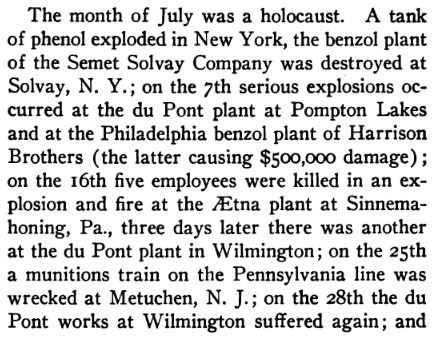
While his book is wrong about other aspects, this Blum theory is useful here to keep in mind since by the summer of 1915 America was being described in The German Secret Service book as a “holocaust” of sabotage and explosions killing Americans and destroying properties.
Scarcely a week went by during the autumn without an explosion and fire which wiped out from one to a dozen lives, and from one hundred thousand to a million dollars. […] It is no mere metaphor to say that during 1915 and 1916 the smoke of German explosions in factories in the United States was spreading across the sun, casting a deepening shadow of war over America.
And I’m not joking about this 1918 book describing German attacks on Americans as a “holocaust”
At the same time the same book gives vivid details of double-agents who not only knew of the spies, but infiltrated them in San Francisco in 1915 and managed to get them arrested.
Each incident raised havoc in its immediate vicinity. Each represents a carefully worked-out plan involving a group of destroying agents… the affidavit of Johannes Henrikus Van Koolbergen, dated San Francisco, August 27, 1915 may serve to show typical methods of operation…. Von Bincken explained he was a German army officer, on secret service, and employed directly by Franz Bopp, the German consul in San Francisco. […] On the window-sill of 303 Piccadilly Apartment sat a flower pot with a tri-colored band around its rim. If the red was turned outwards… come right upstairs. If he saw the blue, he was to loiter discreetly about until the red was turned; if the white area showed he was to return another day.
Van Koolbergen was recruited by the Germans to be paid $3,000 to travel to Canada and blow up a train, bridge or tunnel between Revelstoke and Vancouver. Instead he contacted the British secret service, worked with them on a sting and undermined the whole German operation.
Curious why it doesn’t say he worked with the Wilson administration.
The logic of these terror cells being developed in a neutral country and President Wilson hiding all such evidence of domestic terrorism is a topic worth exploring more on its own. I’ll leave it for now to focus instead on one of the more interesting counter-intelligence operations that went down on the West Coast.
For a little more background, a man named Franz von Papen was a military attaché for the German Embassy in DC, who played as a popular American socialite even after WWI started in 1914.
Abruptly in 1915 the American government officially ordered Papen to return to Germany. A careless mistake had suddenly unraveled Papen’s actual activities and his diplomatic status was ended.
It turns out he had been buying all the gunpowder in America, hiding it in warehouses to create an artificial shortage — prevent Allies from having it shipped to them and (perhaps even more likely) to use for domestically killing Americans with bombs.
Papen also created a shortage with a string of shell companies that would ghost anyone in Britain trying to acquire military equipment — his operations would take orders and gather information with no intention of ever delivering anything to anybody.
That should sound familiar to anyone who has studied the Trump family business model.
Many of Papen’s crooked operations were exposed and came crashing down in 1915 because his paymaster stepped off an elevated train in NYC forgetting his briefcase. An American agent tailing Papen’s paymaster immediately grabbed it (again, don’t forget Wilson claimed ignorance and surprise at spies monitored for years under his government) and a major number of German intelligence operations were done and dusted.
So dumb.
At this point America probably should have arrested and jailed him for life (he actually went on a “vacation” around the country and officials lost track), but then they probably would have had to admit that Germans were running amok, directing global terror cells and blowing up Americans with bombs.
Arrest on first chance might sound extreme because it’s a bit of hindsight.
On the other hand look at the case of Franz Von Rintelen, another German spy leader. He was convicted in 1917 and 1918 on Sherman Anti-Trust law violations, fraudulent passport, and destruction of merchant ships, which sent him to a decade in Federal prison. Rintelen was active in the same timeframe. So why not Papen?
Instead Papen flew free back to Germany (via fascist Spain) and in January 1933 became infamous as the guy who personally convinced Hindenburg to appoint Hitler Chancellor of Germany (with Papen as Vice-Chancellor). Papen argued he would be able to keep Hitler in check, but instead was stabbed in the back (not literally, since he actually survived “night of the long knives” while many of his colleagues were murdered).
Super dumb.
Speaking of white supremacists who stab their colleagues in the back, did you know that is how Wilson became president?
…he went into politics, swapping the presidency of Princeton for the [1911] governorship of New Jersey by convincing the Democratic Party bosses of that state that he would be their puppet, but backstabbing them once he achieved power…Wilson won the 1912 election with less than 42 percent of the vote…
That should sound familiar to anyone who has studied the Trump family political model.
Wilson could have slammed Papen and blocked German spying right then and there in 1915. I suppose some would argue such a rebuke would have pushed America’s issues with Germany into light and forced a war position (as opposed to being “neutral” while letting Americans get killed in a bombing “holocaust”). Yet all the delays at the cost of American lives make little sense compared to the imperative for defense of the country (and protecting her allies from global terror plots).
Ok, now on to specifics of terror cells on the West Coast after Wilson became President, which resonate with what we are seeing today.
It was July 22, 1916 (still a year before Wilson would declare Germany an enemy, but just eight days before the Black Tom explosion in NYC) that a massive explosion rocked downtown San Francisco and killed 10 people.
Foreshadowing the Black Tom investigation, law enforcement took it upon themselves to gin up spotty evidence and false charges to imprison an American — ignoring the German threat.
It became known as the Preparedness Day bombing, because the bomb exploded during a huge parade staged to show that the U.S. was prepared to enter World War I. Juries convicted two labor union organizers, Tom Mooney, 33, and Warren Billings, 22, of the crime, although, as it turned out, the convictions were based on perjured testimony and doctored evidence. The real bombers were never caught. Investigations later showed that Mooney and Billings had been framed by San Francisco District Attorney Charles Fickert, who was acting on behalf of the city’s business establishment, anxious to strike a blow at labor unions and what they saw as dangerous leftists and anarchists.
Since the federal government hadn’t yet declared war on Germany, and wouldn’t admit it was aware of German spies spreading through the country and committing acts of domestic terrorism, which led to Papen’s expulsion… this story all rotates on local police investigation.
I suppose more than anything the following one stands out from a sleepy beach town south of San Francisco.
During the first weeks of 1917 the Santa Cruz, California police reported they were onto something rather significant — even reporting it as a center of German espionage with daily briefings on U.S. military activities.
A downtown spot in Santa Cruz (corner of Lincoln and Pacific) had a peanut stand setup where German speakers loitered, posing as hobos and (as described above) labor activists for plausible deniability.
As much as the news reports tell us the Preparedness Day bombing six months earlier in SF was falsely pinned on non-Germans, police in January of 2017 were singing a different tune of foreign interference.
Word was sent to San Francisco of Germans gathering, likely spies, and a request was made for an undercover agent. Quickly “Agent 18” a native German speaker was deployed and made fast friends with… the literal peanut gallery.
Schulenberg carried a precious gems book, and made horseback trips into the mountains. Yet when Agent 18 questioned him, Schulenberg’s responses showed he knew nothing of mining. His “Handbook of Precious Stones,” found in the possession of other German spies, was used as a code book.
That’s why I say this story is… dumb as rocks. Glad you’ve made it this far.
His first three targets were the Santa Cruz wharf, the new Davenport potash plant, and a county bridge while a Monterey troop train crossed it carrying communications experts. Then he planned to blow up docks in San Diego, San Francisco, Portland, Seattle and British Columbia, and kill his nemeses…
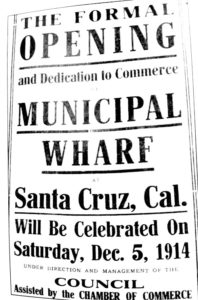
The Santa Cruz wharf, a far cry from its present boring tourism format, had been opened with great fanfare in 1914 as a massive attraction for West Coast commerce and military interests — a prominent target for terrorists.
Wilson dragged his heels on federal laws against foreign espionage until June 15 of 1917 (following US entry into WWI on April 6) so we’re talking about local police being creative in the first months of 1917 acting like they could knowingly infiltrate foreign spy ring to stop terrorism.
It likely helped a lot that a suspicious guy pretending to be a rock expert, carrying a book about rocks, didn’t know a thing about rocks and had a bedroom full of guns and explosives. It’s not as bad as carrying a “white privilege” card but it seems pretty close.
And that is how local authorities in California caught a German spymaster in WWI.
This all changed further as one might expect by July 1917, after America officially sided with the Allies against the Central Powers.
Not only had war finally been declared (mentioning spies), with an espionage act passed for counter-intelligence and a propaganda office to control the narratives, but another massive explosion happened July 9th. This time the bomb exploded in a shipyard north of San Francisco.
United States District Attorney J. W. Preston of San Francisco made the following statement to the press: ‘I have been awake to the danger for some time of spies at work in San Francisco. I contend that every citizen should be on guard constantly against them . . . It is hard for the American public to realize that there are agents of the German government in their midst; but it is a fact that there has been and is an amazing display of intrigue at the expense of the law and hospitality of the United States.
Here again we have a contradiction of people saying they knew all along there were spies from Germany, yet officially the record shows President Wilson did little about it and then acted like it was a shock to find out Germany was spying.
The messaging at this point was being curated carefully into propaganda by a Committee on Public Information (CPI), established by Woodrow Wilson on April 14, 1917 — a week after he formally entered the US into the Great War
I hope all this is useful to someone. It would be great if people soon perhaps could stop saying they are shocked to find out in 2021 Russia has been spying in America and instigating violence, given all the obvious signs we learn from history.
Or perhaps also great if people stop saying they are shocked to see a rise of white insecurity domestic terrorism in California as a result of “America First”… given what happens every time it is in the White House.
This also could be titled “quick intro to Silicon Valley ethics”:
1617 rent-able carriages (shared ride) by order of monarch
1662 fixed routes for shared ride by order of monarch
1823 Stanislas Baudry’s Omnés Omnibus (for everyone)
1853 Impériale omnibus (upper deck cheaper)
2008 Google bus (no poor people allowed)
2017 Lyft shuttle (no poor people allowed, for profit)
The last step was perfectly captured by many critics who can write better than me:
And the latest piece of truly visionary invention has come courtesy of transport company and Uber rival Lyft. The company has created what they’re calling the ‘Lyft Shuttle’, which allows users to “ride for a low, fixed fare along convenient routes with no surprise stops”. All you have to do, the company says, is “walk to the stop. Hop in. Hop out. Walk to destination”.
It’s a bus. They’ve invented the bus.
It’s not the first time a disruptive ride-sharing app has accidentally invented the bus, either. Uber has also been guilty of the same thing.
Despite the fact that THIS IS VERY OBVIOUSLY JUST A FUCKING BUS AND EVERYBODY KNOWS HOW BUSES WORK, some Twitter users have found the whole concept kind of difficult to get their heads around.
But hey, maybe we’re being too harsh on Lyft. Yes, they may have just invented the bus, the first example of which was created in 1823, but their version has loads of disruptive new elements. Case in point:
Lyft Shuttle: buses without the poor people. What an innovation.
I made some jokes about this in my KiwiconX presentation, all from personal experience hacking the Silicon Valley bus systems, and I wrote up the curious history of the apartheid “lift system“, but nothing as funny as the above.
a blog about the poetry of information security, since 1995