
I am honored to be the first person on ZeroDaysLive Video to have been an audio-only guest. You can watch/listen to me being interviewed here:
Category Archives: Security
The History Behind Curtis Mayfield’s “Move On Up”
There’s a line “do not obey” within the famous Curtis Mayfield song “Move On Up” (from his 1970 debut album Curtis).
Take nothing less than the supreme best
Do not obey for most people say
’cause you can pass the test
So what we have to do is
move on up and keep on wishing
Remember your dream is your only scheme
so keep on pushing
What might “do not obey” refer to?
To start, let’s look all the way back at Woodrow Wilson’s racist “America First” campaign of 1916, which manifested in years of organized white mobs committing widespread violence and terrorizing black neighborhoods.
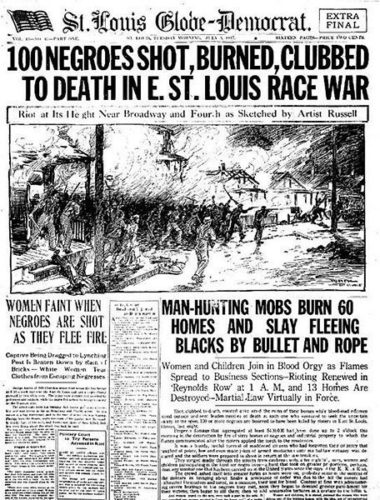
Historians, for example, might point to the NYC 1917 Silent Parade meant to protest the fact that in America “black skin was death warrant”, or the Chicago 1919 massacre that was part of a “Red Summer” of white supremacist terrorist acts.

This frightful condition continued such that by 1921 all of Tulsa’s black neighborhoods and “Wall Street” were burned to the ground by planes dropping napalm.
Here’s an eyewitness account published by Smithsonian:
I could see planes circling in mid-air. They grew in number and hummed, darted and dipped low. I could hear something like hail falling upon the top of my office building. Down East Archer, I saw the old Mid-Way hotel on fire, burning from its top, and then another and another and another building began to burn from their top…
The side-walks were literally covered with burning turpentine balls. I knew all too well where they came from, and I knew all too well why every burning building first caught from the top… ‘Where oh where is our splendid fire department with its half dozen stations?’ I asked myself. ‘Is the city in conspiracy with the mob?’
Even a “white Tulsan perspective” published in 1921 admitted “lack of law enforcement was in no small part a contributing factor” to death and destruction from domestic terrorist groups attacking Americans.
White violence mobs facilitated by law enforcement literally pushed Americans into forced labor and mass graves, followed with construction of a KKK convention hall on top of cities ruined by white violence (an early form of racist “urban renewal” politics made famous by Nixon, although he more subtlety used dynamite and bulldozers instead of napalm and planes)…
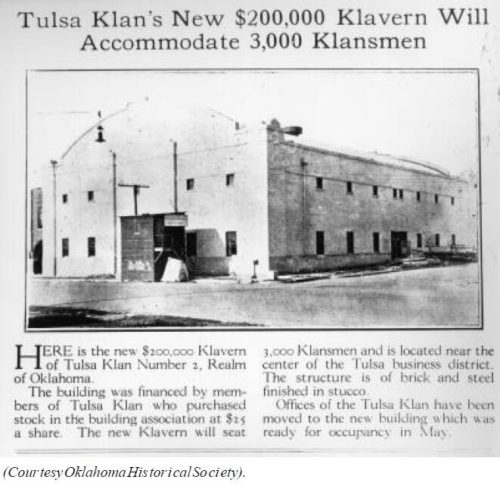
A news story written in 1921 clearly called out “old white group control” as a form of American tyranny:
One of the charges made against the colored men in Tulsa is that they were “radical.” Questioning the whites more closely regarding the nature of this radicalism, I found it means that Negroes were uncompromisingly denouncing “Jim-Crow” cars, lynching, peonage; in short, were asking that the Federal constitutional guaranties of “life, liberty, and the pursuit of happiness” be given regardless of color. The Negroes of Tulsa and other Oklahoma cities are pioneers; men and women who have dared, men and women who have had the initiative and the courage to pull up stakes in other less-favored States and face hardship in a newer one for the sake of eventual progress. That type is ever less ready to submit to insult. Those of the whites who seek to maintain the old white group control naturally do not relish seeing Negroes emancipating themselves from the old system.
All of this, the fact that America continued to systemically deny freedom and liberty based solely on race throughout the 1900s, still is rarely if ever taught in American schools.
Blocked from upward mobility by state-sanctioned violent white supremacist mobs — meaning police offered the opposite of help to Americans under attack — you perhaps can see exactly why black community protection groups emerged.
In other words, ethnic-based “gangs” were started as a way to enable the kind of peace needed to prosper, by defending American communities against organized white supremacist domestic terrorism.
Although some black gangs likely formed to counter the aggressive white youth, the unorganized black youth were no match for the well-organized, all-white gangs that were centered in their athletic clubs.
Wherever white oppression tactics were found, and police failed in their duties, a gang was likely formed to defend against injustices and thus enable a degree of protection to help enable gains in health, wealth and prosperity.
Catholic (Polish, Irish, German, Italian), Chinese, Jewish and black gangs all were established to protect against American domestic terrorism. These ethnic gangs also fundamentally depended on fund-raising and community support events. It is a fine line obviously between donations and extractions/taxation, given a lack of transparency or legal representation possible in gang systems.
A story from Milwaukee, for example, involves a fund-raising event on a huge boat in Lake Michigan. A violent storm caused a collision that sank the boat and decimated that community by drowning the “Irish Union Guard” abolitionist militia leadership. So many leaders of that one community died in just one fund-raising tragedy, it has been said the entire balance of Milwaukee’s political power abruptly shifted on that day towards German militia running the city.
Another story, this time from Minneapolis, is how Jewish gangsters violently attacked any German “Silver Shirt” militia (Nazi) rally, calling it a “patriotic duty as Americans” to shut-down pro-Hitler influence operations.
Berman learned that Silver Shirts were mounting a rally at a nearby Elks’ Lodge. When the Nazi leader called for all the “Jew bastards” in the city to be expelled, or worse, Berman and his associates burst in to the room and started cracking heads. After ten minutes, they had emptied the hall. His suit covered in blood, Berman took the microphone and announced, “This is a warning. Anybody who says anything against Jews gets the same treatment. Only next time it will be worse.” After Berman broke up two more rallies, there were no more public Silver Shirt meetings in Minneapolis.
Totally defeated on the streets the Silver Shirt members then became the Minneapolis Police Department (MPD) to gain an unfair advantage over their targets (the city in conspiracy with the mob), but that’s a blog post for another day.
Gangs typically dissipated as they become assimilated by mainstream opportunities (upward mobility) in America (even a catholic has been elected President). However America has such high levels of continued oppression of blacks (1950s White House urban renewal was encoded race warfare) it is no wonder black gangs have lingered.
See the film “Rubble Kings” for an excellent look at the socio-economics of how and why New York gangs were formed in the 1960s and what helped them dissipate in the Bronx. Hint: upward mobility through opportunities in music and art — foundations of today’s rap and hip-hop markets.
With that in mind, let’s look at what Mayfield may have been writing about in his lyrics. The year was 1970 when he released his debut album Curtis, and also when one of the Chicago gangs (Blackstone Rangers) tried to pressure Mayfield to fund them.
He did not obey. Instead he offered them a concert and used his platform to drive a “move on up” message.
He was pushing hope for equality and justice of assimilation that other the races in America were allowed to achieve, leaving behind the need for paying for gang protection from the systemic violence of white power groups.
The Atlantic has described the situation as…
…no other society in human history has imprisoned so many of its own citizens.
To make an even finer point on the social power of this song, by 1975 a popular TV show about black “nouveau-riche” prosperity in America, called The Jeffersons, created a theme song called “Movin’ On Up“.
Fish don’t fry in the kitchen
Beans don’t burn on the grill
Took a whole lotta tryin’
Just to get up that hillNow we’re up in the big leagues
Gettin’ our turn at bat
As long as we live
It’s you and me, baby
There ain’t nothin’ wrong with that
For further reading, consider how “up that hill” in The Jeffersons 1975 theme song is likely a reference to American intolerance — “shining city on a hill“.
CHANGEMAKERS: Data Ethics and How to Save the Web
Honored to be a part of the Inrupt mission as profiled by Andrew Sears on All Tech is Human (ATIH) CHANGEMAKERS. Here’s a full text version of my interview:
Davi Ottenheimer is the Vice President of Trust and Digital Ethics at Inrupt, a company striving to restore the power of balance on the web through data decentralization technology. For over 25 years, he has worked to apply security models to preserve human rights and freedoms. He is the co-author of Securing the Virtual Environment: How to Defend the Enterprise Against Attack (2012) and the author of The Realities of Securing Big Data, which is due to release this year. Davi spoke with ATIH about where the web went wrong and how decentralization technology can get things back on track.
ATIH: Tell us about your journey to your present role at Inrupt. How did you first become interested in digital ethics work?
My interest in digital ethics goes back to at least sometime in the early 1980s. The 414s seemed to me a foreshadowing of where the world was headed, at least in terms of society defining shades of lawful and unlawful data access. Their story felt very normal, not at all exceptional, because at that time it was similar to what I was experiencing in school and it was on the cover of big publications like Newsweek.
My family also exposed me very early to authorization concepts in both digital and analog tech. I basically grew up seeing computers as a natural next step like a tractor replaces the ox; no one really would want to be without one. That gave me a fluid understanding of ethics across a wide technology spectrum. For example as a child in very rural Kansas we had only a shared “party line” for telephone; my parents would of course tell me it was wrong to listen to our neighbors’ calls. I was fascinated by it all and by the time I was in college studying philosophy I was running my own copper from taps on building wires to connect dorm rooms, shifting underutilized resources to community service by taking over computer labs and all kinds of typical mischief. At the same time I was playfully exploring, I also ended up helping investigate or clean up some clever abuses of the lines by others (e.g. toll fraud, illegal reselling).
More to the point in college I always tried to turn in digital versions of assignments including a hypercard stack (precursor to websites) on ethics of linguistic regulation of Internet hate speech. That felt more exceptional, substantially entering digital ethics, because my teachers sometimes bristled at being handed a floppy instead of the usual paper. I was deep in a world at this time many professors had access to yet barely seen. I still figured at that point since I could dive into it anyone could and soon would. It was around 1990 that I excitedly showed a political science professor a 30 second video clip that I had spent 12 hours downloading and reconstituting. I had been studying information warfare and told him dissemination and manipulation was entering a whole new domain with Internet video… he told me “just do your damn homework” (some typical assignment on Middle East peace options) and walked away shaking his head. I felt at that moment I wasn’t giving up or going back, digital ethics had become my thing.
After college I applied to do political research at LSE and they countered with an offer in the history course. I accepted and explored far more historic cases of ethics in intervention (information warfare by Orde Wingate, and power dynamics in taking over large scale systems while not really owning them — 1940 British invasion of Ethiopia). My history advisor was truly amazing. He encouraged me to go professional with technology work and even told me it wouldn’t be a bad idea to pursue as a career.
It was great advice and I went straight into working for a DEC reseller in California pushing decentralization with PCs and TCP/IP. Getting paid to take hardware and software completely apart to fix it was like heaven for me. From those first phases of interest we can fast forward through twenty-five years of hands-on security within many industries around the world of all sizes and shapes. My journey has always been about convincing people from field to board-level that unsafe technology alters power dynamics, and that we protect liberties by bringing safety principles into engineering as well as policy.
A few years ago a very small database company reached out for help fixing their widely publicized product security flaws. Literally millions of people were being harmed, and they told me they weren’t finding people willing or able to help. I agreed to jump into it on the condition they let me drive end-to-end encryption at the field-level into their product as a feature, while I also cleaned up management practices. It was after we released that end-to-end field-level encryption feature, and after I guided them through IPO and massive growth to a much safer and more proper course including external oversight, that Bruce Schneier strongly suggested I consider the new Inrupt mission to bring Solid to life. I was thrilled to be given the opportunity to join such an important and challenging role.
ATIH: Inrupt is advancing the development of Solid, an open source platform designed to remake the web. What’s wrong with the web that we have today?
Solid presents a powerful yet very simple concept to remake the web: your data lives in a Pod controlled by you. Any data generated by you or your things (e.g. watch, TV, car, computer, phone, thermometer, thermostat) goes to your Pod. You then control access at a meaningful level, where consent has real power. I call it the need for an off button and a reset button for big data. Don’t want your data used anymore by who knows who? You have that choice. Want to be the authoritative source on data about you? Also your choice. If your doctor wants to look at your fitness tracker data, you grant that. When a family wants to share moments in photos, they grant that. Want your machines to talk with each other, not the manufacturer, and only at certain times? Up to you, through your Pod controls.
We expect this to evolve with completely distributed models, although sounding idealistic, because they are necessary and thus not out of the question. At the same time, efficiencies of scale and basic economics tell us many people will have Pod service providers instead of going with homegrown or localized varieties. As a long-time self-repair and build-your-own-kernel linux advocate I see no conflict innovating towards both off-grid piece-meal installations, as well as abstract and monolithic cloud services. You win because you have a lot more flexibility in a world where you seamlessly can flow between different worlds of control that suit you.
Sir Tim Berners-Lee calls the Solid project of decentralization being pro-human, as opposed to what he calls the current anti-human web platforms. For me perhaps the best way to explain the current problem with the web might be aggressive centralization, which historians used to say about the neo-absolutist surveillance state of 1850s Austria. I find it useful to reference history events to explain socio-economics that we see today with Google.
Another aspect of the problem, which I have been giving presentations about recently, is how our “digital bodies” owned by large proprietary platforms becomes a form of human trafficking.
Unfortunately 1850s American slave plantations seem to be an appropriate history reference as well. It actually explains Facebook data management and expansionist habits. I don’t say this lightly, especially as Memorial Day was created in 1868 specifically to honor those who made the ultimate sacrifice to win the war that was supposed to end slavery in America.
In my presentations on big data security, for example, I literally ask people to consider how the cotton gin was invented by a woman to end slavery, yet instead it led to state sanctioned rape of American women and forced births to rapidly expand human trafficking. That’s not the kind of history anyone really hears in school, and those are the actual facts. The web was invented to bring freedom, to end our digital selves being locked away, yet it has led to state sanctioned collection methods with vastly expanded proprietary control over almost our entire lives.
ATIH: How did these problems with the web come about?
That’s a great question. There has been massive pressure for data centralization from so many camps that have failed, it’s almost a wonder at all that some succeeded in cornering the web. I’d like to think the problems are the exception (e.g. like nationalization of the telephone under President Woodrow Wilson, or invasive inspection and destruction of U.S. mail under President Andrew Jackson) and we’re course-correcting to get back on track.
Cable television and AOL dial-up services both, believe it or not, were considered threats at some point to the success of a decentralized web. Microsoft too, although it obviously found itself in US government regulatory trouble when it aggressively tried to center the web around its browser and operating system. Some might point to RFC2109 but I find the socio-economics to be more important than this technical specification that helped build statefulness.
Perhaps the real turning point that set back decentralization came soon after the web was being panned as just a fad that would never rebound after the dot-com disaster. We witnessed in a time of crisis the giant transfer from small businesses to conglomerates, which might feel familiar to economists looking at today’s pandemic.
The optimism of the hugely diverse commercialization efforts by startups, which in a large part led to the crash, generated a kind of popular herd momentum that was picked up by the few dominant remaining technology firms. They in fact roared out of the dot-com crash with far more influence, far more human connectivity, and the market rewarded a kind of fast monopolistic growth as it escaped financial downturn. The web’s standardization and ease of use, once transformation to it was popular, made it a perfect vehicle for massive-scale growth.
The next market crash, from the mortgage crisis, then served as another accelerator on the trend for centralization coupled with more powerful devices becoming less expensive and default connected to the standards-based web. The technology sector became seen as a stable financial engine and attracted business innovators who believed user generated content had the best potential value and they set out to build systems that flipped the web on its head; would keep users connected by making it difficult to exit.
What’s notable about this history is the financial conditions and technological shifts that may never again materialize in quite the same way. That’s why I see dangerous centralization as a form of regression, an error that requires applied humanitarian correction. It’s like firing a CISO who steals, or countering the rise of extremist anti-science cults that typically form in response to recent scientific breakthroughs. I don’t believe in an inherent centralization need, or natural monopoly, in this context. In fact I see more the opposite, that we should think about Facebook in terms of why abolition of slavery never should even have been a debate. Had there not been the stress effects that led to over-centralization as a form of wealth preservation (arguably an incorrect response fueled by other unfortunate market conditions) the web could have continued to evolve in the more naturally pro-human model.
ATIH: Inrupt’s Co-Founder, Sir Tim Berners-Lee, calls Solid a project “to restore the power and agency of individuals on the web.” How does Solid accomplish this?
Giving users consent controls over their data, making the technology that represents a human to be actually human-centric, is the path forward. The Pod is a representation of one’s self that should be liberating, and is manifestly difficult to do without Solid. Many people now seem to agree we can and need to fundamentally alter the balance of power, whether they call it Solid or something else. Given that everywhere you are something is a computer generating data that represents you, taking control of your digital body has become essential.
In terms of projects at massive scale I’ve lived through early days on multiple data sharing standard initiatives (DICOM, TCP/IP, HTTP, HTML, KMIP) and worked deep inside the security teams for the biggest data platform companies (EMC, Yahoo, ArcSight, etc) so much of the scope and ambition feels familiar. I mean when you really think about it, the Solid protocol could be even bigger and more exciting, like a 1968 Carterfone moment or even 1862 Emancipation Proclamation, in terms of how small decisions restore power to individuals at massive scale.
The market either will keep building costly bilateral bridges and proprietary hubs people are trapped on, like we’re seeing with Apple and Google attempts at a COVID-19 alerting API. Or standard languages and protocols will emerge to lower barriers to human-centric innovation and expand the web again by decentralizing it and shifting to Solid. If it’s the latter we’ll see a boom in more generalized global prosperity. Trust is an essential step towards making it all work, just like always, yet user security awareness levels are so much higher than I’ve ever seen before. Doing things the right way for humans to preserve their agency, to help everyone avoid becoming victims of digital trafficking, brings up all kinds of granular authorization discussions. We are quite literally reimagining technology in ways that the Solid protocols will better augment and protect positive human conditions, complex communities, cultures and all.
ATIH: What does your role as VP of Trust and Digital Ethics look like day-to-day?
I get up and wonder if I can configure my toothbrush to start streaming its data to my Pod. Pour a cup of tea and think about a digital assistant reading data in my Pod to know exactly what leaf and temperature “Earl Grey, Hot” means, and how accurate automated speech recognition would become when designed from the start to be highly localized on Pod data and trained for my particular accent within my community or even my family.
But seriously, every day is running a gamut of working on trust concepts for the specification and protocols being designed, including security for the related products being engineered and the services offered to support both at a global production-ready scale.
People are coming to us with very real problems to solve across every sector and industry. It’s a great feeling to be helping them, working with such a passionate team that carries a real vision of a better future. Lately there has been a lot of discussion with both large and small organizations that have similar values and find Solid and Inrupt deliver a valuable piece in their own human-centered technology development projects.
Almost every day I am reminded of the important lessons and legacy of John James Ingalls such as his application of “ad astra, per aspera”, roughly translated as purposefully shooting for the stars, which became the Kansas state motto in 1861.
Bletchley Park Codebreaker Obituary: Ann Mitchell
The death of Ann Mitchell, aged 97, was just announced in Edinburgh.
One of only 5 women accepted to read mathematics at Oxford in 1940, she finished her degree a year early and went on to play a key role in Hut 6 “Machine Room” at Bletchley Park.
Hut 6 dealt with the high priority German army and air force codes, most important of which was the “Red” code of the Luftwaffe. They wrote out some of the jumbled nonsense which had been received and underneath wrote a “crib” of the probable German text. Ann’s key role was the next step in breaking the code, composing a menu that showed links between the letters in the text received and the crib, with the more compact the menu, the better. As every code for every unit of the German forces was changed at midnight, each day the work began all over again to identify clues to the new day’s codes. It was an intense intellectual process, working against the clock, and the urgency provided a constant challenge. Ann and her colleagues in Hut 6, most of whom had degrees in economics, law or maths, worked around the clock in shifts, with one free day each week. As the war came to a close, the number of messages declined until there were no more. “I did go up to London for VE Day on 8 May 1945 but I remember very little about the celebrations,” she said. The codebreakers returned to normal life and, having signed the Official Secrets Act and sworn not to divulge any information about her work, Ann never told anyone, not even her husband, about her wartime role.
She led a life of great service delivered quietly — her groundbreaking WWII work in mathematics was not officially recognized until 2009.
Women, whose stories have been told far less widely than the men they worked with, reportedly made up three-quarters of the workforce at Bletchley Park.

Whatever the reason for the remarkable women codebreakers to be rarely mentioned while their male colleagues were profiled, historians lately have been trying to update and correct the message.

Food for thought when you consider the origins of cyber security had such a high percentage of women, and yet in the latest surveys “women accounted for 10% of the cybersecurity workforce in the Asia-Pacific region, 9% in Africa, 8% in Latin America, 7% in Europe and 5% in the Middle East.”
Like many veterans after the war Ann contributed to other areas. She researched social impacts of divorce and made significant contributions to Scots family law, “which ensured that the needs of children were properly taken into account in a divorce settlement”.
The BBC also has details of her life.