Category Archives: Security

Israel’s Chief Rabbi Accused of Genocide Incitement

1969 assignment of nationality, pointing to an existing address for absorption, is how Israel used to frame Palestinians. Golda Meir, reflecting on regional identities as all recently designated states, denied anyone would be Palestinian. Her framework said West Bank arabs are Jordanian (a nationality extended to them by Jordan’s 1954 law).

2026 is a completely different story. Denial of humanity, denial of any address, is an escalation to genocide as a statement about the people. This is how officials of the Israeli state speak of Palestinians today.

Meir’s scheme gave the 1948 Arabs citizenship and the West Bankers Jordanian passports, which they held until 1988. Everyone had a legal somewhere, so the peoplehood question was lobbied as a filing decision about which state processes the claim. Notably absent from her theory is Gaza, which left a dangerous gap.

Egypt administered Gaza from 1949 to 1967 and never extended citizenship to people living there. When Egypt retreated from Gaza in the 1967 war, the Gazans who were left behind under Israeli rule weren’t treated as Egyptian or Israeli. They were stateless under Meir, stateless after Camp David, which Sadat negotiated without returning Gaza to Egypt, stateless under Oslo’s interim status, and stateless today. Her framework had no exit for the Gazans, which is how it grew into the crucible of Palestinian nationalism, from the fedayeen era onward.

When you look at the Meir foundations, the exit paths are the focus. Palestinians were to become citizens of Israel and Jordan. Yet Jordan withdrew the exit in 1988, responding to the First Intifada (because Jordan was undermined by the Arab League reaffirmation of its own 1974 Rabat designation of the PLO as “sole representative”, despite King Hussein objections), and the Israeli citizenship track was locked to the 1948 population. So the Gaza equation escalated as an address for people with no address, while Jordan was losing control, challenging her theory.

Fast forward to today and Israeli state officials speak publicly in the register the Genocide Convention defines as incitement.

The Chief Rabbi holds a salaried state office. Under Article III(c) of the Genocide Convention and the ICTR’s Akayesu and Nahimana precedents, authority and audience are what convert dehumanizing rhetoric into incitement.

The Chief Rabbi holds a generational, descendant role. His father Ovadia Yosef, also a former Chief Rabbi, said in 2010 that Palestinians should perish from this world and that Abbas should be struck with a plague. His brother Yitzhak preceded him in the same office.

The Chief Rabbi chose a venue with a particular political meaning. Gush Katif Museum commemorates the settlements evacuated from Gaza in 2005, which frames the topic as taking land.

The Chief Rabbi’s speech lands precisely on that old Meir citizenship gap: the one population she never accounted for is the one he dehumanizes, denying their rights, marking their land for destruction and settlement by Jews only.

In an address at West Jerusalem’s Gush Katif Museum, Israel’s Chief Rabbi David Yosef denied Palestinians exist as a people and said they ‘have no rights’. He also claimed Gaza and occupied West Bank cities for Jews, and called for Gaza’s destruction and Jewish settlement.

Ben Gvir Genocide Gallows: Israel Enacts Nazi Decree of December 1941

Itamar Ben-Gvir stood on fresh concrete this week and posted the video. Israel’s national security minister toured the foundations of a death row and hanging facility inside a maximum-security prison in central Israel, pointed at the ground, and promised executions. The complex will include viewing booths so that families of victims can watch. Ben-Gvir said the booths follow the American model.

Days earlier the same minister advocated thirty to forty targeted killings per night in Gaza, extending beyond people posing any immediate threat, and said of the people there:

They are not even people.

The French foreign minister called the remarks inhumane.

The German chancellor said they violate international law.

Notably, Ben-Gvir himself already has been convicted for incitement to racism and support of a terrorist organization (Kahane’s Kach Party).
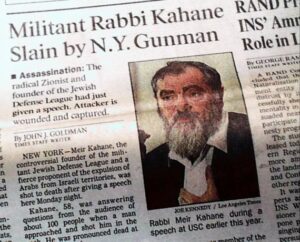
Meir Kahane was assassinated in New York in 1990. His movement didn’t die. It radicalized. Baruch Goldstein, a Kach follower, massacred 29 Palestinian worshippers in Hebron in 1994. Yigal Amir, a Kahanist inspired by Goldstein, assassinated Prime Minister Yitzhak Rabin in 1995. The man who signed Oslo, the man who could negotiate. Weeks before the killing, a teenage Itamar Ben-Gvir brandished an ornament stolen from Rabin’s car on live television and said: “We got to his car, and we’ll get to him too.”

Ben-Gvir was exempted from military service because of his extremism. He was convicted of incitement to racism and support for a terrorist organization. He kept a portrait of Goldstein above his fireplace. In 2022, Netanyahu brought him into government as National Security Minister. Bezalel Smotrich, another Kahanist, became Finance Minister.

Despite all this, since December 2022 Ben-Gvir has directed Israel’s police and its prison service.

The gallows enforces a specific legal architecture. That architecture has a very well-known direct precedent from the Holocaust, and the precedent was adjudicated.

Start with the statute. On March 30, 2026 the Knesset passed the Death Penalty for Terrorists law, 62 votes to 48, with Netanyahu voting in person. I published a full analysis of its civil-court provision, which prescribes death or life imprisonment for killing “with the aim of negating the existence of the State of Israel.” The intent element was engineered to keep Jewish defendants outside its reach, a design confirmed at passage by the Israel Democracy Institute. The same statute operates differently in the military courts. There death becomes the only available sentence, with life imprisonment reserved for a judicial finding of special circumstances.

The military courts try Palestinians. Jewish Israelis accused of comparable violence in the same territory answer to civilian courts, where the intent element shields them. One statute, two tracks. The civilian track carries the definitional exemption. The military track carries the mandatory gallows.

Four structural elements follow. The statute’s application rests on group membership. It makes death the default sentence rather than the maximum. It routes the targeted population through a separate court system. It exempts a group through definitional language alone.

This is the precise setup of RGBl. 1941 I S. 759, the Nazi decree of December 4, 1941 on penal law for Poles and Jews in the annexed eastern territories.
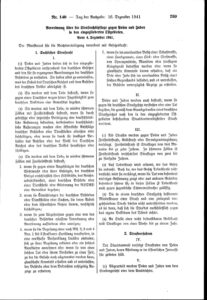
That decree created a separate criminal code for two populations, prescribed death for offenses that carried ordinary penalties for Germans, and ran the trials through special courts outside the regular system. Section I(3) made death the sentence for hostile remarks about Germany and for tearing down official notices. Section V(1) assigned every trial to the Sondergericht. The Austrian National Library holds the scan of the original gazette pages, linked above. Read it. The whole apparatus takes three pages. It needed only a ministerial signature. The Israeli statute carried a parliamentary majority, 62 to 48.

Section III(2) of the decree deserves its own paragraph. Death is imposed wherever the law threatens it. Where the law provides for a lesser sentence, the court imposes death anyway upon finding a besonders niedrige Gesinnung, an especially base disposition, a rule the decree extends expressly to juvenile offenders. The decree drew its life and death line through a judicial finding about the defendant’s inner state. The Israeli statute does the same work in reverse. An intent clause selects who dies. A special-circumstances finding decides who lives. Both instruments place the capital line inside a disposition judgment rendered by the separate system, and both write that judgment into the statute as the mechanism of the differential itself.

Defenders of the Israeli statute surely will argue that the 1941 decree made trivial conduct capital, any “anti-German” remark, a torn poster, while the new law attaches to “murder” convictions. The conviction data explains why this doesn’t land. The military courts convict at a rate of 99.74 percent, by the system’s own annual report, and the overwhelming majority of convictions arrive through plea bargains. A murder conviction produced by the separate system is an output of the separate system. The predicate is manufactured inside the differential, which is exactly how the special courts of 1941 supplied theirs.

The 1941 decree went to trial. The Nuremberg Military Tribunal in United States v. Altstoetter (1947), the Justice Case, prosecuted the Reich Ministry of Justice officials who drafted differential penal law and the special-court judges who applied it. The Tribunal treated the decree as an instrument of the extermination program, applied the new term genocide to a legal system, and convicted ten defendants, among them the ministry’s former acting head and a sitting judge. Its most quoted sentence:

The dagger of the assassin was concealed beneath the robe of the jurist.

That describes Israel today.

The theory of liability matters more than the rhetoric. Altstoetter established that operating a group-differential death statute through a separate court system is itself a crime against humanity, independent of any single execution. The Tribunal convicted the drafters and the appliers. Applied to 2026, that theory reaches the Knesset members who wrote the exemption, the military judges who will impose the mandatory sentence, and the officials building the facility.

The Association for Civil Rights in Israel has petitioned the Supreme Court to strike the law down. The petition is pending. The state’s answer is concrete. Enforcement infrastructure rises ahead of adjudication. The Altstoetter defendants argued that valid legal form made their conduct lawful. The Tribunal convicted them for that reliance.

The Justice Case settled whether legal office protects the operators of such an instrument. It ruled the robe is part of the crime.

Israel abolished the death penalty for murder in 1954, six years after executing Meir Tobianski, an innocent man, by firing squad on the day of his arrest.

The Tobianski gravestone reads killed by mistake.

The abolition was a founding correction, the state admitting what state killing does, and why it is incompatible with the state. The new genocide viewing booths are an attempt to repeal the state of Israel.

This Day in History: 1953 Iran Coup

Years ago NPR did a nice breakdown of the American efforts to overthrow the Iranian government in 1953.

ABDELFATAH: OK, so Kermit Roosevelt entered Iran on July 19 with a pretty big mission ahead of him – stage a coup to get rid of Iran’s prime minister, Mohammad Mossadegh.

ARABLOUEI: And we’ll explain why in a bit.

ABDELFATAH: But the first question Roosevelt had to answer…

KINZER: I’ve asked myself this question.

ABDELFATAH: …Was, how?

KINZER: So you’re sent into a foreign country. And your assignment is overthrow the government. What do you do? Like, what do you do on the first day? Nine o’clock, you get to the office. How do you start?

ABDELFATAH: Even though the CIA had devised a plan for Roosevelt, no one was sure it would actually work. It was suddenly up to Roosevelt to destabilize a whole country.

(SOUNDBITE OF MUSIC)

ARABLOUEI: Step one.

KINZER: Seize control of the Iranian press.

ARABLOUEI: Basically, buy them off with bribes.

KINZER: It turned out that the press was quite corrupt.

ARABLOUEI: And soon enough, Roosevelt had columnists, editors and reporters from most of Iran’s newspapers on his payroll. Then anti-Mossadegh propaganda began printing everywhere.

KINZER: Mossadegh was a Jew, a homosexual, a British agent, anything that they thought would outrage people.

ARABLOUEI: There was such an appetite for these stories that Iranian journalists just couldn’t keep up, so Roosevelt had to recruit CIA agents back in Washington to write some of the articles for the Iranian press.

KINZER: In fact, one of them later wrote a memoir. And he talked about how bizarre it was. At the CIA, you had the people plotting the Iran coup, and then you had analysts on the other side who weren’t aware of the covert action. And he said, I would write an article about how Mossadegh was an atheist, and he hated God. And then a couple of days later, a guy from the other side of the hall in the analysis division would run over to my office holding up an Iranian newspaper and saying, wow. You won’t believe how the newspapers in Iran are denouncing Mossadegh. Look at this article. And I couldn’t tell him, I wrote that article.

That’s just the setup. The first coup attempt failed. And then came the second. Here’s the punch line.

ABDELFATAH: Roosevelt set the stage for his second coup attempt. And on August 19, it began.

ARABLOUEI: Hundreds and hundreds of rioters filled the streets of Tehran. And, in a word, it was chaos.

(SOUNDBITE OF ARCHIVED RECORDING)

UNIDENTIFIED REPORTER #7: Three hundred killed and hundreds wounded is a conservative estimate.

KINZER: And his plan was this. First of all, hire gangs of Iranians through people who controlled criminal protection rackets, and pay them to go out on the street and cause chaos.

ABDELFATAH: So Roosevelt actually paid criminals and gang members to storm into the city.

ARABLOUEI: Beat up people in the streets.

ABDELFATAH: Break shop windows.

KINZER: Shoot your guns into mosques.

ABDELFATAH: And while doing all that, yell…

KINZER: We love Mossadegh. We love communism.

ARABLOUEI: And then…

KINZER: He hired a second mob to attack the first mob.

ARABLOUEI: Which led to bloody, violent clashes between the two mobs.

ABDELFATAH: And the really trippy thing was that everybody involved…

KINZER: Everybody involved in the battles was being paid to be there. But what they didn’t know was they were being paid by the same source.

ARABLOUEI: The CIA – and all of this was designed to create confusion and to signal that Mossadegh was the source of the violence in the country, that he was losing control, which was becoming more and more true.

And so, the CIA overthrew a democratically elected government in Iran.

Trump Officially Promotes Communist Traits, Abruptly Tells Hegseth Let it Go

It was just the other day I remember reading this analysis:

North Korean leader Kim Jong-un is reviving his grandfather’s Marxist-Leninist principles as the regime confronts complex regional geopolitics and internal challenges. […] In its propaganda output, the Kim regime has emphasized upholding “communist traits” as a moral imperative for North Korean citizens.

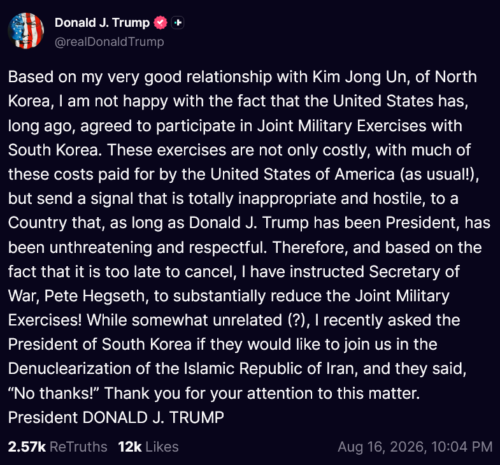
And so I found today Trump is officially endorsing “communist traits”, and giving the order to American military to allow communism to grow. Trump today (Sunday) ordered the Pentagon to unpredictably gut Ulchi Freedom Shield (18,000 South Korean soldiers training jointly with American forces), claiming his own order today was “too late to cancel” an exercise that starts… (checks watch) tomorrow.

Source: Trump Family

North Korea, for their part, has threatened the U.S. by describing these very same joint defense exercises as “rehearsal for an aggressive war“. Trump has just called the war-mongering communist regime “unthreatening and respectful” after North Korean soldiers last week crossed the military demarcation line until shots were fired to send them back.