A search on Google Maps for COVID-19 cases highlights the northern “panhandle” area of Idaho, which stands out from the rest of the nation.
175 cases in Benewah County (population 9,285) is incredibly high. Why?
The 120 cases in Kootenai County (population 171,362) are a huge clue. Everything around Kootenai is showing spread, completely counter to the downward move everywhere else.
It looks fairly clear to me that the city of Coeur d’Alene failed in their basic duty to protect health, becoming an intentional infection center.
‘I would not vote to mandate masks’ says Coeur d’Alene mayor
Kootenai County’s positivity rate dropped to 4.3% based on 1,220 PCR tests for the week ending March 5. It reached a high of 40% just six weeks ago.
Google is pulling data from the NYT, and there’s evidence cases may be even higher than what was being reported by Idaho officials.
The Coeur d’Alene Wastewater plant conducted a test of the city’s sewage, and the results suggested as many as 490 people could be infected with COVID-19.[…] Officially, the Panhandle Health District reports that only 87 people have COVID-19 in Kootenai County.
Remember 2015 when an incoming CISO infamously announced he was quitting Yahoo? In retrospect we know he was failing to disclose their breaches, trying to sneak out the back door yet avoid charges of misconduct.
His abrupt departure, after just one year in his first ever attempt to be a CISO, was announced very loudly as an intention to lead Facebook instead, because he said it was the best in the world at protecting people’s information (and soon after promising privacy where there would be none).
In fact his track record delivered the exact opposite, and regulators are not pleased.
The decision follows an inquiry by the Data Protection Commissioner (DPC) into a series of 12 data breach notifications received by DPC the between June and December 2018,
The regulator found that Meta Platforms Ireland infringed Article 5(2), and 24(1) of the GDPR data protection law, which require organisations to put measures in place to meet key data protection principles.
The DPC found that Meta “failed to have in place appropriate technical and organisational measures which would enable it to readily demonstrate the security measures that it implemented in practice to protect EU users’ data”.
Today the government is announcing that executives whose companies fail to cooperate with Ofcom’s information requests could now face prosecution or jail time.
As much as people like to talk up Apple as a privacy advocate, it’s rarely a bright line with an either/or position.
Buried in a macOS 12.3 release (with general availability two days ago) was an important change to the data flow of user files.
Deprecations.
The kernel extensions used by the Dropbox desktop app and Microsoft OneDrive are no longer available. Both service providers have replacements for this functionality currently in beta. (85890896)
That means macOS 12.3 no longer allows opening any files stored in the cloud through third-party applications; users must instead download all files with Apple’s macOS Finder before opening them with any other applications.
That basically kills the entire access model of a product like Dropbox “Smart Sync“, which is built on the premise someone can avoid downloading files to a local system, managing permissions entirely through an app instead.
Stop worrying about hard drive limits. Sync only what you need, and access all your files seamlessly from your desktop or mobile.
There are privacy implications here, as well as control issues, and it will be interesting to see whether Apple can justify the changes within a context of privacy.
On a related note, macOS 12.3 security content also discloses a huge number of major flaws such as “bypass login” and “execute arbitrary code with kernel privileges” and “malicious application may be able to gain root”.
Lots of good reasons to not download files to a local system, let alone give the OS any more access than necessary.
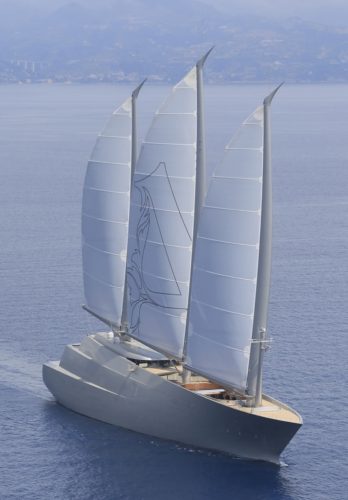
A boat builder boasted in 2017 about their 143m ship with gross tonnage of 12.600 that can only go 20 knots:
Her name: SAILING YACHT A. She will draw eyes the world over, as no other superyacht has ever done before.
Apparently this prediction of drawing eyes came true just now. Italian police announced the 530 million euro monstrosity had achieved their full attention.
Italian police have seized a superyacht from Russian billionaire Andrey Igorevich Melnichenko, the prime minister’s office said on Saturday, a few days after the businessman was placed on an EU sanctions list following Russia’s invasion of Ukraine. […] Designed by Philippe Starck and built by Nobiskrug in Germany, the vessel is the world’s biggest sailing yacht, the government said. Melnichenko owns major fertiliser producer EuroChem Group and coal company SUEK.
EuroChem Group AG, a leading global fertilizer producer, announces that Andrey Melnichenko has resigned his position as Non-Executive Director of the Board of Directors, and withdrawn as main beneficiary, effective March 9, 2022. The move follows Mr. Melnichenko’s inclusion in an EU sanctions list, and was taken to ensure EuroChem is able to continue providing millions of people around the world with nutrients for agriculture, helping to underpin global food security.
Nutrients that underpin global security?
*Cough* bullshit *cough*.
But seriously, this opulent waste of money on a party yacht sinks any claims to Melnichenko or his company giving a crap about global food security.
Source: Nobiskrug
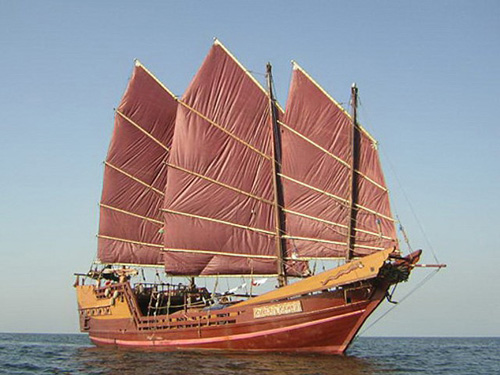
It might be the ugliest sailboat I’ve ever seen. At best it resembles a Chinese Junk.
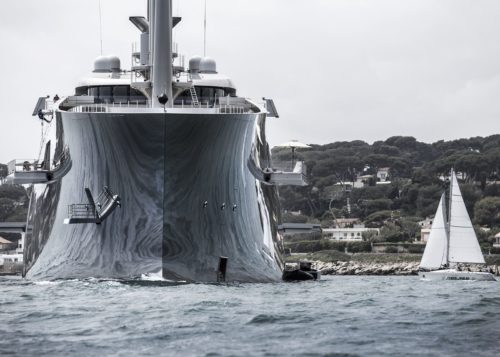
A trio of 300 ft masts with full battens on a 480 ft lethargic bathtub make no sense to me at all. I’m not kidding about bathtub designs being slow. Surface area clearly increases towards the waterline.
Source: Nobiskrug
It has all the grace and efficiency of a flat tire.
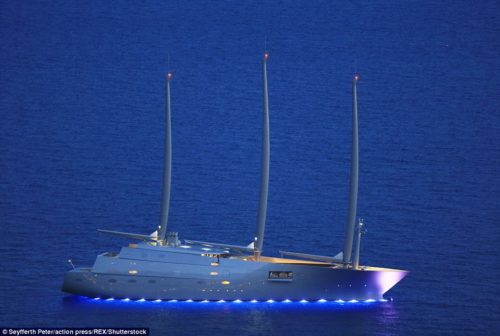
Really it looks like someone took a big container ship and chopped its stern off, then crammed on a cruise ship’s reverse poop deck. Running lights make it even uglier, like an old running shoe from Walmart.
Source: DailyMail
To be fair we’re talking about a fertilizer and coal billionaire who wanted a party boat that could operate on clean wind power instead of fertilizer or coal. Nothing about it sounds right, if you see what I mean, and yet somehow I am certain the Italians will know exactly what to do.
a blog about the poetry of information security, since 1995