Thompson also says it’s important to remember that espionage isn’t new.
“We’ve got to be careful not to jump up and down — throw the toys out of the cot — when an internationally normal activity of espionage is being conducted, because others do it too.”
[…]
“Despite the fact that my job title is head of information warfare, and I talk a lot about cyber warfare, there’s actually no such thing. There’s just warfare,” Thompson said.
Why not go one further than Thompson and say there is no such thing as cyber?
And while we’re at it that there’s no such thing as information technology, there’s just technology. So really there’s just warfare and technology.
Yet we know not all warfare is generically technology-centered. But seriously, warfare can be waged with different methods, tools and platforms, such that adding a modifier shouldn’t be a big talking point.
Chemical warfare, for example, is just warfare. Economic warfare is just warfare. Guerrilla warfare is just warfare. Psychological warfare is just warfare. Mountain warfare is just warfare. Naval warfare is just warfare…and the list goes on.
All that being said I agree with Thompson that espionage is nothing new and should be taken in historical context.
Much of what people call hacking these days is simply them observing things and reporting what they see, such as looking at a picture and noticing that it has clues to exact location. This is a far cry from what used to be called hacking, because once upon a time (since the 1400s) it meant a technical process being manipulated or modified.
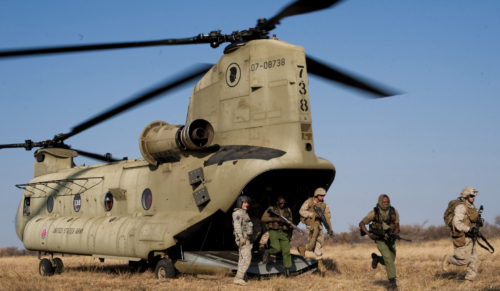
During Southern Accord 2012 U.S. Army Africa, and other U.S. military forces foster security cooperation while conducting combined, joint humanitarian assistance, peacekeeping operations and aeromedical evacuation exercises. (U.S. Army Africa photo by Sgt. Adam Fischman)
The latest analysis of the Syria crisis increasingly reveals it is a Russian plan that the White House has swallowed hook, line and sinker. Both Russia and China stand poised to expand into areas formerly allied with America, to expand their own operations that will erode American relations and influence.
Unilateral withdrawal clearly harms U.S. interests both short (UN Security Council now comparing it to Bosnia, with regional destabilization) and long (high bar to gain foothold or respect for re-entry) terms, yet America somehow allows Executive-branch folly to proceed.
Perhaps you recall just a few months ago a similar withdrawal story was brewing in Africa? That probably should have been reported as a much starker warning of what was to come.
Gen Waldhauser said the troops will be deployed to missions where the US sees as high-priority.
“We all realise, you know, Africa, with regards to the prioritisation of our national interests … there’s no doubt about the fact that that it’s, you know, it’s not number one on the list,” Gen Waldhauser was quoted as saying.
The Trump administration views preparation for potential conflicts with China or Russia to be of higher priority than combating terrorism in Africa.
Now with the White House flying a white flag in abandoning its Kurdish allies in Syria, inviting Russia to roll right in afterwards, there might be a clearer explanation for abandonment of African forces.
The Kremlin’s goal is to emulate China’s success in fostering economic, diplomatic, and military links with Africa. To become an important partner, Moscow is organizing the first-ever Russia-Africa summit on 23-24 October.
The American pull-out from Africa serves the opposite of preparation elsewhere for potential conflicts with China or Russia.
Consider that turning tail and intentionally opening doors to Russian military sales expansion has been manifested by a brand new announcement that Russia is abruptly now pushing into new African allegiances:
While Moscow is focused primarily on other regions, it regards Africa as an attractive venue to evade international sanctions imposed by Western nations and deepen ties with old and new partners while scoring points at the expense of the United States.
Part of Russia’s engagement in Africa is military in nature. The Russian military and Russian private military contractors linked to the Kremlin have expanded their global military footprint in Africa, seeking basing rights in a half dozen countries and inking military cooperation agreements with 27 African governments
America claiming to be redirecting its military towards confrontation with Russia is double-talk. It’s pulling its hands off the wheel, literally opening the door and handing keys to arms dealers to drive. This will mean a spread of anti-humanitarian influences and locking the U.S. out of “forward” stations for military and civilian operations, which will greatly increase risk of harm to the United States (along with any democratic nations and states).
What is especially baffling is how China and Russia are doing basically the same expansionist plan, threatening American influence and ability to protect values, yet get such different treatment by the White House.
Replace the word China with Russia in this next story and you should see the problem with the U.S. unilateral withdrawal from Syria as well as Africa:
“There are two concerns about these investments,” said Ohio Rep. Bob Gibbs, the top Republican on the Subcommittee for Coast Guard and Maritime Transportation. “First, the dual commercial and military uses of these assets; second, that the debt incurred by these countries will tie them to China in ways that will facilitate China’s international pursuits and potentially inhibit U.S. overseas operations.”
Kenyan government risks losing the lucrative Mombasa port to China should the country fail to repay huge loans advanced by Chinese lenders. In November, African Stand reported on how Kenya is at high risk of Losing strategic assets over huge Chinese debt and just after a few month the Chinese are about to take action.
Bottom line is that pulling back to confront Russia and China is counterproductive. Advance deployments and influence is what was designed to prevent a lopsided confrontation, by forming global alliances that maintain what Eisenhower wisely referred to as the American need for a confederation of mutual trust and respect.
Losing alliances also means American warfare technology (which depends increasingly on intelligence) becomes less reliable in the very near future. Perhaps I’m stating the obvious but things like “Simple map displays require 96 hours to synchronize a brigade or division targeting cycle…” will get performance gains faster/better through augmenting human alliance networks in the field rather than pulling out and relying on AI alone.
Update October 24: LSE’s Stephen Paduano and alum John McDermott write in The Economist that the rise of Russian activity in Africa has been accompanied by senseless violence.
When three Russian journalists tried to investigate their country’s shady operations in the Central African Republic they turned up dead in July 2018
How do you expect to counter China if you’re leaving where they are going? From the article, in response to China hosting leaders from 54 African countries yearly, “At the launch of Prosper Africa in Mozambique this year, the United States failed to send even a Cabinet secretary.”
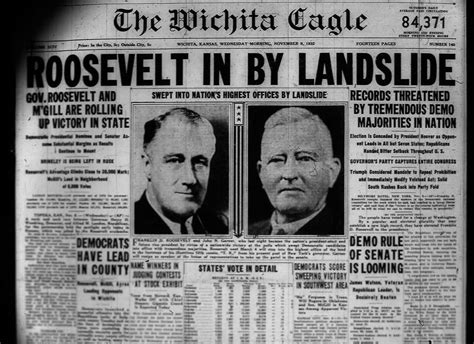
Regulation and targeted response strategies to fight disinformation worked after FDR took office in 1932, and it’s likely to work again today when someone will muster the national trust of residents ready to take action.
Without that kind of popular support, and by instead making conciliation to technology companies, it’s unlikely we’ll see any progress today.
DefenseOne writes there’s been a necessary shift in security from a focus entirely on confidentiality towards more integrity. They then propose three steps to get there.
First is better, faster understanding by the U.S. government of what disinformation American adversaries are spreading—or, ideally, anticipation of that spread before it actually happens. […]
Second is, in appropriate circumstances, the swift, clear, and direct intervention of U.S. government spokespersons to expose falsities and provide the truth. […]
Third is an expanded set of U.S. government partnerships with technologies companies to help them identify disinformation poised to spread across their platforms so that they can craft appropriate responses.
What this article misses entirely is what has worked in the past. Unless they address why that wouldn’t work today, I’m skeptical of their suggestions to try something new and untested.
Point one sounds like a call for more surveillance, which will obviously run into massive resistance before it even gets off the ground. So there’s a tactical and political headwind. Points two and three are unlikely to work at all.
The most effective government spokesperson in past typically was the President. That’s not possible today for obvious reasons. In the past the partnerships with technology companies (radio, newspaper) wasn’t possible, and it’s similarly not possible today. Facebook’s CEO has repeatedly said he will continue to push disinformation for profit.
I’ve been openly writing and presenting on this modern topic since 2012 (e.g. BSidesLV presentation on using data integrity attacks on mobile devices to foment political coups), with research going back to my undergraduate and graduate degrees in the mid-1990s.
What worked in the past? Look at the timeline after the 1932 Presidential election to 1940, which directly addressed Nazi military disinformation campaigns (e.g. America First) promoting fascism.
Breakup of the organizations disseminating disinformation (regulation).
Election of a President that can speak truth to power, who aligns a government with values that block attempts to profit on disinformation/harms (regulation).
Rapid dissemination of antidotes domestically, and active response abroad with strong countermeasures.
Roosevelt defeats Nazis at the ballot box: “By 1932, Hearst was publishing articles by Adolf Hitler, whom Hearst admired for keeping Germany out of, as Hitler put it in a Hearst paper, “the beckoning arms of Bolshevism.” Hitler instead promoted a transcendent idea of nationalism—putting Germany first—and, by organizing devoted nationalist followers to threaten and beat up leftists, Hitler would soon destroy class-based politics in his country. Increasingly, Hearst wanted to see something similar happen in the United States.”
The question today thus should be not about cooperating with those who have been poisoning the waters. The question should be whether regulation is possible in an environment of get-rich-quick fake-it-til-you-make-it greedy anti-regulatory values.
Take Flint, Michigan water disaster as an example, let alone Facebook/Google/YouTube/WellsFargo.
After officials repeatedly dismissed claims that Flint’s water was making people sick, residents took action.
America has a history of bottom-up (populist) approaches to governance solving top-down exploitation (It’s the “United” part of USA fighting the King for independence). A bottom-up approach isn’t likely to come from the DefenseOne strategy of partnerships between big government and big technology companies.
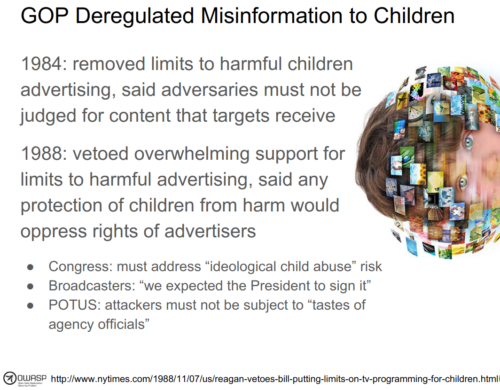
In fact, with history as our guide, we can see how President Reagan’s concept of partnership with big technology was to remove protection of American children from predators (promoting “ideological child abuse” for profit), as I explained in my 2018 OWASP talk “Unpoisoned Fruit“.
I’m not saying it will be easy to rotate to populist solutions. It will definitely be hard to take on broad swaths of corrupt powerful leaders who repeatedly profit from poisoning large populations for personal gains.
Yet that’s the obvious fork in our road today, and even outside entities know they can’t thrive if Americans choose to be united again in their take-down of selfish profiteers who now brazenly argue for their right to unregulated harms in vulnerable populations.
If Zuckerberg were CEO of Juul… right now he’d be trying to excite investors by saying ten new fruity tobacco flavors are coming next quarter for freedom-loving children.
The boss of e-cigratte maker Juul stepped down on Wednesday in the face of a regulatory backlash and a surge in mysterious illnesses linked to vaping products.
I wrote in 2012 about the immediate need for regulation of vaping. Seven years later that regulation finally is happening, sadly after dozens have been dying suddenly and without explanation. A partnership with tobacco companies was never on the table.
Bottom line is if you ever wonder why a Republican party today would undermine FCC and CIA authority, look at FDR’s creation of them to understand how and why they were designed to block and tackle foreign fascist military and domestic disinformation campaigns.
As part of its services to the industry, FTI monitored environmental activists online, and in one instance an employee created a fake Facebook persona — an imaginary, middle-aged Texas woman with a dog — to help keep tabs on protesters. Former FTI employees say they studied other online influence campaigns and compiled strategies for affecting public discourse. They helped run a campaign that sought a securities rule change, described as protecting the interests of mom-and-pop investors, that aimed to protect oil and gas companies from shareholder pressure to address climate and other concerns…
Founded in 1982 in Annapolis, Md., as a firm that provided expert witnesses and presentations for litigation, FTI has grown into a multinational firm that employs almost 5,000 people in 28 countries. Its business spans a wide range of services, from business consulting to crisis communications.
‘increased users risk of remote video surveillance by strangers and remained on users’ computers even after they deleted the Zoom app, and would automatically reinstall the Zoom app—without any user action—in certain circumstances,’ the FTC said. The FTC alleged that Zoom’s deployment of the software without adequate notice or user consent violated US law banning unfair and deceptive business practices.
And they basically lied for years and years about security.
…Zoom claimed it offers end-to-end encryption in its June 2016 and July 2017 HIPAA compliance guides… also claimed it offered end-to-end encryption in a January 2019 white paper, in an April 2017 blog post, and in direct responses to inquiries from customers and potential customers… In fact, Zoom did not provide end-to-end encryption for any Zoom Meeting…
I’ve written before about Zoom’s egregious bad-faith business practices here and here.
“Because of the fear monster infecting this country, I have been asked for this poem, this song. Feel free to use it, record it, and share. Please give credit. This poem came when I absolutely needed it. I was young and nearly destroyed by fear. I almost didn’t make it to twenty-three. This poem was given to me to share.” — Joy Harjo
I release you, my beautiful and terrible
fear. I release you. You were my beloved
and hated twin, but now, I don’t know you
as myself. I release you with all the
pain I would know at the death of
my children.
You are not my blood anymore.
I give you back to the soldiers
who burned down my home, beheaded my children,
raped and sodomized my brothers and sisters.
I give you back to those who stole the
food from our plates when we were starving.
I release you, fear, because you hold
these scenes in front of me and I was born
with eyes that can never close.
I release you
I release you
I release you
I release you
I am not afraid to be angry.
I am not afraid to rejoice.
I am not afraid to be black.
I am not afraid to be white.
I am not afraid to be hungry.
I am not afraid to be full.
I am not afraid to be hated.
I am not afraid to be loved.
to be loved, to be loved, fear.
Oh, you have choked me, but I gave you the leash.
You have gutted me but I gave you the knife.
You have devoured me, but I laid myself across the fire.
I take myself back, fear.
You are not my shadow any longer.
I won’t hold you in my hands.
You can’t live in my eyes, my ears, my voice
my belly, or in my heart my heart
my heart my heart
But come here, fear
I am alive and you are so afraid
of dying.
a blog about the poetry of information security, since 1995