July 1st marks the beginning of a Civil War battle that many historians say is one of the most pivotal. And, as many historians also like to note, a love of pillaging Americans for their shoes supposedly is what drew pro-slavery forces arrogantly into Gettysburg on this date.
This topic of shaking-down hardworking Americans for their shoes is tied to General A. P. Hill. The man was a wealthy elitist who expected things for free (see also: slavery) and eagerly had abandoned his appointment in the U.S. Army to fight against freedom. To put it simply, Hill was committed to the violent expansion of slavery long after the practice had been abolished around the world.
Two decades before Hill was born, in 1807 the English already had abolished its slave trade. The idea of slavery became so unjustifiable in English society that by “1824 there were more than 200 branches of the Anti-Slavery Society in Britain“. No surprise then the agrarian state of New York abolished slavery 1827, England emancipated slaves in 1833, English Colonies 1838…but I’m getting ahead of myself here.
Mary Wollstonecraft, credited with helping found modern British feminist ethics, famously wrote against slavery in 1792:
Is sugar always to be produced by vital blood? Is one half of the human species, like the poor African slaves, to be subject to prejudices that brutalise them, when principles would be a surer guard, only to sweeten the cup of man? Is not this indirectly to deny woman reason?
Wollstonecraft’s sentiment was shared in the colonies, believe it or not, and thus we see examples like the agrarian colony of New York debating how to expedite emancipation, two decades earlier than Wollstonecraft’s call for a boycott on slave-made goods:
Most of the Revolutionary leaders who came to power in New York in 1777 had anti-slavery sentiments, yet, as elsewhere in the North, the urgency of the war with Britain made them delay, and they restricted their activity to a policy statement and an appeal to future legislatures “to take the most effective measures consistent with public safety for abolishing domestic slavery.” This resolution passed in the state Constitutional Convention by a vote of 29 to 5.
Note the five dissenters. Obviously some in the 1700s were not quite convinced. And so by 1861 we have a treasonous General A. P. Hill taking up arms against his own country. In a nutshell, many white elitist men in America did not want to do hard work and believed their easy/lazy lives and financial inheritances (see also: people treated as property to be bought and sold) were threatened unless they could continue to enslave Americans and steal their goods.
Today you may be surprised to see the U.S. Army has named a fort after an infamously treasonous and foolish man like A. P. Hill. Given that he dedicated his life to killing American soldiers for personal profit, who thought this made any sense?
The installation was named in honor of Lt. Gen. Ambrose Powell Hill, a Virginia native who distinguished himself…
Please take special note of the fact that the U.S. Army doesn’t call the person they are honoring an American, because his treason to preserve slavery by killing Americans, killed his citizenship.
Also nice try U.S. Army with your Virginia reference. Obviously Hill was far from being a true native of Virginia.
That being said I must agree with the second part of the sentence, this treasonous man hateful of his own country certainly distinguished himself. The U.S. Army doesn’t mention it but his impatience, as well as lust for plundering Americans and putting people in chains, may have led to one of the greatest tactical blunders in U.S. military history. So distinguishable.
Also he contracted gonorrhea while a cadet at West Point, screwed around so much he graduated late, and became known for taking “sick leave” right in the heat of any major battle.
Now, to be fair to Hill being so distinguished, I must admit he shared poor decision-making with his pro-slavery General Heth on June 30th, 1863. Heth had ordered his pro-slavery General Pettigrew to enter Gettysburg and ransack it. Pettigrew had followed these orders at first but turned tail after he observed American cavalry and infantry already near the town.
In “The Civil War: A Narrative” there’s a scene where Hill approaches Heth and hears of Pettigrew’s reluctance. Hill, our man of the hour, then insists to Heth there can be no significant American forces present.
OOPS.
The narrative tells us Heth obediently then sends his Pettigrew back once again to plunder Gettysburg and “get those shoes!”
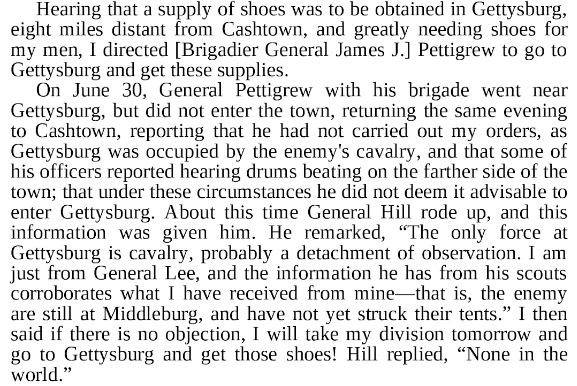
Narratives aside, by 5AM on July 1st, as Heth himself approached Gettysburg to damage it, he realized Pettigrew had been right, Hill was stupidly wrong, and significant numbers of American forces were present. Yet even that didn’t dissuade Heth, who continued ordering Pettigrew to march on.
Hill’s insistence that he conferred with Lee and there would be no resistance to plunder seems to be the real story here, shoes or not. There was an inherent desperation of Lee and his pro-slavery men to plunder America (see also: slavery), which on this particular day began the largest land battle in the western hemisphere, lasting 3 days and killing nearly 50,000 people, to the disadvantage of pro-slavery forces.
One of the stranger footnotes (no pun intended) to this story is that while Gettysburg had a lot of American forces defending freedom, it didn’t have any shoes.
These pro-slavery Generals, all of them, not only chose to be blind to the evils of slavery, they also were blind on two more levels. A particularly inhumane General with the ironic name of Early (infamous for helping to invent the “Lost Cause” view) had tried to pillage Gettysburg days before Heth had set his sights on it.
This means Americans living in Gettysburg already had been subjected to pro-slavery militia demanding ransom in 1,000 shoes and attacking the town.
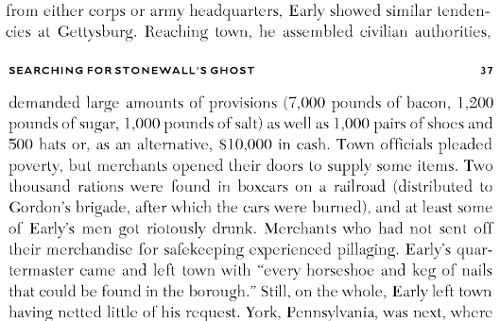
No shoes were found, as you can plainly read here:
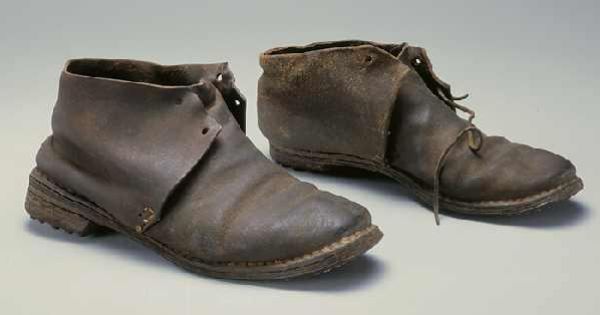
Had there been any shoes, they might have been the standard issue “Jefferson Boots”, named after Thomas Jefferson who is thought to have created an American fad for French ankle-high laced shoes by wearing them instead of previously common English ones with large buckles.
However, again I must say, NO SHOES IN GETTYSBURG.
So for those historians arguing pro-slavery forces really centered their offensive on shoes, maybe put a sock in it.
Is there any evidence that pro-slavery General Early told others that the town couldn’t cough up any Jefferson boots despite his violent demands? Lee and Hill both supposedly had scouts relaying information but perhaps it wouldn’t have made any difference what Early said, given how Pettigrew was rebuffed when he tried to explain the dangers of trying to plunder Americans on this day.
To put this in perspective, it’s not like in the days leading up to the Gettysburg battle someone could tell Lee or Hill that slavery is unjustified and they would listen; if these men wanted stealing to be in their plans, they were going to threaten and kill Americans until some damn things to steal were found or everyone was dead for refusing to see things the pro-slavery way.
Again, Hill quit the U.S. Army to plunder America in the most unjustified way to retain elite status. In that sense Gettysburg was simply another day of plunder to Hill and his men, whether stealing goods, separating babies from mothers, or perpetuating slavery to improve his own status at the expense of others.
Within three days pro-slavery forces had been destroyed at Gettysburg, which helped signal an end to their plans to use violence against fellow citizens to expand slavery practices into western territories (what the war was really about); 60 years after England had abolished slavery, and 30 years after slaves in America (if still colonies) would have been emancipated, the self-proclaimed “elite” white supremacists fighting to perpetuate obviously tyrannical practices of their former King were defeated (pun not intended).
Also, just as one final footnote, I think it is time for the U.S. Army to officially remove honors to Hill. I say that not only because Hill was a murderous traitor and terror to Americans, but also because we could say he finally got the boot he so desired.





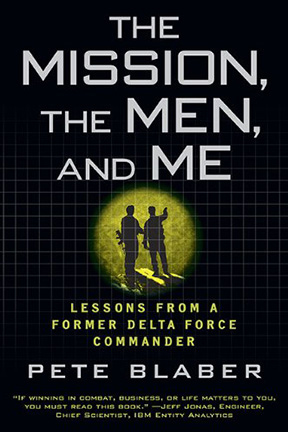 Pete Blaber’s book “The Mission, the Men, and Me: Lessons from a Former Delta Force Commander” gets a lot of rave reviews about business practices and management tips.