
This story starts on 12 May 2026, in the run up to the AFCEA trade show in Bonn, when Deutsche Telekom and Rheinmetall announced a joint drone shield for German critical infrastructure. Their release said they had split a detection problem into parts.
The first part was ISM bands at 2.4 or 5.8 GHz, and passive RF scanners on cell towers to identify those by protocol signature. That was depicted as the shield.
The remaining part said flights were on mobile networks with a SIM inside. The release called it a research area, basically admitting a hole in the shield, pointing to the Helmut-Schmidt-Universität in Hamburg for current state.
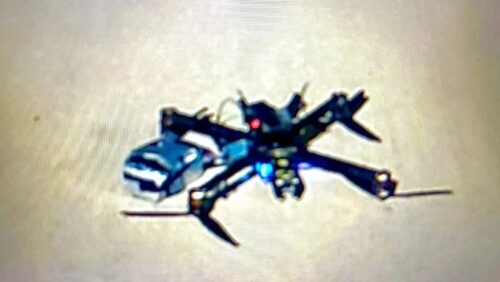
Twelve weeks later, on the evening of 4 August, a drone carrying Semtex and PETN in a sealed food can came to rest against a Ukrainian An-124 at Standplatz 213 of Leipzig/Halle airport. According to ZDF frontal and a joint WDR/NDR/SZ report cited by the NZZ, the drone carried two SIM cards and a 5G router, exactly as Telekom had described as the hole.
WWI isn’t forgotten
Recently I pointed out how modern OPSEC descends from the Russian Second Army broadcasting its marching orders in the clear before Tannenberg in 1914. The May release press by Telekom is not some obscure brief. It was the largest German carrier and the largest German arms maker describing their slow moving front line, and weakness in their flanks.
Reading it reminded me of how the Russian General shot himself to death after making a similar mistake. The RF part is the known position: Telekom says it has located illegal drone flights for police since 2017, including during the 2024 European Championship. Because the mobile space was described as research only, anyone planning anything was handed a map. The proposed technique is to setup passive radar, reading timing changes in reflected cellular signals across at least four masts to build a movement picture. Using detection in physics instead of a link makes sense and is the right direction. However, it telegraphs to attackers that the physics techniques are not yet deployed anywhere, and certainly were not on 4 August.
Every post-incident statement I have found from the vendors has been talking about the wrong part of this story. Rheinmetall’s Armin Papperger told dpa the company is working with Telekom to use cell towers for early drone detection nationwide. Cell towers with RF sensors detect the 90 percent. The Leipzig drone was in the other ten. As a ZDF drone expert put it, the drone was indistinguishable from a mobile phone to a frequency scanner at the airport.
That method is very, very well known and studied in cyber security, because attacks are stuffed into data channels to make them difficult to block. It’s a matter of getting the detection systems pointed into the right channels at the right time.
Detection by declaration
The May release had another note about detecting cellular drones: 5G network slicing, meaning they would shift to a dedicated data lane for drone control. A slice identifies the drones that register in it. An attacker would use their regular consumer SIM, on the general slice, and the special drone channel would see exactly nothing. This is the counter-UAS equivalent of asking passengers to declare intent not to bomb a plane and calling the declaration a control. Cooperative identification has value for airspace management without attackers. It has none when the attackers appear as everyone else does.
The same logic applies to the detection systems installed at Leipzig. Security sources told ZDF that whether and why triggers failed remains under investigation. Airport counter-UAS is built on signatures of a point-to-point link between a controller and an aircraft. It is behavior prediction: an object that behaves like a drone on the spectrum is flagged. This attack device behaved in a way that fooled the detection. So a loaded high-risk cargo aircraft was proven to be exposed to public airspace for four hours, until a bus driver kicked the attack drone over at 23:42.
Carrier records were recording
Investigators did not find the operator through the airport, because instead they found a direction. ZDF frontal reported on 18 August that analysis of 5G radio data and the seized SIM cards pointed to a cell sector in Sachsen-Anhalt near Merseburg, roughly ten kilometres from the scene, the direction from which a second drone allegedly flew. Bild had earlier reported a third SIM located in the same area. A special police unit searched there without result.
That is a Funkzellenabfrage on traffic data, which the Bundesverfassungsgericht knows well because they have two decades experience fencing it in. It worked here for two simple, yet volatile, reasons: the drone was recovered intact including SIMs, and the carrier stored those recent records. Neither is something security can bank on, usually. The German state had no targeted detection setup for cellular-controlled drones, so attribution flipped to bog-standard telecom metadata after the fact. Leipzig will most likely be cited in the next round of the Vorratsdatenspeicherung debates. Cell metadata retention became the attribution method for a critical sensor design failure at an airport perimeter.
Pilotless Schengen
In March, I wrote about the FOI taxonomy of convicted spies in Europe: the Observer, the Disposable, the Mobile Spy exploiting open borders. The model assumed the disposable one is who carries out the act. Leipzig separates the roles. Someone in Germany placed a small antenna in a tree at Kursdorf, north of the airport, which investigators believe served as a signal amplifier, and someone delivered the explosives. The reporting tells us a pilot needed internet. As the ZDF expert said, a café in Leipzig or a chair abroad would do equally well.
The two suspects identified on 2 September by NDR, WDR and SZ fit exactly that split. A Russian-born Latvian passport holder, described as the logistician and instructor, entered through Berlin in late July, drove to Leipzig, and flew out two days before the drone launched. A Belarusian with a Russian passport, in Schengen on an Italian tourist visa issued in Minsk, left DNA on the drone, inside the explosive can, and on the antenna in the tree. The hands were caught on DNA. The instructor was gone before the flight. The pilot is still unidentified. Dobrindt called them Low-Level-Agenten, which is the ministry’s word for disposable.
Every counter-sabotage approach that rests on catching the person who flies is going to run into the cybersecurity problem of the last 20 years at least. You get the mule, the person who installs, and that’s it. The skill and the risk are decoupled by design. German intelligence has already said as much. The joint BKA, BND, BfV and BAMAD warning I covered on the Leverkusen rail sabotage describes Russian services recruiting locals through social media and messenger apps, directly or via intermediaries.
Sequencing
The attribution path in the press doesn’t have much to it. On 7 August, two days after the discovery, the Wall Street Journal reported that US officials assessed the drone as likely linked to the Russian government. On 25 August, flight-tracking data showed a US government transport from Joint Base Andrews landing in Moscow; the Washington Post and CNN identified the passenger as CIA Director John Ratcliffe, carrying a message about attacks on NATO territory, with preceding intelligence flagging sabotage, cyber and drone operations.
On 27 August, ABC News quoted a US official calling the explosives and device structure typical of the GRU. On 1 September the Interior Minister Dobrindt stated that police investigations, the pattern of the act and intelligence findings together established Russian responsibility. The government closed the Russian consulate in Bonn. That same morning, before the announcement, self-built rockets fitted with explosives hit the 50Hertz substation at Turnow-Preilack that feeds Jänschwalde into the grid; Brandenburg police opened a “129a” investigation, the terrorist organisation statute.
No source connects the Ratcliffe trip to Leipzig. I am placing them in one timeline because they occurred in one. The evidentiary basis for German attribution has not been published. I’m simply pointing out the sequence where Washington held an assessment within 48 hours, delivered a warning in person three weeks later, and then Berlin’s uncharacteristically formal attribution to Russia followed the warning by a week. Whether that reflects coordination, German realization they can’t trust America, or a new pace of Bundesanwaltschaft work, is all unknown. It remains the same minister who, after the Berlin blackout, ruled Russia out on ZDF before the investigation was finished.
Target exposure
The Antonov, according to SZ citing police reports, had flown ammunition from France and it was still on board. Leipzig has a public role in the Ukrainian airlift and every charter announces itself on ADS-B. Russia is of course watching it all with minimal cost, just like the rail line north of Leverkusen that burned in July.
The question the vendors have been answering is how they can recognise a drone. But the actual question from this incident veers more towards why a loaded aircraft sat reachable from public airspace for four hours by any object that did not match a signature. Allow list, not a deny list. Recognition is a prediction that leaves open the historic failures of systems that rely on consistency in attacks to get a “feeling” of safety. Reachability is reality, and it says German site risk isn’t being managed properly. The Telekom release told us in May that Germany not only was expecting attackers to self-identify, but that the flanks were sitting open on a slow-moving frontal defense shield.
Source caveats
The SIM, router, antenna and relay details come from security sources via ZDF frontal, WDR/NDR/SZ, Zeit and Bild, consistent across five outlets and confirmed by none officially.
The Merseburg cell sector is single-source to ZDF frontal. The suspect identities are NDR/WDR/SZ with ZDF and Zeit corroborating, and Zeit reports the Bundesanwaltschaft is investigating two people; the office itself has not commented on identities.
The France ammunition detail is single-source to SZ. The Bundesanwaltschaft’s own 6 August release confirms only professional explosives, a detonator, and a probable second drone.
The Telekom/Rheinmetall release is primary and public.
Everyone is still acting like the network is dark. Nobody has asked why cyber evidence is missing from attribution. The answer is attackers used the mobile network to stay anonymous, the state uses the same network to collect intelligence. Who wants to expose it?
The network leads to servers. DNA leads to people. The Bundesanwaltschaft charges people. It does not charge Russia. So the case file will name the two Low-Level-Agenten, and the minister will name Russia, and the cyber evidence that connects them will not surface.
German law says reading cell records near Merseburg was a police task under 100g StPO, so it was reported. Following the link to a server abroad is BND work, which will only reach a court as “nachrichtendienstliche Erkenntnisse.” That is why Dobrindt’s attribution on 1 September had three pillars yet only two with any content. The US said the same thing in two days, because it is a single view with nothing to file.