
ICE’s plan for Socorro, Texas puts 8,500 beds into 826,780 square feet of warehouse. Ninety-seven square feet per person, gross, in a standard design whose documents list holding areas, gyms, cafeterias and a gun range.
That’s big. Very big.
Now apply that same density to the floor space of the 474 AI data centers on Erin Brockovich’s community map and the buildings hold 8.7 million people. That is 63 percent of everyone living in the United States without status. Count only the floor space running today and the buildings hold 561,000 people, eight and a half times the number ICE had in custody at the last count.
Let’s be honest about history, as I didn’t go to LSE for nothing. If we know anything at all about President Jackson, Trump’s favorite, we should strip the word datacenter from the map and read the buildings as removal camps. Jackson’s genocidal Removal Act of 1830 gave the policy its word, and the stockades of 1838 cruelly held the Cherokee through a summer of disease before the trail of tears killed about a quarter of them, with as many again dead after arrival, by Russell Thornton’s reckoning.

Seen as labor camps the major complaints the towns have been filing suddenly vanish, almost too easily.
| The complaint | The camp function |
|---|---|
| Too much water | Deprivation |
| Too much energy | Deprivation |
| Too few jobs | Slave labor |
The Map
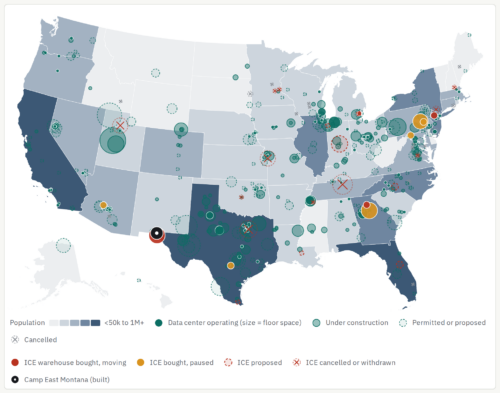
Map 1. Data center floor space counted as camp capacity. Shading is the unauthorized population by state (MPI, 2023). Teal markers are the 474 facilities on the Brockovich map, sized by estimated floor space. Red and amber markers are ICE’s warehouse purchases.
Two conversions make the map useful and both come from published figures. Stargate Abilene is about 4 million square feet for 1.2 gigawatts and xAI’s Colossus is 785,000 square feet for its first 150 megawatts, so one gigawatt is roughly 4 million square feet of shell at 250 watts per square foot. ICE’s own Socorro plan supplies the second figure, 97 square feet per bed. The Brockovich dataset, built on Compute Atlas and Epoch AI, claims 211 gigawatts across the country, 13.6 of them running. That is 846 million square feet claimed and 54 million built.
| State | Beds at ICE density | Unauthorized residents | Coverage |
|---|---|---|---|
| Texas | 2,250,000 | 1,966,000 | 114% |
| Utah | 957,000 | 138,000 | 693% |
| Pennsylvania | 528,000 | 250,000 | 211% |
| New Mexico | 383,000 | 63,000 | 608% |
| Ohio | 356,000 | 90,000 | 396% |
| Indiana | 339,000 | 137,000 | 248% |
| Georgia | 329,000 | 479,000 | 69% |
| Arizona | 304,000 | 307,000 | 99% |
| Illinois | 267,000 | 588,000 | 45% |
| Florida | 62,000 | 1,223,000 | 5% |
| California | 56,000 | 2,910,000 | 2% |
| New York | 47,000 | 836,000 | 6% |
| United States | 8,719,000 | 13,737,000 | 63% |
Beds divide estimated floor space by 97 square feet. Population is the Migration Policy Institute’s 2023 estimate. At 500 watts per square foot, the densest halls now being built, the claimed floor space still holds 4.4 million and the running floor space 281,000.
Texas alone claims 218 million square feet, enough to hold every unauthorized resident of the state with room to spare. Utah’s campuses would hold seven times Utah’s unauthorized population, New Mexico’s six times, Ohio’s four. California, New York, Florida and Illinois hold 40 percent of the people and 5 percent of the floor space.
The Geometry
The German camps sat far from the people they were built for. Berlin alone held a third of the country’s Jews, and the cities held the Communists and Social Democrats. The camps went to a disused munitions works outside Munich, a moor at Esterwegen, the Ettersberg above Weimar, a quarry at Mauthausen. The Reichsbahn moved the population to the site. A gap between where people live and where capacity is built is the signature of a camp system, as seen on the map.
There are two logical steps in sequence for how sites were set, which also are on the map.
The First Logic: Custody Where Labor Is Free
Prussia placed camps in the Emsland moors in 1933, and by 1934 the Justice Ministry ran them as prison labor camps cutting peat. In 1938 the SS founded its own quarrying company, Deutsche Erd- und Steinwerke, and from then placed Flossenbürg, Mauthausen, Gross-Rosen and Natzweiler at granite quarries, Neuengamme at a brickworks. The prisoner was free labor attached to a resource, and the camp went to the resource.
The American jurisdiction for that arrangement is the Thirteenth Amendment exception, used in full in seven states that pay prisoners nothing for regular work: Alabama, Arkansas, Florida, Georgia, Mississippi, South Carolina and Texas (ACLU and the University of Chicago Law School Global Human Rights Clinic, Captive Labor, 2022). Texas, Mississippi and Georgia rank in the top twenty states for data center floor space per resident. Texas and Georgia hold 20,000 of the 34,000 warehouse beds ICE has bought.
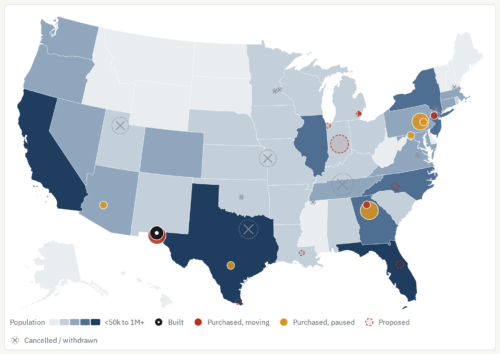
Map 2. ICE’s Detention Reengineering Initiative against the unauthorized population by state. Sites are sized by planned beds and colored by status.
The Bureau of Justice Statistics’ 2023 imprisonment rates against floor space per resident give a rank correlation of 0.46 across the fifty states, 0.50 with Utah removed. By quartile of floor space per resident, mean imprisonment rates run 356, 381, 318 and 226. The ten states that imprison the fewest people, Massachusetts through Washington, all sit in the bottom twenty for floor space, seven of them in the bottom twelve, four with none at all. States that decline to imprison their own residents decline to host this floor space.
| State | ICE beds bought | Imprisonment rate 2023 | Floor space, sq ft per resident |
|---|---|---|---|
| Texas | 10,000 | 477 | 7.1 |
| Georgia | 10,000 | 449 | 2.9 |
| Pennsylvania | 9,000 | 300 | 3.9 |
| Arizona | 1,500 | 448 | 3.9 |
| Maryland | 1,500 | 261 | 1.5 |
| New Jersey | 1,500 | 125 | 0.2 |
| Michigan | 500 | 328 | 1.1 |
Imprisonment rate is sentenced prisoners per 100,000 residents (BJS, Prisoners in 2023, Table 7). Floor space per resident uses Census 2023 population estimates.
The Second Logic: Industry Where Water and Fuel Are Cheap
IG Farben chose Auschwitz in 1941 for Silesian coal, the water of the Vistula and the Sola, limestone and the rail junction. Its planners reported the camp’s labor as a further advantage, and the SS built Monowitz beside the plant. The campuses that break the prison correlation follow this logic. Creekstone’s 10 gigawatt site at Delta, Utah, the town beside the Intermountain Power Plant, runs on its own gas and solar on state trust land. Homer City in Pennsylvania is a dead coal plant converted to gas. Project Jupiter at Santa Teresa, New Mexico runs on an on-site gas microgrid, the 7 gigawatt Lea County proposal sits on the Permian Basin, and Alaska’s North Slope proposal would run on its own pipeline. Utah imprisons 186 people per 100,000 and has the largest campus in the country under construction, while Salt Lake City stopped the ICE warehouse with a water ordinance. Monowitz siting puts water and fuel first. Custody arrives afterward.
The two logics converged in 1942, when armaments plants pulled roughly a thousand subcamps to the factories and the prisoner followed the machine. This history lens yields a prediction. The next purchases in America will land at power and water in unpaid-labor states, while the transit sites stay at the rail heads and airports. Texas already fits all three.
Water, Energy, Jobs
The city of Social Circle, Georgia locked the water meter on the million-square-foot warehouse ICE bought for a 10,000-person mega-center. From the city’s statement:
Our permit to draw water out of the river is 1 million gallons a day. Our sewer plant can process 660,000 gallons per day and is at capacity. Their BLUF analysis indicates a daily water and sewer need that exceeds these amounts.
ICE’s Detention Reengineering Initiative answers with engineering reviews to make every site run independent of local water, power and wastewater. The town holds the valve today. The plan moves the valve inside the fence, where the operator decides who gets water. That is the kwanliso configuration, a self-contained site where provisioning is at the guard’s discretion and deprivation is the baseline condition of the site.
The Atlantic ran Elias Wachtel’s “The Data-Center Panic Is Overblown” in June and Andy Masley’s “The Data-Center Debate Is Divorced From the Facts” on 19 September, the second written, by the magazine’s own disclosure, on a grant from Coefficient Giving, the renamed Open Philanthropy, whose principal funder Dustin Moskovitz is an investor in Anthropic. Both essays argue at the national average, where water per query is trivial and grid strain is manageable. Social Circle measures its own river. The 1941 method chose sites by local water and local coal, and a town that reads its permit against the project’s demand is reading the project the way its builders do.
The jobs claim resolves the same way. ICE told Salt Lake City a warehouse for up to 10,000 people would bring almost 10,000 jobs. Detainees already do the cooking and cleaning in ICE facilities under the $1 a day “voluntary work program,” and GEO Group lost about $23 million in Tacoma in 2021 over it. In the German system the SS rented prisoners to firms at three to six Reichsmarks a day, so the prisoner was revenue. Here ICE pays GEO and CoreCivic per bed-day, so the bed is the product and the body is a cost, which is why this system builds capacity first and finds people second.
The density is already documented. The DHS Inspector General’s report of 14 September 2026 on the Everglades camp found 79 detainees confined in metal enclosures of about 18 square feet, for periods up to two hours, and housing that gave detainees less than half the living space federal standards require.
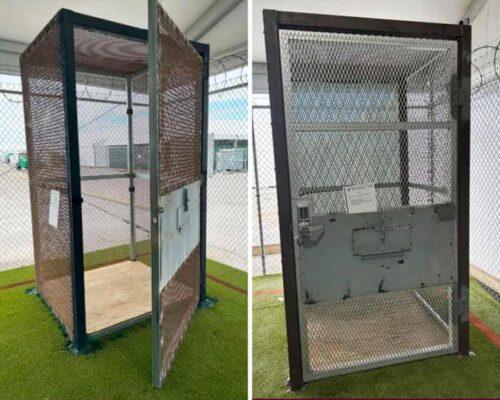
The posted policy on the enclosures:
safe and secure place in general population for detainees to reflect on their behavior choices, manage their emotions, reduce stress, and practice self-directed behavior
| Square feet per body | |
|---|---|
| 42U server rack, plus aisle | 8, about 25 |
| Birkenau horse-stable barrack, 400 assigned | 10 |
| Everglades “calming area” enclosure | 18 |
| ACA standard for multiple-occupancy housing, unencumbered | 25 |
| ICE Socorro plan, gross | 97 |
Processing Becomes Terminus
Trump set the number himself. In his interviews with Time on 12 and 27 April 2024 he put the population at “probably 15 million and maybe as many as 20 million by the time Biden’s out,” and answered the question of camps with “I would not rule out anything,” adding that there would be little need for them because the people would be taken out of the country quickly. In December 2024 he told the same magazine, “I want them out, and the countries have got to take them back.” Stephen Miller had already described to the New York Times, in November 2023, vast holding facilities to be built by the military on open land near the Texas border. Twenty million is ten times the entire American prison and jail population and beyond any camp system ever operated; the Gulag peaked near 2.5 million and the German system near 700,000 held at once in early 1945. The plan’s premise is an open exit, and the countries taking people back is the condition that fails first.
Population equals flow times dwell. ICE holds about 65,765 people, has removed 356,389 in this fiscal year through mid-July, and reports an average stay of 52 days, up from 42 in 2022. Sixty-five thousand divided by 52 days times 365 is 462,000 a year, which is the removal pace. The pipe is balanced. Add the plan’s 92,600 beds and the system holds 158,000, which at 52 to 60 days is a pipe for one million a year, the administration’s stated target. The size is transit-sized. The design fails at the exit, because intake is the only variable the operator controls. Removal depends on flights, receiving countries and 570 immigration judges facing a 3.3 million case backlog with waits near 900 days. The release valve is gone: since July 2025 ICE reads section 1225 to deny bond to anyone who entered without inspection, and the Board of Immigration Appeals agreed in Matter of Yajure Hurtado. Any reservoir whose outlet is smaller than its inlet fills. Terminus arrives by arithmetic.
That is the German sequence, read correctly. Heydrich’s Schnellbrief of 21 September 1939 (Nuremberg document PS-3363) separated the immediate concentration of Jews in cities from the goal it served:
Es ist zu unterscheiden zwischen 1. dem Endziel (welches längere Fristen beansprucht) und 2. den Abschnitten der Erfüllung des Endziels (welche kurzfristig durchgeführt werden).
Hitler had set that final goal in his letter to Adolf Gemlich of 16 September 1919, fourteen years before he took power: “die Entfernung der Juden überhaupt.” The exit was removal. Emigration first, then the Nisko reservation in October 1939, then Madagascar in 1940. Each closed. Emigration was banned outright on 23 October 1941, and the holding pens turned terminal by attrition, about 43,000 dead in the Warsaw ghetto in 1941, then by decision. The Wannsee protocol of 20 January 1942 (NG-2586) records the substitution in one sentence:
An Stelle der Auswanderung ist nunmehr als weitere Lösungsmöglichkeit nach entsprechender vorheriger Genehmigung durch den Führer die Evakuierung der Juden nach dem Osten getreten.
Emigration out, evacuation to the East in. The verb stayed the same and the destination changed. Slavery was a 1942 addition when the war economy needed hands, and Vernichtung durch Arbeit came with the Thierack-Himmler agreement of 18 September 1942 (PS-654). “Removal” is the same destination-agnostic verb.
The American exit is already being redefined the same way. When a country declines to take someone back, the answer since the Supreme Court’s June 2025 order in DHS v. D.V.D. is a third country, and CECOT was the proof of concept: 238 Venezuelans flown to a foreign prison on 15 March 2025 and held there uncharged for four months. That is a terminus, built offshore. Zadvydas v. Davis caps post-order detention at a presumptive six months; third-country removal is the workaround. Deaths in ICE custody reached 25 in fiscal 2025, the most since 2004, and fiscal 2026 passed that total by the end of March with 26.
| Germany 1933 to 1945 | United States 2025 to 2026 | |
|---|---|---|
| Building | Munitions works, brewery, mill, moor barracks; from 1942 a standard horse-stable type | Logistics warehouses, 250,000 to 1,000,000 sq ft; “standardized design” |
| Site | Away from the cities; at quarries, brickworks, rail junctions; Auschwitz for coal and water | Away from California, New York, Florida; Socorro, Social Circle, Tremont; campuses at power plants and gas fields |
| Water and power | SS-controlled; Birkenau without washing barracks until 1943; DPRK huts without electricity | Sites engineered independent of local water, power, wastewater; towns locking meters |
| Dwell | Transit camps: Westerbork about 10,000 held, 100,000 through; Drancy 5,000 to 7,000, 65,000 through | Processing sites 3 to 7 days; mega-centers 60 days; 52-day average today |
| Labor | Prisoner rented to industry at 3 to 6 RM a day; the body was revenue | Bed-day paid to operator; $1 a day work program; the body is a cost |
| The word | Aussiedlung, Evakuierung, Endziel | Removal, remigration, self-deportation |
| Exit | Emigration until 1941; then “the East”; DPRK kwanliso: none | Removal flights; third countries since June 2025; CECOT |
| Jurisdiction | Schutzhaft, custody outside the courts | Civil detention; bond denied under section 1225 since July 2025; federal ownership to bypass state law |
Who Is Building It
The people choosing this were raised inside what it produces. Elon Musk’s grandfather Joshua Haldeman led Technocracy Incorporated in Canada, was arrested in 1940 when Canada banned the movement as a national security risk, chaired Social Credit in 1946 while its members read the Protocols into Hansard, and told Die Transvaler in 1951 that Canada’s attitude had encouraged him to settle in apartheid South Africa. Peter Thiel’s father left Germany as the 1968 anti-Nazi movement rose and placed his son in the German school at Swakopmund, where the New York Times found “Heil Hitler” in use as the everyday greeting in 1976, while he managed construction of the Rössing uranium mine for the apartheid nuclear supply chain. Stephen Miller writes “remigration,” the Identitarian term, and the State Department proposed an Office of Remigration. Musk told an AfD rally in Halle to stop dwelling on past guilt.
People who reach for the vocabulary of 1941 and site their buildings by its method have read the manual, or were raised by people who relayed it to them.
The precedent that fits best is Monowitz, where private capital chose a site for coal and water and bought custody from the Nazi SS as an input. The data center is a private plant and ICE is the supplier. That is the Nazi arrangement that ended worst of all, and it is the one being built.