Category Archives: Energy

The Venezuelan Profit Motive in U.S. Closure of Hormuz

The Strait of Hormuz was operational until Trump unilaterally launched U.S. military action against Iran to predictably close it. Why would America close the strait? I find many people still scratching their head, especially after Trump announced he would keep the strait blockaded if Iran tried to open it. He clearly doesn’t want it to be open, even as oil prices go higher and higher.

Oil prices directly hit American pocketbooks. But they also are being raised by a military disruption that costs taxpayers billions every day. This post takes a look at some causal relationships for all this cost landing on Americans, and how it appears to be a get-rich-quick scam by the Trump family.

The closure is the third such event in the modern history of the chokepoint. The first was the Tanker War of 1984 to 1988, in which Iraq and Iran attacked one another’s shipping and the United States reflagged Kuwaiti vessels under Operation Earnest Will. The second was the tanker attacks and seizures of 2019, including the limpet mine attacks in the Gulf of Oman and the seizure of the Stena Impero. The current closure is the longest, the most kinetic, and the first in which the strait has been mined as policy rather than as harassment. The actors are thus very familiar, while the new arrangement is not.

As everyone with a clue predicted, Iran executed its asymmetric strategy designed across four decades for exactly this moment. Mining the strait, attacking the Fujairah pipeline terminal, and striking shipping at the Hormuz approaches are all historic doctrine the Islamic Revolutionary Guard Corps has rehearsed since the Tanker War. The strait is the one instrument over which Tehran telegraphed their escalation dominance, and it is being used as designed.

The American response, branded Project Freedom, is a deployment of 100 aircraft and 15,000 personnel that the Pentagon says is not an escort mission. Earnest Will, in 1987, was an escort mission. Project Freedom however is the language of liberation attached to a permitting plan. The forces deployed are being called sufficient only for a traffic toll booth, declared insufficient to clear it and return to normal.

Venezuela puts all of this in proper context. The third actor in the arrangement is the one usually absent from press accounts of the Hormuz crisis. Maduro was captured on January 3, at great cost to the U.S. taxpayer, and Venezuelan hydrocarbon production was forcibly passed to U.S. operational control in the same week. Venezuelan crude is heavy, sour, and capital-intensive, meaning the economics all relate to high Brent prices and not the low ones. It goes something like this:

Price delta from the closure
Brent before the war $72
Brent today $114
Premium per barrel $42
Windfall at current Venezuelan output (350,000 bbl/day)
Per day $14.7 million
Per year $5.4 billion
Windfall at 2018 peak output (1.2 million bbl/day)
Per day $50 million
Per year $18 billion

The table lays out the operating subsidy for Venezuelan production, paid by every oil consumer. It appears at the pump in Iowa that Trump keeps talking about. But it also is in the diesel cost of a Bavarian trucking firm, and in the invoice of a Singapore shipping line, let alone all the manufacturing that depends on oil. Trump interference in Hormuz is driving the numbers up, in a way reminiscent of tin-pot dictatorships squeezing their populations before making a run for exile.

Marcos stripped the Philippine treasury and flew to Hawaii. Mobutu looted Zaire and died in Morocco. Ben Ali, Duvalier, all did the same play of extract while in office, exit as it fell apart. Manafort’s work with Somalia’s Barre, before advising Trump, is surely no coincidence. And that’s not to mention Manafort’s clients also were Mobutu, Marcos and Jonas Savimbi of Angola.

The Trump family is deep into Saudi LIV money and UAE real estate, making a $2 billion Affinity Partners deal via Kushner. Trump projects run in multiple Gulf jurisdictions, along with crypto holdings to escape American oversight. Trump is personally controlling Venezuelan oil proceeds through an offshore account in Qatar, with $250 million already awarded to Vitol whose senior trader gave $6 million to the 2024 campaign, and Paul Singer positioned to convert Venezuelan crude into refined product through distressed U.S. assets he is acquiring. It’s yet another pipe into the Trump extraction architecture.

As long as Brent stays above the threshold at which Venezuelan crude clears, the closure looks more and more like a very cynical Trump family business plan to pump, destroy and run.

Looking at how the other Manafort clients ended up, if Trump abruptly fled to Russia, Saudi Arabia or the United Arab Emirates, none of them would extradite him.

Speaking of the Gulf monarchies, they occupy a fourth position. Saudi Arabia, the United Arab Emirates, and Kuwait need the strait to export their approximately seventeen million barrels a day. With the Fujairah strike they lost their principal alternative. OPEC’s announced production increase, of several hundred thousand barrels a day, contrasts against a wartime loss estimated at approximately fourteen million barrels a day. Riyadh and Abu Dhabi have thus become consumers of a security framework they do not control, from an angry “sitting duck” President they can’t depend upon.

European and Asian importers typically have been absent from the strategic conversation, yet they also fit. Japan, South Korea, India, and the European Union receive the price signals and pay it. The South Korean-linked vessel that exploded at the strait on Monday is one example. Nations declaring energy crisis and immediate pivot to other forms of energy is another. Denmark this month paused new grid connections after capacity requests reached 60 GW against a peak demand of 7 GW, with data centers accounting for nearly a quarter of that. The Danish framed a pause as their window to rewrite how large electricity consumers can abruptly demand supply.

Kpler reports 170 million barrels of crude and refined product trapped on 166 tankers in the Gulf, against roughly 900 million barrels sidelined since the war began. Kpler also tells us it could take at least three months to clear the strait once it reopens. The duration of the closure, the rate at which it is relieved, and the sequence in which tankers depart are now functions of U.S. permitting decisions rather than maritime conditions.

Treasury Secretary Bessent stated on Monday that the world will be awash in Trump oil on the other side of the Trump closure. If we look at history, the Tanker War ended when Iran accepted UN Resolution 598 after the destruction of much of the Iranian navy in Operation Praying Mantis and the shootdown of Iran Air 655. America strategically forced that conclusion. Earnest Will ended when reflagged tankers no longer were needed. The present closure has no comparable analysis, because resolution doesn’t actually seem related to the dispute between Iran and Trump. Instead, closure appears more and more to be a cynical Trump gambit to corner the supplies for a price at which a separate set of investments, in a separate hemisphere, becomes profitable to him.

On that math the strait will reopen when an artificially high Venezuela price no longer needs to be defended.

Just a theory. But if the dictator shoe fits…
Trump Oil Disaster Has the World Going Oil Free

Presumably Trump thought, like some 1950s McCarthy buffoonish cartoon character, that he was going to violently corner oil, by deploying the U.S. military to take it all over like a gangster.

Predictably, that hasn’t worked. The stability of oil is gone forever. Chaos of Trump has become permanently attached to any concept of “centralized” fuel distribution like oil, because he is such an archetypical villain of centralization. Decentralized, sovereign, energy is on the table like it’s the 1900s again.

At COP30 in 2025, co-sponsors Colombia and the Netherlands announced the First International Conference on the Just Transition Away from Fossil Fuels. It will be held in Santa Marta in Colombia from 24-29 April.

“There is a clear momentum to phase out fossil fuels, and now is the time to capitalise on it,” said the Netherlands’ Deputy Prime Minister and Minister for Climate Policy and Green Growth, Sophie Hermans.

Existential AI Threat Friedman Warns About is Craig Mundie

Thomas Friedman calls Craig Mundie his “technology tutor.” He’s said it publicly, repeatedly, for over a decade. Perhaps it’s meant to sound endearing. It’s actually a sad confession. The most influential foreign affairs columnist in America openly outsources his entire understanding of technology to a single person. Why?

That person’s track record deserves closer examination within context of a larger institutional failure rated as success.

Microsoft Failure Man

In 1982, Mundie co-founded Alliant Computer Systems, a maker of vector-parallel mini-supercomputers. He became CEO. The company filed for bankruptcy June 5, 1992 because they didn’t see the PC coming.

He joined Microsoft that same year to run the Consumer Platforms Division. Here is what he built and championed:

Year Product / Initiative Outcome
1992 Windows CE Dead
1990s Pocket PC Dead
1990s Auto PC Dead
1997 WebTV Networks ($425M acquisition) Dead
1990s Interactive television Dead
2000s Digital rights management strategy Dead

When Bill Gates stepped back from daily operations in 2006, Mundie and Ray Ozzie were appointed to fill his visionary role. Mundie became Chief Research and Strategy Officer. During his tenure in that position, Google beat Microsoft to self-driving cars. Apple beat Microsoft to voice recognition with Siri. Microsoft missed mobile. Missed search. Missed social. Missed cloud computing until Satya Nadella arrived and reoriented the entire company away from the strategy Mundie had been overseeing.

To be fair, Ballmer overruled strategy recommendations, and search and social blinders may have been other divisions’ calls. But show me the wins. By late 2012, Mundie was moved to “Senior Advisor to the CEO,” the corporate equivalent of a quiet pasture upstate where his opinions wouldn’t be heard anymore. He retired in 2014.

Selling Invisible Pants to Elites

What happens to a technology executive whose products all failed but whose rolodex thrived? He becomes a bogus sage. Mundie landed on the National Security Telecommunications Advisory Committee under three presidents. Obama’s PCAST council. The Bilderberg Group steering committee, which he attended every year from 2003 to 2019 except one. The World Economic Forum. And then the capstone: co-authoring Genesis with Henry Kissinger and Eric Schmidt, a book about AI published in November 2024.

Kissinger.

The architect of the secret bombing of Cambodia. The man who backed the coup in Chile and the Indonesian invasion of East Timor. Who enabled the Pakistani genocide in Bangladesh. Who treated civilian populations as abstractions to be managed through force. This is who Mundie chose as his co-author on the governance of a technology that will reshape civilian life everywhere.

That tone-deaf choice tells you everything about the Mundie gambit: power managed by the powerful, consequences borne by everyone else. Talk down and ignore reality.

The technology product arc of disasters was foreshadowing. Build things that fail. Accumulate institutional access along the way. Pivot from practitioner to advisor once the failure pattern becomes undeniable. The access persists because Davos doesn’t audit skills like product launches. It rewards gravitas in presence.

The Column

This week Friedman published a column about Anthropic’s Claude Mythos announcement. His source for interpreting its significance was, naturally, Craig Mundie. The column treats Mundie’s analysis as authoritative. It contains Mundie’s three-step framework for responding to the threat. It quotes Mundie at length. It cites no other technical source.

Friedman writes:

[Mundie is] a former director of research and strategy at Microsoft, a member of President Barack Obama’s President’s Council of Advisors on Science and Technology and an author, with Henry Kissinger and Eric Schmidt, of a book on A.I. called Genesis.

Every word of that sentence is true. Every word of it is also designed to obscure the fact that Mundie’s actual technology career was a sequence of expensive bets that all lost.

The credential list substitutes for any actual performance record.

The Friedman column is similarly bad at placing bets. It describes AI-powered vulnerability discovery as if no one had ever heard of fuzzing, static analysis, or red team operations.

OMFG.

He illustrates the threat with a scenario where children accidentally take down a power grid. This is the Computer Fraud and Abuse Act (CFAA) debate of 1984, recycled. Congress passed it in 1986 after WarGames convinced legislators that teenagers with modems could launch nuclear weapons. Before that, Captain Crunch and the phone phreakers were going to launch nukes, shut down power or destroy the telephone system.

Did he just wake up from 1986?

By early 1999 I personally had reported clear text authentication on the American bulk power grid in five states. Thousands of routers vulnerable to trivial destruction. Did I break anything? The old geezer in a suit panicking that “kids will break everything” has been the go-to move for people who want to centralize control of new technology for forty years. Friedman presents it as an original insight, as if nobody remembers the 414s.

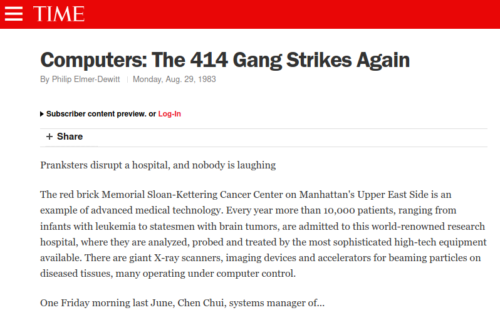
Time Magazine in August 1983, with a stern prediction that kids with computer access will get someone killed.
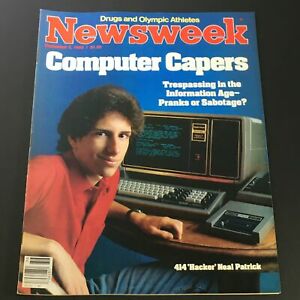
The youngest of the 414s on the cover of Newsweek, September 5, 1983

He proposes US-China cooperation on AI governance in the same week the US is actively restricting chip exports to China to prevent exactly the AI capability development he’s now asking them to collaborate on. He doesn’t notice this dumb contradiction because he’s transcribing, not analyzing. He would do far better to trust AI than the hallucinations of Mundie.

Meatspace

A columnist who calls someone his “tutor” on a subject is telling you he cannot independently evaluate what that person says. Friedman admits no second opinion on technology, and he lacks the technical literacy to know what questions would surface one. Mundie tells him this is unprecedented. Friedman writes that it’s unprecedented. Mundie says it requires US-China cooperation. Friedman writes that it requires US-China cooperation.

This is how a man who got WebTV, Windows CE, the Pocket PC, interactive television, and digital rights management wrong becomes the person explaining artificial intelligence threats to New York Times readers.

The technology tutor model has an obvious flaw. The student can’t evaluate the false tutor, because the student can’t evaluate the subject. He can only evaluate the tutor’s confidence, which is deeply ironic. Just like the real danger with a bad AI chatbot, confidence is the one thing Craig Mundie has never lacked.

The threat of AI is the relationship Friedman has with Mundie, not the AI.

BYD Nail in Tesla Coffin: Test Proves Only One Has Cells That Don’t Burn

Tesla simply buys battery cells from Panasonic and CATL and calls itself an innovation company.

Panasonic has sold its entire stake in longstanding battery partner Tesla for about ¥400bn ($3.6bn)

Tesla simply has Siemens build factories for it, assembles parts, and calls itself a manufacturing company.

Musk called the Siemens chief and said, “I want to build electric cars, but have no idea how to do it.” There were many problems with the ramp-up of the factories, because Musk did not even know how to help himself.

Tesla simply suppresses death, fire and crash data, and treats safety failures as PR problems rather than engineering problems.

All in all, Tesla has turned out to be the worst car company in history, with numbers of unnecessary and predictable deaths in the hundreds that continue to rise.

To understand the significance of the Tesla fraud, let’s rewind to when Musk in 2011 laughed nervously on camera when a reporter asked him about BYD as a competitor. It was just like when Blackberry laughed at the iPhone. The reporter foolishly let him off the hook, unable to press him to a real explanation. Why was he so scared he burst out laughing? Why did he keep laughing when she tried to ask for reasons?

Today we see BYD, unlike Tesla, dominates the market with real innovation and real engineers. They manufacture their own cells, motors, chips, and software. And most notably, they have progressed significantly while Tesla has not at all. You could buy a 2012 and a 2026 Tesla and wonder what changed if anything.

BYD said on Thursday that sales of its battery-powered cars rose nearly 28% to 2.26 million units in 2025. Vehicle deliveries at Tesla dropped 8% year on year to 1.64 million vehicles delivered in 2025.

BYD had a fatal battery fire in 2012. But BYD admitted the failure was theirs, and spent eight years engineering it completely out of the physics. Their cells don’t burn now. Tesla had fires starting in 2011 and by comparison did nothing. They have since had hundreds of battery fires and Autopilot fatalities. They responded only with a fog of PR, NDAs, and data suppression. Tesla cells burn dangerously sudden and hot and everyone knows it.

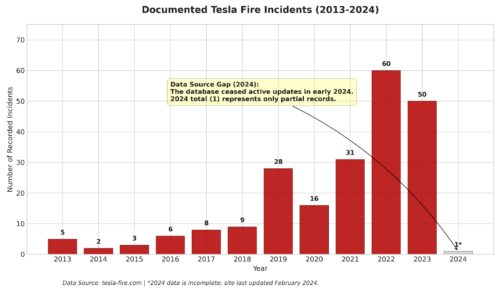
Total Tesla Fires as of 4/4/2026: 232 confirmed cases.

Fatalities Involving a Tesla Car Fire Count: 83

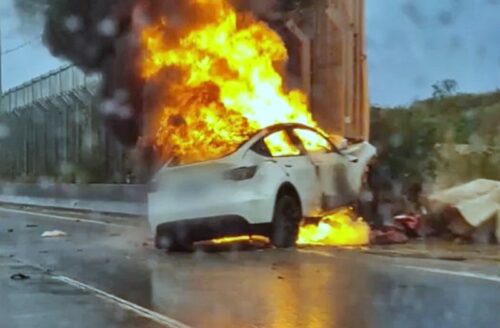
Teslas notoriously “veer” uncontrollably and crash. Design defects (e.g. Pinto doors) trap occupants and burn them to death as horrified witnesses and emergency responders can only watch helplessly. Source: VoCoFM, Korea, 2024

The BYD battery nail test is the difference made visible. The NMC chemistry Tesla uses detonates like a bomb on puncture and occupants are burned to death. BYD’s LFP Blade Battery does NOT burn. That’s not a marketing claim. That’s the physical property of the cell. Tesla can’t pass the test.

This is because of two completely different institutional responses to killing people with a product. Wang Chuanfu lost sleep, pulled his engineers together, and demanded they reproduce the failure mechanism until they understood it completely. Musk slept like a baby, increased his social media ranting, played video games, laughed at journalists and just kept shipping cars that predictably crash and catch fire.

In fact, when news hit that a BYD in Hong Kong caught fire, an investigation found it was NOT CAUSED BY BYD. That’s how rare BYD fires have become. It’s an amazing thing to report, compared with the hundreds of Tesla fire cases open and unresolved despite their fatalities.

The new Chinese legislation (July 1, 2026) legally mandates “no fire and no explosion” for batteries. Tesla becomes illegal, as it always should have been.

Without fraud, there would be no Tesla:

Category Tesla BYD Winner
Top Speed ~261 km/h (Plaid) 496.22 km/h (U9 Xtreme, Papenburg 2025) BYD
Hypercar Status Roadster 2.0 promised 2017, still a demo car, production pushed to 2027 Shipping 3,000 hp hypercars that jump, float, and dance BYD
Safety Ranking Dead last in 2026 TÜV Report. Model Y failure rate 17.3%, worst in its age group in over a decade Top tier Euro NCAP. LFP chemistry stable by design BYD
Fire Record 232 confirmed fires, 83 fire fatalities. Volatile NMC chemistry, aging packs, no engineering fix Blade Battery passes nail penetration test. Fires so rare a single Hong Kong incident made international news BYD
Range Honesty “Range Diversion Team” rigged dashboard algorithms. DOJ probe. 30-40% real-world shortfall on highway Consistent real-world performance matching advertised range BYD
Battery Cells Bought from Panasonic and CATL. Panasonic sold its entire Tesla stake for ¥400bn Designed, manufactured, and tested in-house BYD
Factories Called Siemens to build them. “I want to build electric cars, but have no idea how to do it” Vertically integrated. Own chips, motors, software, production lines BYD