
Update: The US Attorney General has put forward the argument that a single tiny pellet of buckshot was found in the fibers of an officer’s vest, and that officer had opened fire “instantaneously” as return fire. Yes, it’s as counter-factual as it sounds.
The officer’s first shot is most likely drowned out by the sound of the louder shotgun blast, as they happened almost instantaneously…
“Almost” is doing a lot of work, where audio is slowed down dramatically to establish a theoretical delay of a few milliseconds at 20:36:43.
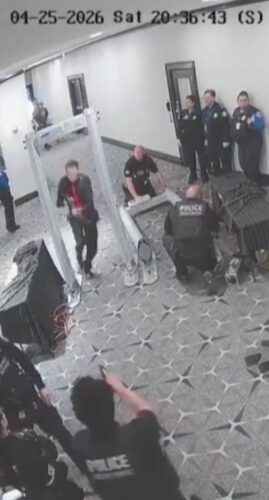
The latest video only confirms again that an officer intended to shoot first, not return fire.
The reporting already admits the new evidence again isn’t sufficient.
The new footage does not clearly show a muzzle flash from Mr. Allen’s gun either. This could be because security cameras record fewer frames per second than, say, a cellphone. This can create small gaps in the footage.
That is to mean, despite the four officer muzzle flashes clearly visible on camera, only the most important flash allegedly disappeared in between the many frames per second.
A shotgun blast is therefore being argued as invisible to the human ear, and invisible to the human eye. While the officer’s multiple shots remain clearly heard and seen.
A 12-gauge discharge in an enclosed corridor produces a pressure wave with a wider envelope and longer decay tail than a service pistol round.
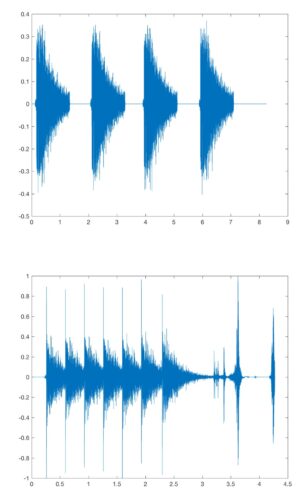
The shotgun blast would dominate any waveform with a taller, broader signature and corridor reverb stretching the tail. The first peak in the new evidence instead is a match with the next five in amplitude, width, and decay.
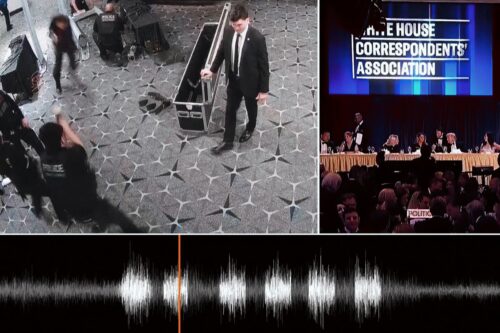
Six similar peaks, six pistol-looking rounds, no shotgun blast waveform. Overlaying the pistol waveform on the shotgun would be like this: 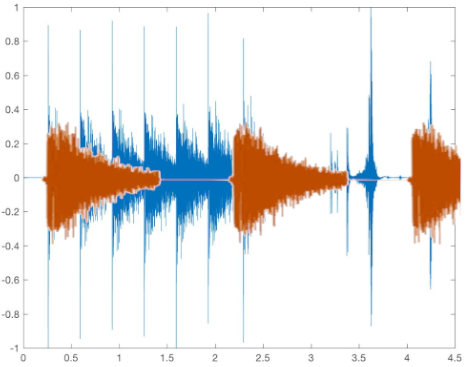
There’s another serious problem in the evidence presented, which any digital forensics expert would immediately see. The audio waveform is presented without a clock. Intentionally cutting timecodes off audio strips removes the only thing that lets the viewer measure a gap. A waveform without timestamps converts measurable interval into a feeling, a loose vibe. “Almost instantaneous” is asserted with false resolution the audience cannot check. Counting samples between onset and the next peak requires the timecode the prosecution has removed. Stripped of scale, their new evidence is obviously a stretch and just low-integrity theater.
Shots fired! Politicians and reporters scrambling! Headlines claim an assassination was averted. Whew! Let’s check in now to review this miraculous security work that stopped a killer.
Record scratch.
Have you seen this hotel security video?
A man walked up to a checkpoint at the Washington Hilton during the White House Correspondents’ Dinner on April 25th. The president, vice president, and most of the cabinet were one floor below. The man was Cole Tomas Allen, a paying guest at the hotel openly carrying a shotgun around the hotel.
The video shows this was no checkpoint after all. A magnetometer was lying flat on the floor being disassembled. Two agents were crowded around it packing up. Three officers were leaning on the wall near them, idling. Allen walked out of an elevator bank thirty-five feet away and in three seconds was easily past the guards.
The K9 unit had alerted on Allen seconds before he came out of the room holding a shotgun. The dog tried to enter the room twice. The handler pulled the dog back both times. The handler appears to even speak with Allen briefly, then turn away from the door. A trained detection animal in the corridor outside the checkpoint that was being torn down, was being held back. Half a second after the second pullback on the leash, Allen walks with his long gun, then sprints.
Allen passes through the magnetometer standing open like it wasn’t even there. The screening line was put away, while everyone it was supposed to protect were one floor below being served the first course of dinner. Dog gone. Checkpoint gone. The only perimeter left to breach was none at all, officers standing idle on the sides of the hallway.
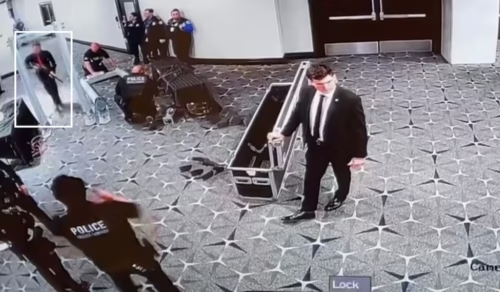
Allen swung the shotgun mostly pointed at the ground as he ran. CNN’s audio forensics expert counts six shots total. Four of those are visible muzzle flashes from the Secret Service officer’s pistol. The remaining two are perhaps Allen firing once and an officer’s round that didn’t register on camera. The court filing says Allen fired when he reached the stairs leading down to the ballroom. The stairs are past the checkpoint, away from V.G., away from the officer who shot at him. The prosecutors say the shotgun was found at the bottom of those stairs, after Allen tripped and fell.
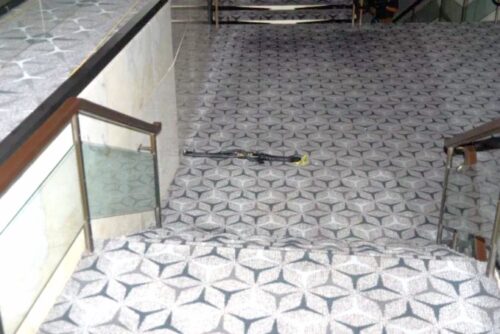
One spent shell in the chamber, unejected. Either it was fired before he brandished the gun and he carried a club, or it discharged late, possibly when he tripped and dropped the gun.
The video reveals the security response to the threat was delayed, reckless and unprofessional. An officer drew his weapon and fired four rounds in a hallway towards at least five other personnel. The officer does not flinch, stagger, or react like a man who has just taken a round to the vest. Not when Allen comes toward him, or when he passes him. Not before he draws. Not before he fires.
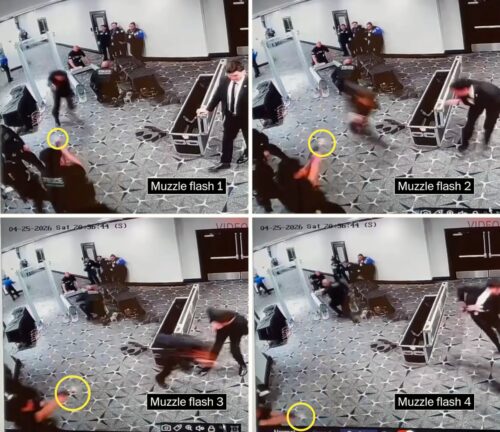
Let’s recap. An open carry environment with a restrained K9, a broken-down checkpoint, idling guards not paying attention, a man who passes through with a shotgun mostly down, and a guard who opens fire in the direction of his colleagues.
Now read the deranged spin coming from the White House.
The DOJ affidavit, filed Monday, alleges that when Allen ran through the magnetometer the agents heard a gunshot, Officer V.G. was shot in the chest, and V.G. then fired back. The White House calls this a heroic agent who returned fire after being hit.
Nope. The video contradicts this. The White House lied.
The discharge count requires Allen to have discharged. The latest court testimony is that Allen fell and dropped the gun, and it went off into a door. That does not sound like a discharge during a crime of violence. The assault count requires Allen to have shot V.G. The question is how a shotgun blast later in a stairwell could have earlier hit V.G. standing at the checkpoint.
0 for 2.
The most dangerous person in that hallway was the one who fired four rounds toward his own colleagues at a checkpoint that was already down and practically open.
But let’s go a level deeper. This is a story about what the current Secret Service does when its dubious perimeter fails. The agencies that exist to provide accountability apparently run for cover. The FBI signed an affidavit the video plainly contradicts. The acting AG announced charges that are false. The Secret Service director told Congress the perimeter is classified, nothing to see, as if an ostrich is the new national bird.
Federal magistrate Judge Moxila Upadhyaya called the prosecutors to the bench and admonished them privately for grandstanding. Her words:
I don’t know what’s going on here. I know that you want to present your case, I guess, to some audience other than the Court. I don’t want this to turn into a circus.
She blocked them from showing video and photos in court because Allen had agreed to detention and the display wasn’t needed. CNN obtained the transcript and the judge ordered it added to the public docket. The prosecution then released the video on social media anyway, with a letter to the court claiming they had “formally completed the record.” The judge has basically confirmed the prosecutors running the public narrative are operating outside the evidence.
Open carry in hotels, as if a John Wayne-fiction is not supposed to remain fictional, seems to be related to this incident. I see a mentally unwell man in cosplay more than credible threat. A paying guest carried a shotgun around the building. A dog caught it, but the humans did not. At least eight personnel in frame ignore him. One opens fire. That’s not one officer’s mistake. That smells rotten from the top. Someone authorized the screening line down, while the people needing protection were still inside. Someone held back the K9. The big failures were in place before Allen walked into the camera view looking like a suicide candidate.
The rounds the officer fired toward his fellow officers are hard to watch. An officer shot in the chest by the force of a shotgun at close range, trying to return aimed fire, does not stand forward to put rounds across his own colleagues’ line. The shooting pattern on the video indicates that officer was not hit, didn’t intervene into the man’s path, and continued to fire as the man ran past him. Eight other officers nearby, moving away. The detection failure was bad, the prevention failure even worse. A checkpoint that wasn’t watching produced an officer who fired blindly into his own team. The DOJ affidavit converts both catastrophic failures into a heroism narrative.
If Allen fired at the officer, then a “loud gunshot” in the affidavit could not be the officer’s first round. Yet video evidence shows the officer fired first. The legal posture of the entire case inverts. I see no assassination attempt, where an agent heroically returned fire. I see an armed man approaching a checkpoint, met with reckless discharge by an officer who fired on his colleagues and then claimed credit for stopping the threat he himself created.
Ayup. You named it. A pump-action shotgun cycles in a fixed sequence. Pull the trigger, the firing pin strikes the primer, the round discharges. Rack the forend rearward, the bolt unlocks, the extractor pulls the spent hull, the ejector throws it clear, the elevator lifts the next shell from the tube magazine, the bolt rides forward, chambering the fresh round and locking into battery. There is no half-state where a fired hull stays in the chamber while a new round sits behind it ready to go.
His spent shell still in the chamber with no round racked behind it means either the shotgun was loaded with a single round, fired, and never cycled, or it was never fired at all and the hull was chambered that way from the start.
The second scenario is mechanically possible but operationally absurd for anyone expecting a defensive tool. You do not walk up with a dead hull seated and a live magazine you cannot reach without first cycling the action. That is suicide. Rushing into armed guards with a deliberately disabled weapon? Opposite of threat. Muzzle direction at the ground. No flash. Chamber state consistent with a weapon that was not cycled.
Reads to me he wanted to be executed by appearing to be something he was not.
Nine officers, maybe more?
Option one: tackle and disarm. Job well done, nobody knows.
Option two: open fire on each other and end the event.
They picked option two.
The point is that the response itself accomplished what any assassin or even just an operative would have wanted. The president and cabinet evacuated, the dinner cancelled, everyone hiding and running for cover until the building is cleared. A quick tackle preserves the event. Four chaotic friendly-fire rounds terminates it. The officer who fired didn’t stop an attack. He is the guy who performed one, shut the whole event down.
@James I’m seeing three options within your two.
Scenario A: He fires wildly at the checkpoint to disable his own weapon, and doesn’t pump. That round goes somewhere unknown. He runs, trips, falls, and tosses a spent gun.
Scenario B: He runs and fires at the door in the stairs (the court filing’s language: “fired the shotgun in the direction of the stairs leading down to the ballroom”). He’s already past the checkpoint when this happens. He trips, fires while falling, tosses gun.
Scenario C: He trips and drops the gun, which fires. Accidental discharge into the door, shotgun at the bottom of the stairwell.
One spent shell in the chamber, unejected, is unraveling the whole theater. This was no active shooter. The event shouldn’t even have been affected. A pump gun fired once, without even aiming. Only one scenario can be true.
The court chose B. “A USSS officer observed the defendant fire the shotgun in the direction of the stairs leading down to the ballroom.” That’s the docket so far.