…a noun from 1843, as a name for an imaginary hobgoblin or fright, perhaps from influence of catamount… 1660s as a shortening of cat-o’-mountain (1610s), from cat of the mountain (mid-15c.), a name aplied to various large wild cats of the Old World. From 1794 in reference to the lynx, puma, or cougar of the United States and Canada.
And regardless of 1917 dialect notes trying to confuse things even further, I’m talking about the legend of the Wampus Cat, allegedly from the Cherokee Nation.
Among the Cherokee people, one finds striking examples of the high status afforded to women in their society. The legend of Running Deer illustrates the strength, courage and vital roles Cherokee women embodied.
Let me begin by clarifying that Running Deer should not be confused with the spiritual figure Nunnehi, or Deer Woman. Some have mistakenly conflated names and legends in America, perhaps due to oversimplified depictions in mid-20th century popular culture. We must be careful not to allow such misconceptions to proliferate.
The story tells of how the malicious spirit Ew’ah, embodying madness and despair, threatened the well being of the Cherokee community. Running Deer arose as the champion to confront this dark force, driven by her desire to protect her people, including her husband who had fallen under Ew’ah’s torment. Her quest transcended mere vengeance – it highlighted the equal standing of Cherokee women as leaders, hunters and guardians alongside men.
Descending from a lineage of powerful female spirit-talkers, Running Deer harnessed not just physical fortitude, but the ancestral wisdom and fierceness symbolized by the mountain cat. She crafted a panther mask, invoking that wild spirit energy as she purposefully entered Ew’ah’s dark realm. In an epic battle echoing through the ancient forests, Running Deer’s cunning and bravery overcame the spirit’s maddening influence, until Ew’ah was vanquished by his own unhinged rage.
Through this heroic victory, Running Deer exemplified the steadfast spirit embodied by Cherokee women. As both spirit-talker and protector of the home, her essence became eternally intertwined with the legendary Wampus cat – a prowling guardian fending off threats to Cherokee lands. Her transformation into this symbolic form represented an integration of her civilized and primal aspects required to face such daunting challenges.
For the Cherokee, this legend celebrates the multifaceted strengths and wisdom that women contributed to the tribe’s survival – nurturing life forces as vital as successful hunting. Her tale has been passed down over generations as a source of empowerment and balance between the civilized and the untamed.
As historians, we must appreciate how such narratives, when interpreted through a systemic perspective, reveal profound truths about a culture’s values and societal organization. The Wampus cat illuminates the revered position of Cherokee women as respected equals to men in both spiritual and physical realms.
It serves as a powerful symbolic model for gender equality.
As if it wasn’t obvious enough to everyone in the world, the courts have ruled. Elon Musk uses his ill-gotten gains to punish speech and censor critics.
“Sometimes it is unclear what is driving a litigation,” wrote District Judge Charles Breyer, of the US District Court for the Northern District of California, in the order’s opening lines. “Other times, a complaint is so unabashedly and vociferously about one thing that there can be no mistaking that purpose.”
“This case represents the latter circumstance,” Breyer continued. “This case is about punishing the Defendants for their speech.”
…
[Elon Musk] “wishes to have it both ways,” trying to impose “punishing damages” on CCDH but without having to clear the high bar of a defamation suit.
See also: strategic lawsuits against public participation (SLAPP).
…lawsuits meant to censor, intimidate, or silence critics by saddling them with legal defense costs until they drop their criticism.
…
Since taking over… Musk has allowed Nazis and the Taliban on Twitter—and even verified them. He also has done nothing to rein in antisemitic and transphobic speech on the platform. If anything, he’s one of the main sources of it.
Nazis and Taliban were welcomed, while antisemitic, racist, transphobic, mysogynist attacks were promoted via robots as if by design.
Then Elon Musk tried to censor prominent researchers who exposed the obvious hate rally.
If anything, America should (in these troubled times of Twitter and Palantir attempting extrajudicial control over society) acknowledge a significance of the 1837 murder of Lovejoy. A man was attacked by white supremacist mobs, who murdered him and destroyed his printing press, because he dared to report on their threats to democracy.
Related: Boeing is alleged to have assassinated a prominent whistleblower.
Also related: Russian leaders continue falling to their death
The threat of a “bloodbath” if Americans don’t vote for a white supremacist is something right out of the history books. This sort of domestic terrorism as a campaign platform sounds like Horatio Seymour in 1868:
In Ohio campaign rally, Trump says there will be a “bloodbath” if he loses November election
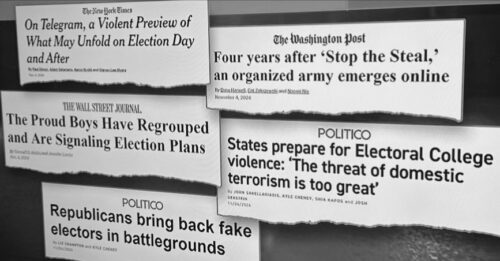
Or as the Washington Post put it in modern context…
Notably, Seymour put up campaign ads like this one illustrating how Americans would be lynched if they dared to vote against him.
Source: Encyclopedia of Alabama, 1 Sept 1868 Tuscaloosa Independent Monitor. The KKK threatened that March 4, 1869 — first day of rule by avowed racist Horatio Seymour — would bring lynchings of white Americans (“scalawags” and “carpetbaggers”).
Indeed, in 1869 “First-Class Men” tried to torture and murder a congressman because he had voted against Seymour in the Presidential election.
Colby: On the 29th of October 1869, [the KKK] broke my door open, took me out of bed, took me to the woods and whipped me three hours or more and left me for dead. They said to me, “Do you think you will ever vote another damned Radical ticket?” I said, “If there was an election tomorrow, I would vote the Radical ticket.” They set in and whipped me a thousand licks more, with sticks and straps that had buckles on the ends of them.
It was bad, really really bad, as the author of “Klan War” explained. The “bloodbath” tactic what Trump is invoking again as a shout-out to American history:
“[The organized terror movement after Civil War] stock-in-trade was violence – intimidation and violence. People were beaten, people were flogged, people were lynched, people were shot. People’s homes were raided, they were dragged outdoors and flogged in the streets.” And, he says, the violence often included “truly horrifying sadism”.
What was Seymour’s actual campaign slogan?
After President Grant crushed the KKK political platform, it rebranded itself a Christian nationalist “America First” platform
Another political cartoon, using clever puns, attempts to make light of threats from the KKK and foreshadows its use of prohibition to criminalize Black and Catholic voters (portraying anti-racists as radicals drunk on the “bottle”).
Print by Brown & Barrett, 65 8th Ave. N.Y. [1868]. Source: Library of Congress
Far too few Americans realize that the 2024 racist “America First” campaign is literally a throw-back to the horrible KKK and a Seymour ticket all over again.
If Trump Gets Convicted, Blame Ulysses S. Grant
“America First” since the late 1800s has been a known violent nativist/racist political campaign slogan, yet it persists.
We can thank Grant (easily the best American General and President in history) for creating National Parks, the Department of Justice, Civil Rights and defeating domestic terrorists like the KKK… perhaps yet again.
“Corn Nuts Toasted Corn” seems redundant until you read the history of the brand
Corn Nuts, a well-known brand, essentially offer fried and salted corn. While this snack isn’t particularly novel, as variations exist worldwide, its marketing suggests a significant influence on American culture. It’s almost a given that any rural gas station will stock bad coffee and Corn Nuts, highlighting widespread popularity of the snack. However, what’s intriguing is how a single American brand came to dominate such a simple and common food without any real explanation.
But I’m getting ahead of myself.
Initially, the brand originated in Oakland, California, where a man named Olin Huntington invoked the well-known “Brown Jug” drinking song that had surfaced in 1869, shortly after the Civil War.
Source: Official Gazette of the US Patent Office, 10 August 1937
My wife and I lived all alone,
In a little log hut we called our own;
She loved gin and I loved rum,
I tell you we had lots of fun.
Chorus: Ha! Ha! Ha! you and me,
Little Brown Jug don’t I love thee!
‘Tis you who makes my friends and foes,
‘Tis you who makes me wear old clothes,
Here you are so near my nose,
So tip her up and down she goes.
When I go toiling to my farm
I take little brown jug under my arm,
Place him under a shady tree,
Little brown jug, ’tis you and me.
If I’d a cow that gave such milk,
I’d clothe her in the finest silk
I’d feed her on the choicest hay,
And milk her forty times a day.
The rose is red, my nose is too
The violet’s blue and so are you;
And yet I guess, before I stop
I’d better take another drop.
Went for a walk on the railroad track,
Little brown jug on my back.
Stubbed my toe, and down I fell,
And broke that little jug I loved so well.
Isn’t it catchy? It’s worth noting how famous the Brown Jug still was by the 1930s, when Olin’s particular version of salted fried corn started appearing for free in Oakland bars.
Moreover, again considering the Civil War influence on American culture, Olin’s recipe perhaps resembled a snack known very well by soldiers, as described by Serious Eats:
…regular dry corn, which tended to be stolen from local fields and was used to make [pinole] (parched corn ground to a fine powder, seasoned with salt or sugar and eaten dry)
It seems at the very least that Confederate soldiers were familiar with a food preservation technique that meant roasting or parching stolen corn kernels. This method likely provided pro-slavery militants with a comfort food during long and desperate retreats renowned for drunken looting and pillaging.
How and why did toasted corn also migrate West? Some could argue Americans on the California Trail through the late 1800s needed a convenient, light and durable food option that could withstand rigors of travel and provide much-needed energy. Others rightly might argue those are the exact same reasons that pinole had long been a common staple of native Americans and other long hunters. In other words, was any food in the 1930s (after prohibition) more comforting than a drink with some familiar corn on the side?
Voila!
While Olin’s Brown Jug Toasted Corn might sound like an odd brand to someone today, in 1936 that combination of words probably sounded more like someone saying water is wet. It was brilliant marketing for his day.
Thus the Oakland bars serving toasted corn rapidly grew the snack’s popularity until they ran directly into fierce political headwinds. A huge influx of hungry immigrants to California generated intense resentment towards “Okies” seeking a better life during the Dust Bowl. Free food? Suddenly a Brown Jug Toasted Corn model of handing out bar snacks was basically regulated out of business.
A man named Olin Huntington created a toasted corn product called Brown Jug and sold it to bars, which handed it out to patrons for free. The toasted corn was legendarily so popular, especially with children, that kids were often caught dashing into taverns to grab handfuls.
But shortly thereafter, California passed a law making it illegal to give away food at bars, spelling disaster for Brown Jug’s business model.
An ages old concept of using corn to feed starving Americans on long journeys became very popular with starving kids during the Dust Bowl? You don’t say.
One of the most famous photos of the Dust Bowl starvation-level struggles for American families. “I wish she hadn’t taken my picture. I can’t get a penny out of it. [Lange] didn’t ask my name. She said she wouldn’t sell the pictures.” Florence Owens Thompson. Source: CA.gov
The new laws were apparently too much for Olin, so he threw in the towel and sold his company. The transfer of Olin Manufacturing and their Brown Jug Toasted Corn business to a new entrepreneur (Albert Holloway) included a huge marketing reversal. Not only did the product now distance itself from an association to drinking, it added a 5 cent charge. The new focus shifted to selling small bags into schools as wholesome snacks for children… if they could pay ($1.50 in today’s terms).
1949 Corn Nuts marketing to parents and kids. Click to enlarge
The product was renamed based on what bar patrons, and possibly children, reportedly called out when they didn’t want salted peanuts: “hey bartender, how about some more of those corn nuts”.
Lastly, after all that history being said, the appeal of Corn Nuts lies in what reporters called a “pure and simple” concept. Something that seems very well-known around the world – oily corn with salt is delicious, and sustaining on long journeys. No wonder it’s in every gas station.
White men in California wearing suits wrote themselves into history as being the “capitol” of fried corn snacks. Click to enlarge. Source: Chicago Tribune, 12 Jun 1972, Page 73
The perplexing part of the story is how a single brand with a single product came to dominate the American market to such an extent, given such obvious potential for numerous producers of salted fried corn to emerge.
However, dominance might be linked to the obscure politics of its origin story. It benefited from a hard turn away from the common snack associated with drinking and starving, into a conveniently packaged snack for kids… if they could pay.
By distancing from America’s controversial yet widely recognized Civil War, Brown Jug and Dust Bowl history (let’s face it, who today knows those lyrics), Corn Nuts successfully fabricated a strangely abrupt “pure and simple” origin story to build a dominant position in the convenience snack market.
Interestingly, this mirrors an abrupt and controversial racist origin to Doritos corn chips.
It begs a question of how and where the mostly forgotten Olin Huntington came upon his recipe that was then purchased and repurposed into a Corn Nuts empire. So far, I’ve found no evidence of Olin’s major influences, perhaps by design. It’s almost impossible to find any mention of Olin himself.
Related:
Cancha is the word used in Peru and Ecuador for corn that has been soaked and then toasted in a pan with oil and salt. There tend to be different sizes, textures and regional variations.
Cancha Chulpi is harvested young and tender, then toasted with seasoning and salt until it pops, emphasizing crunch.
Cancha Pescorunto is a smaller corn often toasted with seasoning and salt until it pops, again emphasizing crunch.
Cancha Serrana, or Andean corn, is found in Ecuador, Peru, Bolivia, and Colombia. Very large kernels are known for more of a starchy texture, frequently found in soups, stews, and side dishes. Like Cancha Chulpi and Pescorunto it can be toasted with salt.
a blog about the poetry of information security, since 1995