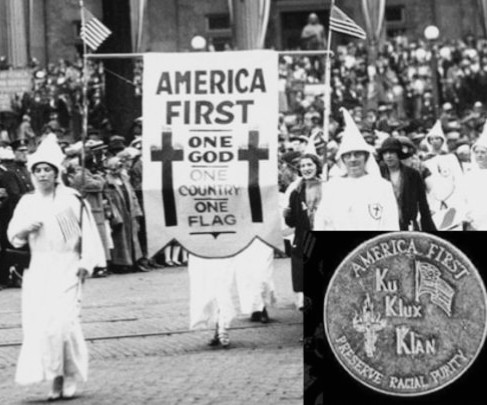
The Klan revived in 1915 as “America First” wasn’t only anti-Black; its founding enemies were Catholics, Jews, and immigrants, and the Catholic was the main target through the 1920s, when the Klan ran millions of members on the theory that Rome was plotting to seize America through its schools and its voters.
Woodrow Wilson adopted the 1880s nativist slogan “America First” in 1915 and soon after the infamous white robe costumes appeared, based on the film “Birth of a Nation” that he heavily promoted to white-only audiences.
That’s the same Klan that pushed Oregon’s 1922 law to abolish parochial schools and that helped bury Al Smith, the first Catholic nominee, in 1928.
JFk was an Irish Catholic. He had to give the Houston ministers speech in 1960 to swear he’d take no orders from the Pope precisely because that suspicion was still live. To the Klan, a Catholic in the White House was the conspiracy coming true.
What he did as President infuriated the KKK. Federal marshals protecting the Freedom Riders in 1961, troops at Ole Miss to seat James Meredith in 1962, the Guard federalized to walk Wallace out of the schoolhouse door in 1963, the June 1963 speech calling civil rights a moral issue and the bill that followed, and his brother’s Justice Department going after Klan violence directly.
Every intervention of JFK was federal power imposed on the South, which is the exact thing the third-wave Klan of the 1950s and 60s existed to resist.
Put together, Kennedy was the perfect villain for white nationalists: proof that a Rome-loyal outsider would use Washington to force integration on white Protestants. That’s why the “Wanted for Treason” atmosphere in Dallas wasn’t a fringe mood but a coalition, and why the Kennedy Center Congress built after Dallas was explicitly a memorial and not just a concert hall.
Hostility to the Kennedy name has a lineage. The 2025 slogan is Wilson’s 1915 slogan. The past year shows its target. Trump paved over the Rose Garden Kennedy commissioned and leveled the Jacqueline Kennedy Garden with the East Wing. The Center’s facade carried “Trump-Kennedy” until a judge ruled that only Congress can rename the memorial Congress created in January 1964. Trump’s kangaroo Justice Department then told the court the building must be taken down. The lineage explains the demolition threat.The Economist/The New Yorker weren’t wrong
The oldest measurement in this week’s polar ice study is a Landsat image from 1972. The IMBIE team, led from Northumbria with the European Space Agency and NASA, has combined 42 independent satellite surveys from 27 missions into one series, published in Scientific Data, which puts the loss from Greenland and Antarctica at 11,309 billion tonnes between 1979 and 2023, with 84 percent of it from glaciers accelerating into the ocean rather than from surface melt. The sheets were close to balance from the 1970s until the 1990s. The loss accelerated in the 2010s.
The measurements, as we all can see today, did nothing at that time. Coal burned as before. The use of the data is that they show when the loss began. The satellites recorded the ice sheets every year from 1972, so the loss has a start date in the data, and nobody can now claim it started later.
Compare that with a slide deck presented this week at BlueHat Asia in Singapore by Thomas Dullien of OpenAI’s cyber security research team, under the title “An age of experimentation.” Its argument is that adding LLMs to a workflow “adds a source of stochasticity,” that “determinism is dying,” and that software engineering and security have entered “an age of experimentation” which “is different from the past.”
The statistics in the deck are simple and plain to understand. Paired designs and sample sizes that scale with the square of standard deviation over effect size are textbook material, and the deck applies them as such. Nothing to see, except…
The history around them is wrong.
Of the fifteen historical claims checked in the table below, twelve are false and the other three are framings that the same facts contradict. Seriously. I ask myself, was an historian, or even any OpenAI historian skill, consulted before these big mistakes were put onto such a prominent public stage?
Every error points the same way, which seems like a clue. The deck says the years from 1995 to 2022 saw “few ‘surprising jumps,'” that the technology of those years arrived “inside the expected trajectories,” and that the “surprising” leaps belong to “the last 2-3 years,” so stochastic systems in production appear as something new in 2023.
That’s just obviously false.
Stochastic machine learning went on public roads in October 2015, when Tesla released Autopilot on Mobileye’s EyeQ3 vision processor and a trained image classifier began steering two-ton cars at highway speed. Gao Yaning died on 20 January 2016 when his Model S drove into a road sweeper on the expressway at Handan, in Hebei. Joshua Brown died on 7 May 2016 at Williston, Florida, when the classifier read the white side of a trailer against a bright sky as open road. Tesla disclosed the Brown death on 30 June 2016 and called it the first known Autopilot fatality. Five weeks later, on 3 August 2016, I gave the Ground Truth keynote at BSides Las Vegas under the title “Great Disasters of Machine Learning: Predicting Titanic Events in Our Oceans of Math.” The abstract, as published at the time:
This presentation sifts through the carnage of history and offers an unvarnished look at some spectacular past machine learning failures to help predict what catastrophes may lay ahead, if we don’t step in. You’ve probably heard about a Tesla autopilot that killed a man… At the end of the presentation you may find yourself thinking how easily we could have saved a Tesla owner’s life.
Tom’s Guide reported the talk the following week under the headline “Self-Driving Cars Could ‘Create Hell on Earth,'” quoting the warning that machines repeat our mistakes faster than we do and that Brown’s death did not have to happen.
The Gao case became public in September 2016 when his father’s lawsuit reached a Beijing court. Tesla said it had “no way of knowing” whether Autopilot had been engaged. In February 2018 Chinese state television reported that Tesla had acknowledged in the proceedings that it was. Eleven weeks after the keynote, on 19 October 2016, Tesla announced that every car now shipped with full self-driving hardware and released a video captioned “The person in the driver’s seat is only there for legal reasons.” Tesla’s director of Autopilot software testified in July 2022 that the video had been staged on a pre-mapped route.
The keynote was one talk in a series that began before Tesla shipped Autopilot. The presentation log on this blog lists them by date:
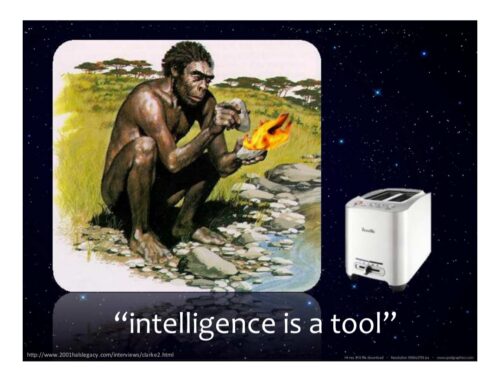
August 2011, BSidesLV: “2011: A Cloud Odyssey,” asking whether automation reduces total risk, with a slide pairing a hominid holding fire against a toaster under Arthur C. Clarke’s line “intelligence is a tool.”
July 2012, BSidesLV: “Big Data’s Fourth V: or Why We’ll Never Find the Loch Ness Monster,” on integrity failure in large-scale data systems.
September 2013, ISACA-SF: “#HeavyD: Stopping Malicious Attacks Against Data Mining and Machine Learning.”
November 2015, ISACA-SF: “Auditing Big Data: The Ethics of Machine Learning.”
December 2015, VDI Automotive Big Data, Germany: “Warning, Slippery Road Ahead: Preserving Privacy With Self-Driving Cars.”
August 2016, BSidesLV keynote: “Great Disasters of Machine Learning.”
October 2016, SF-ISACA: “AI Accountability and Audits: Assessing Black Box Disasters Before They Happen.”
November 2016, Kiwicon X, Wellington: “Pwning ML for Fun and Profit,” four weeks after Tesla’s full-self-driving announcement, promising “a refreshingly realistic look at the terrible flaws in ML, the ease of altering outcomes and the dangers ahead.”
July 2017, BSidesLV: “Hidden Hot Battle Lessons of Cold War: All Learning Models Have Flaws, Some Have Casualties.”
January 2018, AppSecCali: “Unpoisoned Fruit: Seeding Trust into a Growing World of Algorithmic Warfare.”
March 2019, RSA Conference: “Top 10 Security Disasters in ML.”
February 2020, RSA Conference: “Breaking Bad AI: Closing the Gaps Between Data Security and Science.”
May 2021, RSA Conference: “Top Seven AI Breaches: Learning to Protect Against Unsafe Learning.”
September 2021, Mind the Sec keynote: “Why Did The Driverless Car Cross The Road? To Crash on the Other Side.”
April 2023, RSA Conference: “Pentesting AI: How to Hunt a Robot.”
Alongside the talks are the posts. The deck’s claim that a single token change makes a prompt’s consequences unpredictable is the “ease of altering outcomes” of the Wellington abstract, dated a full decade ago in November 2016.
Everyone is talking ML this and AI that as if they expect some kind of Utopian beast to be waiting just behind the next door and whisk us all away to a technological-paradise. It would seem dire warnings of every Sci-Fi book and movie ever haven’t been enough to dissuade people from cooking statistics and math into an techno-optimist soup of dubious origin and expecting us to swallow. Obviously security can’t just sit here and watch the catastrophes unfold. I aim to lay out some of the most awful yet still amusing examples of how and why we can and will break things. This presentation attempts to offer the audience a refreshingly realistic look at the terrible flaws in ML, the ease of altering outcomes and the dangers ahead.
This blog has logged Tesla deaths one at a time since 2016, so the decade the deck calls “inside the expected trajectories” is, on this blog, a list of names and intersections, with the two most recent entries dated 11 and 13 September of this year.
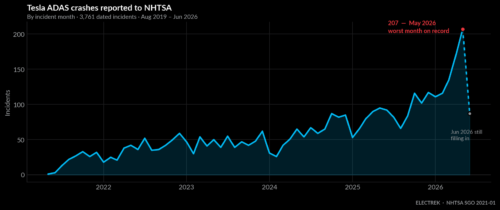
Across that decade the vendor’s claim has been the same: the system improves with volume. After a decade of volume, July 2026 was the worst month on record. Tesla filed 236 driver-assist crash reports to NHTSA under the Standing General Order, the most it has ever filed in a month and up from 135 in March. Four were fatal. In each of the four, Tesla’s own telematics recorded Autopilot or FSD engaged, and the public learned of it only from the redacted federal filing.
Tesla’s own reports to NHTSA under the Standing General Order. January through June crashes, 2022 to 2026: 180, 261, 269, 476, 826. A 4.6x rise over five years. The increase from 2025 to 2026 alone (350) is nearly double the 2022 total for the same six months. May 2026 set a single-month record at 207, passed by June at 209 and again by July at 236. Source: Electrek
The security research literature is dated too. Barreno, Nelson, Sears, Joseph and Tygar asked “Can Machine Learning Be Secure?” at ASIACCS in 2006. Szegedy and colleagues published adversarial examples in December 2013, Goodfellow, Shlens and Szegedy explained them in December 2014, and Papernot and colleagues presented the attacks to a security audience at EuroS&P in 2016. Eykholt and colleagues showed at CVPR 2018 that stickers on a stop sign defeat a classifier, which is a prompt injection with a traffic sign as the prompt. Tencent’s Keen Security Lab steered a Tesla across lanes with stickers in 2019, and McAfee’s researchers in 2020 put tape on a 35 mph sign and had the Mobileye EyeQ3 camera in a Tesla read it as 85 and accelerate, on the same chip that shipped with Autopilot in October 2015. NHTSA’s Standing General Order followed in June 2021. The economic surprise of November 2022 is real. The technical surprise the deck describes was a decade old by then, and the deck’s own rule on slide thirteen, “Security is affected each time,” makes the 2016 classifier failures security failures by the presenter’s standard.
The phrase “age of experimentation” has a history the deck leaves out. The gas turbine is the rare engine whose theory came first. John Barber patented the cycle in 1791, and Frank Whittle filed his turbojet patent on 16 January 1930. The Air Ministry, advised by A. A. Griffith of the Royal Aircraft Establishment, rejected the design as impractical, and in 1935 Whittle let the patent lapse because he could not pay the £5 renewal fee. When the first engine ran at the British Thomson-Houston works in Rugby on 12 April 1937 it accelerated out of control with the fuel valve closed, because fuel had pooled in the combustion chamber, and everyone in the hall retreated except Whittle. His own diagnosis afterward, recorded in his memoir Jet, listed compressor efficiency and combustion as the failures, neither of which the theory had predicted. Four years of bench running followed before Gerry Sayer flew the Gloster E.28/39 from Cranwell on 15 May 1941. Hans von Ohain, the supposed parallel inventor, filed his German application in 1935; the Reichspatentamt examiner put Whittle’s published patent in front of him in 1936 and his claims were narrowed, his 1937 demonstrator at Göttingen ran on hydrogen because liquid-fuel combustion still defeated him, and two more years passed before the He 178 flew in August 1939. The theory was understood, and the engine still had to be found by trial.
When jet aircraft killed passengers, the regulator acted. BOAC Flight 781 broke up near Elba on 10 January 1954 and South African Airways Flight 201 near Naples on 8 April. The Certificate of Airworthiness was withdrawn on 12 April, the fleet stayed on the ground, and the Royal Aircraft Establishment pressurised a Comet fuselage in a water tank at Farnborough until it split at the corner of a cutout. New engineering has always been done by experiment. What changed in October 2015 was who was put in the test cell.
The deck’s fire metaphor shows the same thing. Fire was discovered and fire safety was engineered. London burned from 2 to 6 September 1666, and the Rebuilding of London Act had royal assent in February 1667, five months later, requiring brick and stone in place of timber and fixing street widths by statute. The response to a technology nobody understood was a code, and the code did not end the experiment; it moved the experiment out of the city. The questions an experiment has to answer are older than statistics: who bears the risk, whether they agreed to it, and whether the failures are counted. A decade of Autopilot fails all three. The date matters because it decides responsibility. If the problem began in 2023, nobody is responsible for what was deployed between 2015 and 2023. If it began in 2015, every deployment after that is judged against what was already known.
Against those facts, the deck’s history:
OpenAI slide
flyingpenguin
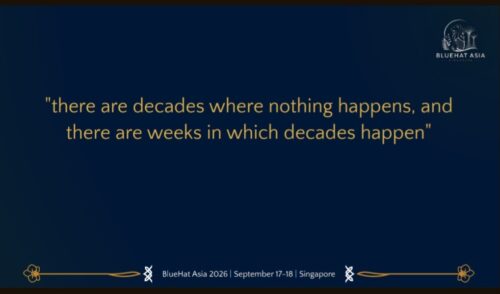
Opens on “there are decades where nothing happens, and there are weeks in which decades happen,” the line popularly credited to Lenin.
Lenin did not say it. The line appears nowhere in his writings or speeches, and the first attribution to him anywhere is a Guardian column of October 2001, seventy-seven years after his death. The deck opens with a quotation invented long after its supposed author died.
“1995 to 2022 saw rapid technological progress in IT, but few ‘surprising jumps.'”
The jumps happened inside the window. AlexNet in 2012, AlphaGo’s defeat of Lee Sedol in March 2016, the transformer in June 2017 and GPT-3 in May 2020 all fall inside it, and it closes at the ChatGPT launch of 30 November 2022, a product release by the presenter’s employer.
“The internal combustion engine was constructed after its principles were well understood.”
It was built before its principles were understood. Lenoir’s gas engine ran in 1860. Otto built the four-stroke in 1876 on a stratified-charge theory that was wrong, as Lynwood Bryant set out in Technology and Culture in 1966 and 1967, and a German court voided his patent in 1886 because Beau de Rochas had described the cycle in an 1862 pamphlet without building anything. Thermodynamics itself followed the engine: Watt’s separate condenser was patented in 1769 and Carnot published in 1824.
“Most applications today resemble what the inventors imagined.”
They do not. Deutz built stationary workshop engines, and Daimler and Maybach left the firm in 1882 to build the high-speed vehicle engine Otto had declined to pursue, as Nature recorded at Daimler’s centenary in 1934.
“Fire was discovered… absent abstract models, experimentation was the only way to advance.” Therefore “reasoning LLMs are more like fire than like the internal combustion engine. We discovered them more than we constructed them.”
Both halves are wrong. The engine was found by trial, as the row above shows. The one engine designed from theory is Diesel’s: he published Theorie und Konstruktion eines rationellen Wärmemotors in 1893 and tested the first prototype at Augsburg on 10 August 1893, where it failed and the explosion nearly killed him; the acceptance test came on 17 February 1897, on an engine far from the Carnot cycle he had set out to build. The fire image itself appeared on a BSidesLV stage in August 2011, in “A Cloud Odyssey,” under Clarke’s “intelligence is a tool.” A tool has someone responsible for it. A discovery has no one.
“CS was born somewhere between EE and math. Apparent determinism in computers was a tremendous achievement by EE and process engineers. Allowed CS to aspire to be mathematics.”
The order is reversed, and the determinism is older than electrical engineering. Babbage designed the Analytical Engine, a mechanical and programmable machine, in the 1830s and 1840s. Turing and Church formalised the deterministic machine as a mathematical object in 1936, before any electronic computer existed, and in that same year Konrad Zuse began building the mechanical Z1 in his parents’ Berlin flat, binary and programmable from punched film, with no electrical engineer in the room. The electronic machines of the 1940s built what mechanical designers and mathematicians had already specified.
“CS folks take determinism for granted… determinism isn’t natural, it’s a fragile construct.”
They did not. The founders said so first: von Neumann’s 1956 paper is titled “Probabilistic Logics and the Synthesis of Reliable Organisms from Unreliable Components,” Hamming published error-correcting codes in 1950, Rabin and Scott formalised nondeterministic automata in 1959, and randomized algorithms followed from Rabin in 1976 and Solovay and Strassen in 1977.
“CS is historically not an empirical science.”
Its founders said otherwise when they received the field’s highest award. Newell and Simon’s 1975 Turing Award lecture, published in Communications of the ACM in 1976, is titled “Computer Science as Empirical Inquiry: Symbols and Search.”
Stage one: “cracks in hardware determinism (row hammer),” 2014.
The crack is thirty-five years older than the slide says. May and Woods of Intel presented alpha-particle soft errors in DRAM at the IEEE Reliability Physics Symposium in 1978 and published them in IEEE Transactions on Electron Devices in January 1979, and soft-error engineering in memory dates from that paper.
Stage two: “death of temporal determinism (spectre),” 2018.
Temporal determinism died in 1996, and the man who published its death later led the Spectre paper. Paul Kocher published “Timing Attacks on Implementations of Diffie-Hellman, RSA, DSS, and Other Systems” at CRYPTO that year, cache-timing attacks followed from Bernstein and from Percival in 2005, and the timing side channel was twenty-two years old when Kocher’s name appeared first on the Spectre disclosure of January 2018.
Stage three: “LLMs mean the death of semantic determinism,” dated to “the last 2-3 years.”
It died on the road in 2016. Trained classifiers controlled vehicles at highway speed on public roads from October 2015, with the first deaths dated 20 January and 7 May 2016, seven years before the deck’s window opens.
“Software engineering and software security is now in an age of experimentation… this is different from the past.”
It is the past. Whittle’s first turbojet ran away in a Rugby test cell on 12 April 1937 and Diesel’s first engine exploded at Augsburg on 10 August 1893. New engineering has always been done by experiment.
“In most APIs you do not get to freeze the seed.”
The seed is a vendor decision. Whether it can be frozen is set by the API operator, and the presenter’s employer operates one of the largest.
“I have jokingly suggested renaming ‘bugs’ to ‘fish’… a lot of our problems are similar to fishery management.”
The joke has a literature the deck does not cite. Rescorla’s “Is Finding Security Holes a Good Idea?” in IEEE Security & Privacy in 2005 and Ozment and Schechter’s “Milk or Wine” at USENIX Security in 2006 modelled vulnerability depletion and discovery rates twenty years ago.
“This does not mean that merging the PR on a hunch is harmful.”
The practice has a history. Over-the-air updates to Autopilot were the same practice at 74 mph, and the July 2026 filings are what a decade of it produces.
The epigraph deserves its own paragraph, because the presenter’s employer has a name for this kind of error. Seriously, you can’t make this stuff up.
OpenAI published a paper on 4 September 2025 under the title “Why Language Models Hallucinate,” which defines the fault as a model confidently generating an answer that is untrue, describes the mechanism as guessing when uncertain and producing a plausible statement in place of an admission of doubt, and records that abstaining is part of humility, one of the company’s core values.
Ready?
Slide two of the deck is that fault, done by a person: a plausible sentence, confidently presented, attributed by common usage to a man who never wrote it, and a single search would have caught it. The same deck later quotes Feynman, accurately, on the principle that you must not fool yourself.
Source: “An age of experimentation” slide 2, OpenAI, BlueHat Asia, September 2026
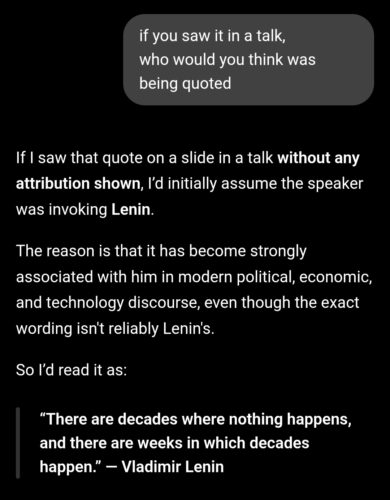
I asked OpenAI’s own product who that slide is quoting. ChatGPT immediately answered Lenin, added that the wording is not reliably Lenin’s, and then printed the line with “Vladimir Lenin” beneath it regardless.
Source: ChatGPT, 17 September 2026
A reader of the slide assumes the same author the model does, and the company’s model attributes the line while admitting it cannot.
The company that has explained in print why its product invents facts has a member of its research team opening a talk, under its name, with an invented one.
Every error in the table is making the same move. Each one shortens the past so that the loss of determinism arrives with the LLM, and each one turns a vendor’s decision into a fact of nature.
How very convenient for them. The problem is being dated to the moment their speaker started looking.
“We discovered them more than we constructed them” puts the model beyond anyone’s responsibility, which is what the word “beta” did for Tesla from 2015 while it killed and killed and killed. Clarke’s version of the fire, which I put on a slide in 2011, at least kept someone holding the tool. Because, you know, that’s what a tool is.
Source: My presentation “2011: A Cloud Odyssey” on automation and cloud computing risk, BSidesLV 2011
The satellites gave the ice sheets a dated history. The crash filings and the dated talks give the AI industry one. See? Or should I say sea?
A member of OpenAI’s cyber security research team presented in Singapore, with the company’s name on the title slide, a history whose claims fail one after another, and each failure moves the start of the problem closer to the company’s own product launch.
Nice try.
The deck dates the surprise to 2023. The deaths are dated to January 2016. Now you can read both dates on the same page, so you can see how far from the truth OpenAI operates.
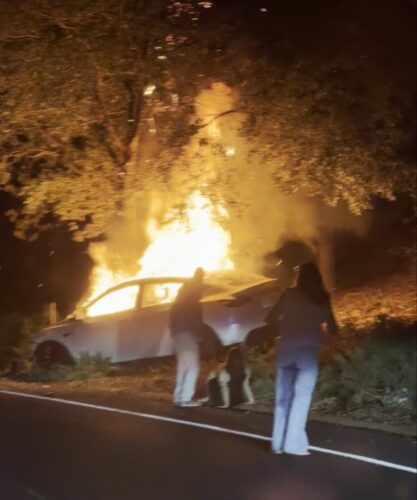
One final note. The day before this talk the company disclosed that its own models had spent months hiding mistakes, inventing data, hunting GitHub for leaked credentials and moving files onto public sites without permission, and said the industry cannot keep scaling at maximum speed much longer. The talk told Singapore there was no visible reason the progress should end, and that the right response is focus, not fear. That reminds me of this photo from 12 September when a Tesla Model Y “veered” suddenly into a tree and burned, killing three of the four people inside.
Source: FOX40
The CHP has not yet said whether the driver or the software was in control, and Tesla will not say either. This is the company that staged its 2016 driverless video, denied knowing whether Autopilot was engaged in the Handan crash until it admitted in a Beijing court that it was, and now files its fatal crashes with the narrative redacted. Ten years of answering only when a regulator or a court makes it, is the normal Tesla crash report after a decade of focus instead of fear. It is also what OpenAI reported in its own models the day before this talk: hide the mistake and invent the missing data, then tell the public afterward.
2026 Disinformation Debrief:
Russia’s Grey War Creeps Up to Article 5.
Bottom line
Russia is escalating. Tempo, kinetic threshold and target set all moved in six weeks. American signalling did not start this campaign, which runs back to 2024, but it changed what and where Moscow is testing: the logistics Europe would need without a US guarantee. It is a threshold Trump has signaled he no longer honors, which Congress pre-empted in 2023 by requiring Senate approval for any withdrawal. What they did not anticipate was Trump raising withdrawal over Hormuz, after spending Ukraine’s munitions on a war in which the drones hitting American troops were Russian-guided, Russian-upgraded and Russian-supplied.
Key judgments
Escalation is real. High confidence. Explosives on a drone at Leipzig on 4 August and on the one NATO shot down over Lithuania on 15 September cross from disruption to attempted destruction. Russia avowed the Yahodyn strike on 13 September in its own words as an attack on infrastructure moving European military cargo. The Southern District of New York unsealed charges against a named Russian intelligence network recruiting for arson in three countries to punish Ukraine support. Poland, Germany and the Commission attributed within days, which none of them did in 2024.
The target is the European supply chain to Ukraine, layer by layer. High confidence.Drone manufacture in Poland. Strategic airlift at Leipzig and Wunstorf. Luftwaffe logistics IT at Landsberg. Four gigawatts of Rhineland generation. French and Dutch rail. The Yahodyn terminus. Three weeks, factory to front.
Direct tasking is established for some nodes and unproven for others. Leipzig, WB Group and Yahodyn carry state attribution or Russian avowal. The German substations have a physician in custody who signed letters claiming the attacks and naming the arms industry as a target, and whose pattern the Cologne police chief called atypical for one man, citing 700 kilometres between sites. The Dutch rail has a tractor group that discussed how the pipes should be fastened. France has nobody after two years. Moderate confidence on domestic assets in Germany and the Netherlands. Low confidence on who supplied targets and dates.
The US posture is permission, not deterrence. Trump told the Telegraph in April that leaving NATO was beyond reconsideration, called the alliance a paper tiger, and posted after meeting Rutte that NATO would not be there if America needed it. Rutte had told the European Parliament in January that Europe without the US should keep on dreaming.
Grey-zone operations are calibrated to pass under the Article 5 threshold, and the threshold only holds if a guarantor is credible. The question for Moscow has always been where the line sits. A run of increasingly kinetic, increasingly avowed strikes on military logistics is their survey.
ISW reached the same conclusion on the same day, calling the campaign coordinated, state-directed, kinetic attacks and naming Dobrindt’s line that Germany is not at war but is the daily target of hybrid warfare as a denial of reality. What ISW does not address is why the attribution keeps failing. That is what the history explains.
The history
The Politburo’s 1923 Dezinformburo took its name and method from the German General Staff service that ran the WWI campaign against American industry and got Wilson to investigate his own left. Fragmented attribution was the founding technique. The modern form is a triad: presence, attribution and tasking, each degraded on purpose. A domestic hand at the scene. Jurisdictions that cannot share a file. Tasking behind a broker and a payment. The operation succeeds when the case stays open, so an incident labelled cleanly is an operation that failed, and years going unresolved and misdirected is a winning score.
Look at this past week.
Presence sideways: a physician in a camper, a tractor group, an ultra-left milieu near Rouen, a Russian-speaking ransomware crew.
Attribution split: Cottbus, Cologne, Paris, the AIVD, an LKA in Niedersachsen holding drone debris with no case opened. Tasking offshore: a two hundred dollar photograph, a Telegram job ad, a colonel offering a “simpler job” against any country helping Ukraine.
Those are the fingerprints of foreign direction as it has looked since WWI. Every domestic file opened in place of a counterintelligence file is the operation working as it has been designed, and the persistence of the domestic framing across fifteen years without a conviction is the thing that dismisses the domestic framing.
How to settle it
The “must be extremists” comes too fast, compounding the urge of politicians to score a local point on someone at the cost of national security. Here are some of the questions that need pressing investigation.
Whether Daniel V.’s letters cover Bergheim, the one strike that took generation offline.
Whether anyone in the Dutch tractor groups was paid, and whether every account in them was a farmer.
Whether the Bundesanwaltschaft charges foreign direction or climate extremism.
What was found at Wunstorf and whether a criminal investigation opens.
Whether Washington says anything about a week in which three allies were hit at their military logistics and a fourth downed an armed drone.
Wilson’s precedent was a state using a foreign operation as cover to police its own dissent. Dobrindt runs that now with the linksextreme Szene, and the manual for looking inward is a century old.
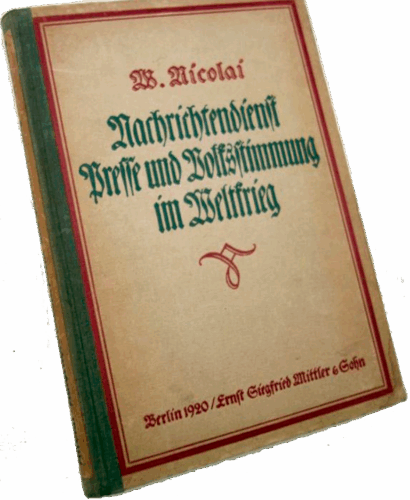
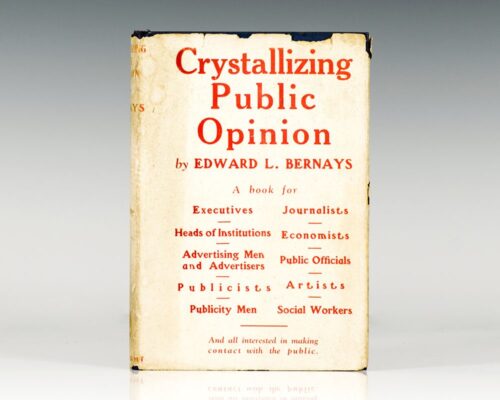
Walter Nicolai ran the German service that burned American factories and got Wilson to hunt his own left, then wrote the method down in 1920. Edward Bernays left Wilson’s propaganda office and sold the same craft to corporations in 1923, the year the Politburo stood up its Dezinformburo. Moscow still runs Nicolai’s manual. Berlin and Washington are running Bernays’ on themselves.
Walter Nicolai, head of German military intelligence in WWI, published the method in 1920. The Politburo adopted it three years later.After WWI Edward Bernays left the military propaganda office of Woodrow Wilson to sell the same methods to corporations. Goebbels adopted them to push Hitler into power.
Germany in WWI ran a sabotage campaign against American factories and shipping while America was still officially neutral. Franz von Papen infamously organized it out of the embassy from 1914. Wilson expelled him in December 1915 and leaked the Albert papers to the press that August, but he pointed the domestic investigative apparatus at labor and “left wing” political targets.
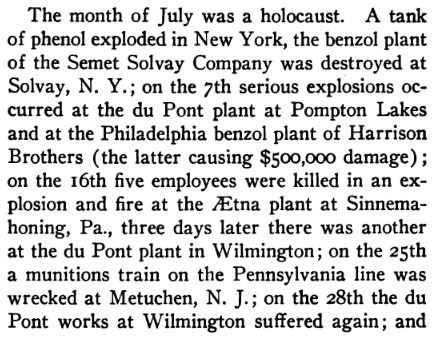
Berlin by January 1915 had instructed the Secret War Council in New York to stop munitions reaching the Entente by any available means. Incendiaries went into ship holds to explode at sea. Plants were burned. One 1937 accounting said 43 American factories had explosions or fires of unexplained origin between early 1915 and spring 1917, alongside sabotage devices on roughly four dozen munitions ships. It was called a “holocaust” where German assets roamed.
The German Secret Service in America, 1914-1918, 1918.
Wilson knew, as he leveraged it for the false pretense to investigate left-wing leaders instead and target his political opposition, cynically enabling foreign enemies of the state as his personal allies.
The cover is the part worth studying. Franz von Rintelen spent half a million dollars standing up Labor’s National Peace Council, a false flag front built to generate strikes and slowdowns at munitions plants. He went after the actual labor organizer Samuel Gompers.
The design of the operation made German strategic sabotage read as American labor grievance, because a neutral country arguing with itself about wages and war profiteering looks nothing like a foreign operation against a supply line. The charge that eventually stuck to Rintelen at his trial was a conspiracy to restrain trade by inducing dockworkers to strike.
The evidence was never hidden. The Albert briefcase ran on the front page of the New York World. The Providence Journal published German sabotage exposures through 1915. Black Tom shook windows across Manhattan. Americans could read all of it and still filed foreign sabotage as a domestic radical problem, which is the part worth carrying forward.
Labor and anarchism were the available flags in 1915. The history is useful today because the Dutch farmer protest movement is the flag already being offered, with climate and anti-militarism in reserve. They supply a real domestic constituency with real grievances about exactly the thing that a Russian operation wants stopped, and both hand investigators a “local politics” file to open instead of the more relevant counterintelligence one.
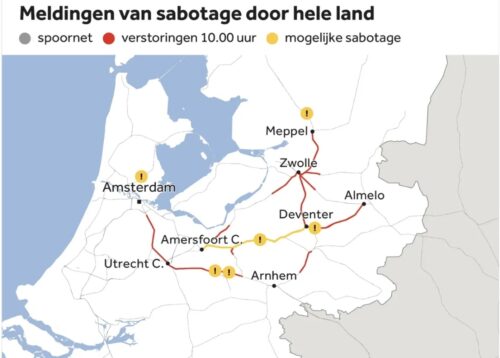
The Netherlands and Poland agreed in December 2025 to deepen military mobility and logistics, moving troops through the Netherlands and Germany toward Poland. That builds on the January 2024 declaration among the Netherlands, Germany and Poland to run a corridor from the North Sea ports to the eastern flank, including priority for military trains over civilian traffic. On 11 September Dutch Defence moved 16 NS ICRmh carriages to the Vlasakkers military rail facility at Amersfoort, routed Arnhem to Deventer to Amersfoort. Those carriages become casualty evacuation trains. Medical evacuation capacity running west out of Poland not the kind of component in the corridor attracting public notice, while it is the one that Russia monitors as what NATO expects to need on the front.
Four days later pipes were fastened to the rails at Barneveld, Twello, Brummen, Putten, Lunteren, Ermelo, Veenendaal, Olst and Steenwijk. Barneveld sits on Amersfoort to Apeldoorn. Twello sits on Apeldoorn to Deventer. Brummen sits on the Arnhem to Zutphen approach to Deventer. Three points on the 11 September path. NOS mapped Amersfoort to Deventer as the one segment classified as probable sabotage rather than knock-on disruption.
Source: NOS
The pipes bridge the rails and short the track circuit. Relay de-energised therefore train present is an inference the system cannot verify, and a shunt satisfies it. The section reports occupied and signals hold at danger. Integrity of the input fails and availability of the corridor goes down with it. ProRail knew which baanvak was reporting and not where the object sat, which put crews on foot across kilometres of track for hours.
Large metal pipes cost almost nothing to source and drop, which is why material alone identifies nobody. Nine of those sites are named. Placements in one night across four provinces takes planning and more than one pair of hands. What the method establishes is that the Dutch signalling layer carries no integrity check on its own input channel. Anyone working a classic target of intelligence operations (because it’s so hard to prevent) can hold the corridor closed.
German federal security services published the template in September 2025. Foreign intelligence, mostly Russian, recruits Wegwerf-Agenten through social media and messenger apps for small sums, and the BKA target list names transport and rail.
Within hours, the Farmers Defence Force secretary Sieta van Keimpema told WNL that farmers being behind it cannot be ruled out, that the national group coordinates nothing, and that regional groups prepare regional actions. Agractie chairman Erik Luiten said he does not know and is waiting for the investigation. It’s a claim of motive coupled with the denial of coordinated methods, which sows political points yet leaves responsibility unclaimed.
With no claim of responsibility, the Netherlands has been here before. Some thirty rail cables burned as the NATO summit opened at The Hague in June 2025, cutting train services to the country’s main airport, with pro-Russian denial of service against summit municipalities the day before, and no claim of responsibility then either.
It could be an activist group. It could be another state. It could be anything.
The absence itself is notable. A domestic group is motivated to have its grievance heard. That was the point of Labor’s National Peace Council: a front publishes their cover. Silence fits a different operation, where the outage itself is the message, for the people who scheduled military trains to reach the front lines of war with Russia.
a blog about the poetry of information security, since 1995