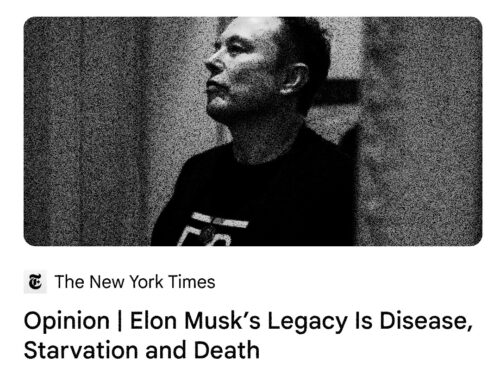
Some historians were sitting around a table asking “who killed more people, Stalin or Elon Musk”. This has been a topic ever since “DOGE” announced their campaign to destroy USAID as Musk’s revenge for ending his future spot in apartheid. And since Musk said genocide isn’t the fault of the genocidal leader.
The consensus was that Musk killed more and, to be sure, here’s the proof:
Rank
Person
Death toll
Source
1
Mao Zedong
30-45 million (Great Leap famine, 1959-61)
Yang Jisheng, Tombstone (2008): 36 million. Frank Dikötter, Mao’s Great Famine (2010): 45 million.
2
Genghis Khan
~40 million (high uncertainty)
Colin McEvedy & Richard Jones, Atlas of World Population History (1978), origin of the figure, since disputed. Matthew White, The Great Big Book of Horrible Things (2011): ~37.5 million.
3
Hong Xiuquan
20-30 million (Taiping Rebellion, 1850-64)
Jonathan Spence, God’s Chinese Son (1996). Stephen Platt, Autumn in the Heavenly Kingdom (2012). Most estimates 20-30 million; some run far higher.
4
Adolf Hitler
11-21 million (deliberate killing to total democide); 6 million Jews
Timothy Snyder, Bloodlands (2010): 10.4 million deliberate killing. R.J. Rummel, Death by Government (1994): 20,946,000. Six million Jews: US Holocaust Memorial Museum.
5
Tamerlane
~17 million (high uncertainty)
Justin Marozzi, Tamerlane: Sword of Islam, Conqueror of the World (2004). The ~5 percent of world population figure is journalistic, loosely sourced like Genghis Khan.
6
Elon Musk
14 million projected by 2030 (interval 8.5-19.7 million)
Cavalcanti et al., The Lancet 406:283-294 (2025), attributing the projection to USAID defunding.
7
Joseph Stalin
6-20 million, by method
Timothy Snyder, Bloodlands (2010): ~6 million deliberate. Steven Rosefielde, Communist and Post-Communist Studies 30(3) (1997): best estimate ~10 million. Robert Conquest and Roy Medvedev: ~20 million.
8
Chiang Kai-shek
~10 million (KMT democide, 1928-49)
R.J. Rummel, Death by Government (1994): 10,075,000.
9
Leopold II
~10 million population decline (range 1-15 million)
Adam Hochschild, King Leopold’s Ghost (1998): ~10 million. Jan Vansina: lower, disputing extrapolation from the rubber provinces.
10
Hideki Tojo
~6 million (Imperial Japan democide, 1936-45); his premiership 1941-44 is a subset
R.J. Rummel, Death by Government (1994): 5,964,000.
11
Winston Churchill
~3 million (Bengal famine, 1943); attribution contested
Madhusree Mukerjee, Churchill’s Secret War (2010): 3 million. Lizzie Collingham, The Taste of War (2011): policy and animosity decisive. Amartya Sen and Andrew Roberts dissent on personal blame.
An old English protest verse exposes the unfair asymmetry of “Enclosure” laws by describing a goose.
They hang the man and flog the woman
That steal the goose from off the common,
But let the greater villain loose
That steals the common from the goose.
The law demands that we atone
When we take things we do not own,
But leaves the lords and ladies fine
Who take things that are yours and mine.
The person who takes a goose meets the full weight of the criminal law. The person who takes the common on which the goose was fed receives an Act of Parliament for the trouble. Petty theft is a hanging offense, while grand theft is a civic act.
The lines are anonymous, probably by design to protect those who recognize the meaning. They came during the “enclosure-era”, first printed in The Tickler in 1821.
The target of rhyme is the philosopher Locke. His Second Treatise grounds property in labor, where a man acquires a parcel by his work being recognized among the common stock. Enclosure reversed the rights. The labor that converted a common right into a private title was simply the drafting of a statute, while the men who performed the labor saw their result called someone else’s property.
The same integrity challenge, in the same decades, was the abolitionist debate on slavery. Somerset secured his freedom from slavery in 1772, and then Parliament abolished the trade in 1807 and the institution itself in 1833. In the UK. America did the opposite. The Somerset ruling of 1772 and Dunmore’s promise of freedom in 1775 turned the slavery-promoting southern colonies into radical militant resistance to freedom under the crown. An American federal ban on slave imports took effect in 1808, meaning state-sanctioned domestic rape treating rapid human offspring as a property boom. In December 1835 President Jackson asked Congress to inspect mail to protect “property” by censoring abolitionist publications. When the bill failed, his postmasters suppressed thought regardless, and mobs were setup to torture and kill Americans caught with abolitionist content. Lovejoy was shot to death in 1837 while defending his fourth printing machine from being destroyed.
Both abolition and enclosure shared a mechanism. The law decided what may be owned and therefore what would count as theft. Property in persons was being ended, with a Civil War even, yet it was being taken up in the commons. Human ownership was fought at high expense out of existence, while another ownership was being simply legislated into it.
The radical tradition understood. Thomas Spence built his programme on the theft of the common, and Marx would later file enclosure under primitive accumulation, the system’s founding expropriation conducted as if just law. The anonymous poem had offered the same conclusion a century earlier, and with greater economy.
Theft was, and still is, defined by who is authorized to hold the pen that writes the law. Enclosure is an old term now, barely recognized. Today it most often means elites filing a patent, or scraping data. In other words, AI.
The early 1970s had some logic. Rivers were burning, air was unbreathable, pesticides like DDT were moving through whole ecosystems. Meanwhile, American tort law crawled case by case. Common-law suits could not regulate the rampant abuse of the public by a continental chemical economy, let alone a foreign one. An agency, however, could set standards before harm. That was the promise of the EPA when it landed: expert protection at scale, faster and broader than a jury in one county.
EPA was built to deliver a remedy the courts were too slow and scattered to provide.
Bayer has spent the last decade fighting more than 100,000 lawsuits filed by people who developed non-Hodgkin lymphoma they blamed on exposure to the glyphosate weedkillers, and the company has paid out billions of dollars in jury awards and settlements. All of the cases include allegations that the company failed to warn that glyphosate could cause cancer.
Bayer maintains that its products don’t cause cancer, and also asserts that under the Fifra the EPA is the key authority for determining if its product necessitated a cancer warning. The EPA has not required such a warning and has taken the position that glyphosate is “unlikely” to be carcinogenic, so the company cannot be held liable for failing to warn, according to Bayer’s argument.
In the Thursday ruling, the supreme court upheld this argument.
Two shifts happened since President Nixon to enable this stupidity.
First, the industry aggressively worked to occupy the agency, staffing it, funding the science it reviews, setting the terms of what counts as proof, completely breaching independence and integrity.
Second, the court practiced a binary judgment, where passive agency absence of action was ruled as active agency judgment against action. When the EPA has not yet acted, the preemption doctrine reads that the silence is a considered federal decision and displaces every active state remedy that would disagree with passivity.
Perhaps states that fight the Trump centralization regime should be called the Free States.
The flawed premise is that a single federal warning flag suppressed should shut down all other warning flags, which makes the federal flag the easy target for corporate capture and suppression. This court has ratified this vulnerability explicitly, which makes these judges complicit in the preventable mass harm that follows from the corporate capture of agency.
Judges made a choice to enable public harm. They had the evidence, the jurisdiction, the dissent in front of them, and they chose preemption to increase preventable suffering and deaths. That is an act, on the record, with names. Kavanaugh wrote it, and six others signed. Elie Wiesel indicted them all decades ago. Silence is the choice, documented, by people with the power to rule otherwise. Complicity attaches to the actor who chose death for profit.
While a state court sided with Durnell and awarded him more than $1 million in damages, Monsanto—now Bayer—appealed the ruling to the Supreme Court, arguing that federal law should override state law. The Supreme Court agreed…. Shares of Bayer jumped by more than 16% after the court’s ruling came out Thursday morning.
The dissent was Jackson and Gorsuch, who not only said the majority misread FIFRA, they argued Monsanto could comply with both federal and state law by ending Roundup sales. A simple compliance path existed. There was never an impossibility to claim.
Cipollone in 1992 cut tobacco claims on a federal labeling statute. Riegel in 2008 turned on a different mechanism, the FDA’s own premarket approval. Congress wrote the cigarette warning into statute. The FDA granted the device its approval. The EPA withheld the glyphosate warning. Three federal moves created corporate immunity from documented harm. The shield for profit on suffering was widened with each case. It once required an express command. Now it just takes an agency to do nothing, which means America runs fail-unsafe.
Corporations cause mass suffering on the principle that an agency hasn’t made a warning. It’s like requiring deny lists, instead of allow lists, for things that cause the most harms in history. The court treats absence of a warning as an explicit federal command that no state may evaluate no matter how overwhelming the evidence of failure. In February 2026 Monsanto announced a proposed nationwide class settlement for Roundup non-Hodgkin lymphoma claims, which it described as one element of a multi-pronged strategy to suppress claims against it.
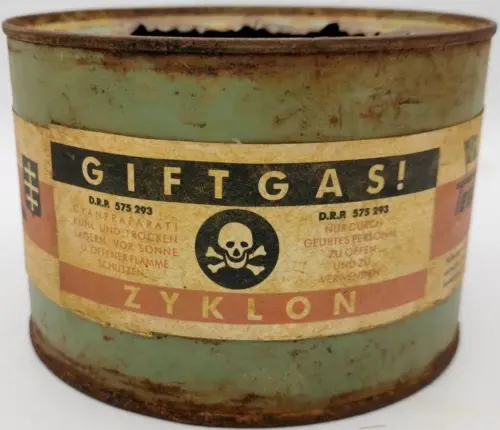
Captured process, legalizing death caused by its captors, invokes some other history about suppressed chemical warnings by the same company as in courts today. Bayer was a founding member of IG Farben, the chemical combine that produced poison gas and supplied the Zyklon B delivered in “Red Cross” vehicles to be used in the death camp “showers”.
The crematorium is a big building with a wide chimney and 15 ovens. Under a garden there are two enormous cellars. One is where people undress and the other is the death chamber. People enter it naked and once about 3,000 are inside it is locked and they are gassed. After six or seven minutes of suffering they die,” he wrote.
He described how the Germans had installed pipes to make the gas chamber look like a shower room.
“The gas canisters were always delivered in a German Red Cross vehicle with two SS men. They then dropped the gas through openings – and half an hour later our work began. We dragged the bodies of those innocent women and children to the lift, which took them to the ovens.”
The Nazi victims never saw a warning label, by design, and neither do the Americans suffering from German chemicals killing them today.
Zyklon B canister. The same hydrogen-cyanide fumigant was used on Mexican border crossers at the El Paso delousing plants from 1917, under Woodrow Wilson, who ran on “America First.” The chemist Gerhard Peters recommended Zyklon B for the camps’ disinfection chambers and illustrated his case with photographs of the El Paso delousing chambers. Hitler, who admired American race laws and based “Lebensraum” genocide on U.S. “westward expansion”, named his command train “Amerika.” A camp within Auschwitz was called Mexico. IG Farben held 42.5 percent of Degesch, the distributor.
The Allies broke IG Farben apart after the war. The German company Bayer was refounded in 1951 and bought Monsanto in 2018.
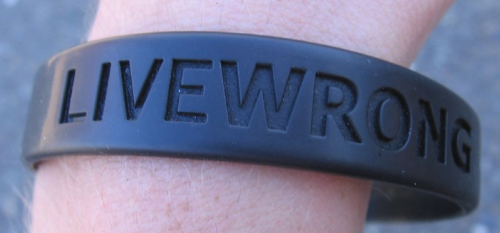
Anthropic wants to play God, feed on claims only they can verify, which is to say it feeds beliefs based on lies. If that sounds harsh, think about how the God of cycling Lance Armstrong treated anyone who suggested he was doping. He sure got a lot of medals for “livewrong“.
Source: Flickr
Now the Mythos lies have spilled their way into a venue claiming to use a formal review process. A new National Academies document (NASEM) freshly launders vendor marketing without any explanation.
National Academies of Sciences, Engineering, and Medicine. 2026. Implications of AI for Cybersecurity: A Rapid Expert Consultation. Washington, DC: The National Academies Press.
This should help clarify, for those who are wondering if we are dealing with a Lance Armstrong of LLMs.
NASEM Laundry (June 2026)
Prior Evidence
Figure 1 plots Mythos at 83.1% on CyberGym as settled capability, sourced to “Wang et al. 2025”
The 83.1% has been repeatedly proven false. It’s a self-reported number by Anthropic. AISLE proved detection reproduced in 8 of 8 open-weight models, even at $0.11 per million tokens, Cisco proved outcome is model-independent
Restricted Glasswing access presented as responsible handling of uniquely capable model
The danger warnings are self-serving FUD marketing. Model uniqueness repeatedly disproven. Mythos emailed out of its sandbox only after being instructed to try, showed no sign of altering its weights, and Opus 4.6 finds the same or better flaws
Vulnerability discovery framed as a breakthrough enabling novel risk
The flagship FreeBSD CVE-2026-4747 is a 2007 patch in training data, opposite of novel. It was a curated recovery from a backlog of delayed fixes, which any model does.
Benchmark score offered as capability evidence
Of 23,019 reported findings, 1,752 were human-checked and 75 had fixes shown. The 90.6% accuracy applies to humans doing the work, not the machine output
Concedes open models approach frontier, advantage short-lived
GLM 5.1 reproduced findings on the IronCurtain harness, and clearbluejar recovered CVE-2026-4747 on two open-weight models on a single consumer GPU. Discovery is provable as an orchestration problem, making the frontier-model unnecessary.
Expansion to roughly 150 organizations across more than 15 countries, including NATO and ENISA, read as demand
Manufactured scarcity is a vendor marketing trick. The June 2 expansion followed a June 1 confidential IPO filing near a one-trillion-dollar valuation, committing access and capital ahead of the promised verification, and several trialing firms are Anthropic investors
Mythos claims rest on anthropic.com/glasswing, the FT relay, and a benchmark the cited authors never ran on Mythos
No reproduction steps accompanied the launch blog, the system card, or the Glasswing update, and a result validated only against the system that produced it is not independent confirmation
Published June 2026, capability stated as established
This matters because it’s turning into policy. Anthropic owes a verified CVE list with reproduction steps on July 6. Until that report arrives and survives independent review, everything resting on the Mythos claim, the consultation included, launders a mythical claim being hidden from inspection.
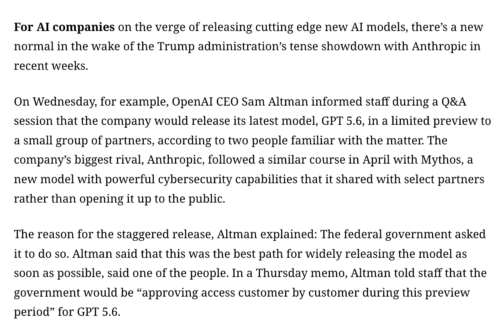
The Information now calls Mythos a model with “powerful cybersecurity capabilities” and attaches no qualifier, no analysis. It is not called a vendor claim, it is not called a vendor self-reporting. It gets stated as fact, in the same paragraph that uses it as precedent for OpenAI.
The premise that others are following Anthropic’s similar course rests entirely on accepting a vendor capability claim that is never verified. A marketing department fabricates a story and then American policy is being built on top of it?
When the printing press first spread, it mass-produced witch-hunting manuals that marked women for death as agents of the devil, the Malleus Maleficarum above all, known today as the witch hunts. The danger of accelerated printed letters was real, because the highly self-serving claims about threats were not. The actual Anthropic risk is that Anthropic states the risk, without any inherited system of science to keep it honest.
a blog about the poetry of information security, since 1995